
Feeding Growing Horses Right: A Complete Guide to the Tribute Growth Pellet
Low NSC, high fiber, and Uptake Technology™ — why the Tribute Growth Pellet is built specifically for young horses, pregnant mares, and lactating mares
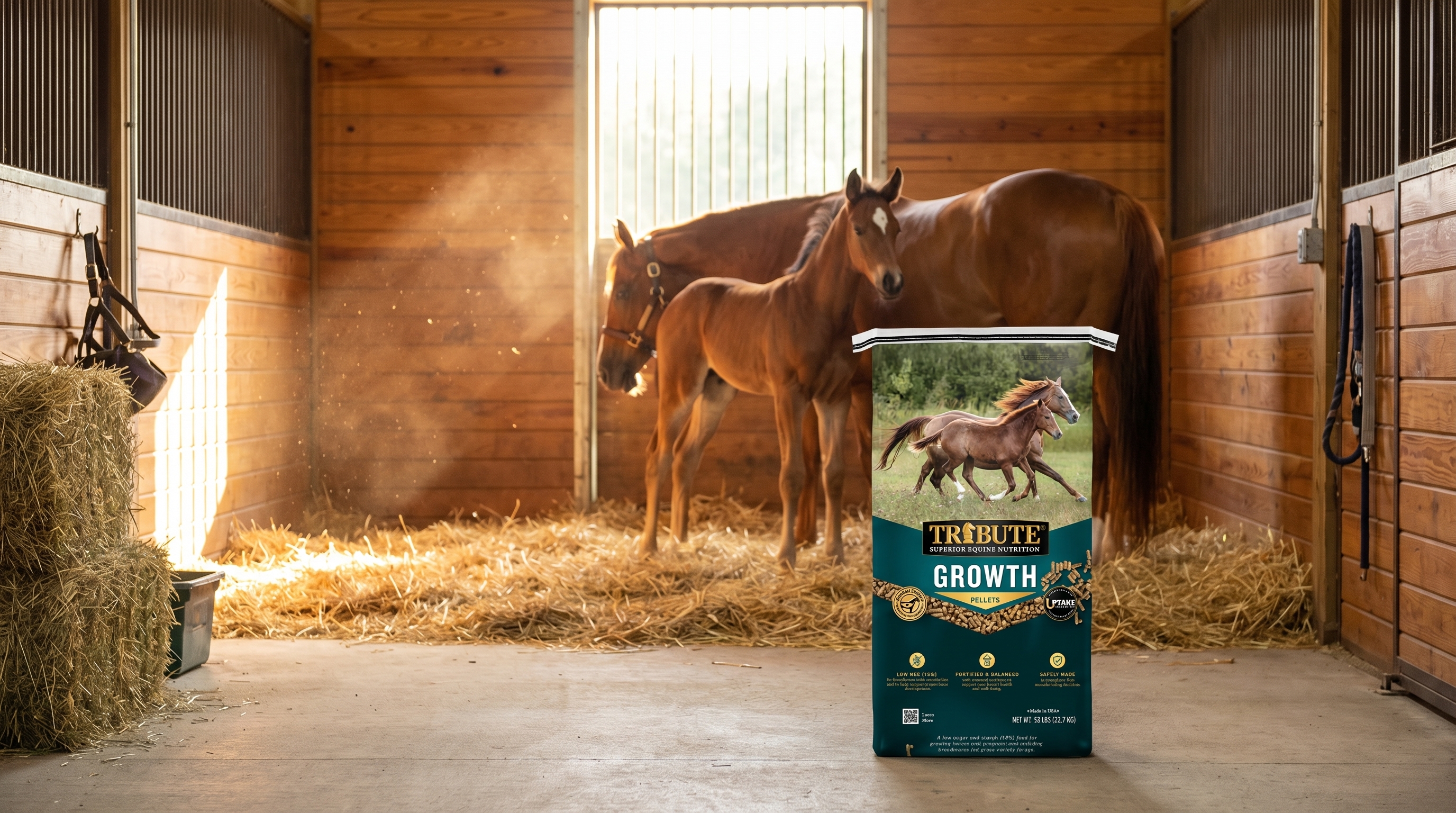
Foals grow faster in their first year of life than at any other point in their development. From birth through the first 18 to 24 months, a horse's skeletal system, tendons, and muscle tissue are building at a rate that demands precisely calibrated nutrition — the right protein quality and quantity, the right calcium-to-phosphorus ratio, the right energy density, and critically, the right level of non-structural carbohydrates. Too much sugar and starch during this window and you create the conditions for Developmental Orthopedic Disease. Too little energy or protein and you compromise bone density, muscle development, and long-term performance potential. The same precision applies at the other end of the equation: pregnant and lactating mares have nutritional demands that rival those of horses in serious athletic work, and feeding them on a generic maintenance ration shortchanges both the mare and the foal she's carrying or nursing. The Tribute Growth Pellet is formulated specifically for these high-demand life stages — and we carry it at Liberty Farm, Home & Garden in Galion, Ohio.
Why Growing Horse Nutrition Is Fundamentally Different
A mature horse at maintenance is, nutritionally speaking, a relatively straightforward problem. Their bones are done growing, their organ systems are established, and their primary nutritional job is maintaining what already exists. A growing horse — or a mare producing life — is something else entirely.
In the first year of life, a foal's body weight can increase by 300 to 400 percent. During this explosive growth phase, the skeleton is laying down bone mineral at a rate that demands consistent, correctly balanced calcium and phosphorus. The muscles are building protein at a rate that requires high-quality amino acids — particularly lysine, threonine, and methionine — in amounts that far exceed what forage alone provides. The digestive system itself is still maturing, which means the form and digestibility of the feed matters as much as its nutrient content.
What makes this even more complex is that the relationship between energy source and skeletal development is direct and consequential. High-starch, high-sugar feeds cause rapid spikes in blood glucose and insulin, and elevated insulin has been shown to disrupt the maturation of cartilage at the growth plates — the very tissue that determines whether a young horse's joints develop correctly. The result can be osteochondrosis, physitis, or other manifestations of Developmental Orthopedic Disease that affect soundness for years or permanently.
A feed designed for growing horses therefore has to accomplish something a general-purpose feed does not: deliver meaningful energy and complete nutrition while keeping the NSC (non-structural carbohydrate — sugar plus starch) level low enough to protect developing joint tissue. That's the design challenge the Tribute Growth Pellet is built to solve.
Understanding NSC: Why the Number Matters
NSC stands for non-structural carbohydrates — the combined total of simple sugars and starches in a feed. In mature horses at maintenance, moderate NSC is generally not a concern. In growing horses, in horses with metabolic conditions, and in mares prone to insulin dysregulation, NSC level is one of the most important numbers on a feed tag.
The mechanism is straightforward: starch and sugar are broken down rapidly in the small intestine and absorbed as glucose, triggering an insulin response. In young horses, elevated post-meal insulin interferes with the action of insulin-like growth factor 1 (IGF-1) in cartilage, disrupting the normal maturation process at the growth plates. Research from multiple veterinary universities, including work published by equine nutrition faculty at the University of Kentucky and Cornell, has consistently linked high dietary NSC to increased incidence of Developmental Orthopedic Disease in foals and weanlings.
The practical implication: a growth feed for young horses should keep NSC at or below approximately 20 percent of dry matter. The lower, the better for horses with any predisposition to metabolic or orthopedic concerns. The Tribute Growth Pellet achieves an NSC of 15 percent — meaningfully below the threshold where orthopedic risk increases. This is the feed's most important number.
Developmental Orthopedic Disease: What Ohio Horse Owners Need to Know
Developmental Orthopedic Disease (DOD) is an umbrella term covering a group of skeletal conditions that arise during the rapid growth phase of young horses. The most common manifestations include osteochondrosis dissecans (OCD lesions in joints), physitis (inflammation at the growth plates, often visible as swelling around the knees or fetlocks), angular limb deformities, and flexural limb deformities.
DOD is multifactorial — genetics, rate of growth, exercise, and nutrition all play roles. But nutrition is one of the few factors you can directly control, which makes it the logical starting point for prevention. The nutritional risk factors most clearly linked to DOD in peer-reviewed research are: excessive total calorie intake driving rapid growth rate, high NSC causing repeated insulin spikes, imbalanced copper-to-zinc ratios, and calcium-phosphorus imbalance.
A well-formulated growth feed addresses all four. The Tribute Growth Pellet's 15 percent NSC directly targets the insulin spike mechanism. Its trace mineral profile is designed to deliver copper and zinc in ratios that support cartilage matrix development. And its fiber-first energy approach — 18 percent crude fiber — provides fermentable energy from digestible fiber sources rather than from starch, supporting caloric needs without the metabolic disruption of a high-grain diet.
| DOD Risk Factor | Mechanism | How Tribute Growth Pellet Addresses It |
|---|---|---|
| High NSC (sugar + starch) | Insulin spikes disrupt IGF-1 action at growth plates | 15% NSC — below the risk threshold |
| Rapid growth rate | Skeleton outpaces cartilage mineralization capacity | High fiber energy is slower-release, supports steady growth |
| Copper-zinc imbalance | Inadequate copper impairs cartilage matrix cross-linking | Balanced trace mineral profile formulated for growth |
| Calcium-phosphorus imbalance | Incorrect ratio impairs bone mineral density | Correct Ca:P ratio for skeletal development |
Pregnant Mare Nutrition: Third Trimester and Beyond
A broodmare's nutritional requirements are modest for much of gestation — the first two trimesters, the fetus is small enough that its demands barely register on the mare's overall nutritional budget. The picture changes dramatically in the third trimester, roughly the final 90 days of the 340-day gestation period. During this window, approximately 70 percent of the foal's total birth weight is gained, and the mare's energy, protein, and mineral requirements increase substantially as a result.
In Ohio, where many foaling dates target February through April to align with breeding season calendars, the third trimester typically falls in the coldest months of winter — when energy demands from thermoregulation are already elevated and forage quality from stored hay can be variable. The combination of increased fetal demand and cold-weather maintenance requirements makes late-gestation nutrition a period where underfeeding is genuinely easy to do accidentally.
The specific nutrients that matter most in late gestation are protein (particularly lysine, for fetal muscle development), calcium and phosphorus (for fetal skeletal development), and vitamin E (for immune function in the newborn foal, transferred through colostrum). A growth-specific formulation addresses all of these more completely than a maintenance or all-purpose feed.
Lactating Mare Nutrition: The Most Demanding Phase
The nutritional demands of lactation exceed those of late gestation — and they exceed those of most levels of athletic work. A mare producing peak milk (roughly 3 percent of her body weight per day in the first three months of lactation) requires energy intakes comparable to a horse in moderate-to-heavy training while simultaneously delivering complete nutrition through her milk for a rapidly growing foal.
The consequences of underfeeding a lactating mare are two-sided: the mare draws on her own body reserves — muscle mass, bone mineral, fat stores — to maintain milk production, and eventually milk volume or quality declines, slowing the foal's growth. Both outcomes are avoidable with correct feeding. The critical nutrients for lactating mares are energy (increased by 70 to 80 percent above maintenance), lysine (the first-limiting amino acid for milk protein), calcium and phosphorus (secreted in significant quantities in milk), and copper and zinc (transferred to the foal through milk at levels that affect the foal's own developmental health).
The Tribute Growth Pellet: A Closer Look at the Formula
The Tribute Growth Pellet is built around three nutritional parameters that define good growth-phase equine nutrition: low NSC, high fiber, and elevated fat. Understanding what each of these means in practice clarifies why the formula is designed the way it is.
15% NSC. As discussed above, this keeps dietary sugar and starch well below the level associated with increased DOD risk. It also makes the feed appropriate for mares with metabolic histories — insulin dysregulation, prior laminitis, equine metabolic syndrome — who might otherwise be excluded from most growth formulations due to the starch content required to hit energy targets.
18% Crude Fiber. High dietary fiber supports the hindgut fermentation that is central to equine digestive health. Fermentable fiber from sources like beet pulp and soy hulls provides slow-release energy without the glucose spike of starch — energy that supports growth without the metabolic disruption. It also physically fills the digestive tract in a way that reduces the gastric ulcer risk associated with high-concentrate feeding programs.
8% Fat. Fat is the most energy-dense macronutrient available in horse feed and the one with the lowest NSC impact. Elevated dietary fat supports the caloric demands of growth, pregnancy, and lactation without requiring high starch inclusion. Fat also supports coat quality, skin health, and — in young horses — the development of myelin sheaths in the nervous system.
| Nutrient Parameter | Tribute Growth Pellet | Significance |
|---|---|---|
| NSC (sugar + starch) | 15% | Below DOD risk threshold; safe for metabolic mares |
| Crude Fiber | 18% | Hindgut health; slow-release energy; ulcer risk reduction |
| Crude Fat | 8% | Dense energy without starch; coat and nervous system support |
| Target Horses | Foals (3 months+), weanlings, yearlings, young horses; pregnant and lactating mares | Life-stage specific formulation |
| Bag Size | 50 lb | Standard farm bag |
Uptake Technology™ and Constant Comfort®
Tribute has built two proprietary systems into the Growth Pellet that address issues beyond basic nutrient content: Uptake Technology™ targets nutrient absorption efficiency, and Constant Comfort® targets gastric health. Both matter more for young and reproductive horses than they do for mature horses at maintenance.
Uptake Technology™ is Tribute's approach to improving the bioavailability of key minerals and nutrients. In practical terms, it means the trace minerals in the formula are provided in organic chelated forms — minerals bound to amino acids or organic acids that are absorbed more efficiently than inorganic mineral salts. For growing horses, this matters because the minerals most critical to skeletal development — copper, zinc, and manganese — are often present in feeds but poorly absorbed due to competition with other minerals in the digestive tract. Chelated forms sidestep much of that competition, making more of the mineral available for actual use in cartilage, bone, and enzyme systems.
Constant Comfort® is Tribute's gastric buffer system. Young horses fed concentrated diets are at elevated risk for gastric ulcers — the rapid acid production that accompanies high-concentrate feeding creates conditions that irritate the squamous mucosa of the stomach. Foals and weanlings are particularly susceptible because their hindgut fermentation capacity is still developing. The Constant Comfort® system uses buffering ingredients that help maintain a more stable gastric pH, reducing irritation during the post-meal period when acid production peaks.
Starting Age and Feeding Rates
The Tribute Growth Pellet is labeled for use beginning at 3 months of age. At this point, foals are still nursing but are also beginning to explore and consume solid feed alongside their dam. Introducing a growth-specific concentrate at this stage — often called "creep feeding" because feed is offered in an area the mare cannot access — sets the foal up with the trace minerals and protein quality needed to support the rapid growth of the weanling phase.
Feeding rates vary significantly by body weight, growth stage, and how much forage the horse is consuming. As a general framework: foals in the creep-feeding phase typically consume small amounts initially, building to one to two pounds of concentrate per day by the time they approach weaning. Weanlings typically need the most concentrate relative to body weight — often 1 to 1.5 percent of body weight per day between forage and concentrate combined. Yearlings and two-year-olds transition toward maintenance requirements as growth slows. Pregnant mares generally need minimal concentrate in early and mid-gestation, increasing to meaningful supplementation in the third trimester. Lactating mares in the first three months post-foaling typically need the highest concentrate intake of any life stage.
Always refer to the feeding directions on the Tribute Growth Pellet bag for specific rate tables by weight and life stage. These rates are calibrated to the actual nutrient density of the formula and should be followed before making your own adjustments. When in doubt, consult a Tribute-certified equine nutritionist or your veterinarian.
| Life Stage | Starting Age / Condition | Relative Concentrate Need | Key Nutritional Priority |
|---|---|---|---|
| Creep-fed foal | 3 months, still nursing | Low — building to 1–2 lb/day | Trace minerals; protein quality |
| Weanling | 4–6 months at weaning | High relative to body weight | Skeletal mineralization; DOD prevention |
| Yearling | 12–24 months | Moderate, decreasing with age | Continued bone density; muscle development |
| Late-gestation mare | Final 90 days of pregnancy | Moderate increase over maintenance | Fetal development; colostrum quality |
| Lactating mare | Foaling through weaning | High — peak in months 1–3 | Milk volume; milk mineral content; mare condition |
Transitioning to Tribute Growth Pellet
Any change in a horse's feed should be made gradually over a minimum of 7 to 10 days. The equine hindgut microbiome — the bacterial community that ferments fiber and produces a significant portion of a horse's usable energy — is highly sensitive to rapid dietary changes. Abrupt feed transitions can cause colic, loose manure, or changes in behavior that are entirely avoidable with a proper transition schedule.
Begin by replacing 20 to 25 percent of the current ration with Tribute Growth Pellet on days one and two. Increase to 50 percent on days three through five. Move to 75 percent on days six through eight, and complete the transition to full ration by days nine or ten. Monitor manure consistency and appetite throughout — soft or loose manure is a signal to slow the transition further. Any loss of appetite, signs of discomfort, or behavioral changes warrant pausing the transition and consulting your veterinarian.
For foals introduced to creep feed for the first time, the transition is inherently gradual because intake starts near zero and builds naturally as the foal discovers and learns to eat solid feed. The foal's own appetite and curiosity pace the introduction more organically than a formal transition schedule allows for.
Forage First: The Role of Hay and Pasture
The Tribute Growth Pellet is a concentrate — it is designed to complement forage, not replace it. Free-choice hay or pasture access remains the foundation of any equine feeding program, including programs for young and reproductive horses. Forage provides the bulk fiber that drives hindgut health, the physical chewing time that buffers stomach acid and prevents ulcers, and a significant portion of total caloric intake at all life stages.
For pregnant and lactating mares, high-quality grass hay or mixed grass-legume hay (orchard grass with some alfalfa, for example) provides a strong forage base that the growth pellet rounds out with concentrated protein, fat, and trace minerals. For growing foals and yearlings, pasture access is especially valuable because the continuous slow intake of fresh grass more closely mimics the natural grazing pattern their digestive systems are optimized for.
The key is matching forage quality to the animal's stage and then using the concentrate to fill the gaps that forage cannot adequately address — primarily lysine, certain trace minerals, and additional fat-based energy for the highest-demand phases of growth and lactation.
Related Products at Liberty Farm, Home & Garden
For a complete young horse and broodmare nutrition program, these products are available at Liberty Farm, Home & Garden:
- Tribute Constant Comfort Plus (40 lb) — A low-starch, high-fiber feed with gastric support built in, designed for horses with metabolic concerns or digestive sensitivity. Shares the Constant Comfort® technology with the Growth Pellet and is a good option for mature horses in the same barn on a reduced-starch program.
- Tribute Senior Sport Textured Horse Feed (50 lb) — For aged mares being maintained alongside younger stock, this textured feed delivers balanced nutrition in a highly palatable form suited to horses with dental challenges.
- Buckeye GRO 'N WIN Ration Balancer (50 lb) — A concentrated vitamin and mineral pellet for growing horses on excellent-quality pasture who don't need additional calories. Where the Growth Pellet provides energy plus nutrition, this ration balancer delivers the nutritional profile at a much lower feed rate for easy keepers.
- Hansen-Mueller Steam Rolled Oats (50 lb) — A traditional energy source for horses in work. Not a substitute for a growth-specific formulation, but a useful addition for yearlings or two-year-olds entering light training who need additional calories beyond what forage and the growth pellet supply.
Frequently Asked Questions
Keep Reading
Late-Summer Pasture Checkup: Repair, Reseed, or Rest Your Ohio Fields?
A practical late-August pasture guide for Ohio livestock owners: assess plant cover, soil fertility, weeds, grazing pressure, and whether to repair or reseed.
Molting Season Prep: How to Support Your Chickens Through the August Transition
Learn how to recognize and support your chickens through their annual molt in late summer and early fall. This seasonal guide from Liberty Farm, Home & Garden in Galion, Ohio covers nutrition, management, and timing for north-central Ohio flocks.