
Why Your Lawn Has Weeds That Look Like Grass — and How SEDGEHAMMER+ Finally Gets Rid of Them
Why nutsedge defeats standard weed killers, how SEDGEHAMMER+ Turf Herbicide selectively eliminates yellow and purple nutsedge without harming your lawn, and how to apply it correctly for season-long control
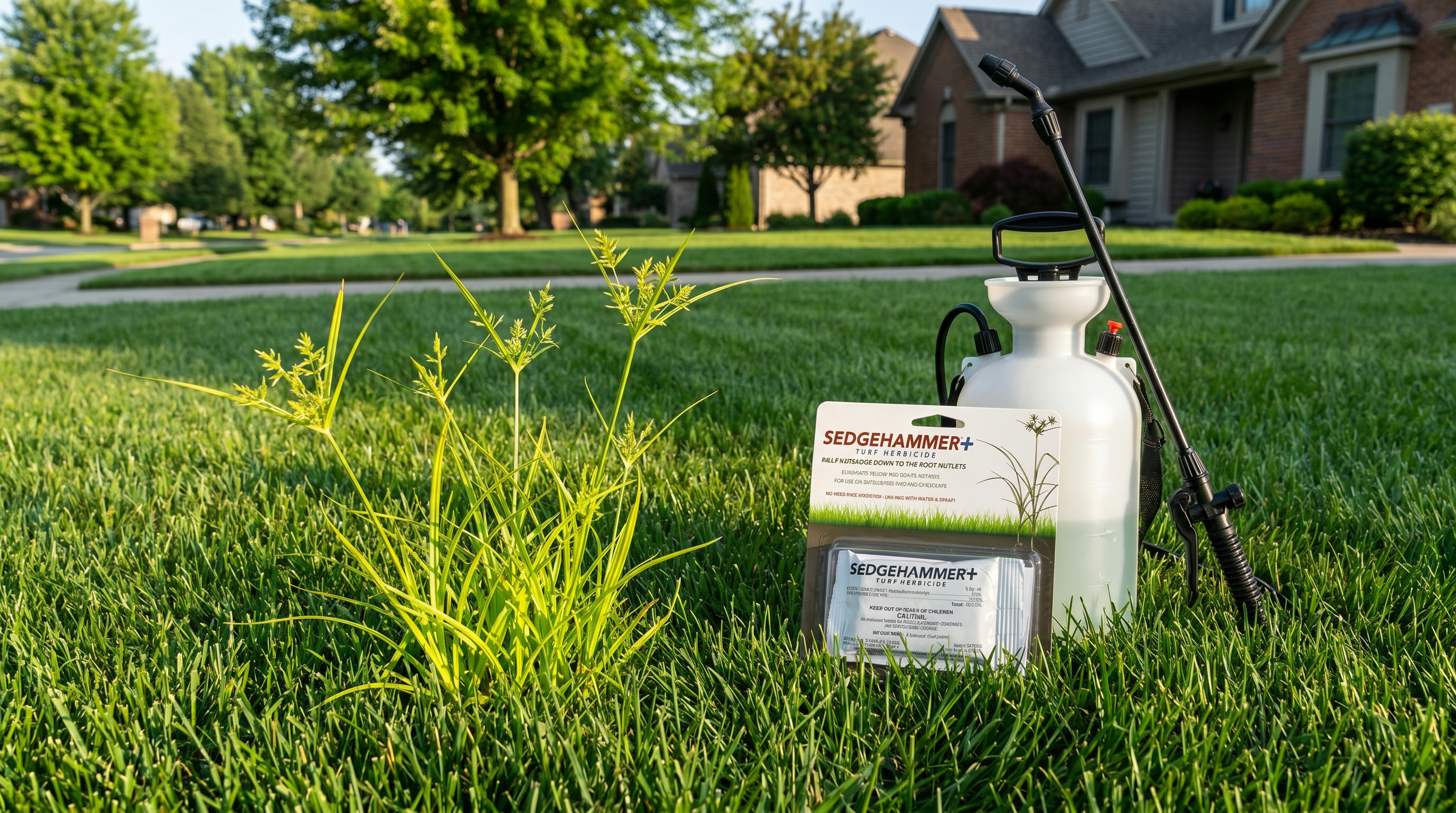
Every summer, the same thing happens in Ohio lawns: a flush of upright, lime-green growth appears above the turfgrass — faster-growing, brighter, and stubbornly resistant to every product in the garage. Homeowners spray it with broadleaf weed killer. Nothing happens. They hit it with glyphosate concentrate. It comes back. They mow twice a week trying to keep it level with the turf. It outpaces the mower anyway. The problem is not the product they're reaching for — the problem is that nutsedge is not a grass, not a broadleaf weed, and plays by completely different rules. SEDGEHAMMER+ Turf Herbicide (13.5 g) from Gowan is the professional-grade selective answer: a sedge-specific chemistry that moves through the plant and down into the root system, controlling yellow nutsedge and purple nutsedge without harming the surrounding lawn grass. If you have nutsedge, this is the product built for it.
What Is Nutsedge and Why Standard Weed Killers Fail on It
Nutsedge looks like grass from a distance. It grows in tufts that rise above the surrounding turf, typically with a brighter, more yellow-green color than the lawn around it. Up close, the difference is obvious: nutsedge stems are triangular in cross-section, not round like grass. The leaves emerge in sets of three from the base rather than two like a grass blade. This triangular stem is the visual key — if you roll the stem between your fingers and it has corners, it is sedge. A grass blade rolls smoothly. A sedge stem does not.
The reason nutsedge defeats standard herbicides comes down to biology. Grasses and broadleaf weeds share physiological pathways that common herbicide chemistries exploit. Nutsedge is classified in the sedge family — its cellular structure, its wax coating, and its metabolic pathways are different enough that broadleaf weed killers simply pass through without effect. Non-selective herbicides like glyphosate will damage nutsedge shoots, but the plant's survival strategy lies underground: a network of underground stems called rhizomes and small tuber-like structures called nutlets. Even if the top growth is killed, the nutlets resprout quickly — sometimes more vigorously than before. This is why nutsedge always seems to come back stronger after you try to kill it the wrong way. The root structure is the problem, not the above-ground plant.
Effective nutsedge control requires a chemistry specifically designed to move through the sedge leaf, translocate through the vascular system, and reach the nutlets underground. That is what SEDGEHAMMER+ is engineered to do.
Yellow Nutsedge vs. Purple Nutsedge: Identifying What You Have
Ohio lawns deal with two species of nutsedge: yellow nutsedge (Cyperus esculentus) and purple nutsedge (Cyperus rotundus). Both are controlled by SEDGEHAMMER+, but understanding which one you have helps set realistic expectations for the control timeline and for what you'll see at the soil level if you dig up plants.
Yellow nutsedge is by far the more common species in Ohio. It tends to emerge in late spring and summer, thriving in warm, moist conditions. Yellow nutsedge grows vigorously in areas where water sits — low spots, areas near downspouts, compacted sections where water doesn't drain freely. The seed head, when present, has a yellowish to straw-colored appearance. Yellow nutsedge nutlets form in chains and can persist in the soil for years. A single plant can produce hundreds of nutlets in a single season.
Purple nutsedge is more commonly found in southern states but does appear in Ohio, particularly in warmer microclimates. It is generally considered harder to control than yellow nutsedge because its nutlet-chain structure is more complex. The seed head has a reddish-purple to brown coloration. If you are unsure which species you have, it doesn't affect your application approach — SEDGEHAMMER+ controls both species.
Both species share the same growth pattern: they emerge from nutlets in the soil, develop above-ground shoots, and then produce new rhizomes and nutlets underground. Young plants, actively growing and not under drought stress, are the most susceptible targets for any systemic sedge herbicide. Applications made to actively growing plants that are transpiring normally will show the best systemic movement and root-zone control.
How SEDGEHAMMER+ Works: Selective Sedge Chemistry
SEDGEHAMMER+ contains halosulfuron-methyl as its active ingredient. Halosulfuron-methyl belongs to the sulfonylurea herbicide family — a class of chemistry that works by inhibiting an enzyme called acetolactate synthase (ALS). This enzyme is required for the synthesis of branched-chain amino acids that plants need to survive. When the enzyme is blocked, growth stops, the plant begins to yellow and die back, and the effect progressively moves through the vascular system toward the root zone.
The selective mechanism — why halosulfuron-methyl kills sedge but not the surrounding turf grass — comes down to metabolic differences between plant families. Grasses can rapidly break down halosulfuron-methyl through their metabolic processes before it reaches effective concentrations in the plant's tissue. Sedges lack this detoxification ability, so the compound accumulates to lethal concentrations in the plant's growing points and root system. This metabolic selectivity is what makes SEDGEHAMMER+ safe for use over established turfgrass while still being lethal to the sedge growing in the same area.
The systemic movement — the fact that SEDGEHAMMER+ moves through the plant and downward toward the nutlets — is critical to effective control. A contact-only sedge killer would eliminate top growth and leave the nutlets intact. SEDGEHAMMER+'s translaminar and systemic movement means it follows the plant's vascular pathways to reach the underground reproductive structures that make nutsedge so difficult to eliminate. Multiple applications over the course of a season are typically needed to exhaust the nutlet bank in the soil, because not all nutlets germinate simultaneously and the ones still dormant in the soil will eventually emerge.
How to Apply SEDGEHAMMER+ Turf Herbicide the Right Way
Correct application technique makes a significant difference in how well SEDGEHAMMER+ performs. Follow these steps carefully for best results:
- Mix according to label directions: The 13.5 g packet is formulated as a water-dispersible granule. It must be mixed with water and applied as a spray — it is not applied dry. Read the label for the specific mixing rate and the amount of area the mixed solution covers. Do not exceed the labeled rate.
- Add a surfactant: SEDGEHAMMER+ performance is significantly improved with the addition of a non-ionic surfactant (NIS) at the labeled rate. The surfactant helps the spray solution penetrate the waxy cuticle on the sedge leaf and increases absorption. Without a surfactant, absorption is reduced and efficacy may be lower. A standard non-ionic surfactant at 0.25% to 0.5% of the spray solution volume is typical — check the SEDGEHAMMER+ label for the specific recommendation.
- Apply to actively growing sedge: Applications to dormant, drought-stressed, or very young sedge seedlings are less effective. Sedge should be actively growing and green at the time of application. Ideal application timing is when sedge is in the 2-8 leaf stage — past the seedling stage but not yet fully mature. Larger, older plants take longer to show symptoms and may require multiple applications.
- Use adequate spray volume: Apply enough spray to wet the sedge foliage thoroughly without excessive runoff. If spray is running off the leaves before absorption, you are applying too much at once. A fine to medium droplet size with adequate coverage is the goal.
- Do not water in immediately: After application, allow at least several hours without irrigation or rainfall. SEDGEHAMMER+ works through foliar absorption — washing it off the leaves prematurely reduces uptake. The label specifies a rain-free window; observe it.
- Mow before, not after: Mow the lawn before application rather than after. Removing leaf area by mowing immediately after application reduces the absorbing surface and lowers the dose the plant takes in. Wait several days after application before mowing to allow full absorption and translocation.
When to Apply SEDGEHAMMER+ for Best Results in Ohio
Timing in Ohio follows the soil temperature and sedge emergence cycle. Nutsedge nutlets begin germinating when soil temperatures reach around 50–55°F at a 4-inch depth, which in the Galion, Ohio area typically puts initial emergence in late April through May. The first flush of sedge growth happens in late spring and early summer as temperatures climb into the 70s and 80s.
The optimal window for a first application is late May through June, when sedge plants are actively growing and in the 3-6 leaf stage. Plants at this stage are large enough to absorb adequate herbicide but have not yet produced significant nutlet banks underground. Treating early-season plants reduces the nutlet production that would otherwise occur through summer and sets up better control for future seasons.
A second application in mid to late July is often warranted for lawns with established nutsedge pressure. Nutlets that were dormant during the first application will have germinated by this point and the new plants are treatable. Most Ohio lawns with a significant nutsedge history benefit from two applications per season — one in June and one in late July — for the first year or two. As the nutlet bank in the soil is depleted over successive seasons, nutsedge pressure typically decreases significantly.
Do not apply in late summer when sedge plants are beginning to senesce (die back naturally at the end of the growing season). Herbicide absorbed by a plant moving into dormancy has reduced translocation to the root zone. Applications made to actively growing plants in peak summer are far more effective than late-season applications to plants slowing their metabolism.
What to Expect After You Apply SEDGEHAMMER+
SEDGEHAMMER+ is a systemic herbicide, not a contact killer, which means visual symptoms appear gradually rather than within hours of application. Understanding the normal symptom progression helps set realistic expectations and prevents premature re-application.
Within the first three to five days after application, treated sedge plants typically show yellowing that begins at the growing point and tips of new leaves. This yellowing — often described as a characteristic pale yellow chlorosis — indicates that the ALS inhibition is working and new tissue is not forming normally. This is a good sign, not a cause for concern.
Over the following one to three weeks, the yellowing progresses through the plant as older tissue is also affected by the blocked amino acid synthesis. The sedge plant stops growing upward. Stems may begin to wither. Eventually the plant collapses and desiccates. Full visual control of top growth typically occurs within two to four weeks of application, depending on temperature, plant size, and environmental conditions. Warm temperatures accelerate symptom development; cooler or overcast conditions slow it.
The underground component takes longer to show evidence of control because nutrient reserves in the nutlets can sustain some residual activity before the root system fully dies. In subsequent weeks, the nutlets attached to the treated plants should also be compromised — reducing their ability to resprout. However, because not all nutlets in the soil were attached to treated plants, new plants will likely emerge from the remaining nutlet bank, particularly if this is your first season treating nutsedge. This is expected and normal — not a treatment failure. Plan for a follow-up application.
Nutsedge Prevention: Addressing the Conditions That Cause It
SEDGEHAMMER+ controls the plants that are present, but the cultural conditions that allow nutsedge to establish and thrive in the first place do not change on their own. Addressing these conditions alongside chemical control leads to much better long-term outcomes and reduces how much product is needed in future seasons.
Drainage is the most important cultural factor. Yellow nutsedge in particular is strongly associated with wet or poorly drained soil. Areas where water stands after rain, zones near downspouts that chronically stay moist, and compacted areas where water doesn't move through the soil profile are all prime nutsedge habitat. Improving drainage — through aeration, adding topsoil to low spots, redirecting downspout flow, or installing drainage channels in chronic wet areas — directly reduces the growing conditions nutsedge prefers.
Dense, healthy turfgrass is your best long-term defense. Nutsedge establishes most readily in thin, stressed turf where it has space and light access. A thick, well-fertilized, properly mowed lawn is much more resistant to nutsedge encroachment than a sparse or stressed lawn. After nutsedge is controlled, overseeding thin areas and maintaining an appropriate fertilization program gives your turf the competitive advantage over any future nutlet germination.
Mowing height matters too. Cool-season turfgrasses like tall fescue and Kentucky bluegrass, common in Ohio, compete best against weeds when mowed at 3 to 4 inches during the warm season. Low mowing stresses the turf and opens the canopy to weed and sedge establishment. Raising your mowing height is one of the simplest steps toward better overall weed suppression, including nutsedge suppression once the nutlet bank is being depleted by chemical control.
SEDGEHAMMER+ Quick Reference
| Factor | Details |
|---|---|
| Active ingredient | Halosulfuron-methyl (sulfonylurea ALS inhibitor) |
| Target weeds | Yellow nutsedge, purple nutsedge, and other sedge species |
| Application method | Mix with water; apply as foliar spray with surfactant |
| Safe turfgrasses | Most established cool-season and warm-season turf — see label |
| Timing (Ohio) | Late May through July; apply to actively growing sedge |
| First symptom appearance | 3–5 days post-application (yellowing at growing points) |
| Full visual control | 2–4 weeks after application |
| Applications per season | Typically 2 for established infestations (June and late July) |
| Surfactant required | Yes — non-ionic surfactant improves efficacy significantly |
| Manufacturer | Gowan Company |
Related Products at Liberty Farm, Home & Garden
For a complete nutsedge and lawn weed management program, Liberty Farm, Home & Garden carries several products that pair well with SEDGEHAMMER+:
- Roundup Plus Weed and Grass Killer Concentrate (16 oz) — For spot-treating isolated patches of unwanted grass or weeds in landscape beds, hardscape cracks, and fence lines where selective chemistry is not needed. Not for use on lawn areas where you want to keep the turf, but an effective tool for perimeter and hardscape management alongside in-lawn nutsedge control with SEDGEHAMMER+.
- Spectracide Weed and Grass Killer Concentrate (16 oz) — Another non-selective option for clearing areas ahead of renovation or new seeding. If your nutsedge pressure is severe enough that you're considering a lawn renovation in the worst areas, a non-selective application followed by re-establishment is sometimes the most practical approach for very heavily infested patches.
Stop in at Liberty Farm, Home & Garden in Galion, Ohio and we can help you identify whether nutsedge is what you're dealing with and which application approach makes the most sense for your lawn's situation. We carry SEDGEHAMMER+ Turf Herbicide and can walk you through the mixing, timing, and surfactant recommendations that get results. Once you use the right product for nutsedge, the difference is immediately clear — and so is the lawn.
Frequently Asked Questions
Keep Reading
Stop Mice Before Fall: A Practical Ohio Home and Outbuilding Guide
Mouse-proof your Ohio home, garage, barn, or feed shed before fall with practical exclusion, storage, trapping, and safe cleanup steps.
Fall Webworms in Ohio: What to Do About Those Late-Summer Tree Nests
Identify fall webworm nests in Ohio trees, distinguish them from tent caterpillars, assess damage, and choose safe late-summer management.