
The Feeder Built for a Real Rabbitry: A Complete Guide to Galvanized Rabbit Feeders and Getting Pellets Right
Why the feeder you use is just as important as the feed you put in it — and how the Pet Lodge galvanized sifter feeder solves the problems that plastic feeders and dishes can't
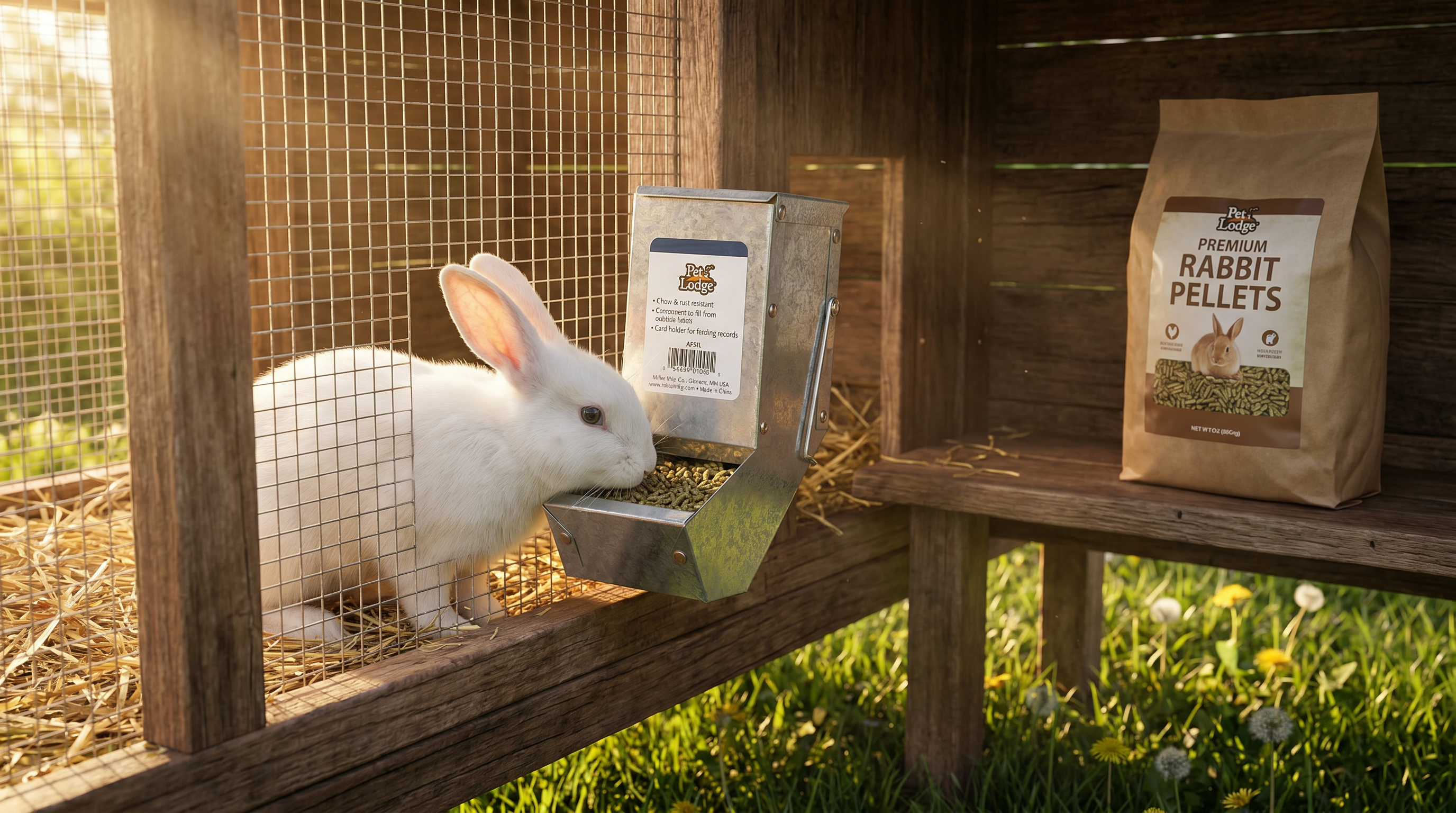
The feeder is an afterthought in most rabbit setups — a dish, a plastic crock, or a bowl perched on the cage floor. That approach works until it doesn't: pellets get soiled, moisture collects, feed dust builds up in the bottom, and the rabbit picks around the fines and refuses whole portions of perfectly good feed. A purpose-built galvanized steel feeder changes the entire equation. The Pet Lodge Galvanized Feeder with Sifter Bottom & Lid (5 in) addresses each of those problems with a classic design that experienced rabbit keepers have relied on for generations: galvanized steel construction that won't rust or harbor bacteria, a sifter bottom that separates fine dust from usable pellets, and a hinged lid that keeps feed dry and clean between feedings. It's available at Liberty Farm, Home & Garden in Galion, Ohio, and it's the kind of feeder that makes a real difference in both feed efficiency and daily management of your rabbits.
Why Your Rabbit's Feeder Matters More Than You Think
In a small pet rabbit setup, the feeder rarely makes headlines — but in a serious rabbitry or even a well-run multi-rabbit household, the feeder is one of the most operationally important pieces of equipment you own. It determines how much feed gets wasted versus consumed, how quickly pellets spoil or become unpalatable, how much time you spend managing feeding every day, and whether your animals are getting the nutrition you're paying for or eating around a growing pile of dusty fines at the bottom of their bowl.
The core issue with inadequate feeders is contamination and waste. A dish or open bowl on the cage floor collects urine splash, soiled bedding, and fecal pellets from animals that step in or knock feed over. Rabbits are clean eaters — their foraging instincts are finely tuned to reject food with any contamination signal, including smell. Once pellets carry the odor of urine or feces, most rabbits stop eating from that dish, even if the pellets themselves look fine. The result is wasted feed, inconsistent nutrition, and a daily frustration that compounds over time.
The problem is compounded by the nature of pelleted rabbit feed itself. High-quality rabbit pellets — uniform, compressed cylinders of alfalfa, hay, and grain — shed a certain amount of fine powder and dust during handling and transport. In a plain bowl, that dust accumulates at the bottom over several days of feedings. Rabbits don't eat the fines — they're too powdery to pick up easily, and the texture is unpleasant for an animal designed to eat whole, fibrous forage. So a layer of increasingly unpalatable feed dust builds up in the bottom of the dish, you top it off with fresh pellets, and the waste compounds. A feeder with a sifter bottom solves this mechanically, automatically, every time you fill it.
What Makes a Galvanized Steel Feeder Different
The choice of galvanized steel as the material for a rabbit feeder isn't tradition for tradition's sake — it's a functional decision that holds up against every alternative. Galvanized steel is zinc-coated carbon steel, and the zinc layer prevents rust in the moist, ammonia-rich environment of a rabbit hutch. It's a combination that plastic, ceramic, and untreated metal simply cannot match over time.
Plastic feeders and dishes are the most common alternative, and they have two significant weaknesses in a rabbit environment. First, plastic harbors bacteria in surface scratches. Rabbits gnaw — it's a compulsive behavior tied to their continuously growing incisors — and even a feeder positioned at the cage wall will eventually be subjected to attempts at chewing. Those gnaw marks create surface microfractures that harbor biofilm even after washing. Over weeks and months, this contributes to a chronic low-level contamination that's invisible but persistent. Second, plastic doesn't tolerate the caustic cleaning agents that are sometimes necessary for full hutch sanitation. Galvanized steel can be scrubbed with a stiff brush, scalded with hot water, and treated with dilute bleach solutions without degrading.
Ceramic crocks are often used as rabbit feeders and are better than plastic in terms of non-porous surface hygiene — but they're heavy, easily tipped by active or aggressive rabbits, and require a separate mounting solution to keep them elevated off the cage floor. They also break. A galvanized wall-mounted feeder mounts directly to wire hutch panels, sits at the correct feeding height without any dishes or stands, and stays in place regardless of how much attention a rabbit gives it.
The Sifter Bottom: Why It's the Most Important Feature on a Rabbit Feeder
The sifter bottom is the feature that sets a proper rabbit feeder apart from a container that merely holds feed. It consists of a perforated or screened bottom panel — typically with small holes or a mesh — through which fine powder, dust, and feed fines fall freely, away from the usable pellets above. The mechanism is simple and passive: as rabbits eat and as the feed settles, the fines migrate downward and pass through the sifter while whole and partial pellets remain in the feed column above.
The practical effect is that the feed your rabbit actually eats stays clean and consumable throughout the feeding cycle. You're not building up a waste layer of rejected fines at the bottom of the feeder. The rabbit gets consistent access to whole pellets from the first feeding to the last. And when you refill, you're adding fresh feed on top of a clean remaining supply rather than layering new pellets over an accumulation of material the rabbit has already rejected.
For keepers who portion pellets carefully — and you should be, especially for adult pet rabbits where overfeeding is a real issue — the sifter bottom also gives you a more accurate read on how much the rabbit has actually consumed. With a plain bowl, it can be hard to tell whether low feed levels reflect consumption or compaction of rejected fines. A sifter feeder gives you a cleaner picture: what's in the feeder is what remains after actual eating, not a mix of consumed pellets and ignored powder.
The Lid: Keeping Pellets Fresh Between Feedings
The hinged lid on the Pet Lodge Galvanized Feeder serves several practical functions that an open-top feeder can't replicate. The most obvious is protection from moisture — rain and dew in outdoor hutch situations, humidity from the animal's breath in enclosed environments, and direct splashing from water bottles or bowls mounted nearby. Pellets that absorb moisture clump, mold, and ferment. A fermented pellet doesn't look obviously different from a fresh one, but it carries bacterial and mold loads that can cause digestive upset. A lid over the feeder is a simple, passive prevention for a problem that's otherwise surprisingly common in humid Ohio summers.
The lid also keeps the feed column from picking up airborne debris — hay chaff, bedding particles, fecal dust — that circulates in the hutch environment. This is especially relevant in outdoor hutch situations where leaf litter, dust, and other organic material can settle into an open feeder over the course of a day. In a well-ventilated outdoor hutch in May, an open feeder can pick up a significant amount of debris between the morning feed check and the afternoon one.
Perhaps most usefully, the lid discourages the animals from climbing into or on top of the feeder. Rabbits are curious and physically capable — a young rabbit or a bold adult will attempt to sit in or on an open feeder, which contaminates the feed immediately and sometimes results in the feeder being knocked off the cage wall. A hinged lid that seats over the feed opening physically prevents this behavior without requiring any management on your part.
Sizing the Feeder to Your Setup
The 5-inch designation on the Pet Lodge feeder refers to the approximate diameter or span of the feed opening, which determines both the volume of feed it holds and the number of animals that can eat from it simultaneously. The 5-inch size is the mid-range in the Pet Lodge lineup — larger than the 3-inch starter model used for young kits or individual animals, and sized appropriately for a single adult rabbit in a hutch, a bonded pair of smaller breeds, or a grow-out pen of juveniles.
Matching feeder size to your actual animal count and feeding frequency matters more than most keepers initially realize. An undersized feeder for your number of animals means constant refilling and competition at the feeder opening — dominant animals monopolize access and subordinate ones get inconsistent feed intake. An oversized feeder isn't necessarily a problem, but it does mean feed sits in the feeder longer between complete turnovers, which reduces freshness compared to a properly sized feeder that empties and gets refreshed daily.
As a general sizing guide:
- Single adult pet rabbit: The 5-inch feeder handles a single adult rabbit comfortably with daily feeding. The volume accommodates a full day's measured ration with room for the sifter mechanism to function properly.
- Bonded pair of medium breeds: The 5-inch feeder works for two animals if you're feeding measured daily portions and checking twice daily. For larger breeds with bigger ration requirements, a single larger feeder or two 5-inch feeders on opposite sides of the hutch is more appropriate.
- Small rabbitry with multiple pens: The 5-inch model is the workhorse for individual hutch bays — one per pen is standard in commercial and semi-commercial rabbitries. The step up from the 3-inch model means the feeder handles a doe and her growing litter until weaning without requiring multiple daily refills.
- Grow-out groups: Young rabbits from weaning to market weight can be group-penned and fed from shared feeders. The 5-inch model works for small groups; larger grow-out setups may want the next size up to reduce competition at feeding time.
Choosing the Right Pellet to Fill It With
A well-designed feeder like the Pet Lodge galvanized model makes the most of quality feed — but the feed itself has to meet a basic quality threshold to deliver the results you're looking for. Not all rabbit pellets are equivalent, and the differences matter to your animals' health and condition.
For most adult pet rabbits and standard rabbitry use, the Kalmbach 15% Pelleted Rabbit Feed is a solid, dependable everyday choice. It's a uniform pelleted formula — no seeds, no colored bits, no muesli components that encourage selective feeding — with consistent protein and fiber content suitable for healthy adult rabbits across most breeds. It's available at Liberty Farm, Home & Garden in both 25 lb and 50 lb sizes, making it practical for both small household setups and larger rabbitries.
For animals with higher nutritional demands — breeding does, growing kits, show rabbits, or animals being brought into competitive condition — the Kalmbach 16% Best-in-Show Rabbit Pellets provide a slightly elevated protein level formulated specifically to support peak condition and coat quality. Available in 8 lb and 50 lb formats, it's the choice for keepers who are actively working with rabbit condition and need a formula that delivers. Both feeds work perfectly with the Pet Lodge galvanized feeder — the uniform pellet size moves well through the feeder column and the fines sift cleanly through the sifter bottom.
| Feature | Details |
|---|---|
| Product | Pet Lodge Galvanized Feeder w/Sifter Bottom & Lid (5 in) |
| Brand | Pet Lodge |
| Material | Galvanized steel — rust-resistant, easy to sanitize |
| Sifter Bottom | Yes — separates feed dust and fines from usable pellets |
| Lid | Yes — hinged, keeps feed dry and debris-free |
| Size | 5 inches — mid-size for single adult rabbits or small groups |
| Mount Style | Wire cage wall mount — keeps feed off the cage floor |
| Best For | Adult rabbits, grow-out pens, small rabbitries |
| Available At | Liberty Farm, Home & Garden, Galion, Ohio |
How to Feed Pellets Correctly: Portion, Frequency, and Method
The feeder provides the hardware. Knowing how to use it well — appropriate portions at the right times — is what turns a quality feeder into a genuine health tool for your animals. Pellet feeding guidelines differ somewhat between pet rabbit and rabbitry contexts, but the core principles are consistent.
For pet rabbits on a maintenance diet (healthy adults not in breeding condition), the standard guideline is approximately one-quarter cup of pellets per five pounds of body weight per day. A 5-pound Dutch rabbit gets roughly a quarter cup; a 10-pound Flemish Giant gets about half a cup. These are guidelines, not absolute rules — rabbit condition, activity level, and hay consumption all factor in, and the animal's body condition score (ribs palpable but not prominent, no fat deposits over the spine or hindquarters) is a more reliable guide than any specific portion number. The key point is that pellets should be measured and limited, not offered ad libitum from a constantly topped-off feeder, for most adult pet rabbits.
For rabbitry does in production — breeding, pregnant, or lactating — the calculus changes significantly. Does in late gestation and peak lactation have dramatically higher energy and protein demands. Restricting pellets during late pregnancy or lactation compromises doe condition, milk production, and kit growth. Most serious rabbitry keepers offer does ad libitum access to pellets from roughly two weeks before kindling through weaning, then return to measured portions afterward as condition is maintained.
Growing kits from weaning through market weight or breeding age are generally kept on ad libitum feed — they have the energy demands of rapid growth and are not at the obesity risk of a sedentary adult pet rabbit. The 5-inch feeder handles a group of kits effectively in this mode, with daily checks to keep the feed level topped off and sifted of accumulating fines.
Rabbitry Use vs. Pet Rabbit Use: Two Different Approaches
The Pet Lodge galvanized feeder is versatile enough to serve very different contexts, but the management approach differs enough between them to be worth addressing separately.
In a backyard rabbitry context — where the priority is efficient, consistent nutrition delivery across multiple animals with minimal daily labor — the galvanized feeder is the professional standard for good reason. Each hutch bay gets one feeder. Feeding is a single daily pass down the hutch row: fill, check water, note any animals that look off, move on. The sifter bottom means you don't need to dump and clean feeders every other day to manage fines accumulation — the mechanism handles it passively. The lid means outdoor feeders in Ohio weather don't pick up rain, dew, or overnight condensation in a way that soils the feed. For a 10-, 20-, or 30-doe rabbitry, the operational efficiency of a quality feeder multiplied across every hutch is not trivial.
In a household pet rabbit context — where there may be only one or two animals, feeding is done once or twice daily, and the emphasis is on monitoring individual intake and health — the galvanized feeder serves a slightly different but equally valid role. The wall-mount design keeps the feeder off the floor, which matters in larger exercise pens and enclosures where floor-level dishes get knocked over or buried in bedding. The lid allows you to pre-fill the feeder in the morning with the day's measured ration and know that it will still be clean and fresh when the rabbit eats from it in the evening. The sifter bottom means that even if the rabbit doesn't finish the full ration and you're adding fresh feed the next day, you're not compounding a waste layer in the bottom of the feeder.
A note on bonded pairs: if you keep a bonded pair of rabbits together in one enclosure and there is any resource competition between them, two feeders — one on each side of the enclosure — is worth the modest additional investment. Some pairs share a feeder without issue; others have a clear dominant animal who controls access. Two feeders eliminate the competition entirely.
Cleaning and Maintaining a Galvanized Feeder
One of the underappreciated advantages of galvanized steel over other feeder materials is how cleanable it is. A plastic feeder with surface scratches from gnawing holds biofilm in those microfractures — you can wipe the surface clean and still have bacterial colonies in the damage you can't see. Galvanized steel is smooth and non-porous at the food-contact surface, which means cleaning actually gets the feeder clean.
A basic maintenance routine for the Pet Lodge galvanized feeder:
- Daily: Check the feeder each time you feed. Remove any obviously wet, clumped, or soiled pellets from the feeder column. The sifter bottom handles fine powder passively, but wet pellets from a water bottle leak or a rabbit pressing its damp muzzle into the feeder need to be removed manually — wet pellets clump, block the sifter, and mold quickly. Top off with fresh feed as appropriate for your feeding schedule.
- Weekly: Remove the feeder from the cage. Empty all remaining feed — if the sifter bottom is clogged with accumulated fines, tap gently to clear it. Wash the feeder body, sifter, and lid with warm water and a stiff-bristled brush. Mild, unscented dish soap is appropriate. Rinse thoroughly with clean water and dry completely before refilling — residual moisture in the feeder at the time of refilling wicks into the bottom layer of pellets immediately.
- As needed: For a more thorough sanitation — after a disease concern in the hutch, when bringing a new animal into a hutch that previously housed a sick one, or after any contamination event — the galvanized feeder can be treated with a dilute bleach solution (one tablespoon of unscented bleach per gallon of water), rinsed very thoroughly, and allowed to dry fully in open air before use. Do not use bleach and then immediately refill with feed. A full dry-out after disinfection is not optional.
- Inspect the sifter bottom regularly: Fine feed fines can sometimes compact into the sifter holes over time, reducing its effectiveness. A stiff brush run over the sifter during weekly washing keeps the holes open and the sifter functioning as intended.
Galvanized steel will develop a surface patina over time as the zinc layer weathers — this is normal and does not affect function. What you want to watch for is rust at cut edges, particularly around the sifter panel mounting if the zinc coating was damaged during manufacturing. Minor surface rust on non-food-contact exterior surfaces is cosmetic; rust appearing on the inner food-contact surfaces or on the sifter itself warrants replacing the feeder.
Getting Set Up at Liberty Farm, Home & Garden
Whether you're setting up a first rabbit hutch or upgrading the feeders in an established rabbitry, Liberty Farm, Home & Garden in Galion, Ohio has the equipment and feed to put it together right. The Pet Lodge Galvanized Feeder with Sifter Bottom & Lid (5 in) is a working-rabbitry-grade feeder at an accessible price point — purpose-built for the conditions of a wire hutch environment, designed to handle daily use without wearing out, and engineered with the sifter and lid features that make a real operational difference over a basic dish or crock.
Pair it with Kalmbach 15% Pelleted Rabbit Feed for everyday maintenance feeding or the Kalmbach 16% Best-in-Show Pellets for show or breeding animals, and you've got a feeding station that delivers consistent nutrition efficiently and cleanly. Shop online at libertyfhg.com or stop in and our team will help you find the right combination for your rabbits and your setup.
Frequently Asked Questions
Keep Reading
Keeping Rabbits Cool in Ohio: A Practical Summer Heat-Safety Guide
Help rabbits handle Ohio summer heat with practical shade, ventilation, water, cooling, travel, outage, and emergency-readiness steps for responsible owners.
Why Your Rabbit's Salt Lick Keeps Ending Up in the Bedding — and the Simple Wire Fix That Solves It
Salt spools are one of the most common small animal accessories in any rabbitry or guinea pig setup — and one of the most commonly misused. The Little Giant Salt Spool Hanger clips to wire cages in seconds, keeps the spool elevated and clean, and costs almost nothing. Here is everything you need to know.