
The Fertilizer That's Impossible to Burn With: A Complete Guide to Milorganite 6-4-0 for Ohio Lawns
How heat-dried microbe fertilizer works, why slow-release nitrogen outperforms quick-release on Ohio's cool-season grasses, and why the May window is your best opportunity to feed before summer stress arrives
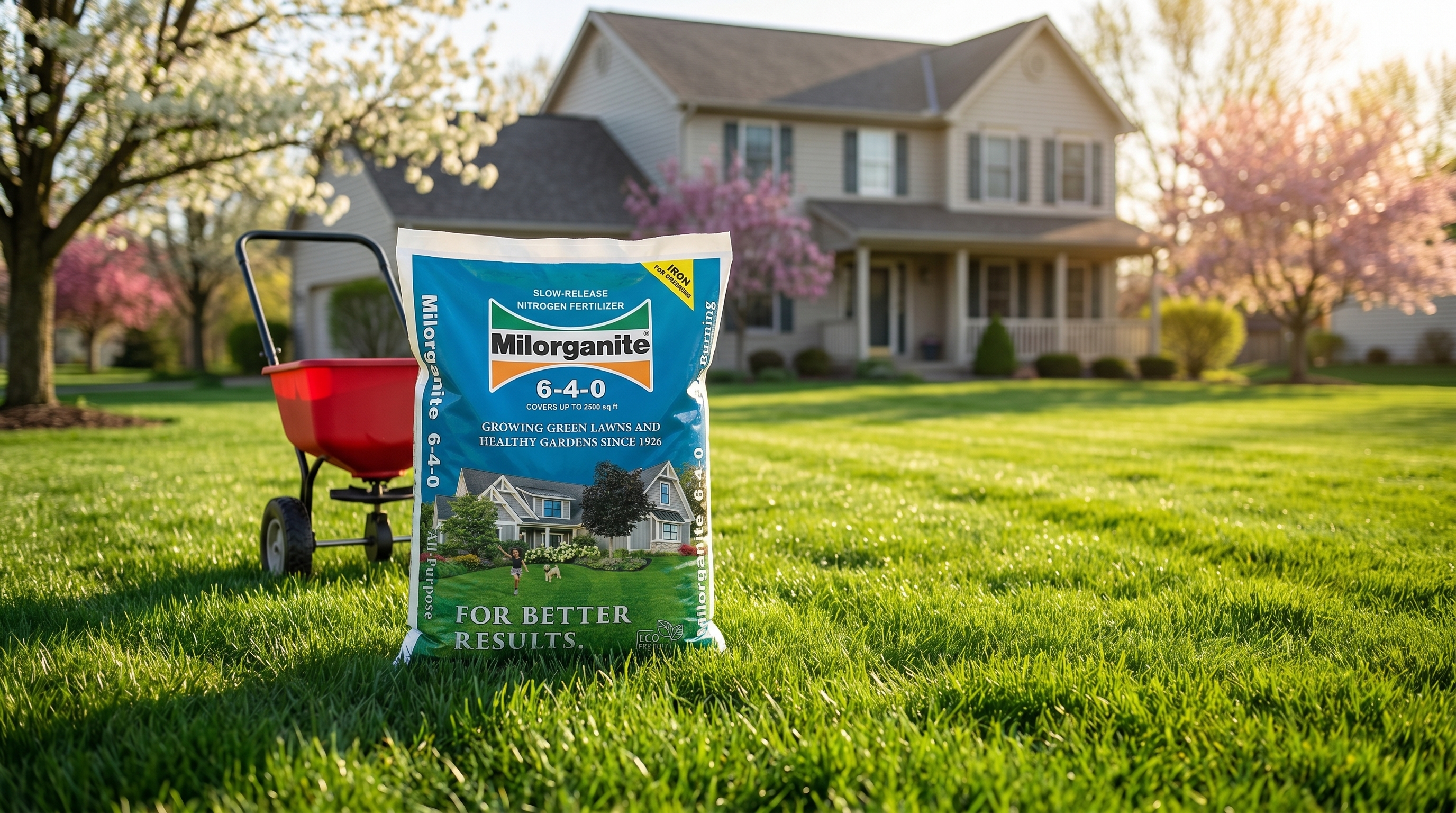
There's a moment in late April or early May when Ohio lawns look almost the way you want them to look — the grass has greened up from winter dormancy, the bare spots are starting to fill in, and the whole yard has that tentative early-season green that makes you want to put down something good before summer stress takes over. That moment is exactly when Milorganite Long Lasting All Purpose Lawn Food 6-4-0 (32 lb) does its best work. Made from heat-dried microbes — a naturally occurring byproduct of municipal water treatment — Milorganite has fed American lawns since 1926. Its 6-4-0 NPK formula delivers slow-release nitrogen that feeds grass gradually for up to ten weeks, contains no synthetic chemicals that can burn turf, and includes natural iron that produces the deep, rich green color most Ohio homeowners are actually after. Available at Liberty Farm, Home & Garden in Galion, Ohio, it's one of the most forgiving fertilizers you can use on a cool-season lawn — and May is the optimal month to apply it.
Why May Is the Optimal Window for Fertilizing Ohio Lawns
Fertilizing an Ohio lawn isn't a year-round activity — the timing matters enormously, and the window in May is one of only two or three ideal application periods in the entire calendar year. Understanding why helps you get maximum return from every bag you spread.
Ohio's dominant lawn grasses — tall fescue, Kentucky bluegrass, and perennial ryegrass — are cool-season species. They grow most actively when soil temperatures are between 50°F and 65°F, which in north-central Ohio corresponds to the April-through-early-June window in spring and the September-through-October window in fall. During these periods, the grass plant is actively metabolizing nutrients, pushing new blade growth, and developing root mass. Fertilizer applied during active cool-season growth gets taken up efficiently and directly translates into better turf.
The challenge with May is that the window closes. By mid-June in Ohio, soil temperatures typically reach the 70s and grass enters a period of reduced growth or partial summer dormancy under heat and drought stress. Applying fertilizer during summer stress — particularly fast-release synthetic fertilizer — is one of the most common ways Ohio homeowners damage their lawns: the nitrogen sits in hot soil, draws moisture from the grass plant instead of delivering it, and causes the brown burn patterns that take weeks to recover from.
Milorganite's slow-release formula changes this equation somewhat — its nitrogen releases through microbial activity in the soil, and that microbial activity slows naturally when soil temperatures spike, meaning Milorganite self-regulates its release rate to some degree. But the principle still holds: May is the better window. Applying in May gives the spring feeding time to work while soil temperatures are still in the optimal range, and the residual slow-release nitrogen continues feeding the turf into June without overwhelming it as heat arrives.
The other reason May matters: root depth. Cool-season grasses deepen their root systems during spring and fall growth periods. A May fertilizer application supports this root development just before the grass needs deep roots to survive July and August heat. Grass going into summer with deeper roots and adequate nutrition holds up significantly better than underfed turf entering the season on depleted reserves.
What Milorganite Is — and the Unusual Way It's Made
Milorganite is genuinely unlike other fertilizers in how it's produced — and understanding the source helps explain why it performs the way it does. The product is made by the Milwaukee Metropolitan Sewerage District (MMSD) in Wisconsin, which has been producing it commercially since 1926. That makes Milorganite one of the oldest continuously produced commercial fertilizers in the United States, with nearly a century of application data behind it.
The manufacturing process begins with wastewater treatment. Milwaukee's municipal wastewater is treated with microorganisms that consume the organic matter — the nitrogen, phosphorus, and other nutrients — in the waste stream. These microorganisms are then separated out, heat-dried at high temperatures to kill pathogens and weed seeds, and pelletized into the small brown granules you see in the bag. What you're spreading on your lawn is, essentially, concentrated dried microbes — organisms that are naturally rich in nitrogen and phosphorus because they spent their life cycle consuming those nutrients.
The heat-drying process is important for two reasons. First, it eliminates pathogens that might otherwise be present in a product derived from wastewater. Milorganite consistently passes EPA standards for biosolid classification Class A Exceptional Quality, the highest designation for treated biosolids, which means it has been tested and confirmed pathogen-free. Second, the heat treatment stabilizes the nutrient content in a form that releases slowly when applied to soil — the nitrogen is locked inside cellular structures that must break down further through microbial activity in your lawn's soil before it becomes available to grass roots.
This is why Milorganite is often described as an organic fertilizer, though the terminology is sometimes debated. It is not synthetic — it contains no urea, ammonium nitrate, or other manufactured nitrogen compounds. Its nitrogen comes from the biological material in the pellets, and it releases through biological processes in the soil. Whether you're managing under OMRI organic certification or just prefer a product derived from natural processes rather than chemical synthesis, Milorganite occupies a distinct category from conventional granular synthetic fertilizers.
How Slow-Release Nitrogen Actually Works in Your Soil
The difference between slow-release and quick-release nitrogen isn't just a matter of pace — it fundamentally changes how the fertilizer interacts with your lawn, your soil, and the rest of your yard's environment.
Quick-release synthetic fertilizers deliver nitrogen as water-soluble compounds — typically urea or ammonium forms — that dissolve immediately when wet and become available to grass roots within days of application. This produces rapid, visible green-up, which is appealing in the short term. The drawbacks: the availability spike is temporary (two to four weeks of active release, then little residual effect), the concentration of soluble nitrogen in the soil is high enough that over-application easily burns turf, and nitrogen that isn't taken up immediately is at high risk of leaching through the soil profile into groundwater, or running off into nearby waterways during rain events.
Milorganite's nitrogen is not water-soluble in this way. The nitrogen is locked in the organic material of the pellets and must be released through decomposition — specifically, through the activity of soil microbes that break down the pellet material and make the nitrogen available to grass roots in the process. This is the same basic mechanism by which composted manure or other organic matter feeds plants, just in a concentrated, consistent granular form.
The practical implications for Ohio lawn owners:
- Feeding that lasts ten weeks. A single Milorganite application feeds the lawn gradually over a ten-week period rather than delivering all available nitrogen in two to three weeks. One May application feeds the lawn through most of July.
- No burn, even at higher rates. Because the nitrogen isn't water-soluble, it can't spike the ionic concentration in soil water high enough to draw moisture out of grass roots the way quick-release nitrogen can. This is why Milorganite is genuinely difficult to burn — even if you double-apply by mistake, the lawn will absorb the extra material over a longer period without the scorching that would result from an equivalent excess of urea-based fertilizer.
- Rain and irrigation sensitivity. Quick-release fertilizers require immediate watering in after application to prevent surface burn and push the dissolved nitrogen to root depth. Milorganite needs water to activate soil microbial decomposition, but it doesn't need to be washed in immediately — the pellets sit on the soil surface without risk of burning the grass blades they contact.
- Soil biology benefits. The organic matter in Milorganite feeds soil microbes, improving the biological activity of the soil. Healthy soil biology improves nutrient cycling, water infiltration, and root environment quality — long-term benefits that accumulate over years of consistent Milorganite use.
Reading the 6-4-0 NPK Label — and Why Milorganite's Formula Makes Sense for Turf
Every fertilizer label shows three numbers representing nitrogen (N), phosphorus (P), and potassium (K) as a percentage of total product weight. Milorganite's 6-4-0 means 6% nitrogen, 4% phosphorus, and 0% potassium. Understanding what each component does — and why Milorganite's specific ratios make sense — helps you evaluate whether it's the right match for your lawn's needs.
Nitrogen (6%). Nitrogen drives the production of chlorophyll and drives blade growth, which is why it's the most visible fertilizer effect in a lawn. The 6% nitrogen content in Milorganite is lower than in many synthetic lawn fertilizers (which often run 20–30% nitrogen), but this is expected and appropriate for a slow-release organic product — the 6% figure represents the nitrogen in the dried pellets, which is released over months rather than weeks. The effective nitrogen delivery over the full feeding period of a Milorganite application is comparable to faster-acting products; it's just spread over a longer time window at lower instantaneous concentrations.
Phosphorus (4%). Phosphorus supports root development and early establishment. It's most valuable when establishing new turf from seed or sod, but it also plays a role in supporting root depth in established lawns. Milorganite's 4% phosphorus contributes to the root-building work that Ohio lawns need to do in spring before summer stress arrives.
Potassium (0%). Milorganite contains no added potassium. Potassium is important for overall plant health and stress tolerance, and many Ohio soils have adequate potassium levels from clay content and weathered parent material. If a soil test reveals potassium deficiency, supplemental potassium from a separate product may be warranted — but Milorganite's phosphorus-focused secondary nutrient profile covers the most common secondary nutrition need for spring turf.
Iron (2.5%). While not part of the NPK formula, Milorganite's 2.5% natural iron content is one of its most valued properties, and we'll cover it in detail in the next section.
| Nutrient | % in Milorganite | Primary Lawn Function | Ohio Spring Benefit |
|---|---|---|---|
| Nitrogen (N) | 6% | Blade growth, chlorophyll production, green color | Feeds actively growing cool-season grass through late spring |
| Phosphorus (P) | 4% | Root development, establishment | Supports root deepening before summer stress period |
| Potassium (K) | 0% | Stress tolerance, water regulation | Not supplied — supplement if soil test shows deficiency |
| Iron (Fe) | 2.5% | Deep green color, chlorophyll intensity | Produces rich green lawn appearance without growth flush |
The Iron Advantage: What Gives Ohio Lawns That Deep Green Color
Ask any lawn care professional what the difference is between an average lawn and a showpiece lawn — with the same grass species, same care, same watering — and iron almost always comes up. Iron is the micronutrient that drives chlorophyll density in grass blades, and the difference between iron-deficient turf and adequately iron-supplied turf is the difference between a yellowish-green lawn and the deep, saturated blue-green that makes neighbors ask what you're doing differently.
Ohio soils are not uniformly iron-deficient — many of the clay-heavy soils in north-central Ohio have reasonable iron levels in the soil profile. But iron availability is highly pH-dependent: as soil pH rises above 7.0 (into alkaline range), iron in the soil converts to forms that grass roots can't absorb. Ohio soils, particularly in regions with limestone-rich parent material or soils that have received heavy lime applications, often trend alkaline enough that iron availability is reduced even when total iron content in the soil is adequate.
This is one of the reasons Milorganite's 2.5% natural iron is meaningful. The iron in Milorganite is organically chelated — bound within the biological material of the pellets — which means it's released in forms that are more available to plant roots across a broader pH range than the ionic forms of iron naturally present in the soil. You get the greening effect even in Ohio's moderately alkaline soils where standard soil iron isn't being absorbed effectively.
Equally important: iron produces deep green color without stimulating excessive blade growth. Synthetic high-nitrogen fertilizers green up a lawn dramatically but also push rapid blade elongation, which means more frequent mowing, increased water demand, and more stress on the plant. Milorganite's iron-driven color improvement happens with a slower, more controlled growth response. The lawn looks better, but you're not committed to mowing twice a week to manage the growth surge that often follows a high-nitrogen synthetic application.
How to Apply Milorganite Correctly on an Ohio Lawn
Milorganite's forgiving chemistry doesn't mean application technique is irrelevant — getting the rates and method right ensures you get the full feeding benefit and even coverage across the lawn.
Coverage rate. The standard application rate for Milorganite is one 32 lb bag per 2,500 square feet. To estimate your lawn's square footage, measure the length and width of your main turf areas (excluding beds, driveway, and house footprint) and multiply. A typical suburban lot in north-central Ohio might have 3,000 to 6,000 square feet of turf, meaning one to two bags per application.
Use a broadcast spreader. Milorganite's small brown pellets are sized for standard broadcast (rotary) spreaders. Apply using the spreader setting recommended on the Milorganite bag — the label includes settings for common spreader brands. Run the spreader in a consistent pattern: make one pass along the perimeter of the lawn, then fill in with parallel passes across the interior. Overlap slightly at each pass to avoid striping. Milorganite's slow-release nature means minor application unevenness is less likely to produce visible stripes than with quick-release products, but consistent overlap still gives the most uniform result.
Apply to dry grass and water in. For best results, apply Milorganite to dry grass blades and then water in lightly after application — about a quarter inch of irrigation or a natural rain event. The watering activates soil microbial activity that begins the decomposition and nitrogen-release process. If rain is forecast within 24 hours, you can skip irrigating and let rain do the job.
Apply in the morning or evening. Midday application in full sun on a hot May day isn't ideal for any fertilizer. Morning application lets the product settle and allows soil temperature to warm into the afternoon, which activates the microbial release cycle. Evening application is equally fine and avoids any midday heat.
Mowing timing. Unlike some lawn care products, Milorganite doesn't require you to wait to mow before or after application. You can mow before applying if you prefer to start with a freshly cut lawn, or after if you want to wait for the first watering. There's no restriction either way.
What Grass Types Milorganite Works On
Milorganite is labeled for use on all grass types, and for Ohio lawns specifically, this covers the primary cool-season species that dominate residential turf in north-central Ohio.
Tall fescue. The most common grass in Ohio residential lawns and the most drought-tolerant of the cool-season options, tall fescue responds well to Milorganite's slow-release nitrogen profile. Because tall fescue has naturally deeper roots than Kentucky bluegrass or perennial ryegrass, it benefits particularly from the spring root-deepening that adequate nitrogen and phosphorus supports. A May Milorganite application gives tall fescue turf the nutrition it needs to push roots deeper before the summer heat that tall fescue handles better than other cool-season species but still struggles with.
Kentucky bluegrass. Kentucky bluegrass is the traditional fine-textured turf grass of northern Ohio and the default choice for premium lawn seed mixes in the region. It has a shorter, more intense spring growth period than tall fescue and enters summer dormancy more readily. A May Milorganite application feeds it during its most active spring growth phase, and the slow-release nitrogen residual extends feeding into early summer when bluegrass transitions to its more restrained summer mode.
Perennial ryegrass. Often mixed with Kentucky bluegrass for faster establishment (ryegrass germinates in seven to ten days versus twenty-plus for bluegrass), perennial ryegrass is present in most standard Ohio lawn seed mixes. It's the grass that greens up first in spring and first to show heat stress in summer. Milorganite's extended release profile supports ryegrass without over-pushing growth into the summer stress period.
Zoysia grass. Some Ohio homeowners in the southern and central parts of the state have warm-season zoysia, particularly in areas with excellent sun exposure. Milorganite can be used on zoysia, but the timing shifts — warm-season grasses should be fertilized from late May through midsummer when they're actively growing, not in early May when they may still be dormant. If you have zoysia, wait until it has fully greened up and is actively growing before applying.
Safety for Kids, Pets, and the Lawn Ecosystem
Milorganite is one of the most frequently asked-about fertilizers when it comes to safety around children and pets, and the answer is consistently reassuring — but it's worth understanding the specifics rather than relying on vague reassurance.
Kids and pets. Because Milorganite is a biosolid product (derived from wastewater treatment), the question of safety around children and pets comes up often. The short answer: Milorganite is safe for kids and pets to return to the lawn immediately after application, without needing to wait for the product to be watered in or dry. Unlike many synthetic pesticides and some herbicide-fertilizer combination products, Milorganite has no restricted re-entry period. Once applied, there's no chemical residue that requires isolation time.
Wildlife and pollinators. Milorganite is not a pesticide and has no toxicity to wildlife. Birds, beneficial insects, earthworms, and other soil fauna are not harmed by the product and are not deterred from the lawn after application. Earthworms in particular benefit from the addition of organic matter that Milorganite represents — worm populations are often higher in soils that receive regular organic matter additions.
Water safety. Milorganite's slow-release nitrogen is significantly less likely to contribute to nutrient runoff than quick-release synthetic nitrogen. Water-soluble nitrogen from synthetic fertilizers is a primary contributor to algae blooms in ponds, streams, and lakes when it runs off in rain events shortly after application. Milorganite's organically bound nitrogen doesn't leach or run off nearly as readily — it remains in the soil organic matter until microbial breakdown releases it gradually. Ohio homeowners with lawns adjacent to ponds, streams, or storm drains have particular reason to prefer slow-release organic fertilizers for this reason.
Note on odor. Milorganite has a distinctive odor when first applied — a slightly earthy, fertilizer-like smell that is detectable in the yard for a day or two after application. This is normal and not a health concern. It dissipates quickly after watering in and is not present at a level that affects normal yard use. Some users report that the smell is more noticeable on warm days; application in the early morning or evening reduces this.
Milorganite vs. Synthetic Quick-Release Fertilizers: A Real Comparison
Ohio homeowners often weigh Milorganite against synthetic quick-release granular fertilizers that are visually similar and sold in the same product category. Understanding the practical differences helps you make the right choice for your situation and goals.
Quick-release synthetic fertilizers — products based on urea, ammonium sulfate, or similar compounds — deliver nitrogen that becomes plant-available within days of application. The advantages are well-known: rapid green-up, consistent NPK ratios, and often lower cost per pound of nitrogen than slow-release alternatives. For lawn care professionals managing large commercial turf on tight schedules, the speed and economy of quick-release products make sense.
For the Ohio homeowner managing a residential lawn, the trade-offs matter differently:
- Burn risk. Quick-release products, particularly urea-based fertilizers, are easy to over-apply in ways that cause burn — especially when spread over wet grass, applied before a heat wave, or over-lapped by spreader passes. The economic case for quick-release fertilizers assumes correct application; mistakes are visually costly and take weeks to recover from. Milorganite's no-burn profile is genuinely valuable for anyone who doesn't use a professional-grade, precisely calibrated spreader every time.
- Application frequency. Quick-release fertilizers need to be reapplied every four to six weeks during the growing season to maintain consistent nitrogen supply. Milorganite's ten-week feed duration means fewer applications to achieve equivalent season-long coverage.
- Environmental footprint. The leaching and runoff risk of quick-release nitrogen is meaningfully higher than slow-release organic forms. For Ohio properties near water, in areas with coarse soils, or where runoff is a concern, slow-release organic nitrogen is the more responsible choice.
- Soil health accumulation. Repeated synthetic fertilizer applications over years don't improve soil biology — they can actually reduce microbial diversity by maintaining soil nitrogen at levels that favor a narrow range of fast-cycling bacteria over the broader, more beneficial soil microbial community. Milorganite's organic matter additions actively support soil biology with each application.
Building a Complete Spring Lawn Program Around Milorganite
Milorganite handles nitrogen, phosphorus, and iron — the core feeding for spring turf. A complete spring lawn program typically layers in a few additional products alongside Milorganite to address the other major spring lawn concerns in Ohio: weed control, crabgrass prevention, and bare spot repair.
For pre-emergent crabgrass control — the most important spring weed management step, applied before crabgrass seeds germinate when soil temperatures reach 55°F (typically late April to early May in Ohio) — FOREVER GREEN® Crabgrass Preventer with Turf Food Fertilizer (32 lb) combines pre-emergent herbicide with a fertilizer component. Because it's a combination product, applying it in the same application cycle as Milorganite would mean you're double-feeding nitrogen — many Ohio homeowners either apply the combination crabgrass preventer in April when the timing is right for pre-emergent applications, then follow with a Milorganite feeding in May once the crabgrass window has passed.
For broadleaf weed control (dandelions, clover, ground ivy, wild violet) after weeds have already emerged, a dedicated broadleaf herbicide — either a stand-alone liquid spray applied to individual weeds, or a weed-and-feed combination product used according to its timing instructions — handles what Milorganite doesn't. Milorganite is a fertilizer, not a herbicide, and doesn't suppress any weeds.
For bare spot repair alongside the main Milorganite program, a high-quality grass seed matched to your existing turf type, plus a light raking to prepare the seed bed, is the straightforward approach. Seeding in May in Ohio is late for spring establishment — cool-season seeds need soil temperatures between 50°F and 65°F, and the window closes as June approaches — but May seeding can work if you're prepared to water consistently. Pair seeded areas with a starter fertilizer for the first six weeks, then transition those areas to your regular Milorganite schedule once the new grass has established.
Stop in at Liberty Farm, Home & Garden in Galion to discuss your specific lawn situation — our team can help you put together a complete spring program that covers fertilizing, weed management, seeding, and any other lawn concerns for your specific property and grass type.
Frequently Asked Questions
Keep Reading
Plant Cover Crops Now: An Ohio Home Garden Guide
Plant fall cover crops in an Ohio vegetable garden with practical guidance on timing, species, seeding, winter care, and spring termination.

Save This Summer’s Garden: A Practical Ohio Seed-Saving Guide
Save tomato, bean, pea, lettuce, marigold, zinnia, and other garden seeds with this practical late-summer guide for Galion and north-central Ohio.