
What the Pros Actually Use on Their Lawns: A Complete Guide to LESCO Weed and Feed 18-0-9
Why professional lawn care companies rely on this formula, what the 18-0-9 analysis really means, how slow-release nitrogen works, and how Ohio homeowners can use it to feed and weed in a single application
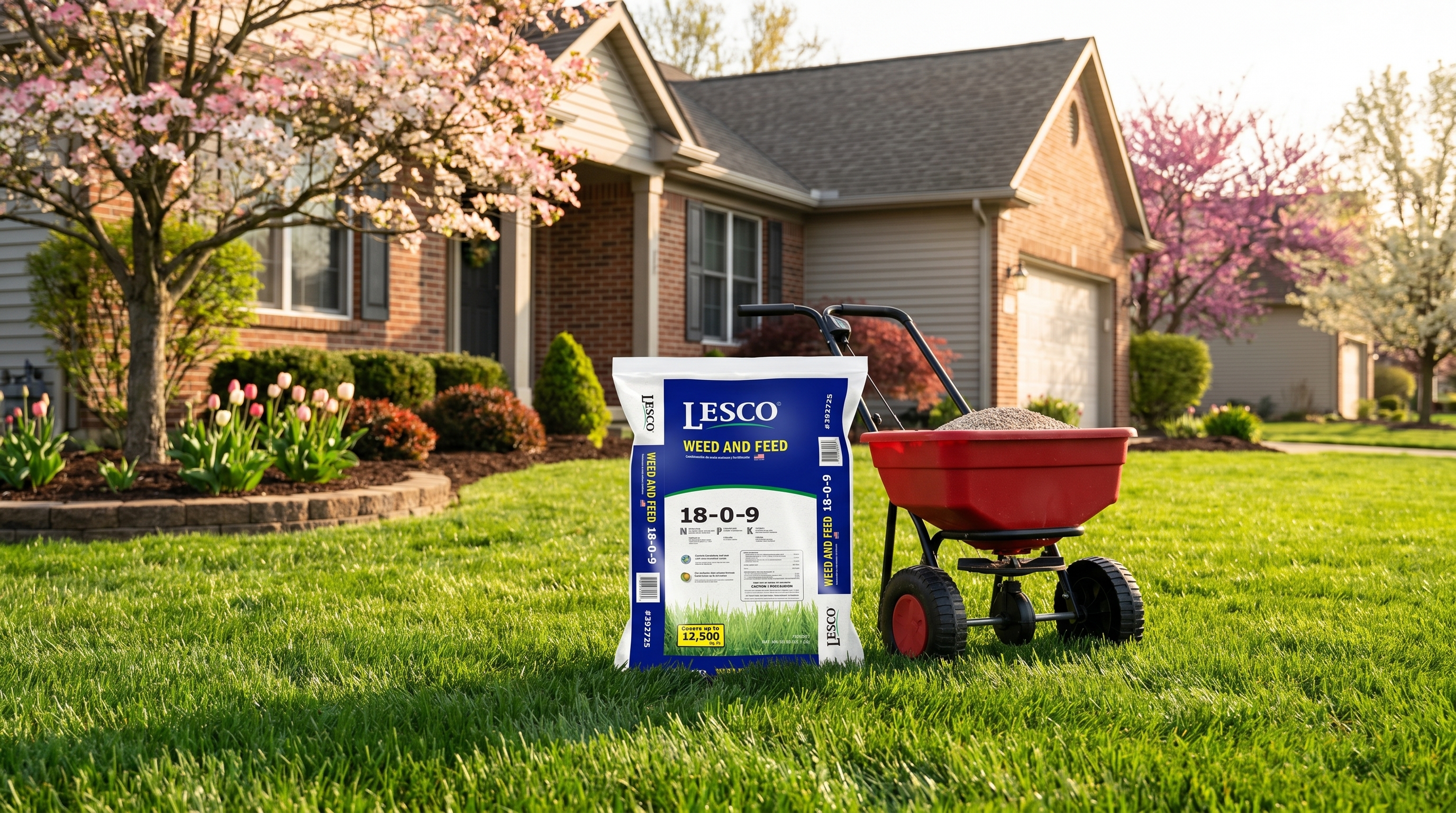
Most homeowners pick their lawn fertilizer off the shelf at whatever box store is closest and accept that it's roughly correct for their situation. Lawn care professionals don't have that luxury — they're applying product to dozens or hundreds of lawns and their results are visible and accountable. The formula they consistently reach for is not a consumer-aisle product. It's LESCO Weed and Feed Professional Fertilizer 18-0-9 (50 lb). It controls over 100 broadleaf weed species while feeding established turf with slow-release nitrogen for extended green-up — and the 18-0-9 analysis is specifically designed for the needs of mature, established lawns rather than new seedings or gardens. Liberty Farm, Home & Garden in Galion, Ohio carries this professional-grade formula so homeowners who want real results don't have to guess at what works.
Why Lawn Care Professionals Choose LESCO
LESCO has been a professional turf supply brand for decades, and the reason it has that reputation is straightforward: it's formulated to perform predictably at scale, in real conditions, on real lawns. Consumer lawn care products are designed to sell off shelves — the packaging has to be compelling and the product has to work well enough for the casual homeowner who applies it inconsistently in variable conditions. Professional products are designed to produce consistent, measurable results on maintained turf, applied correctly, by someone who's watching the outcome closely.
Several things distinguish what professionals expect from a weed and feed product:
- Effective herbicide performance across a wide weed spectrum. A product that controls 15 or 20 broadleaf species is not adequate for a lawn care company handling lawns with dandelions, clover, plantain, spurge, chickweed, ground ivy, and oxalis simultaneously. LESCO Weed and Feed controls over 100 broadleaf species — a breadth of coverage that professionals need to reliably clean up what they find on any given lawn.
- Nitrogen delivery matched to professional application schedules. Lawn care companies typically fertilize on a defined schedule across a season. They need nitrogen that releases extended over time — not a quick flush that greens the lawn for three weeks and fades. Slow-release nitrogen means longer intervals between applications while maintaining visible results.
- A nutrient ratio designed for established turf, not universal application. The 18-0-9 analysis — high nitrogen, zero phosphorus, moderate potassium — is calibrated for established lawns that don't need phosphorus for root development but do need nitrogen for shoot growth and potassium for stress tolerance. We'll cover this in depth below.
- Coverage efficiency at professional scale. A 50 lb bag covering approximately 13,000 sq ft is professional-scale coverage designed for the economics of lawn care companies. For homeowners with larger properties, this efficiency is directly valuable. For standard suburban lots, a 50 lb bag is a season's worth of product or more.
The fact that this product is available to homeowners at all is a significant advantage. Most people applying consumer weed and feed products to their lawns are using something notably inferior to what a professional would use on the same lawn.
What Weed and Feed Actually Does — and Why the Combination Works
The term "weed and feed" is used loosely in the lawn care market, and not all products that carry that label are equivalent. Understanding what weed and feed does mechanistically helps you apply it correctly and set realistic expectations.
A weed and feed product delivers two active components simultaneously:
- Post-emergent herbicide for broadleaf weeds. The herbicide in LESCO Weed and Feed is a selective, post-emergent broadleaf control — meaning it kills broadleaf plants that have already emerged (it is not a pre-emergent that prevents germination), and it is selective (it targets broadleaf weeds while leaving grass largely unaffected at proper rates). The herbicide is absorbed through the leaves and transported through the plant's vascular system, which is why uniform coverage and application timing matter.
- Fertilizer for the lawn. The 18-0-9 granular fertilizer component feeds the turf with the nitrogen and potassium it needs for growth and stress tolerance. This feeds the grass while the herbicide is working on the weeds — so you're strengthening the lawn at the same moment you're suppressing what's competing with it.
The combination matters strategically: a thick, well-fed lawn is the best long-term weed control. When grass is dense and healthy, it crowds out weed establishment. Weed and feed addresses the immediate weed pressure with herbicide while simultaneously building the turf density that makes weed reestablishment harder over the following weeks.
One important clarification: because the herbicide in weed and feed is post-emergent, it works best when broadleaf weeds are actively growing and have leaf surface to absorb the product. Cool, dry weather and dormant or stressed weeds reduce efficacy. The same applies to application method — granular weed and feed requires leaf moisture (morning dew or light watering) to adhere and absorb effectively.
Understanding the 18-0-9 Analysis
The numbers on any fertilizer bag — in this case 18-0-9 — represent the percentage by weight of nitrogen (N), phosphorus (P2O5), and potassium (K2O) in that order. Understanding what each number means helps explain why the 18-0-9 analysis is specifically appropriate for established lawns and why the zero in the middle is not an oversight.
18% Nitrogen (N)
Nitrogen is the primary driver of the green, dense turf growth homeowners are trying to achieve. Nitrogen fuels chlorophyll production (which gives grass its color), shoot growth, and the density of the turf canopy. At 18%, the nitrogen content in LESCO Weed and Feed is significant — this is a high-nitrogen formula designed to produce visible results. Because a portion is slow-release, that nitrogen is delivered over an extended period rather than in a single flush that could cause burn or rapid growth spikes that stress the lawn.
0% Phosphorus (P)
The zero phosphorus in this formula is intentional and appropriate. Phosphorus is critical for root development in new seedings and young plants — which is why starter fertilizers are high in phosphorus. Established lawns typically have adequate phosphorus in the soil from prior applications and natural soil processes. Adding phosphorus to established turf is often unnecessary and can contribute to phosphorus runoff into waterways, which is why many states restrict or discourage phosphorus fertilizer application on established lawns. If you've had a recent soil test showing a phosphorus deficiency, that's a different situation — but for most established Ohio lawns, zero phosphorus is the correct choice.
9% Potassium (K)
Potassium supports stress tolerance in established turf — drought tolerance, winter hardiness, disease resistance, and the ability to recover from traffic and wear. For Ohio lawns that face summer heat stress and winter freezing, potassium is an important component. The 9% potassium level in this formula provides meaningful stress-tolerance support alongside the nitrogen-driven green-up.
What "Slow-Release Nitrogen" Means in Practice
Fertilizers deliver nitrogen in two broad categories: quick-release (water-soluble) and slow-release (controlled-release or water-insoluble). Understanding the difference explains why slow-release products produce better long-term results on established lawns.
Quick-release nitrogen dissolves in water immediately and enters the soil solution rapidly. The grass gets a significant nitrogen input over a short window — typically two to four weeks. This produces a flush of green growth that's visible quickly, which is why consumer products often use quick-release nitrogen: the homeowner sees results fast. The downsides are that the rapid nitrogen flush can cause excessive shoot growth, creates a burn risk in warm or dry conditions, and wears off quickly. After the initial green period, the lawn needs another application.
Slow-release nitrogen — the type used in LESCO Weed and Feed — releases over a longer period, typically six to twelve weeks depending on the specific technology used. This produces several practical advantages:
- More even growth over the release period, without the boom-and-bust pattern of quick-release products.
- Lower burn risk, because the nitrogen concentration in the soil solution at any given moment stays below the threshold that damages roots and foliage.
- Extended feeding from a single application, reducing application frequency and the labor that goes with it.
- Better utilization efficiency — when nitrogen releases slowly, the plant can use more of it before it leaches out of the root zone. Fast-release nitrogen in excess of what the plant can absorb in a short window is lost to leaching.
For Ohio homeowners on a seasonal fertilization schedule, slow-release nitrogen means each application carries the lawn further — which is part of the professional-grade efficiency that makes LESCO worth using over consumer alternatives.
The 100+ Broadleaf Weeds This Controls
The herbicide component of LESCO Weed and Feed is a selective post-emergent broadleaf control. The claim of 100+ broadleaf species is not marketing language — broadleaf selective herbicides in this class genuinely have broad-spectrum activity against dicot weeds while leaving monocot grasses relatively unharmed at standard rates.
The most common broadleaf weeds Ohio homeowners deal with that fall within this control spectrum include:
- Dandelion — the most recognizable lawn weed in Ohio, with deep taproots that regenerate if not killed at the root. Broadleaf herbicides translocate through the vascular system to reach the root when the plant is actively growing.
- White clover — a persistent colonizer in nitrogen-depleted lawns. Ironic given this is a fertilizer that feeds the lawn — a well-fed lawn has a competitive advantage over clover re-establishment after the herbicide does its work.
- Common plantain and broadleaf plantain — flat rosette weeds that establish in compacted areas and high-traffic zones.
- Ground ivy (creeping Charlie) — a stubborn perennial that spreads via stolons in shaded, moist areas. One of the harder-to-control broadleaf weeds; consistent treatment in early spring and fall when it's actively growing improves results.
- Chickweed — a cool-season annual or perennial that establishes heavily in early spring. Timing weed and feed application for early spring cool weather catches chickweed in its most vulnerable actively-growing stage.
- Spurge — a summer annual that forms dense mats in thin lawn areas and along driveways and walks.
- Oxalis (wood sorrel) — a persistent weed that resembles clover with heart-shaped leaves, common in Ohio lawns across all light conditions.
- Wild violet — one of the more difficult perennial broadleaf weeds in Ohio. Multiple applications across seasons may be needed for full control on established violet populations.
The practical takeaway: for typical Ohio lawn weed pressure — the mix of dandelions, clover, ground ivy, and plantain that most homeowners deal with — LESCO Weed and Feed covers the full spectrum in a single application.
How and When to Apply LESCO Weed and Feed in Ohio
Correct timing and application method are both critical for weed and feed products. The herbicide component in particular requires specific conditions to work effectively.
Application timing for Ohio
The two primary weed and feed windows for Ohio cool-season lawns are:
- Spring (mid-April through May) — Apply when broadleaf weeds are actively growing and have enough leaf surface to absorb herbicide. In Ohio, this typically means when daytime temperatures are consistently in the 60s and broadleaf weeds have leafed out fully. Dandelions in bloom are a useful indicator — if they're fully leafed and blooming, broadleaf weed control conditions are generally right. This is also the spring fertilization window for cool-season turf.
- Fall (September through early October) — Fall is actually the preferred weed control timing for persistent perennials like ground ivy and wild violet. In fall, broadleaf weeds are translocating carbohydrates downward toward roots for winter storage, which means herbicide applied to leaves moves efficiently into the root system. Fall applications can produce superior control on deep-rooted perennial broadleaf weeds compared to spring applications.
Application conditions that matter
- Leaf moisture is required. Granular weed and feed needs to stick to the leaf surface of broadleaf weeds to work. Apply when the lawn is moist from morning dew, or water lightly before application. Do not apply immediately before rain — a heavy rain within 24 hours of application washes the granules off the leaf surface before the herbicide absorbs.
- Do not apply during heat stress. Applying any broadleaf herbicide when temperatures are above 85–90°F risks damage to the turf. In Ohio, summer weed and feed applications should be timed for cooler parts of the season or avoided in July and August heat.
- Do not apply to newly seeded areas. Wait until newly seeded areas have been mowed at least three to four times before applying any weed and feed product. The herbicide component can damage or kill seedlings.
- Use a calibrated spreader. At the professional coverage rate of 13,000 sq ft per 50 lb bag, a broadcast spreader calibrated to the correct setting is essential. Under-application reduces both fertilizer feeding and herbicide efficacy. Over-application risks turf damage and wastes product.
Coverage and Application Rate: What 13,000 Sq Ft Means
A 50 lb bag of LESCO Weed and Feed covers approximately 13,000 sq ft at the recommended application rate. To put that in practical terms for Ohio property owners:
- A standard quarter-acre residential lot has roughly 10,890 sq ft total. Subtract the footprint of the house, driveway, and landscaped beds, and the actual turf area is typically 6,000 to 9,000 sq ft. One 50 lb bag handles a full application for this property size with product to spare.
- A half-acre lot with similar structures will have 15,000 to 18,000 sq ft of turf — requiring one to two bags for complete coverage.
- Larger rural properties or acreage lawns benefit most from the professional scale: the 50 lb bag format and 13,000 sq ft coverage rate means fewer bag changes and more efficient coverage across large areas.
Do not adjust the application rate upward in an attempt to get faster or more dramatic results. The 13,000 sq ft coverage rate is calibrated for effective herbicide delivery and safe fertilizer rates simultaneously. Over-application risks turf burn from nitrogen concentration and can stress the lawn at the same time the herbicide is working on weeds — a combination that produces visible damage rather than better results.
What to Expect After Application
Setting realistic expectations for weed and feed results prevents the common mistake of concluding the product didn't work when it's still working.
Herbicide results
Broadleaf weed response to post-emergent herbicide is not immediate. The herbicide absorbs through the leaf surface, moves through the vascular system, and reaches the root over several days to weeks. The visual signs of herbicide activity — leaf curling, yellowing, browning, and eventual dieback — typically appear within 7 to 21 days of application, depending on temperature, weed species, and application conditions. Cooler temperatures slow herbicide activity; warmer temperatures in the mid-60s to 70s accelerate it.
Persistent perennials like ground ivy and wild violet may show significant visual damage without being fully killed on a single application. A second application 30 to 60 days after the first, or a follow-up treatment in the opposite season (spring and fall applications), typically produces complete control on difficult perennial species.
Fertilizer results
The slow-release nitrogen in LESCO Weed and Feed typically produces noticeable greening within one to two weeks of application, with the extended-release component continuing to feed the lawn for six to ten weeks. Unlike quick-release fertilizers that produce a dramatic flush followed by a drop-off, the slow-release profile produces steadier, sustained color and density without boom-and-bust growth cycles.
| Specification | Details |
|---|---|
| Product | LESCO Weed and Feed Professional Fertilizer 18-0-9 |
| Weight | 50 lb |
| Coverage | Approximately 13,000 sq ft |
| Analysis | 18-0-9 (Nitrogen-Phosphorus-Potassium) |
| Nitrogen Type | Slow-release for extended green-up |
| Herbicide | Post-emergent broadleaf weed control (100+ species) |
| Best For | Established cool-season lawns; not for new seedings |
| Ideal Timing (Ohio) | Mid-April through May (spring); September through early October (fall) |
| Application Method | Broadcast spreader; apply to moist turf |
| Brand | LESCO |
| Available At | Liberty Farm, Home & Garden, Galion, Ohio |
Other Fertilizer and Lawn Care Options at Liberty Farm, Home & Garden
Liberty Farm, Home & Garden carries a full range of fertilizer products for lawn, garden, trees, and specialty applications. A few worth knowing about alongside LESCO Weed and Feed:
- Jobe's 4-6-6 Organics Fruit & Nut Tree Spikes (8-Pack) — For established fruit and nut trees, these spike-style fertilizers deliver nutrients directly to the root zone. The 4-6-6 analysis is high in phosphorus and potassium relative to nitrogen — calibrated for productive fruit trees rather than turf. A completely different use case than lawn fertilizer, but a useful complement if your property includes fruit trees alongside lawn.
- Miracle-Gro Performance Organics All Purpose — An organic-based all-purpose formula for vegetable gardens, containers, and flower beds where weed control is not needed and organic certification matters. The right tool when you're feeding garden beds rather than established turf.
- Miracle-Gro Shake 'n Feed Tomato, Fruit & Vegetable (4.5 lb) — Designed for edible garden use: tomatoes, peppers, cucumbers, squash, and other vegetables that need a different nutritional profile than turf. The slow-release format works well for vegetable beds where consistent feeding across the growing season matters.
- Jobe's 8-11-11 Fruit Tree Fertilizer Stakes (5-Pack) — An alternative fruit tree stake formula with higher phosphorus and potassium for established bearing trees. The spike format makes application simple and positions nutrients at the root zone without surface broadcast.
Stop in at Liberty Farm, Home & Garden in Galion or shop online at libertyfhg.com for the full fertilizer and lawn care selection. We stock professional-grade products alongside consumer options and can help you choose the right formula for your lawn size, weed pressure, and seasonal timing.
Frequently Asked Questions
Keep Reading
Plant Cover Crops Now: An Ohio Home Garden Guide
Plant fall cover crops in an Ohio vegetable garden with practical guidance on timing, species, seeding, winter care, and spring termination.

Save This Summer’s Garden: A Practical Ohio Seed-Saving Guide
Save tomato, bean, pea, lettuce, marigold, zinnia, and other garden seeds with this practical late-summer guide for Galion and north-central Ohio.