
Fix Ohio Lawn Problem Areas the Right Way: A Complete Guide to Home Pro Turf Tall Fescue Blend (5 lb)
How the Home Pro Turf Tall Fescue Blend (5 lb) lets you target your lawn's hottest, driest spots — south-facing slopes, bare edges, drought-burned sections — before committing to a whole-lawn conversion
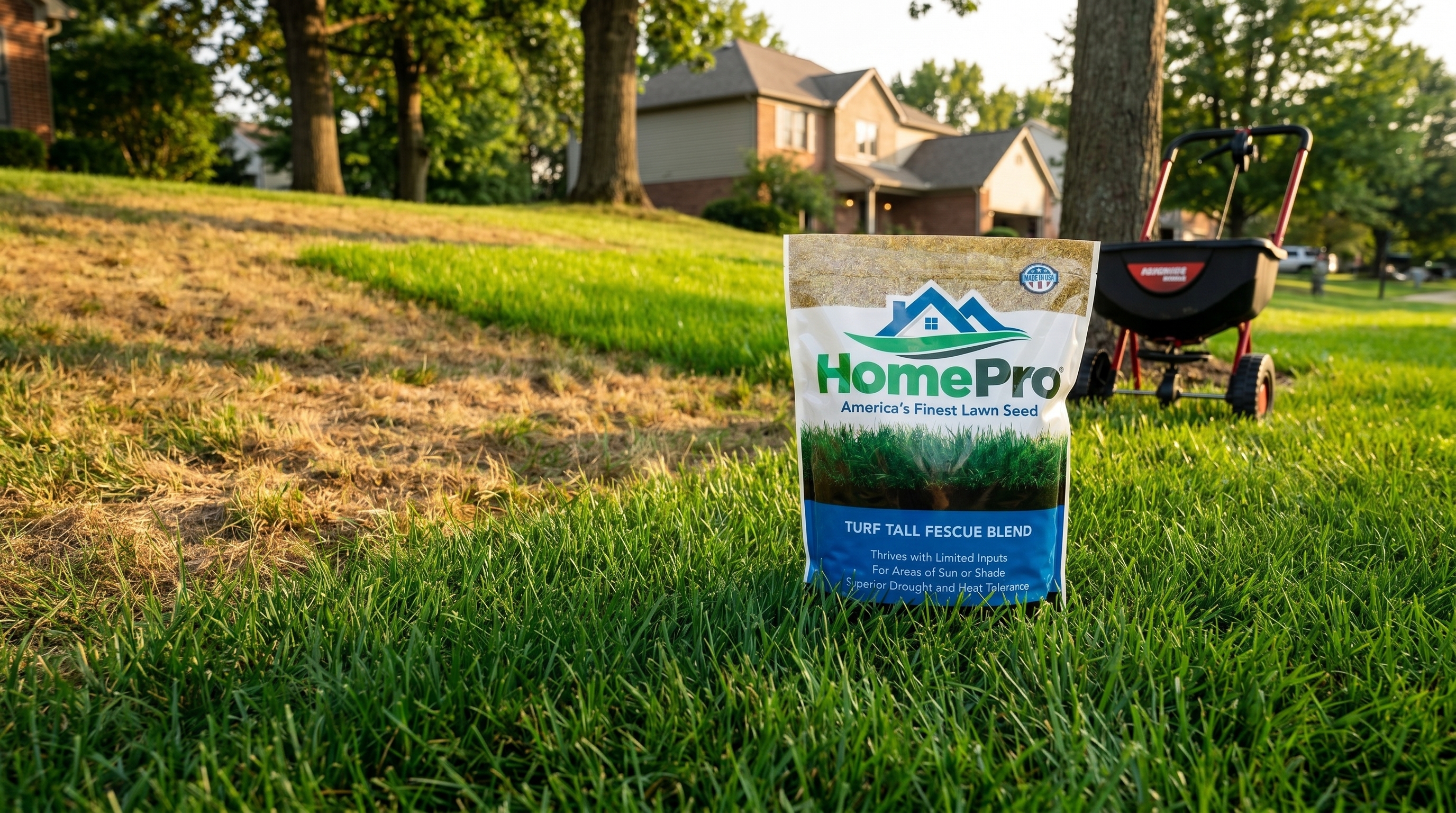
Every Ohio lawn has at least one spot that refuses to cooperate. It might be the slope along the south side of the house that bakes from noon through late afternoon and goes brown by late June. It might be the narrow strip along the driveway or sidewalk where radiated heat kills the grass every August. It might be the section where tree roots compete with turf for moisture, or the area at the bottom of a downspout run where the soil dries out unevenly. These aren't random failures — they're systematic: the same spots fail year after year because the grass you have there isn't suited to the conditions that spot creates. Home Pro Turf Tall Fescue Blend (5 lb), available at Liberty Farm, Home & Garden in Galion, Ohio, is designed for exactly this kind of targeted problem-area conversion — putting a drought-tolerant, deep-rooting tall fescue blend into the spots that need it most, in the quantity that matches a focused repair project rather than a whole-lawn renovation.
Why Certain Lawn Spots Fail Year After Year in Ohio
Understanding why specific areas fail consistently is the first step to fixing them. The patterns are predictable once you know what to look for, and they nearly all point to the same root cause: the grass variety in that area can't access enough moisture or tolerate enough heat to stay healthy through Ohio's summer stress period.
The most common problem-area types in Ohio residential lawns:
- South-facing slopes. Slopes that face south receive direct sun exposure throughout the hottest part of the day. Soil on slopes also drains faster than flat ground — water runs off before it can penetrate deeply. The combination of intense radiant heat and rapid moisture loss creates conditions that exceed what most cool-season grasses can tolerate. Kentucky bluegrass on a south-facing slope will go dormant or die back by mid-July in most Ohio years.
- Driveway and sidewalk edges. Concrete and asphalt absorb heat all day and radiate it into adjacent soil through the evening hours. Soil temperatures along pavement edges can run 10–15°F higher than temperatures in the middle of the lawn. Grass varieties that need moderate summer temperatures struggle here even when adequately watered.
- Areas under or near large trees. Mature oaks, maples, and elms intercept rainfall before it reaches the soil, compete with grass roots for available soil moisture, and create root networks that crowd out turf root development. Areas within the drip zone of large trees experience a combination of drought stress, root competition, and reduced light that makes them difficult for standard lawn mixes.
- Sandy or thin-soil areas. In Ohio's otherwise clay-heavy soils, areas of sandy fill, disturbed soil from construction, or naturally thin topsoil hold moisture poorly and dry out faster than the surrounding lawn. These areas lose soil moisture rapidly between rain events and reward a grass with the root depth to reach beyond the thin, fast-draining surface layer.
- High-traffic paths. The strip of lawn between the driveway and the house, the path to the back gate, the section in front of the garden — these areas experience compaction that reduces soil aeration and root depth. A compact, shallow-rooting soil combined with repeated physical disturbance is hard on most cool-season grasses.
What these areas share is that they present conditions more extreme than the average lawn. The solution isn't better watering or more fertilizer applied to the same grass — it's replacing the grass with a variety whose fundamental characteristics match the conditions that spot creates. That's where tall fescue's deep root system and drought tolerance become the right tool for the job.
What Makes Tall Fescue the Right Grass for Ohio Problem Spots
Tall fescue has characteristics that make it specifically well suited to the kinds of problem conditions described above. Understanding what those characteristics are — and why they matter — explains why converting problem spots to tall fescue works where simply re-seeding with the existing grass type repeatedly fails.
The defining advantage of tall fescue in problem areas is root depth. While Kentucky bluegrass and perennial ryegrass typically root to 6–12 inches in Ohio's clay soils, turf-type tall fescue can root to 24–36 inches under good conditions. That depth difference is the mechanism by which tall fescue stays green through drought conditions that push bluegrass into dormancy: the grass can access subsoil moisture that shallower-rooted species can't reach. On a south-facing slope or along a heat-reflecting driveway, that root depth is what keeps tall fescue alive and growing when the surface soil layer dries out completely.
Beyond root depth, tall fescue has several other characteristics that work in its favor in problem areas:
- Broad heat tolerance compared to other cool-season species. Tall fescue is a cool-season grass — it grows most actively in spring and fall — but it has a wider heat tolerance band than most of its cool-season counterparts. It slows in summer's peak heat rather than shutting down entirely, and it recovers from heat stress faster than bluegrass once temperatures moderate in September.
- Partial shade tolerance. In areas under tree canopy or along north-facing structures, tall fescue maintains adequate density with 4–5 hours of filtered sunlight. This is significantly better shade performance than Kentucky bluegrass, which wants 6–8 hours of direct sun to remain dense.
- Bunch-type growth that stays where you put it. Unlike Kentucky bluegrass, which spreads laterally through underground rhizomes, tall fescue is a bunch-type grass that grows in place rather than spreading. This means it won't invade adjacent beds, walkways, or garden areas, and it stays contained to the problem spots you've converted without requiring ongoing management of lateral spread.
- Adaptability to Ohio's clay soils. Tall fescue tolerates the wet-dry cycles, compaction, and heavy texture that characterize north-central Ohio's clay-heavy soils better than many alternatives. It establishes reasonably well in clay when the soil is prepared properly, and once established, its deep roots help break up compacted layers over time.
Understanding the Home Pro Turf Tall Fescue Blend
The Home Pro Turf Tall Fescue Blend is a turf-type tall fescue blend formulated for the residential lawn applications where tall fescue's characteristics are most valuable: hot spots, drought-stressed areas, south-facing slopes, and sections that experience more heat and moisture stress than the rest of the lawn. The blend draws from turf-type tall fescue varieties — the modern, fine-bladed class of tall fescue developed specifically for residential turf applications — rather than the coarser, older pasture-type fescues that gave the species a rough texture reputation in home lawns for decades.
The 5 lb bag covers approximately 1,000–1,500 sq ft for overseeding, which is the right quantity for a focused problem-area conversion project. This sizing reflects a deliberate choice: for introducing drought-tolerant tall fescue into specific problem zones, 5 lb is typically more than enough for a single season's targeted overseeding, and it allows you to see results from tall fescue in your worst spots before committing to the volume of seed needed for a whole-lawn renovation.
The blend is available at Liberty Farm, Home & Garden in Galion, Ohio — and that local availability matters for timing. Grass seeding is time-sensitive to soil temperature windows, and being able to pick up seed the week before your planting window rather than waiting on shipping means you're not missing the fall seeding window that determines whether tall fescue establishes before winter.
Why the 5 lb Size Is the Right Starting Point
The sizing logic of the Home Pro Turf Tall Fescue Blend (5 lb) deserves direct explanation, because buying the right quantity of seed for the project you're actually doing matters more than many homeowners realize.
At the 5 lb size, the bag covers 1,000–1,500 sq ft at typical overseeding rates. That's the size of:
- A south-facing slope of roughly 25 × 40 feet — a full side slope of a typical residential lot
- The driveway-edge strip the full length of a standard residential driveway, 3–4 feet wide
- Three to five individual hot spots or bare patches of 200–300 sq ft each
- The drip zone area under a large mature tree (30–35 foot canopy spread)
For problem-area conversions, this is exactly the right quantity. Buying a larger bag and using it at thin rates to cover more area might seem economical, but thinning the application rate below the recommended level reliably produces sparse stands that require a second seeding to fill in — and the combined cost of two seedings exceeds what a correctly-sized first seeding would have cost. Buying more seed than you need results in leftover product that deteriorates in storage; grass seed viability drops significantly from one season to the next.
The strategic value of the 5 lb size is that it lets you test tall fescue's performance in your specific problem areas before committing to the larger quantity needed for a full lawn renovation. If the fall overseeding results confirm that tall fescue stays green through the following summer in spots where bluegrass previously failed, you'll have direct evidence from your own lawn to justify expanding the conversion the following season.
When and How to Seed Problem Areas with Tall Fescue
Timing and preparation are the two variables most within your control — and the two most often treated casually. Getting both right is the difference between tall fescue that establishes cleanly and a repeat of whatever seeding project preceded the current one.
Timing: Ohio's seeding windows for tall fescue
Tall fescue germinates best when soil temperatures are between 50°F and 65°F. In Ohio, that range occurs twice a year:
- Fall (late August through mid-October). This is the optimal seeding window. Soil temperatures drop into the germination range as early as mid-August in northern Ohio and persist through October. Seed planted in late August or September germinates quickly, establishes before first frost, and goes into winter with a root system developed enough to survive. The following summer, fall-seeded tall fescue faces its first real heat test as an established plant — with roots deep enough to handle the drought stress that would kill a spring seeding that's still shallow-rooted from the same year.
- Spring (mid-March through late April). Spring seeding is viable but has two complications: new tall fescue seedlings face summer heat before roots are fully developed, and pre-emergent crabgrass control products applied in spring prevent grass seed from germinating. If you seed in spring, you need to forgo pre-emergent crabgrass control in the seeded area for that season.
Preparation: what problem areas specifically require
Problem areas often need more preparation than standard lawn areas because their stress conditions — compaction, heat, root competition — have also degraded the soil surface. Steps that matter most:
- Remove dead material completely. Dead grass, decomposed thatch, and debris should be raked out before seeding. In severely damaged spots, the dead mat can be thick enough to completely prevent seed-to-soil contact. Remove it down to bare or near-bare soil before proceeding.
- Break up the surface on slopes. South-facing slopes often have hard, crusted soil surfaces from repeated wet-dry cycles and erosion. A steel rake or hand cultivator worked into the top inch of the slope creates the loose seedbed that seed needs to settle into moist soil.
- Amend if the soil is poor. Areas of thin topsoil, sandy fill, or severely depleted soil benefit from a light topdressing of quality topsoil or compost — ¼ to ½ inch worked into the surface — before seeding. This gives seed a better germination medium than raw subsoil or clay.
- Core aerate compacted areas. Compacted areas along driveways, paths, and high-traffic zones have soil density that limits root development. Core aeration (pulling soil plugs with a rented aerator) opens the soil, creates pockets that catch seed, and gives roots immediate access to loosened soil below the surface.
- Apply seed and lightly rake in. Broadcast seed at the recommended rate and use a light rake pass to settle seed into the top ¼ inch of the soil surface. On slopes, press seed firmly against the soil surface to prevent it washing off during the first irrigation or rainfall event.
Watering and Establishment for High-Stress Areas
Watering newly seeded problem areas requires more attention than watering standard lawn seedings because the conditions that made these areas problems in the first place — faster drainage, greater heat exposure, more rapid moisture loss — apply equally to your new seedlings until their roots develop enough depth to survive without constant surface moisture.
During germination (the first 14–21 days):
- Keep the top ½ inch of soil consistently moist. On south-facing slopes and driveway edges, this may mean watering twice daily in warm, dry conditions — once in early morning and once in late afternoon — rather than the single daily watering adequate for less-stressed lawn areas.
- Use a gentle spray pattern, not a jet. On slopes especially, high-pressure spray will wash seed off the surface before it germinates. Use a misting or gentle fan pattern that wets the surface without creating runoff.
- Water in the morning when possible. Evening watering on slopes leaves seed and emerging seedlings wet overnight, which can promote damping-off disease in young seedlings. Morning watering allows the surface to dry during the day.
After germination (weeks 3–8):
- Transition gradually to less frequent, deeper watering. Once seedlings are visible and ½ inch tall, begin reducing frequency and increasing duration — the goal is to encourage roots to follow moisture deeper into the soil profile rather than staying at the surface where conditions are most extreme.
- Avoid letting new seedlings on slopes dry completely. Until the roots have reached 4–6 inches in depth, young tall fescue plants in south-facing or heat-exposed areas are still vulnerable to complete surface drying. The transition from surface-watering to deep-watering should be gradual rather than abrupt.
- First mowing: wait until seedlings reach 3–4 inches tall, then mow high (3–4 inch cutting height) with a sharp blade. On slopes, mow across the slope rather than up and down to avoid pulling young plants from the soil with wheel traction.
| Specification | Details |
|---|---|
| Product Name | Home Pro Turf Tall Fescue Blend (5 lb) |
| Grass Type | Turf-type tall fescue blend |
| Overseeding Coverage | Approximately 1,000–1,500 sq ft |
| Best Use | Hot spots, south-facing slopes, drought-stressed areas, driveway edges, problem areas |
| Soil Temperature for Germination | 50°F–65°F |
| Germination Time | 7–14 days under optimal conditions |
| Best Planting Window (Ohio) | Late August–mid-October (fall preferred); mid-March–late April (spring) |
| Sun Requirement | Full sun to partial shade (4+ hours direct sun) |
| Root Depth | Up to 24–36 inches under good conditions |
| Brand | Home Pro |
| Available At | Liberty Farm, Home & Garden, Galion, Ohio |
Other Grass Seed and Lawn Tools at Liberty Farm, Home & Garden
Once you've addressed your primary problem areas with the Home Pro Turf Tall Fescue Blend, Liberty Farm, Home & Garden in Galion carries what you need for broader lawn improvement projects and complementary grass seed selections:
- Schultz® Hardy Lawn Mix Grass Seed (10 lb) — A cool-season blend designed for Ohio's climate, suited for larger overseeding projects and full lawn renovation coverage. Once you've confirmed tall fescue performance in your problem areas with the 5 lb Home Pro bag, the Schultz Hardy Lawn Mix covers larger areas for a broader transition or renovation project.
- Schultz® High Traffic Mix Grass Seed (3 lb) — Purpose-formulated for areas that take repeated foot traffic — pathways, gates, play zones, the strip between the driveway and the door. If your problem area is compaction-driven rather than heat or drought-driven, this traffic-specific mix is the right choice for that spot.
- Schultz® Sun & Shade Mix Grass Seed (3 lb) — A multi-species blend covering both full-sun and partial-shade conditions in a single bag. For Ohio yards with varied light exposure — open slopes that see full sun and adjacent areas shaded by trees — the Sun & Shade Mix addresses both zones without having to manage separate seed applications for each condition.
- Earthway Hand Crank Bag Spreader & Seeder — The right tool for problem-area seeding projects. Its hand-crank mechanism distributes seed in a consistent spread pattern, eliminating the uneven coverage of hand broadcasting and giving you direct control over application in defined problem zones. Ideal for the areas the 5 lb bag covers.
Stop in at Liberty Farm, Home & Garden in Galion or browse online at libertyfhg.com for our full grass seed inventory and lawn care supplies. Whether you're starting with a targeted problem-area fix using the Home Pro Turf Tall Fescue Blend or planning a broader overseeding project for the coming fall, we carry the seed, tools, and products to get it done right.
Frequently Asked Questions
Keep Reading
Plant Cover Crops Now: An Ohio Home Garden Guide
Plant fall cover crops in an Ohio vegetable garden with practical guidance on timing, species, seeding, winter care, and spring termination.

Save This Summer’s Garden: A Practical Ohio Seed-Saving Guide
Save tomato, bean, pea, lettuce, marigold, zinnia, and other garden seeds with this practical late-summer guide for Galion and north-central Ohio.