
The Hardest Part of Keeping Chickens in Winter Is Water — Here's How to Solve It
A complete guide to keeping poultry water ice-free through an Ohio winter, and why the Farm Innovators Heated Poultry Fountain is the most reliable solution for backyard flocks
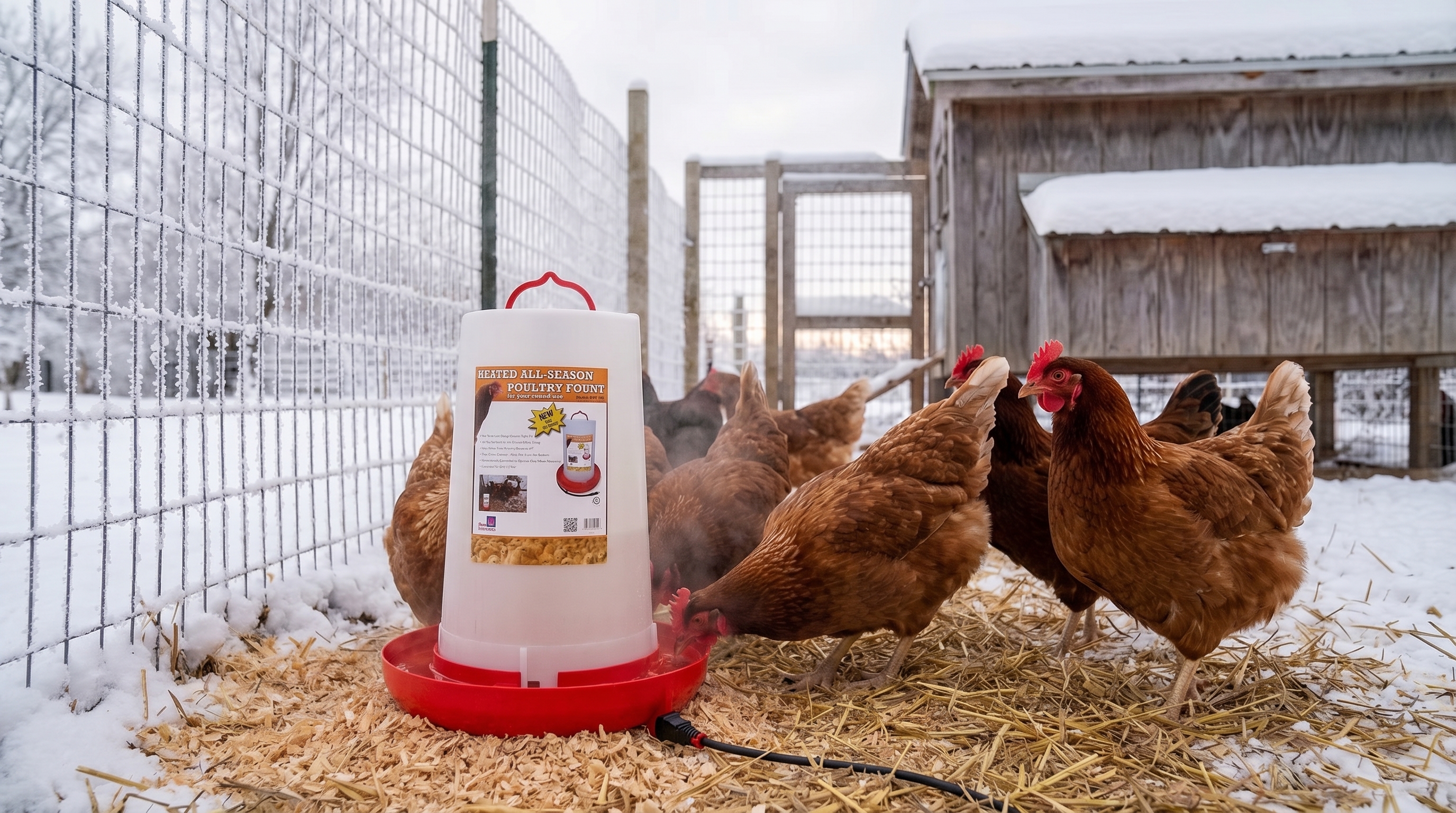
If you raise chickens in Ohio, you already know the winter waterer problem. You walk out to the coop in the morning and the water is a solid block of ice. You dump it, refill it, and by afternoon it's frozen again. Multiply that by a four-month Ohio winter and you're hauling warm water from the house twice a day for 120 days — an exhausting routine that most backyard chicken keepers didn't anticipate when they started their flock. The Farm Innovators Heated Poultry Fountain (100-watt, 3 Gallon) ends that routine. It keeps water ice-free down to 0°F, runs only when needed thanks to a built-in thermostat, and holds enough water for most backyard flocks through a full day without refilling. It's available at Liberty Farm, Home & Garden in Galion, Ohio.
Why Winter Water Is the Hardest Part of Keeping Chickens
Chickens need consistent access to fresh, liquid water year-round — this is one of the most frequently underestimated aspects of flock management for first-time keepers. Poultry can survive surprising cold without any intervention as long as they're dry and out of wind, but their water supply is far more vulnerable than the birds themselves.
The stakes are higher than they might seem. Chickens that go without water for even a few hours in cold weather experience immediate production drops — egg laying is metabolically expensive and one of the first things the body deprioritizes when stressed. A hen that can't drink freely will reduce laying within 24 hours and may take several days to return to normal production once access is restored. In extended cases, dehydration in cold weather contributes to illness and increases susceptibility to respiratory problems, since dry indoor coop air already stresses the respiratory tract.
The standard workarounds — hauling warm water twice daily, using rubber buckets that can be stomped free of ice, or inserting stock tank heaters — all work to varying degrees but impose significant daily labor. A thermostatically controlled heated fountain changes the equation: it maintains liquid water automatically, without intervention, regardless of overnight temperatures.
How the Farm Innovators Heated Fountain Works
The Farm Innovators Heated Poultry Fountain uses a 100-watt internal heating element paired with a built-in thermostat to maintain water temperature just above freezing. The thermostat is the key feature — it means the heater only draws power when temperatures drop to the point where freezing is a risk. When it warms up above that threshold, the heater turns off automatically.
This thermostatically controlled operation has two practical advantages. First, it extends the life of the heating element by not running it continuously when it isn't needed. Second, it keeps operating costs reasonable through a long winter — you're paying to run 100 watts only during genuinely cold hours, not 24 hours a day regardless of conditions.
The 3-gallon capacity is delivered via a standard poultry fountain design: a sealed reservoir that inverts over a base, releasing water into the trough by atmospheric pressure as the birds drink. The bottom-fill design means you tip the reservoir to fill it from the top (which becomes the bottom when inverted), then flip it onto the heated base. The fountain can be used on the ground or hung — hanging keeps litter and debris out of the water trough, which is generally preferable for water quality.
The unit is rated to keep water ice-free down to 0°F — which covers the full range of typical Ohio winter temperatures, including the coldest weeks of January and February in Crawford County and surrounding areas.
What Separates a Good Heated Waterer from a Bad One
Not all heated poultry waterers perform equally, and it's worth understanding what makes the Farm Innovators unit a reliable choice compared to cheaper alternatives:
- Built-in thermostat vs. always-on heaters. The cheapest heated bases and waterers use a simple heating element with no thermostat — the element runs continuously whenever plugged in. This works, but it shortens element life, costs more in electricity, and can overheat the water in mild weather. A thermostatically controlled unit avoids all of these problems.
- 100-watt capacity for 0°F rating. Some lower-wattage heated waterers are rated only to 10°F or 20°F — which fails on Ohio's coldest nights. A 100-watt element provides sufficient thermal output to hold 3 gallons of water above freezing even when ambient temperatures drop to zero.
- Integrated design vs. base + separate fountain. Some chicken keepers use a heated base under a standard plastic fountain. This can work, but compatibility between bases and fountains varies, and the interface between a non-matched base and fountain can be a failure point. An integrated unit designed as a single product eliminates that uncertainty.
- 3-gallon capacity. Smaller heated waterers (1 quart, 1 gallon) require more frequent refilling in cold weather — which partly defeats the purpose. A 3-gallon reservoir gives most small to medium backyard flocks a full day's worth of water without multiple refills.
| Specification | Details |
|---|---|
| Capacity | 3 gallons |
| Heating Element | 100 watts |
| Thermostat | Built-in, factory-preset — runs only when needed |
| Minimum Temperature Rating | Ice-free down to 0°F |
| Fill Method | Bottom-fill (fill from top, invert onto base) |
| Use Options | Ground or hanging |
| Suitable Poultry | Chickens, ducks, and other poultry |
| Available At | Liberty Farm, Home & Garden, Galion, Ohio |
How Many Gallons Does Your Flock Actually Need?
The 3-gallon capacity of the Farm Innovators fountain works well for most backyard flocks — but it's worth thinking through whether it fits your situation. A rough guide:
- Standard laying hens drink approximately 0.5 pints (about 8 ounces) per day in cool weather, rising to as much as a pint per day in summer heat. In winter, consumption is closer to the lower end.
- A flock of 6–8 hens will consume roughly 48–64 ounces per day in winter — well under 1 gallon. A 3-gallon reservoir provides 2–3 days of theoretical capacity, though daily refills are still good practice for water freshness.
- A flock of 12–15 hens might consume 1 to 1.5 gallons per day, meaning the 3-gallon reservoir needs a fresh refill every two days at most.
- Larger flocks (20+) may need two fountains or a larger-capacity heated waterer to avoid running dry between morning and evening checks.
If you have ducks or turkeys mixed into your flock, adjust upward — waterfowl drink significantly more than chickens and are particularly hard on water quality (they dip their bills repeatedly). A dedicated waterer for ducks, separate from the chicken waterer, is worth considering for mixed flocks.
Setting Up the Heated Fountain in Your Coop
Correct placement makes a significant difference in both performance and longevity:
- Keep it away from bedding. Chickens scratch and kick litter constantly. Position the fountain where it won't be directly in the main scratch zone — hanging it is the simplest way to accomplish this. Litter in the water encourages bacterial growth and clogs the trough.
- Keep the cord routed safely. Chickens will peck at anything interesting, including electrical cords. Use cord clips or route the power cord through a conduit or along the wall out of reach. This is a basic safety practice in any heated coop environment.
- Don't put it directly under the roost. Overnight droppings falling into or near the waterer create a sanitation problem fast. Position the fountain away from the area directly below roosting bars.
- Use a dedicated outdoor-rated extension cord if needed. If your coop doesn't have an outlet, run a properly rated extension cord from the nearest source. Use a cord rated for outdoor use and for at least 15 amps — undersized cords with heating appliances are a fire risk.
- Rinse and refill regularly. A heated waterer maintains liquid water, but it doesn't purify it. Empty and rinse the trough every few days, and do a full clean of the reservoir weekly during winter use. Biofilm builds up in any water container and is a source of low-grade bacterial exposure for your flock.
Using This Fountain for Ducks and Other Poultry
The Farm Innovators Heated Fountain is designed for chickens, ducks, and other poultry — but using it in a mixed or duck-heavy flock takes some adjustment. Ducks are messy drinkers by nature: they dip their entire bills repeatedly, splashing water out of the trough in the process. In a cold coop, wet litter around a heated waterer can become a wet, frigid mess faster than you'd expect.
For duck flocks or mixed flocks, a few management adjustments help:
- Place the fountain on a hardware cloth platform or wire rack so spilled water drains away from the litter beneath.
- Increase litter management frequency around the waterer during winter — wet litter in a cold coop contributes to respiratory issues.
- Consider a separate, duck-appropriate water station for bill-dipping rather than trying to do everything through one fountain. Ducks often do better with a deeper trough than what a standard poultry fountain provides for bill-cleaning behavior.
Other Poultry Waterers and Feeders at Liberty Farm, Home & Garden
We carry a range of poultry watering and feeding supplies at Liberty Farm, Home & Garden for different flock sizes and management styles:
- Little Giant Screw-On Poultry Jar (1 qt) — A compact jar waterer that screws onto a standard mason jar or Little Giant base. Useful as a supplemental waterer in a brooder or for small bantam flocks. Not heated — for warm-season or heated-space use.
- Little Giant Screw-On Poultry Waterer Base (1 qt) — The base component for the 1-qt jar waterer system. A good spare to have on hand so you can rotate jars for cleaning without pulling the whole setup offline.
- Little Giant Plastic Feeder Base (1 qt) — A compact feeder base for chick starters and small flock supplemental feeding. The jar-and-base system is one of the cleanest ways to manage feed for young chicks without waste.
- Lixit Chicken Feeder or Waterer with Reversible Base — A versatile unit that works as either a feeder or waterer with a reversible base. Good option for flexibility when you want one unit that can serve double duty depending on the season or setup.
Stop in at Liberty Farm, Home & Garden in Galion and we'll help you figure out the right winter water setup for your flock size and coop layout. We stock what local chicken keepers actually need for Ohio winters — not just what looks good in a catalog.
Frequently Asked Questions
Keep Reading

Late-Summer Pasture Checkup: Repair, Reseed, or Rest Your Ohio Fields?
A practical late-August pasture guide for Ohio livestock owners: assess plant cover, soil fertility, weeds, grazing pressure, and whether to repair or reseed.
Molting Season Prep: How to Support Your Chickens Through the August Transition
Learn how to recognize and support your chickens through their annual molt in late summer and early fall. This seasonal guide from Liberty Farm, Home & Garden in Galion, Ohio covers nutrition, management, and timing for north-central Ohio flocks.