
When Your Plants Need Potassium: A Complete Guide to Espoma Potash 0-0-60
Soil testing, application rates, timing, and which crops benefit most from targeted potassium correction in Ohio gardens
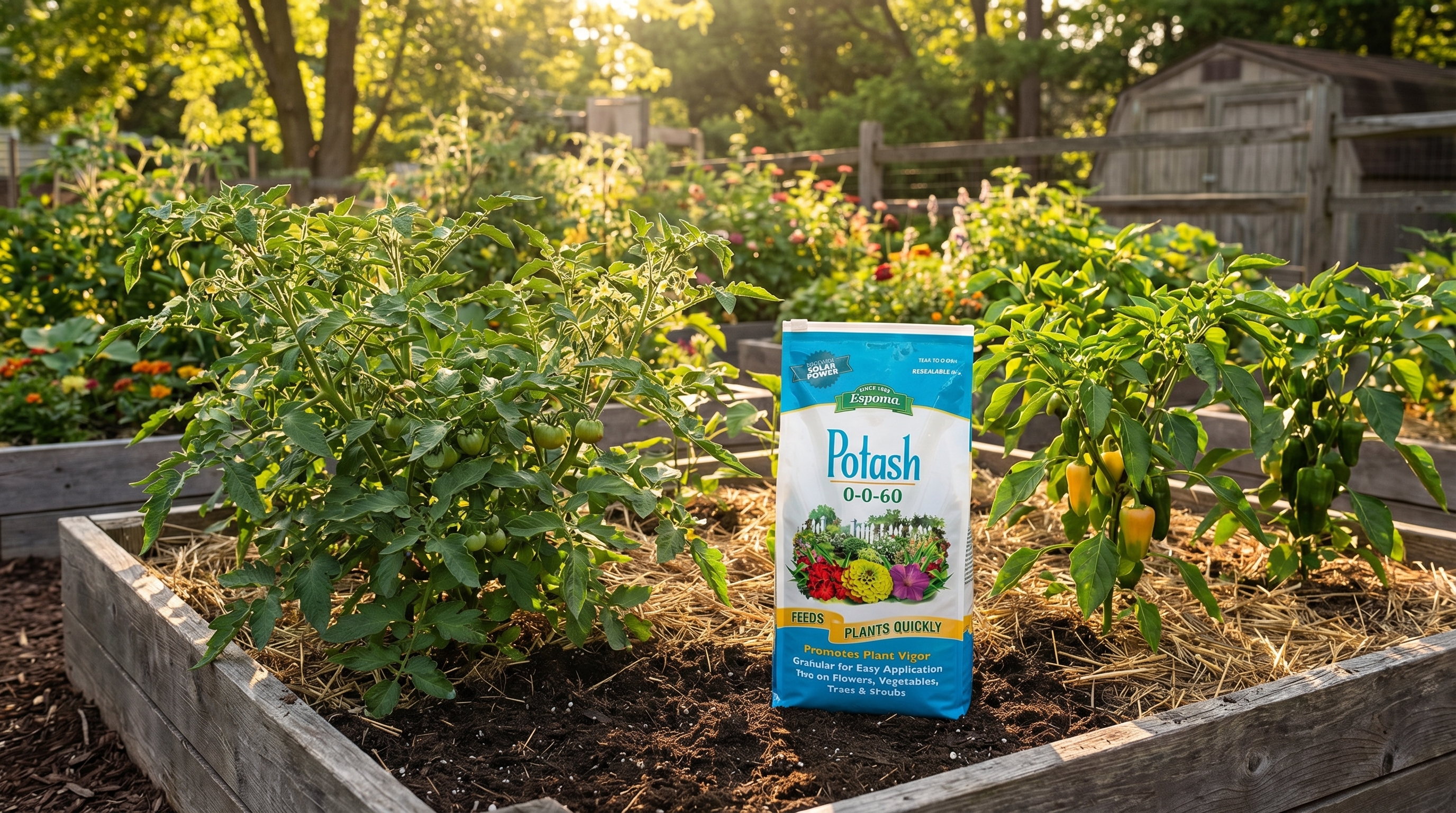
Walk into any garden center and the fertilizer section will be dominated by nitrogen products — lawn foods, vegetable boosters, all-purpose granules promising green growth in days. Phosphorus gets attention too, usually as a transplanting amendment or a bloom booster for flowers. But potassium — the K at the end of the N-P-K trio — is the quiet workhorse of plant nutrition that rarely gets the promotion it deserves. It doesn't produce visible bursts of green growth the way nitrogen does, and it doesn't cause dramatic blooming like phosphorus can. What it does is build the fundamental resilience of a plant: sturdy stems that don't lodge in wind, strong root systems that extract water efficiently, cell walls that resist disease pressure, and the metabolic machinery that lets perennials and turf survive an Ohio winter and come back strong in spring. When potassium is low, plants grow — they just grow poorly, look stressed, and struggle with everything from drought to disease. The fix is targeted: Espoma Potash 0-0-60 (6 lb) delivers concentrated potassium with zero nitrogen and zero phosphorus, so you can correct the deficiency precisely without throwing off the other nutrients your soil already has in balance. We carry it at Liberty Farm, Home & Garden in Galion, Ohio.
What Potassium Actually Does for Plants
Of the three primary macronutrients — nitrogen, phosphorus, and potassium — potassium is the one with the most diverse role in plant physiology. It doesn't become part of plant tissue the way nitrogen and phosphorus do. Instead, it functions as an enzyme activator, an osmotic regulator, and a transport driver, working throughout the plant at the cellular level to keep dozens of essential processes running correctly.
The most visible role of potassium is in water use efficiency. Potassium controls the opening and closing of stomata — the tiny pores in leaf surfaces through which plants exchange gas and lose water. When potassium levels are adequate, stomata respond correctly to water stress by closing to conserve moisture. When potassium is low, that regulatory mechanism breaks down: stomata stay open when they should close, plants lose water they can't afford to lose, and drought damage escalates. In a dry Ohio summer, this is a meaningful difference in plant performance.
Potassium also drives the transport of sugars from leaves to roots, fruits, and storage tissues. Photosynthesis happens in leaves; the sugars it produces need to move through the plant to wherever they're needed. Potassium is a key driver of that phloem loading and transport process. Inadequate potassium means sugars stall in leaves, roots and fruits are undersupplied, and overall plant productivity drops even when nitrogen and phosphorus are adequate.
For perennials, turf grass, and woody plants, potassium plays a direct role in winter hardiness. Potassium increases the concentration of solutes in plant cells, lowering the freezing point of cell fluids. Well-supplied plants can tolerate harder frosts without cellular damage; potassium-deficient plants suffer more freeze injury at the same temperatures. In Ohio's climate — where late-season frosts and hard winter freezes are routine — potassium status at the end of the growing season is a real factor in spring regrowth.
Finally, potassium strengthens cell walls and activates enzymes involved in disease resistance. Plants with adequate potassium are measurably more resistant to a range of fungal and bacterial pathogens. This is not a replacement for fungicide management, but it's a meaningful supporting factor — a plant with correct nutrition is simply harder for pathogens to colonize than a stressed, nutrient-deficient plant.
Recognizing Potassium Deficiency in Your Garden
Potassium deficiency produces a distinctive set of symptoms that differ from nitrogen or phosphorus deficiency. Understanding the signs helps you confirm that potassium is the actual limiting nutrient before applying a targeted amendment — because applying potassium to a soil that doesn't need it is wasteful and can interfere with calcium and magnesium availability.
The most characteristic symptom of potassium deficiency is marginal leaf scorch: the edges and tips of leaves turn yellow, then brown, while the inner leaf stays green longer. This scorching progresses inward as the deficiency worsens. Older, lower leaves typically show symptoms first because plants relocate (remobilize) potassium from older tissues to new growth when supply is limited. If you see leaf-margin browning on older growth while new leaves look fine, low potassium is a strong candidate.
Other common indicators include weak, thin stems that lodge easily (fall over in wind or under fruit weight), poor fruit sizing and quality on tomatoes and other fruiting vegetables, reduced winter survival in perennials and lawns, and an overall appearance of stress and susceptibility to disease that doesn't improve with nitrogen fertilization. Corn showing interveinal chlorosis on lower leaves, with firing (brown scorching) progressing up the leaf edge, is a textbook potassium deficiency picture familiar to any Ohio farmer.
Understanding the 0-0-60 Analysis
Every fertilizer product sold in the U.S. is required to display its NPK analysis on the label. The three numbers represent the percentage of nitrogen (N), phosphorus (P₂O₅ equivalent), and potassium (K₂O equivalent) by weight. For Espoma Potash 0-0-60, the analysis reads: 0% nitrogen, 0% phosphorus, 60% potassium.
That first two zeros are the critical feature. A 0-0-60 product is pure potassium with nothing else — it adds no nitrogen to stimulate excess vegetative growth, no phosphorus to throw off an already phosphorus-heavy soil. This matters enormously in practical application. Many Ohio garden soils — especially those that have received years of balanced fertilizer applications — already have adequate or even excess phosphorus. Adding a complete fertilizer (like a 10-10-10 or 19-19-19) just to get more potassium means over-applying phosphorus and nitrogen in the process. A targeted 0-0-60 product lets you correct the one deficiency that exists without creating new imbalances.
The 60% potassium concentration also means the product is highly efficient by weight. A small amount covers significant area. The 6-lb bag size of the Espoma product is well matched to typical home garden and small-scale farm applications where the goal is precise amendment of a defined area, not broadcast application across acres.
| N-P-K Digit | Nutrient | Value in This Product | What It Means |
|---|---|---|---|
| First number (N) | Nitrogen | 0% | No nitrogen — won't stimulate vegetative growth or burn |
| Second number (P) | Phosphorus (as P₂O₅) | 0% | No phosphorus — safe to use on high-P soils |
| Third number (K) | Potassium (as K₂O) | 60% | Highly concentrated — small quantities correct significant deficiencies |
Soil Testing: The Essential First Step
Potassium is the one macronutrient where applying without testing is most likely to be either ineffective or counterproductive. Here's why: potassium levels in Ohio soils vary enormously. Clay-heavy soils in central Ohio often have naturally high potassium from mineral weathering. Sandy or loamy soils that have been cultivated for years without amendment may be genuinely depleted. You genuinely cannot tell which situation you're in without a test — the visual appearance of a lawn or garden bed does not reveal soil potassium status unless deficiency symptoms are already advanced.
A basic soil test from OSU Extension or a private soil laboratory will report potassium in parts per million or pounds per acre, along with a recommendation for how much potassium to add (if any) to reach the optimal range for your crop or use. It will also report pH, which affects potassium availability — highly acidic soils may have adequate potassium by mass but limited availability because the pH range is wrong. If pH correction is also needed, that's typically addressed with lime before or alongside the potassium application.
The test process is straightforward: collect soil from several spots in the area you want to test (a zigzag pattern across the bed or lawn), mix the samples together, and submit a composite sample. For vegetable gardens, take samples from the top 6-8 inches. For lawns, take from the top 4 inches. OSU Extension offices in Ohio accept samples year-round and return results with specific amendment recommendations — this is the most useful output, because it tells you precisely how many pounds of potassium per 1,000 square feet (or per acre) to apply.
How to Apply Espoma Potash 0-0-60
The mechanics of applying a granular potassium amendment are straightforward. The key variables are rate, timing, and whether to work it into the soil or apply it as a surface application.
For garden beds and vegetable plots, the most effective method is to broadcast the granules evenly over the soil surface and work them into the top few inches with a rake or light tilling before planting. This puts the potassium in the root zone where it's most accessible early in the season. If applying to an established planting, broadcast lightly and water in immediately — this moves the potassium into the soil rather than leaving it concentrated on the surface where it can cause localized salt stress.
For lawns, broadcast with a spreader and water in within 24 hours. Fall is the best timing for lawn potassium applications — applying in September through October gives the turf potassium to build winter hardiness before dormancy. A spring application is also valid if the soil test shows deficiency and you want to support spring green-up, but the winter hardiness benefit is specific to fall timing.
For fruit trees, berry bushes, and perennials, broadcast evenly under the drip line and scratch lightly into the soil surface or mulch layer. Don't concentrate the granules against the trunk or crown. Water in after application.
| Application | Method | Timing | Notes |
|---|---|---|---|
| Vegetable garden bed | Broadcast and till into top 4-6 inches | Before planting, spring | Most effective when incorporated before planting |
| Established garden bed | Broadcast, then water in | Spring or after harvest | Water within 24 hours to move K into root zone |
| Lawn | Broadcast spreader, water in | Fall (primary) or spring | Fall timing maximizes winter hardiness benefit |
| Fruit trees & berry bushes | Broadcast under drip line | Early spring or fall | Keep away from trunk; water in after application |
| Perennial beds | Broadcast over bed, scratch in | Early spring or late fall | Light incorporation improves contact with root zone |
| Root crops (potatoes, carrots) | Broadcast and till before planting | At bed preparation | Potassium is critical for tuber and root sizing |
Which Crops Benefit Most from Potassium
While all plants need potassium, some crops are significantly more sensitive to potassium deficiency than others and show the most dramatic response to targeted supplementation. Understanding which plants in your garden are high potassium users helps you prioritize where a targeted amendment makes the most sense.
Tomatoes are among the heaviest potassium users in the vegetable garden. The process of developing and filling fruit requires sustained potassium transport throughout the plant, and low potassium in tomatoes shows up as blossom end rot (actually a calcium issue aggravated by poor potassium/calcium balance), poor fruit size, and thin skin that cracks or splits easily. Tomatoes grown in the same spot year after year in Ohio gardens will almost always deplete soil potassium over time unless it's replaced.
Potatoes and other root and tuber crops have extremely high potassium requirements — the crop is essentially a storage organ that is concentrating sugars and starch, processes that depend directly on potassium-driven phloem transport. A potassium shortfall in potatoes leads to small, poorly developed tubers with reduced storability. Irish potato growers have historically applied potash more liberally than almost any other amendment, and the agronomic logic behind that practice is sound.
Corn is a classic potassium-demanding field crop, but home gardeners with a few rows of sweet corn in an Ohio garden see the same dynamic on a small scale. Corn grown on depleted ground shows characteristic K deficiency: marginal yellowing and firing on lower leaves, poor stalk development, and ears that don't fill completely. A targeted potassium application based on a soil test corrects this quickly.
Turf grass — particularly cool-season lawns (fescue, bluegrass, ryegrass) common in central Ohio — relies heavily on potassium for fall conditioning and winter survival. The two times turf uses potassium most are immediately after summer stress (recovery from heat and drought) and in the fall buildup toward dormancy. A fall potassium application on a lawn that has been tested and found deficient is one of the highest-impact single amendments you can make for long-term turf health.
Potassium in Combination with Other Nutrients
Because Espoma Potash 0-0-60 contributes only potassium, it's often used in combination with other amendments to build a complete fertility program tailored to what a soil test reveals. Understanding how to pair it correctly prevents over-application and nutrient imbalances.
If a soil test shows low potassium alongside low nitrogen, applying potassium separately and nitrogen separately (or through a balanced fertilizer that provides the right ratio of each) gives you more control than trying to find a single product that hits the exact ratio you need. Granular products like Hi-Yield Ammonium Sulfate 21-0-0 (3.25 lb) provide nitrogen with no phosphorus or potassium, letting you dial in N without affecting your K application rate.
If all three nutrients are deficient, a balanced fertilizer like 19-19-19 Fertilizer (50 lb) addresses N, P, and K in equal proportions across a large area — the right choice when you need a broad foundational application on depleted ground before adding targeted single-nutrient products to fine-tune. But for soils with adequate nitrogen and phosphorus and specifically low potassium, the 0-0-60 Espoma Potash is the right tool because it adds K without over-supplying the other two.
Soil pH also affects potassium availability. Potassium is most available in the pH range of 6.0 to 7.0 — slightly acidic to neutral soil. If your pH is below 6.0, acidic conditions can suppress potassium uptake even when the soil potassium level is adequate by mass. In that case, addressing pH with Granular Lime (40 lb) or Hi-Yield Agricultural Lime (6 lb) alongside the potassium application produces better results than potassium alone.
Espoma and the Organic Amendment Philosophy
Espoma is one of the most established organic and natural fertilizer brands in the U.S., with a product line designed around slow-release and naturally sourced amendments. The Potash 0-0-60 fits within that philosophy as a mined mineral amendment derived from naturally occurring potassium ore. It is not a synthetic product in the way that water-soluble fertilizer salts are — it's a granular mineral that releases potassium as it dissolves into soil moisture and interacts with soil chemistry.
For gardeners following organic practices, this distinction matters. Espoma Potash 0-0-60 is compatible with organic soil management and can be used alongside other organic amendments like compost, blood meal, and bone meal without any contradiction in approach. It contributes a targeted mineral correction within an otherwise biology-driven fertility system.
The 6 lb bag size is appropriate for home gardeners managing garden beds, containers, a small orchard, or a lawn measured in hundreds rather than thousands of square feet. At the application rates appropriate for correcting a documented soil deficiency, a 6 lb bag covers meaningful area without committing to a large bulk purchase of a targeted amendment that doesn't need to be applied every season.
Related Products at Liberty Farm, Home & Garden
For gardeners building a complete soil fertility program or addressing multiple nutrient deficiencies identified in a soil test, these products are available at Liberty Farm, Home & Garden in Galion, Ohio:
- 19-19-19 Fertilizer (50 lb) — Balanced complete fertilizer for broad N-P-K deficiency across larger areas. Pair with Espoma Potash if the soil test shows a higher K need than the 19-19-19 ratio delivers.
- Granular Lime (40 lb) — Raises soil pH in acidic conditions. Correcting pH to 6.0–6.5 improves potassium availability and overall nutrient uptake across the board.
- Hi-Yield Ammonium Sulfate 21-0-0 (3.25 lb) — Pure nitrogen source when only N is deficient. Pair with Espoma Potash when your soil needs both N and K but not phosphorus.
- Hi-Yield Agricultural Lime (6 lb) — Smaller-format lime for targeted pH adjustment in garden beds. Good companion to potassium amendments on acidic soils.
Frequently Asked Questions
Keep Reading
Plant Cover Crops Now: An Ohio Home Garden Guide
Plant fall cover crops in an Ohio vegetable garden with practical guidance on timing, species, seeding, winter care, and spring termination.
Save This Summer’s Garden: A Practical Ohio Seed-Saving Guide
Save tomato, bean, pea, lettuce, marigold, zinnia, and other garden seeds with this practical late-summer guide for Galion and north-central Ohio.