
Ear Corn for Wildlife: Why Whole Cobs Beat Shelled Corn Every Time
A complete guide to feeding ear corn to deer, squirrels, and backyard chickens — and why the cob itself matters
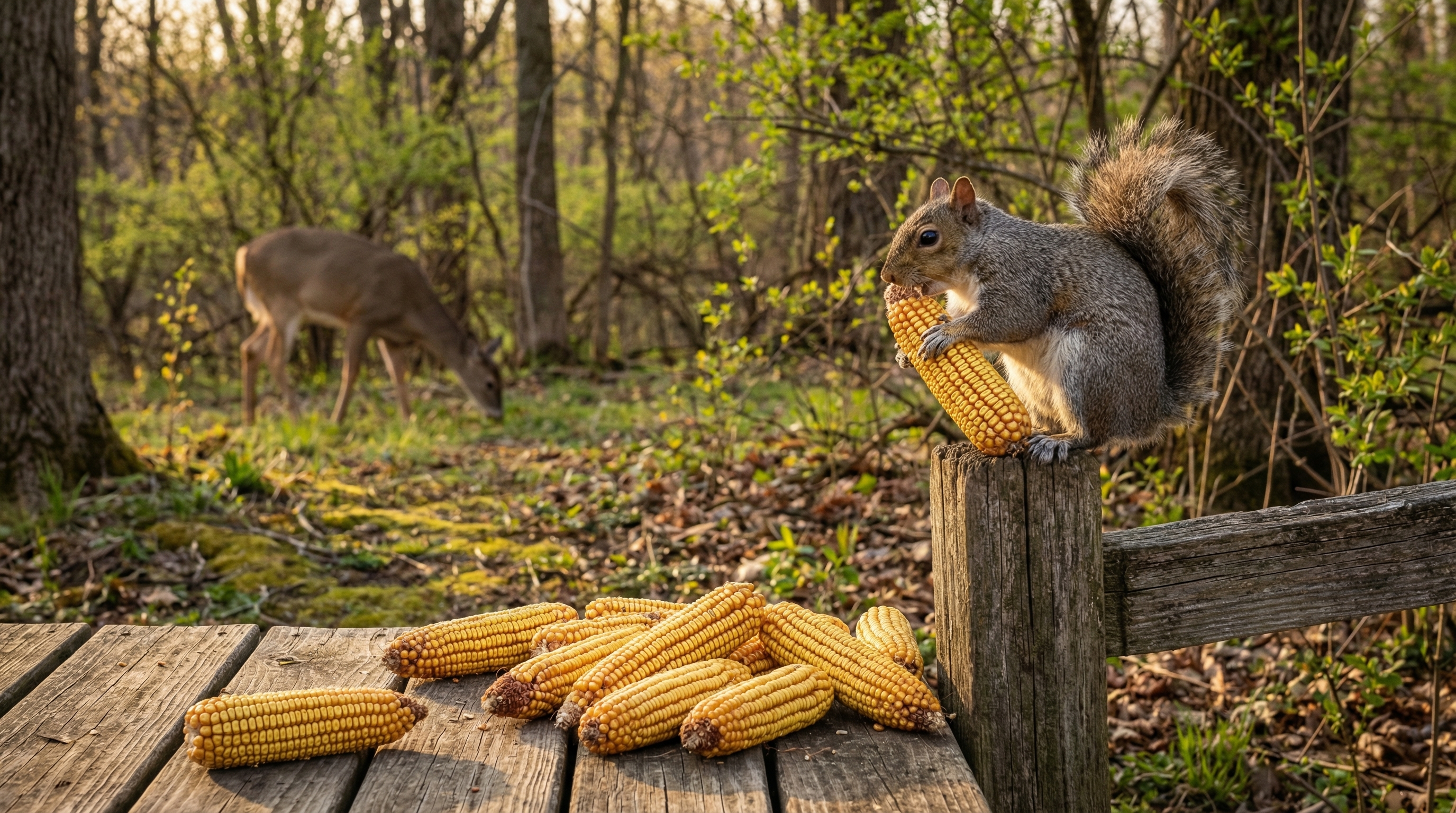
If you've ever watched a squirrel make short work of an ear of corn — holding the cob in both paws, rotating it methodically while stripping kernel after kernel — you understand the appeal. Ear corn isn't just feed. It's enrichment. It gives wildlife and backyard chickens something to work at, keeps them occupied longer than a pile of shelled grain, and wastes dramatically less seed to wind and weather. Ear Corn (20 lb), available at Liberty Farm, Home & Garden, is whole corn left on the cob — the way every animal that loves corn actually wants to eat it. It's a simple product with a clear logic behind it, and once you try it at your feeding stations you'll understand why wildlife enthusiasts reach for it over shelled or cracked alternatives.
What Is Ear Corn, Exactly?
Ear corn is corn harvested and dried with the kernels still attached to the cob — as opposed to shelled corn (kernels removed) or cracked corn (kernels removed and mechanically broken into smaller pieces). The kernels on a dried ear corn cob are fully intact, nutritionally dense, and firmly attached enough that an animal has to work to remove them.
The drying process is critical. Ear corn sold for wildlife and livestock feeding has been field-dried and then further dried post-harvest to reduce moisture content to a level that prevents mold and extends shelf life at outdoor feeding stations. Fresh sweet corn from a garden wouldn't hold up at a deer station for more than a day or two in warm weather. Properly dried ear corn, by contrast, can remain at a feeding site for days without significant quality loss — which is part of what makes it practical for wildlife use.
The kernels on a dried ear are starchy field corn, not sweet corn. Field corn has a higher starch content, lower moisture, and a harder kernel — qualities that make it ideal for high-energy wildlife feeding rather than human consumption.
Why Animals Prefer Ear Corn Over Shelled Grain
The instinctive preference most wildlife and poultry have for ear corn over shelled grain is backed by behavioral ecology. Animals that have evolved to forage for food are wired to engage with food sources that require some effort. That engagement isn't inefficiency — it's enrichment that keeps foraging behavior active and stimulates natural cognitive and physical patterns.
Squirrels are the most obvious example. A squirrel at a corn cob station will grip the cob, rotate it, gnaw kernels free one row at a time, and occasionally carry an entire cob to a caching location. That behavior sequence simply doesn't occur with shelled corn poured into a pan. The cob is the trigger for the full foraging behavioral chain. Squirrels at ear corn stations are more active, stay longer, and provide far more interesting observation than squirrels at a pile of shelled grain.
Deer interact with ear corn differently but with the same underlying preference for working food. At a deer station, whole cobs prompt deer to nose and manipulate the corn, keeping them at the station longer per visit. For hunters and wildlife photographers, extended station visits are a meaningful practical benefit.
Backyard chickens are powerful advocates for ear corn. Chickens are instinctively drawn to pecking at fixed food targets — it activates their foraging behavior in a way that loose grain in a feeder does not. An ear of corn placed in a chicken run will keep a small flock occupied for a significant portion of the day. It's a welfare improvement as well as a feed delivery method.
Ear Corn vs. Shelled Corn vs. Cracked Corn
| Type | Best For | Key Advantages | Limitations |
|---|---|---|---|
| Ear Corn | Deer, squirrels, chickens, wildlife stations | Enrichment, slow feeding, less waste, natural behavior stimulation | Bulkier to store; not suitable for tube feeders |
| Shelled Corn | Large volume feeding, mixed feed blends, ground feeding | Easy to measure, works in feeders, compact storage | High waste from wind and scatter; minimal enrichment |
| Cracked Corn | Wild birds, quail, doves, ground-feeding birds | Smaller pieces accessible to smaller birds; mixes well with seed | Not suitable for deer stations or squirrel enrichment |
Each form of corn has a legitimate role in a wildlife feeding program. The practical reality is that ear corn, shelled corn, and cracked corn aren't competing products — they're different tools for different feeding contexts. Many backyard wildlife enthusiasts use all three: ear corn at a dedicated squirrel or deer station, shelled corn in a gravity deer feeder, and cracked corn blended into ground-feeding bird mixes.
Setting Up an Ear Corn Station for Squirrels
A dedicated squirrel corn station is one of the simplest and most rewarding backyard wildlife setups. The classic approach is a corn cob spike mounted at a convenient height — a simple wooden post with a screw or spike driven through the center holds a cob upright and gives squirrels a stable platform to work from. These are widely available as pre-made squirrel feeders, or you can build one in ten minutes with a scrap board and a large screw.
Placement matters more than equipment. Squirrels are tree-dependent animals — they feel most comfortable when a feeding station is close to a tree they can retreat to if startled. Positioning a corn cob feeder within jumping distance of a mature tree will dramatically increase visitation rates compared to placing it in open lawn. A height of about four to six feet off the ground keeps the feeder accessible to squirrels while reducing ground-level competition from raccoons.
Cycling fresh cobs regularly keeps the station active. Once a cob has been stripped down to the bare cob, replace it. Some wildlife enthusiasts leave old bare cobs as chewing enrichment — squirrels will work on an empty cob for the texture experience — but a fresh cob will draw immediate renewed interest.
Feeding Ear Corn to Deer
Deer are high-volume consumers that benefit from dedicated supplemental feeding setups rather than the small-scale stations that work well for squirrels. Ear corn at a deer station is typically deployed in bulk — either as a pile placed on the ground at a regular site, or as whole cobs placed in a trough-style feeder that gives deer a stable surface to feed from.
The timing of supplemental deer feeding matters. Late summer through early winter is the optimal window for ear corn feeding as a deer attractant and supplement. During this period, deer are building body condition going into rut and winter, and high-starch feed has a clear role in supporting that. In early spring, natural browse and emerging vegetation typically provide abundant forage, and supplemental feeding is less critical.
Ohio landowners interested in supplemental deer feeding should be aware of local regulations around baiting and feeding, which can vary by county and hunting season. Check current Ohio Division of Wildlife guidelines before establishing a feeding program on property you intend to hunt.
| Season | Deer Feeding Benefit | Notes |
|---|---|---|
| Late Summer (Aug–Sep) | Pre-rut condition building | Deer transitioning from summer forage; high energy demand |
| Fall (Oct–Nov) | Rut-period activity and attraction | Peak activity; corn draws and holds deer at stations |
| Winter (Dec–Feb) | Cold-weather energy supplement | High-starch corn supports thermoregulation in cold snaps |
| Early Spring (Mar–Apr) | Post-winter recovery | Natural browse often sufficient; supplement as needed |
Using Ear Corn for Backyard Chickens
Backyard chicken keepers have used ear corn as an enrichment tool and seasonal supplement for as long as there have been backyard chickens. The reasons are straightforward: chickens are driven to peck, and an ear of corn gives them an appropriate, engaging target for that behavior.
The most common approach is to hang an ear of corn in the chicken run at a height that requires the chickens to stretch and reach. This keeps the feeding dynamic interesting and prevents the dominant birds from monopolizing the cob while lower-ranking hens watch from a distance. A simple piece of twine threaded through one end of the cob and tied to a feeder hook or run wire is all the equipment needed.
Corn is a warming feed for chickens — the metabolic process of digesting starchy corn generates body heat, which is why experienced chicken keepers often give corn as an evening supplement during cold weather. The extra metabolic activity helps birds maintain core temperature overnight. This is more a practical folk-wisdom tradition than rigorously documented science, but it aligns with what we know about thermogenesis and feed digestion, and chicken keepers in cold climates have relied on it for generations.
The 20 lb Bag: Right-Sizing for Casual Wildlife Feeding
Ear corn is available in much larger quantities — 50 lb bags, 100 lb bulk sacks — for serious deer feeders managing large properties with multiple stations. The 20 lb bag occupies a different niche: it's the right size for the backyard wildlife enthusiast who wants to run one or two feeding stations without committing to bulk quantities that require significant storage space.
A 20 lb bag of ear corn contains roughly 15–20 full-sized cobs depending on the size of the corn variety. At a busy squirrel station, that might represent two to three weeks of feeding. At a casual deer station where you're refreshing every few days, it's a week to ten days of supply. The manageable size also makes it easier to keep stock fresh — ear corn stored for many months can lose quality, and buying in a size you'll cycle through regularly is good practice.
Related Products at Liberty Farm, Home & Garden
If you're building out a wildlife feeding program, these products complement ear corn well:
- Heath Bell Seed Cake Feeder — A seed cake feeder for attracting a wider range of songbirds alongside your wildlife stations.
- C&S High Energy Large Suet Cake (3.5 lb) — High-fat suet for woodpeckers, chickadees, and nuthatches — a great complement to a ground-feeding corn station.
- More Birds Silver Plastic Tube Bird Feeder (3.32 lb Capacity) — A clean, reliable tube feeder for sunflower and mixed seed if you're expanding beyond wildlife to backyard birds.
Frequently Asked Questions
Keep Reading
Keep the Feeder Up: An Ohio Guide to Fall Hummingbird Migration
Learn when to take down hummingbird feeders in Ohio, how to mix safe nectar, and how often to clean during late-summer migration near Galion.
Planting Fall Deer Food Plots in Ohio: An August Field Plan
Plan an Ohio fall deer food plot with soil testing, smart seedbed prep, mix selection, and local tips from Liberty Farm, Home & Garden in Galion.