
Why Your Rabbit's Salt Lick Keeps Ending Up in the Bedding — and the Simple Wire Fix That Solves It
Salt spools are one of the most common small animal accessories in any rabbitry or guinea pig setup — and one of the most commonly misused. The Little Giant Salt Spool Hanger clips to wire cages in seconds, keeps the spool elevated and clean, and costs almost nothing. Here is everything you need to know.
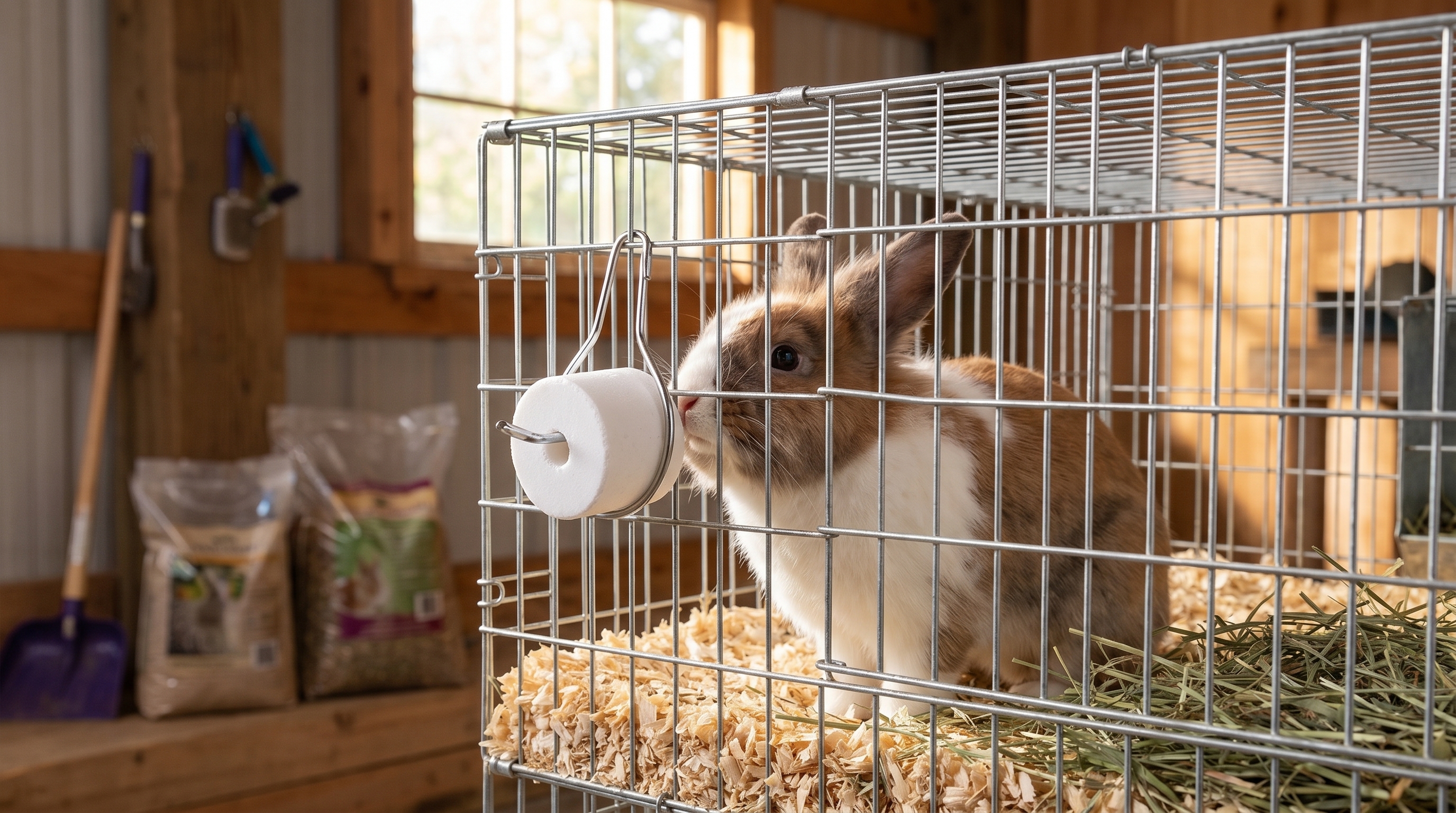
Walk into any pet store and you will find salt spools for rabbits and guinea pigs within the first few feet of the small animal section. They are inexpensive, universally stocked, and almost universally misused. Most small animal owners buy a salt spool, drop it into the cage, and watch it slowly disappear into the bedding over the next week. It gets damp, it gets soiled, and eventually the animal stops using it entirely. The owner assumes the animal does not need salt. The animal is actually just refusing to lick a block that has been sitting in soiled wood shavings. The fix is so simple it almost seems too obvious: hang the spool off the cage wire instead of setting it on the floor. The Little Giant Salt Spool Hanger from Liberty Farm, Home & Garden is a wire clip designed for exactly this purpose. It attaches to the side of any standard wire cage, holds a salt spool at the right height for the animal to access comfortably, and keeps the spool clean and off the bedding where it belongs. At well under two dollars, it is one of the most cost-effective small animal accessories in the store — and one of the most overlooked. This guide covers why small animals need salt access, what happens when a spool sits in bedding, how the hanger works, and how to set up a complete mineral and enrichment station for rabbits, guinea pigs, chinchillas, and other small wire-cage pets.
Why Small Animals Need Consistent Salt and Mineral Access
Salt — sodium chloride — is an essential dietary mineral for virtually every mammal, including rabbits, guinea pigs, chinchillas, and hamsters. Sodium plays a critical role in fluid balance, nerve transmission, and muscle function. Chloride is involved in digestive acid production and cellular transport. Neither sodium nor chloride is stored by the body in meaningful quantities the way calcium or iron can be, which means animals need regular, ongoing access to dietary sodium.
For small animals fed a well-formulated commercial pellet diet, most of their daily sodium requirement is met by the pellet formula itself — manufacturers typically include sodium chloride in their feed at levels calibrated for the species. However, sodium needs vary by individual animal, by ambient temperature (hot weather increases sodium loss through respiration and activity), by reproductive status (pregnant and lactating females have higher mineral needs), and by life stage (growing young animals have different needs than adults).
This is where a free-choice salt spool becomes valuable: it allows the animal to self-regulate its sodium intake beyond what the pellet provides. A rabbit or guinea pig that is running hot, nursing a litter, or simply has slightly higher individual sodium needs will seek out and lick the spool more actively than an animal whose pellet diet is meeting all its needs. The spool is not a replacement for a balanced pellet — it is a supplemental mineral access point that gives the animal agency over its own intake.
Beyond plain sodium chloride, many commercial salt spools also include trace minerals — often iodine, zinc, iron, and manganese — that support thyroid function, immune health, and coat quality. The specific formula varies by product, and owners should look at the ingredient list of whatever spool they are using to understand what they are offering. The hanger itself is mineral-agnostic: it works with standard-diameter salt spools regardless of formulation.
The Problem: What Happens When a Salt Spool Sits in Cage Bedding
A salt spool resting directly on the cage floor or in the bedding layer faces a set of conditions that degrade it quickly and make it unappealing to the animal:
Moisture absorption. Salt is hygroscopic — it absorbs moisture from the air and from surrounding material. Bedding, whether wood shavings, paper pulp, or hay, holds moisture from urine, water spills, and ambient humidity. A spool resting in or near bedding absorbs this moisture continuously, softening the outer surface and creating a damp, sticky texture that many animals find unpleasant. The spool also tends to lose its structural integrity faster when it is consistently damp, crumbling into the bedding rather than being gradually worn away by licking.
Contamination. Rabbits and guinea pigs produce a significant volume of fecal pellets each day — a healthy adult rabbit may produce 200 to 300 droppings daily. These pellets scatter throughout the cage floor. A salt spool sitting on the cage floor will inevitably be surrounded by, and often partially covered by, fecal matter and soiled bedding within 24 hours of placement. Animals will typically not lick a spool that has been in contact with waste, which effectively removes it from use entirely while giving the owner the false impression that the animal simply does not want salt.
Burial. As bedding is disturbed by the animal moving around, burrowing, and rearranging material, a loose spool on the cage floor often becomes partially or fully buried. Even a partially buried spool becomes inaccessible — the animal cannot get a comfortable licking angle, and the reduced surface exposure limits contact.
All three of these problems are solved completely by elevating the spool off the floor. A spool hung 4 to 6 inches above the bedding line stays dry, stays uncontaminated, and stays accessible. The animal can approach it at any time and lick it at the angle and duration of its choosing. This is the entire premise of the Little Giant Salt Spool Hanger.
What the Little Giant Salt Spool Hanger Does
The Little Giant Salt Spool Hanger is a wire accessory made by Miller Manufacturing — a company that has been producing livestock and small animal supply hardware for decades. The hanger is simple: a formed wire frame that clips onto the mesh wire of a standard cage and holds a salt spool suspended at cage-side height.
The clip mechanism is designed for wire cage construction — the type of cage used for rabbits, guinea pigs, chinchillas, and similar small animals where the walls are made from welded wire mesh. The hanger wraps around the cage wire and holds securely without requiring tools, screws, or modifications to the cage. Installation is a matter of seconds: position the hanger at the desired height on the cage wall, press the clip onto the wire, and thread the salt spool onto the hanging hook.
The design keeps the spool in contact with the cage wall side (rather than hanging freely in the middle of the cage), which means the animal can approach it from the inside and lick it against a stable surface. This mimics the natural behavior of animals seeking out mineral deposits in the wild — pressing against a surface to access it — and most animals adapt to a cage-side spool within hours of it being placed.
The hanger is compatible with standard salt spools of the size carried in most farm and pet supply stores. If you are unsure whether your preferred spool brand will fit, the easiest check is to look at the center hole of the spool — standard wire hangers like this one are designed for the standard-diameter hole in most commercially produced salt spools.
How to Install the Salt Spool Hanger on a Wire Cage
Installation is straightforward, but a few placement decisions affect how well your animal will actually use the hanger:
Height placement. The spool should be positioned at a height where the animal can reach it comfortably without straining upward or crouching awkwardly downward. For an average adult rabbit, this is typically 4 to 7 inches above the cage floor (measured to the center of the spool). For guinea pigs, which are lower to the ground, position it 3 to 5 inches above the floor. The goal is that the animal can stand normally and reach the spool with a natural head position. If the spool is too high, the animal will not use it; too low and it risks contact with bedding.
Location within the cage. Avoid placing the hanger directly above or adjacent to the water bottle or food dish. Animals spend significant time at feeding and watering stations, and a salt spool positioned too close can get splashed with water from the bottle spout or contaminated by food debris. A wall section that is open and clear of primary accessories works best. Also avoid corners where bedding tends to pile up, as the bedding accumulation can eventually reach a low-hanging spool.
Away from nesting areas. Rabbits in particular often establish preferred resting and nesting areas within their cage. A salt spool placed directly over a resting spot can drip mineral residue onto bedding (especially in high-humidity conditions) and may get soiled by the animal bedding around it. Position the hanger on a wall away from established resting zones.
Threading the spool. Most commercial salt spools come with a center hole sized for hanging. Thread the spool onto the hanger's central wire prong before clipping the hanger to the cage. Some owners find it easier to clip the hanger first, then press the spool onto the prong from the inside of the cage — either method works.
Which Animals Benefit from a Salt Spool Hanger
The Little Giant Salt Spool Hanger is designed for use in wire cages, which covers most of the small animals commonly kept in a hutch or cage environment. The animals that benefit most:
Rabbits. Domestic rabbits are the primary user of salt spools in a small animal context. They are housed in wire hutches, require consistent access to fresh water and supplemental minerals, and are active lickers — they will seek out and use a properly positioned salt spool regularly. Both indoor and outdoor hutch rabbits benefit from free-choice salt access, and the hanger keeps the spool in usable condition regardless of bedding type (wood shavings, paper pulp, hay).
Guinea pigs. Guinea pigs are social, ground-dwelling animals that spend most of their time moving along the cage floor and walls. They readily use wall-mounted accessories including salt spools, water bottles, and hay racks. A spool positioned at the right height for a guinea pig (lower than for a rabbit) will typically be investigated and used within the first day of introduction.
Chinchillas. Chinchillas are native to high-altitude environments in South America and have somewhat specific dietary needs including careful mineral balance. A plain sodium chloride spool (without added iron, which chinchillas are sensitive to) can be offered free-choice. The wire cage hanger positions the spool accessibly on the cage side and prevents the floor contamination issue that is especially pronounced in chinchilla cages, where the fine dust bath material can quickly coat anything on the cage floor.
Hamsters and gerbils. Hamsters and gerbils in wire cages can also use a wall-mounted spool hanger. These animals are smaller than rabbits or guinea pigs, so position the spool very low on the cage wall — 2 to 3 inches above the bedding — to ensure they can reach it comfortably. Hamsters are somewhat less likely to actively seek out a salt spool than rabbits or guinea pigs, but free-choice access allows those that want it to use it.
Salt Spools vs. Mineral Blocks: What Is the Difference?
In the small animal section of a farm supply store, you will typically find two types of supplemental mineral products: plain salt spools (white or off-white, sodium chloride with minimal additions) and mineral blocks (often red, orange, or brown, containing sodium chloride plus a blend of trace minerals). The Little Giant Salt Spool Hanger works with both, but understanding the difference helps you choose the right product for your animal's needs.
Plain salt spools are primarily sodium chloride — typically 96 to 99% NaCl by weight — with minimal additives. They provide sodium and chloride supplementation without significant mineral loading. These are appropriate for animals on a well-formulated pellet diet that already includes a complete mineral profile, where the owner simply wants to offer free-choice sodium access. Plain spools are the safest choice when there is any uncertainty about the animal's overall mineral intake from other sources.
Mineral blocks include trace minerals in addition to sodium chloride — commonly iodine, zinc, manganese, iron, and copper. These are formulated for animals that may have limited mineral intake from other sources, such as rabbits on a primarily hay-based diet with minimal pellet supplementation. They are also useful for animals with specific needs — iodine for thyroid support, zinc for coat and immune health. However, mineral blocks should be selected carefully by species: as noted above, some trace minerals (iron, copper) that are safe in cattle formulations can be problematic at elevated intake levels for small animals. Use products specifically labeled for your species.
Both types work with the same standard-diameter hole and will fit on the Little Giant Salt Spool Hanger. The hanger itself is just hardware — what matters is the product you thread onto it.
How Often Should You Replace a Salt Spool?
Replacement timing for a salt spool depends on the number and size of animals using it, their individual mineral-seeking behavior, ambient humidity, and whether the spool stays clean and dry. There is no fixed replacement schedule — the spool tells you when it needs to go:
Replace when the spool is small enough to fall off the hanger. As the spool is consumed, its diameter decreases. At some point, the center hole becomes disproportionately large relative to the remaining spool material, and the spool can work its way off the hanger prong and fall into the bedding. Keep an eye on spool size and replace before this happens — a spool fragment in the bedding creates the same floor contamination problem you were trying to avoid.
Replace when the surface is visibly soiled or discolored. Even with a properly mounted hanger, a spool can develop a discolored outer layer from mineral oxidation, cage humidity, or occasional splashing from nearby water bottles. If the outer surface looks dark, greasy, or otherwise different from a fresh spool, replace it. Salt spools are inexpensive enough that there is no benefit to pushing a questionable one.
Replace after any illness in the cage. If an animal in the cage has been sick — respiratory illness, GI issues, or any condition involving discharge — replace the salt spool as part of the post-illness cage cleaning process. Bacterial and viral contamination can persist on mineral surfaces.
For a single adult rabbit using the spool actively, replacement frequency is typically every 4 to 8 weeks under normal conditions. Active mineral seekers or animals in high-humidity environments will go through spools faster; animals that rarely use the spool will use it slower. The hanger itself is permanent cage hardware — only the spool requires periodic replacement.
Setting Up a Complete Small Animal Accessory Station
The salt spool hanger is one piece of a well-organized small animal cage setup. The principles that make the hanger effective — keeping accessories elevated, accessible, and clean — apply to all small animal cage accessories:
A water bottle mounted on the cage wire (rather than a bowl on the cage floor) stays clean, prevents bedding contamination of the drinking water, and gives you a clear daily visual check on water consumption. A hay rack or hay feeder mounted at cage height prevents the waste and contamination that happens when loose hay is thrown onto the cage floor and gets soiled. A food dish positioned off the primary traffic paths in the cage reduces fecal contamination of the pellet supply. Each of these accessories follows the same logic as the salt spool hanger: elevate, stabilize, and keep the consumable clean.
Liberty Farm, Home & Garden carries a range of small animal supplies beyond the salt spool hanger itself. Whether you are setting up a new rabbit hutch or improving an existing cage setup for guinea pigs or chinchillas, the team can help you choose the right accessories for your specific cage type and animal. Stop in at the Galion store or visit libertyfhg.com to browse the current small animal inventory.
| Product | Little Giant Salt Spool Hanger |
|---|---|
| Brand | Miller Manufacturing (Little Giant) |
| Compatible Cage Types | Standard wire mesh cages and hutches for rabbits, guinea pigs, chinchillas, hamsters |
| Compatible Spools | Standard small animal salt spools with center hole (plain NaCl or mineral blend) |
| Installation | No tools required — clips directly to cage wire |
| Primary Benefit | Keeps spool off bedding; prevents moisture absorption and fecal contamination |
| Recommended Height (Rabbit) | 4 to 7 inches above cage floor (center of spool) |
| Recommended Height (Guinea Pig) | 3 to 5 inches above cage floor (center of spool) |
| Spool Replacement Frequency | Every 4 to 8 weeks for a single adult rabbit; sooner if soiled or visibly degraded |
| Available At | Liberty Farm, Home & Garden — Galion, Ohio |
The Little Giant Salt Spool Hanger is available at Liberty Farm, Home & Garden in Galion, Ohio. It is a minor purchase that makes a meaningful difference in whether your rabbit or guinea pig actually uses the salt spool you bought for it — which is the point of buying one in the first place. Pick one up the next time you stop in, or order online at libertyfhg.com.
Frequently Asked Questions
Keep Reading
Keeping Rabbits Cool in Ohio: A Practical Summer Heat-Safety Guide
Help rabbits handle Ohio summer heat with practical shade, ventilation, water, cooling, travel, outage, and emergency-readiness steps for responsible owners.
The Feeder Built for a Real Rabbitry: A Complete Guide to Galvanized Rabbit Feeders and Getting Pellets Right
Why the feeder you use is just as important as the feed you put in it — and how the Pet Lodge galvanized sifter feeder solves the problems that plastic feeders and dishes can't