
The Food Plot Mix That Works Where Others Fail: Antler King Game Changer Clover
A complete guide to planting a perennial clover food plot in tough spots — shaded edges, acidic soil, and no-till terrain — with Antler King Game Changer
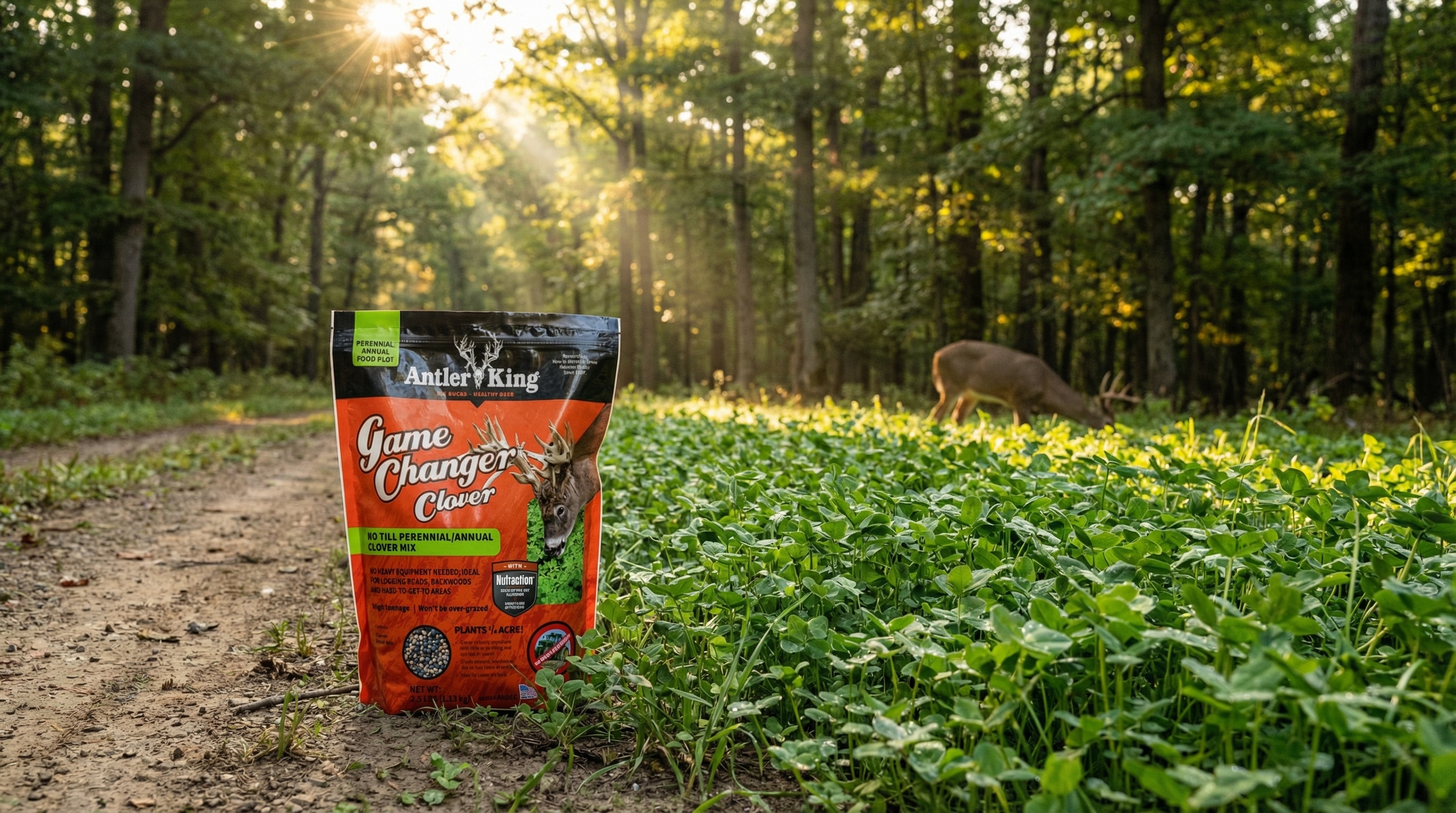
Every serious deer hunter eventually hits the same wall: the best stand location is in the timber, not the open field. The funnel is tucked along a logging road. The staging area is in a shaded clearing. The natural travel corridor runs through heavy canopy where sunlight barely reaches the ground. Standard food plot mixes — the kind designed for tractor-tilled, lime-corrected, open-field conditions — simply don't perform in those spots. The soil is too acidic. The shade is too heavy. There's no room to run equipment. That's the exact problem Antler King Game Changer Clover (2.5 lb) was designed to solve. It's a perennial food plot blend built for the difficult, low-resource spots that most mixes can't handle — and once it's established, it keeps producing for three to four years with minimal maintenance. We carry it at Liberty Farm, Home & Garden in Galion, Ohio.
Why Most Food Plot Mixes Struggle in the Woods
The food plot industry has largely been built around agricultural-style planting: tilled ground, lime-adjusted pH, open sky, and a real planter. That works great in a bean field or a power-line cut. It doesn't work well in the kinds of spots where deer actually live and move during daylight hours.
Whitetail deer are edge animals. They bed in timber, travel along cover corridors, and often feed at the transition zones between woods and open ground — not out in the middle of a wide-open field. The most attractive food plot for mature bucks is frequently the one tucked into the timber 200 yards from the open field, not the open field itself. But that's also the hardest spot to establish a conventional food plot.
The obstacles stack up quickly:
- Shade: Most clovers and brassicas need significant sunlight to germinate and grow vigorously. Logging roads and wooded openings may get four to six hours of direct sun — often less.
- Soil pH: Forest soils tend to be acidic. Dropping leaves, needle duff, and limited agricultural history push pH down into the 4.5–5.5 range. Most food plot mixes want a pH of 6.0 or above and fail to establish in anything below 5.5.
- No-till conditions: You can't get a disk or a drill into a logging road or a narrow woodland clearing without serious equipment. Hand-seeding or light disturbance with an ATV is often the only realistic option.
- Competition from existing vegetation: Wooded clearings have established grasses and forbs that compete aggressively with food plot seed, particularly when the food plot can't establish a dense stand quickly.
Antler King Game Changer Clover was formulated specifically to address each of these. It's not a tweak on a conventional food plot mix — it's a purpose-built solution for exactly these challenging conditions.
What's in the Game Changer Blend?
Game Changer Clover is a blend of four specially selected clover varieties plus brassica. The specific combination matters because different clovers bring different strengths — some establish faster, some are more shade-tolerant, some anchor the stand through drought or cold snaps. The multi-variety approach gives the plot resilience that a single-variety stand can't match.
The brassica component adds cool-season attraction, which clover alone doesn't provide as effectively. Brassicas become highly palatable to deer after the first frost, when cold converts starches to sugars. This means Game Changer plots don't just produce spring and fall — the brassica element delivers a concentrated draw during the early archery and firearms seasons when it matters most.
| Feature | Details |
|---|---|
| Blend Composition | Four clover varieties + brassica |
| Plot Type | Perennial (lasts 3–4 years once established) |
| Minimum Soil pH | 4.8 (tolerates acidic forest soils) |
| Tillage Required | No — designed for no-till planting |
| Shade Tolerance | High — suitable for logging roads and wooded openings |
| Bag Size | 2.5 lb |
| Coverage | Quarter acre (approximately 10,000 sq ft) |
| Best Planting Locations | Logging roads, wooded field edges, shaded openings, ATV trails |
| Best Planting Season | Spring or late summer (late July–mid August in Ohio) |
Planting Game Changer: A Practical No-Till Method
Because Game Changer is designed for no-till conditions, the planting process is within reach of any hunter with an ATV, a backpack sprayer, and a hand-crank or hand-broadcast spreader. Here's how to approach it:
Step 1 — Kill existing vegetation. Spray the planting area with a non-selective herbicide like glyphosate four to six weeks before planting. Let the vegetation die completely and begin to decompose. This is the most important step for no-till success — you're creating surface organic matter (which clover can germinate into) while eliminating competing plants.
Step 2 — Rough up the surface. You don't need to till, but clover germinates best with seed-to-soil contact. If you have an ATV with a drag chain, a section of chain-link fence, or even a heavy-duty rake, work the top inch of soil to break up any crust and create a rough seedbed. On a logging road with exposed mineral soil, this step may already be done for you.
Step 3 — Test pH if possible. Game Changer tolerates pH as low as 4.8, but it'll establish faster and produce more forage at pH 5.5 and above. A soil test costs very little and tells you whether a light application of ag lime would boost your results. If you can't lime before planting, Game Changer will still work — it just may take longer to hit full density.
Step 4 — Broadcast the seed. Use a hand-crank spreader or broadcast by hand. For a quarter-acre plot, the 2.5 lb bag covers the area at the labeled rate. Aim for even coverage. Clover seed is small — calm conditions help prevent loss to wind.
Step 5 — Press seed into the surface. If you have access to a cultipacker or roller, a light pass will improve germination rates significantly. An ATV drive-over also works. On soft soil, your boots can do some of the work. The goal is contact, not depth — clover germinates at or just below the surface.
Step 6 — Time it right. In Ohio, the two best planting windows are early spring (March–May, once soil temps hit 50°F) and late summer (late July through mid-August). The late-summer window is often preferred for hunting plots because the stand establishes before fall, giving deer something attractive during the season's first months. Spring plantings give the plot a full growing season to develop before hunting pressure begins.
Game Changer on Logging Roads and Wooded Edges
The logging road food plot is one of the most underused tools in the whitetail hunter's arsenal. Most hunters think of food plots as large open fields — but a 40-yard-wide strip plot along a logging road running through mature timber can attract more mature buck activity than a two-acre bean field, simply because it's embedded in the bedding and travel cover that bucks use during daylight.
Game Changer was specifically tested and designed for this application. The four-clover-plus-brassica blend is rated for areas with partial shade, meaning it won't fail in spots that get four to six hours of sun rather than eight-plus. That qualification opens up the entire logging road network, every wooded field edge, and the kind of shaded openings that form naturally when canopy gaps appear after blow-down or timber cuts.
A few logging road plot strategies worth knowing:
- Plant in sections, not the whole road. A series of quarter-acre plots scattered along a road network at 200–300 yard intervals tends to pull deer movement better than one long continuous strip. Deer stage between plots, which creates predictable movement.
- Use topography. Saddles, creek crossings, and inside corners in the road network concentrate deer movement naturally. Placing plots at these points amplifies their effectiveness.
- Don't neglect the travel corridor itself. A strip plot along the road doesn't need to be exclusively within the road bed. Extending the plot into the adjacent timber edge — even a few yards into the woods — can make the plot feel more secure to wary deer that won't step into open areas during daylight.
Managing a Perennial Clover Plot Long-Term
One of Game Changer's most practical advantages is its three-to-four-year lifespan. That means you plant it once and manage it, rather than re-seeding every year. For hunters managing remote properties without the time or equipment for annual food plot work, this is a significant advantage.
Annual management for an established clover plot is straightforward:
- Mow once in late spring — around May or early June in Ohio — to a height of four to six inches. This prevents clover from going to seed too aggressively, keeps it in a leafy, palatable state, and reduces weed competition. Don't mow after September 1; you want mature growth heading into hunting season.
- Spot-spray grass encroachment. Grasses are the primary threat to established clover plots. A selective grass herbicide (like a fluazifop or sethoxydim product) applied over the top of the clover will kill invading grasses without harming the legumes. Treat problem areas in late spring before grasses establish a deep root system.
- Re-lime if needed. Every two to three years, a soil test will tell you if pH has drifted back down. A light lime application keeps the plot producing at full capacity. This is especially relevant in timber settings where ongoing leaf litter acidification can slowly drop pH even in an established plot.
- Overseed thin spots. After two or three years, areas of heavy browse pressure or winter kill may develop bare patches. A light overseeding of clover into these spots in early spring keeps the plot dense without starting over.
Pair Game Changer with the Right Attractants and Feeders
A food plot is most effective when it's part of a broader deer management strategy. Once deer are using your Game Changer plot consistently, adding attractants and feeders nearby can extend the time deer spend in the area and increase your chances of a daylight encounter. A few products worth combining:
- Antler King Down & Dirty™ (5 lb) — A granular mineral and attractant blend from the same Antler King lineup. Spreading this near the edge of your Game Changer plot or on a nearby scrape creates an additional draw that keeps deer working the area longer. Pairs naturally with a Game Changer plot because it's the same brand's ecosystem approach to deer management.
- Buck Bourbon Old Fashioned Molasses (1 Gallon) — A liquid molasses-based attractant with a scent profile designed to draw deer at distance. Pour over a bait pile or mix with corn at a feeder near your plot to create a multi-sensory draw that works even when clover isn't at peak palatability.
- Wildgame Innovations Pile Driver Deer Attractant (5 lb) — A granular attractant that can be spread on the ground or mixed into a bait station near your food plot. Effective for pulling deer from surrounding cover into a shootable position near the plot edge.
- Wildgame Innovations Treehugger Gravity Game Feeder — A strap-mounted gravity feeder designed for timber settings — exactly the kind of environment where you're planting Game Changer. Straps to a tree at the edge of your logging road plot, holds corn or attractant feed, and keeps product off the ground to reduce spoilage. No batteries, no programming — just a gravity-feed system that's simple and weather-resistant.
The combination of a perennial Game Changer plot and a nearby gravity feeder creates a year-round destination that deer pattern quickly. Once they're using the area regularly, your stand placement becomes much easier to optimize.
Game Changer vs. Conventional Food Plot Mixes: An Honest Comparison
| Factor | Antler King Game Changer Clover | Conventional Clover/Brassica Mix |
|---|---|---|
| Minimum pH | 4.8 | Usually 6.0–6.5 |
| Shade Tolerance | High (wooded edges, logging roads) | Low to moderate (open field preferred) |
| Tillage Required | No | Usually yes |
| Lifespan | 3–4 years (perennial) | 1 year (annual) or 2–3 years (perennial, if pH is met) |
| Best Planting Locations | Logging roads, wooded clearings, field edges | Open fields, power-line cuts, tilled ground |
| Cool-Season Draw | Yes (brassica component) | Varies by mix |
| Equipment Needed | Hand spreader, ATV optional | Tractor, disc, cultipacker (often) |
| Annual Management | Light (one mow, spot herbicide) | Moderate to heavy (annual re-seeding for annuals) |
The practical takeaway: if you have good, open, tillable ground with adjusted pH, a conventional mix gives you options. If you're working with difficult terrain, forest soils, or no equipment beyond an ATV, Game Changer is in a category of its own for those conditions. For many Ohio hunters, both types of plots coexist on a property — open-field plots for high-volume deer traffic, and Game Changer plots on logging roads and edges where mature bucks actually move during daylight.
Food Plot Strategy for Ohio Whitetail Hunters
Ohio's deer hunting is dominated by agricultural land, but some of the state's best mature buck habitat is in the mixed-timber counties — the hill country of Coshocton, Muskingum, Knox, and surrounding areas where large timber parcels break up the farm ground. These are exactly the landscapes where logging road food plots shine and where Game Changer performs best.
A few principles that work well for Ohio hunting properties:
- Think in terms of deer movement, not just tonnage. A small plot in the right location beats a large plot in the wrong location. The best food plot is one that deer will use during legal shooting hours — which usually means close to bedding cover, with a wind advantage for the hunter.
- Time your pressure to the plot maturity. Give a new Game Changer plot at least one full growing season before hunting pressure near it. Deer need time to pattern a new food source, and early hunting pressure before the plot is established can push deer off the area before they've committed to using it regularly.
- Pair plots with scrapes and rubs. Existing deer sign near a candidate logging road plot location is a strong indicator that the spot is already part of deer travel routes. A food plot that intercepts an existing travel corridor is much more effective than one placed in an arbitrary clearing.
- Go small and strategic rather than large and random. A network of small quarter-acre plots across a property, placed at key travel points, will produce more consistent buck sightings than one large plot placed without regard for how deer move through the land.
Getting Started with Game Changer at Liberty Farm, Home & Garden
We carry Antler King Game Changer Clover (2.5 lb) at Liberty Farm, Home & Garden in Galion, Ohio, along with the full lineup of Antler King and Wildgame Innovations deer management products. Whether you're putting in your first food plot or adding a strategic logging road plot to an existing program, we can help you put together a plan that fits your property and timeline.
Spring is the right time to be thinking about this. A Game Changer plot planted in the next few weeks will be established and browsed all summer — and hitting full production just as archery season opens in the fall. Stop in and we'll help you figure out how many bags you need and what else to pair it with.
Frequently Asked Questions
Keep Reading

Keep the Feeder Up: An Ohio Guide to Fall Hummingbird Migration
Learn when to take down hummingbird feeders in Ohio, how to mix safe nectar, and how often to clean during late-summer migration near Galion.
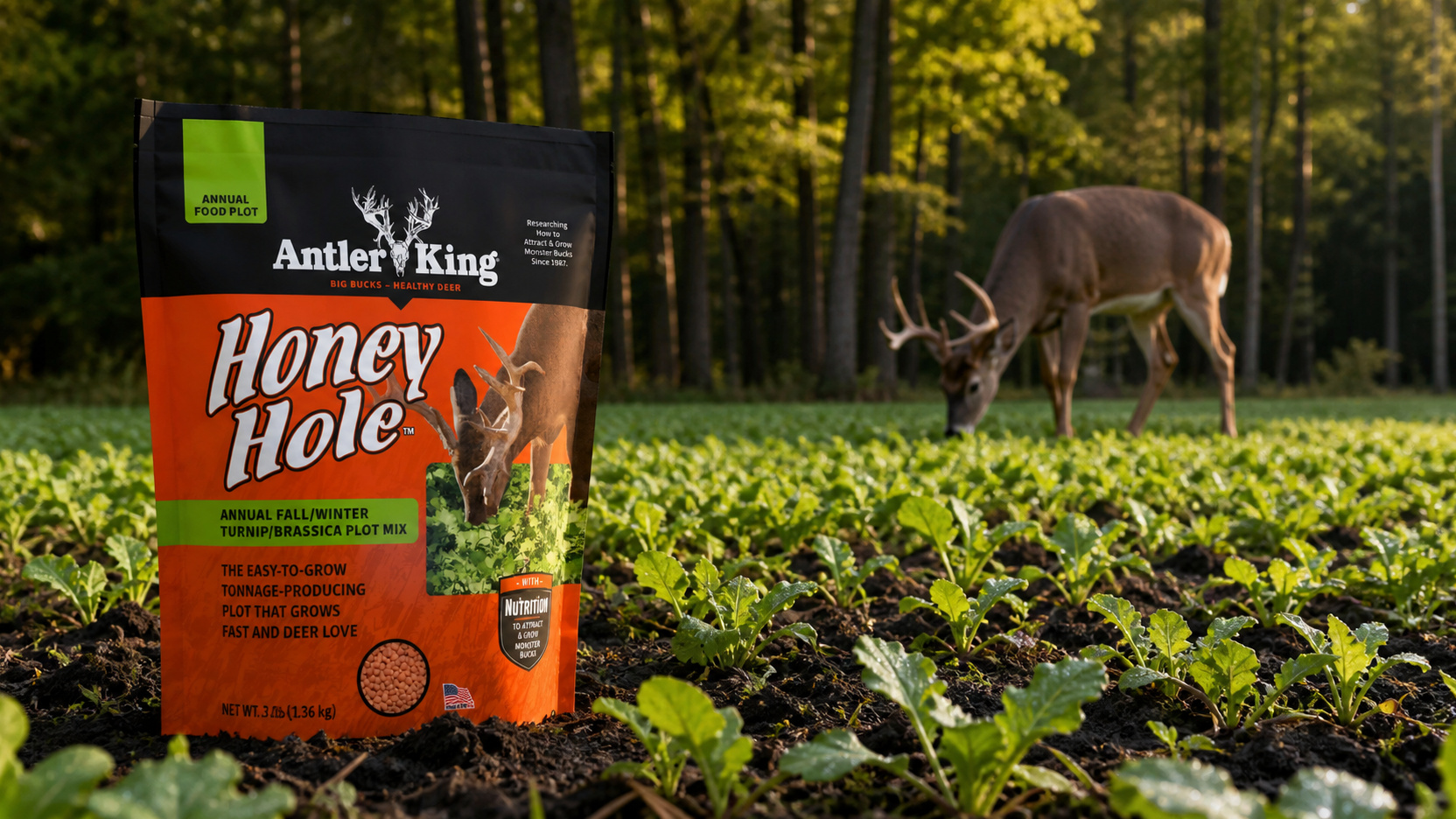
Planting Fall Deer Food Plots in Ohio: An August Field Plan
Plan an Ohio fall deer food plot with soil testing, smart seedbed prep, mix selection, and local tips from Liberty Farm, Home & Garden in Galion.