
The Rustic Planter That Won't Rot, Crack, or Weigh a Ton: A Complete Guide to the Vigoro Cameron Whiskey Barrel Planter
How the Vigoro Cameron 22-inch resin whiskey barrel planter delivers the classic farmhouse look Ohio homeowners love — without the splitting, rotting, or back-breaking weight that makes real wood barrels such a short-lived investment
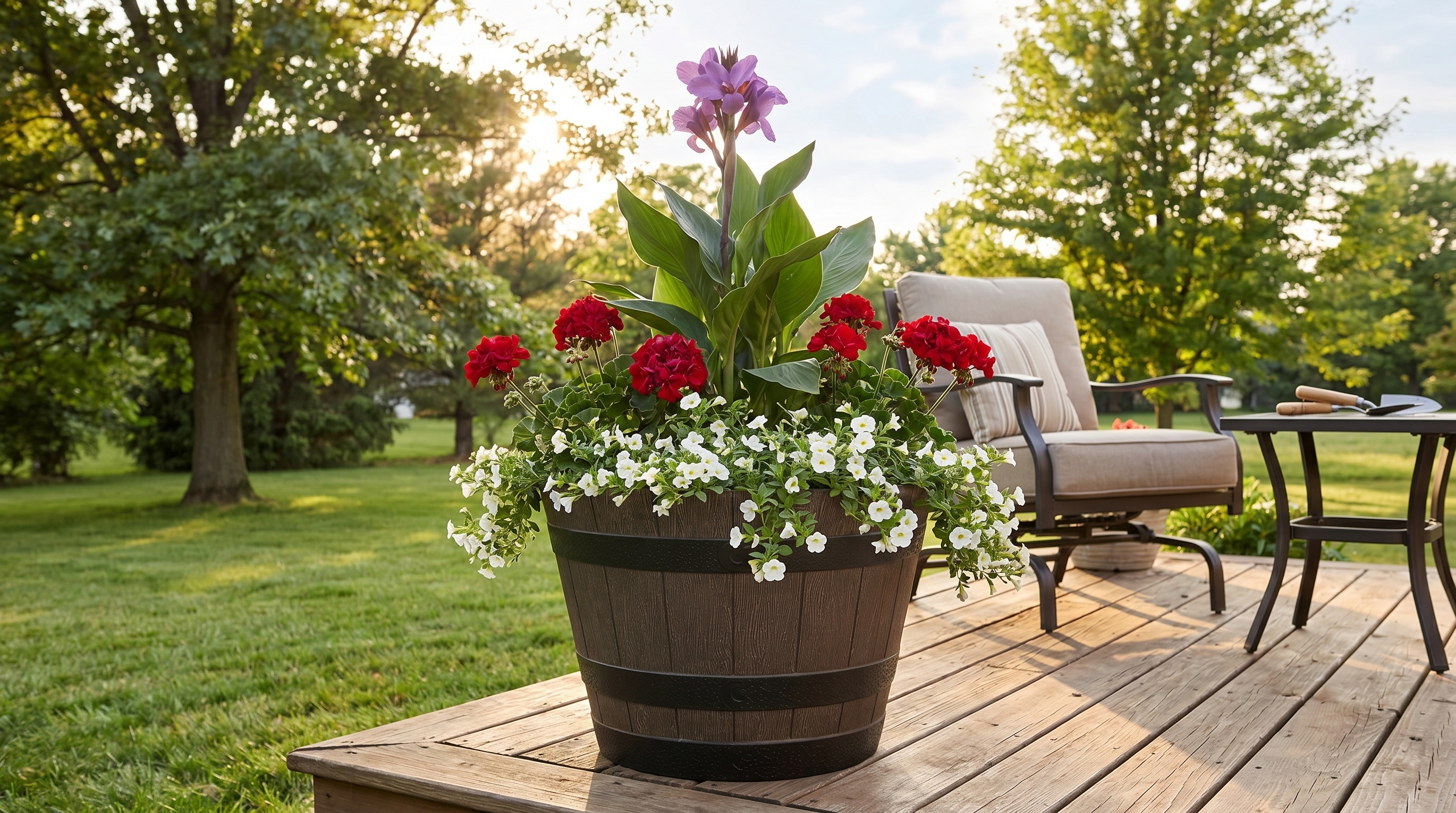
The classic whiskey barrel planter is one of the most enduringly popular choices for Ohio decks and patios — that deep brown stave-and-band silhouette works with everything from cottage-style plantings to bold tropical arrangements, and the 22-inch size provides enough root volume to grow plants that would be root-bound in most standard patio containers within a season. The problem with genuine oak whiskey barrels has always been durability: real wood splits under freeze-thaw cycles, rots from the inside out as soil moisture does its work, and can weigh 40 to 60 pounds before you put a single ounce of soil in them. The Vigoro Cameron Whiskey Barrel Large Brown Resin Round Planter, available at Liberty Farm, Home & Garden in Galion, Ohio, solves every one of those problems: lightweight resin construction, UV-protected faux wood finish that won't fade or crack, and a drainage hole that keeps roots from sitting in waterlogged soil — all in a 22 x 22 x 13.5-inch footprint that makes a genuine visual statement on any deck or patio.
Why Whiskey Barrel Planters Have Always Worked — and Why Real Wood Usually Disappoints
The appeal of the whiskey barrel aesthetic in the garden is deeply rooted in American rural tradition. Actual oak whiskey barrels spent years or decades holding spirit, absorbing and releasing liquid through their stave walls as the wood breathed with temperature and humidity changes. When retired from distillery service, they found second lives as oversized, handsome containers for kitchen garden herbs, flowering annuals, and the kinds of sprawling tomato plants that outgrow standard 12-inch pots by midsummer.
The problem has always been that real wood — even oak, one of the hardest and most rot-resistant domestic hardwoods — doesn't stand up well to the abuse of Ohio's full four-season cycle when used as a planter. The sequence goes like this: the barrel is filled with moist soil in spring, the staves absorb moisture and swell slightly through summer, then autumn brings the first freeze. Water trapped in the wood expands as it freezes, and the wood that expanded to hold it has nowhere to go — it cracks. Over two or three freeze-thaw cycles, the stave integrity that held the barrel together for decades of distillery service fails within a few seasons of patio duty. The hoops rust. The wood softens from the inside as the permanently moist soil environment promotes decay. And when you finally try to move the whole thing, the combination of degraded wood and 40-plus pounds of soil makes it a two-person job that risks the barrel falling apart mid-lift.
The Vigoro Cameron planter takes the visual language of that classic silhouette and renders it in weather-resistant resin — a material that addresses every one of those failure modes directly.
What Makes Vigoro's Resin Construction Different from Real Wood
The Vigoro Cameron Whiskey Barrel planter is made from high-density resin molded to replicate the stave-and-band profile of a traditional oak barrel. The faux wood finish includes visible grain texture, stave lines, and the characteristic barrel bands — visual details that hold up well in the real garden environment even though the underlying material is synthetic. From a distance of five to ten feet, distinguishing this planter from a real wood barrel is genuinely difficult.
Where the differences from real wood actually matter:
- No freeze-thaw cracking. Resin expands and contracts with temperature differently than wood — it flexes rather than fracturing. Ohio winters that crack oak staves won't crack a resin planter. The Cameron can be left outside through a typical Ohio winter without the structural damage that accumulates in real wood planters over multiple freeze-thaw cycles.
- No rot. Resin is impervious to moisture-driven decay. The consistent contact with moist soil that eventually destroys real wood from the inside has no effect on resin. The interior of the planter looks the same in year five as it did in year one, regardless of what you've been growing in it.
- UV-protected finish. The brown faux wood coloring is built into the resin and treated with UV stabilizers that resist fading from sun exposure. Real wood planters typically need to be oiled, stained, or treated annually to maintain their appearance. The Vigoro Cameron requires none of that seasonal maintenance.
- Lightweight. Resin is dramatically lighter than solid oak. The Cameron planter itself weighs a fraction of what a real wood barrel does, which means you can move it to follow the sun, bring it in for winter if you choose, or reposition it on the deck without help. Once filled with soil it will be heavy — a 22-inch planter filled to 10 inches holds roughly 2 to 2.5 cubic feet of soil, which can weigh 40–60 pounds depending on moisture content — but the container itself isn't adding the deadweight that real wood barrels do.
- No tannin leaching. Fresh or freshly-cut oak releases tannins into soil as it gets wet — chemicals that can affect soil pH and potentially stress plants sensitive to pH changes. Resin leaches nothing into the soil. You plant directly in what you put in, without any interaction between the container material and your growing medium.
What the 22-Inch Size Can Handle: Planting Capacity and Options
At 22 inches across and 13.5 inches deep, the Vigoro Cameron planter occupies a useful size category: large enough to accommodate plants that need significant root volume, but not so large that filling it requires an entire pallet of bagged potting mix. Understanding what the dimensions actually translate to in practical terms helps you plan your plantings and soil purchases before you get to the store.
The approximate internal volume of the Cameron planter at full fill is 2 to 2.5 cubic feet of growing medium — roughly 16–20 quarts. In typical practice, you'd fill to within 2 inches of the rim, which puts usable soil depth at roughly 11.5 inches. That's meaningful root space: it comfortably supports vegetables like tomatoes, peppers, and cucumbers that need 12+ inches of root run, large annual arrangements with substantial root systems, perennials that overwinter in the container, and dwarf shrubs and small ornamental trees in smaller sizes.
What a 22-inch planter handles well:
- Single large specimen plants. One indeterminate tomato, one large pepper plant, one upright ornamental grass, or one compact flowering shrub used as a centerpiece planting with trailing or mounding annuals around the base.
- Mixed annual arrangements. The classic thriller-filler-spiller arrangement — a tall centerpiece plant like canna or elephant ear, mid-height fillers like geraniums or petunias, and trailing plants like calibrachoa or sweet potato vine over the edge — works well in a 22-inch footprint.
- Culinary herb collections. Multiple herbs grown together: basil, parsley, chives, oregano, and thyme planted together produce a functional kitchen garden that looks intentional on a deck or patio.
- Compact dwarf shrubs and conifers. Dwarf Alberta spruce, compact boxwood, or a small ornamental dwarf conifer used as a year-round structural planting. These long-lived containers benefit from the resin construction — you're not asking the container to survive five or ten years in a real wood barrel that may not last two.
- Strawberries. A 22-inch round container planted solidly with June-bearing or everbearing strawberries produces a productive and ornamental display — berries cascade over the rim from the outer plants while the center plants mature and fruit.
The Best Plants for a Large Whiskey Barrel Planter in Ohio
Ohio's climate — USDA Zone 6a across most of the state, with north-central Ohio including Crawford County sitting firmly in Zone 6a — shapes which container plants perform well through a full season. The key considerations for container selection are heat tolerance during Ohio's humid July and August peak, root volume requirements relative to the container size, and drainage needs given that containers can't shed excess water the way in-ground plantings can.
High-performing choices for the Vigoro Cameron in Ohio conditions:
- Zonal geraniums (Pelargonium × hortorum). The workhorse annual for Ohio containers. Geraniums are heat-tolerant, drought-tolerant once established, and bloom reliably from May through hard frost. In a 22-inch barrel, plant three to five geraniums to fill the canopy. They pair well with trailing vinca or calibrachoa at the rim for a full arrangement.
- Indeterminate tomatoes (with a cage or stake). A 22-inch planter with good-quality container mix and consistent fertilization can support a full-sized indeterminate tomato through an Ohio growing season. Use a cage or support structure — a tomato plant in full production is heavy and must be supported or it will bend and break. Choose a container-appropriate variety like Patio, Tumbling Tom, or one of the compact indeterminate cherry types for best results.
- Canna lilies. Dramatic architectural plants that thrive in Ohio heat. A single large canna rhizome planted in the center of a 22-inch barrel grows to 4–5 feet, delivers bold foliage from mid-spring through frost, and often blooms in summer. Overwintering cannas requires storing the rhizomes dry through winter — the container can be emptied in fall and stored for spring replanting.
- Elephant ears (Colocasia). Similar impact to canna with more overtly tropical foliage. Elephant ears are very fast-growing and fill a 22-inch container quickly. They prefer consistent moisture and partial shade, making them good candidates for a covered deck or east-facing patio where other plants might struggle.
- Coleus. For shaded deck and patio positions, coleus in multiple complementary varieties creates a foliage-forward display that holds color better in low light than flowering annuals. Modern coleus varieties tolerate more sun than older selections, and the diversity of foliage pattern and color available makes them extremely versatile for mixed container design.
- Ornamental peppers. If you want something edible and ornamental simultaneously, ornamental peppers grown as a group planting in a 22-inch barrel are visually striking from midsummer through frost and produce small, colorful fruits that can be harvested for cooking.
Setting Up Your Vigoro Cameron Planter for the Season
Getting the planter ready at the start of the season takes about 30 minutes and sets up everything that follows. The steps are straightforward but each one matters for what happens over the next six months.
- Choose the right location first. Place the empty planter where you want it before adding soil. A 22-inch container filled with 2+ cubic feet of potting mix and a large plant will be heavy — 60 to 80 pounds for a large planting — and moving it after it's planted risks damaging both the planting and the container. Decide the final position before you start filling.
- Elevate for drainage. The Cameron planter has a drainage hole, but it works best if the base of the planter is slightly elevated off the deck or patio surface. Use pot feet, rubber spacers, or a simple stack of flat stones at the base perimeter to allow water to exit freely. Planters sitting directly on a flat surface can develop a vacuum that prevents drainage and keeps root zones waterlogged.
- Add drainage material — selectively. The traditional advice to put rocks or gravel in the bottom of containers is largely outdated: research has shown that a gravel layer actually creates a perched water table that keeps soil above it saturated longer, not shorter. For the Cameron planter with its good drainage hole, simply use high-quality well-draining potting mix from bottom to top. The exception: if you're planting a large shrub or tree that will live in the container for multiple years, a single layer of landscape fabric over the drainage hole (to keep soil in while water exits) is worthwhile.
- Fill with quality container mix. Fill to within 2–3 inches of the rim. Tamp lightly to eliminate large air pockets but don't compress the mix — potting media should be loose enough for roots to penetrate easily. Water thoroughly after filling to settle the soil and check that the drainage hole is functioning — you should see water exiting within a few minutes of thorough watering.
- Plant at the appropriate time for your plant selection. For frost-sensitive annuals and tropical plants, plant after your last expected frost date. In Galion and north-central Ohio, that's typically mid-May. Hardy perennials and cool-season vegetables (lettuce, kale, pansies) can go in earlier — even April in most years.
Where to Position a Large Planter on Your Deck or Patio
The 22-inch footprint of the Cameron planter is substantial enough that its placement shapes how the entire outdoor space looks and functions. Position is worth thinking through before you plant.
Common placement strategies that work well:
- Entry flanking. Two Cameron planters flanking a deck or patio door creates a classic entry statement. With matched plantings — a symmetrical arrangement in each barrel — the pair reads as a designed feature rather than a pair of containers. Use a bold, upright centerpiece plant with good visual height to create presence at the entry level.
- Corner anchoring. Placing a large planter in the corner of a deck or patio anchors the space visually and softens the hard angle of the deck rail or fence. A single large specimen — an ornamental grass, canna, or small standard tree — placed in the corner with its foliage extending out into the space creates depth and visual interest.
- Focal point planting. Used alone in a prominent position — center of a patio, end of a deck run, or beside a seating area — a single large barrel planter with a bold planting acts as a garden focal point that grounds the seating arrangement. This works especially well with the whiskey barrel silhouette because the container itself is visually interesting regardless of what's planted in it.
- Rail or border definition. Spaced at regular intervals along a deck rail or patio border, multiple planters create a soft border that defines the edge of the space without a physical barrier. Three or five Cameron planters spaced evenly along a deck perimeter with matching or coordinated plantings creates a pulled-together, designed look.
Sun exposure considerations: match your plant selection to the actual light conditions at the planter's position, not the general sun exposure of the property. A deck on the south side of a house may be in full sun from midmorning through late afternoon. A deck under a pergola or roof overhang may receive only a few hours of direct sun. A porch-facing deck may be in morning sun and afternoon shade. Measure or observe light before choosing plants — sun requirements on plant tags and descriptions are meaningful, and the wrong plant in the wrong light is the most common source of container disappointment.
Watering Large Container Planters: The Mistakes That Kill Plants
Containers dry out faster than in-ground plantings, and the larger the container and the larger the plant in it, the faster moisture depletes. A 22-inch barrel in full Ohio summer heat with a large tomato or tropical specimen can need watering every day to every other day in July and August. Understanding how containers behave differently from garden beds prevents the most common watering mistakes.
The most common mistake: inconsistent watering. Container plants suffer more from cycles of drought and overwatering than from either consistent moisture stress or consistent adequate moisture. Allowing a container to dry out completely — to the point where the plant shows wilt — stresses roots, potentially breaks root hair connections to soil particles, and creates hydrophobic conditions where bone-dry potting mix actually repels the first watering rather than absorbing it. Then overwatering in response to visible wilt keeps roots in standing water. The goal is consistent moisture: soil that's uniformly damp at root depth but never waterlogged.
Practical watering approaches for the Cameron planter:
- Check soil depth, not just surface. The top inch of potting mix in a container can look dry while the root zone at 4–6 inches is still adequately moist. Push your finger to the second knuckle — if the soil is cool and slightly damp at that depth, the plant doesn't need water yet. If it's dry at 4 inches, it's time to water.
- Water thoroughly when you water. When you do water, water until it runs freely from the drainage hole. Shallow watering only wets the top few inches of the container, encouraging roots to stay near the surface rather than growing downward to the deeper, more moisture-stable zone. Thorough, less frequent watering develops a deeper, more drought-tolerant root system than frequent, shallow watering.
- Account for rain days. In Ohio's variable summer rainfall pattern, a day of significant rain is a free watering. Adjust your watering schedule after rain events rather than watering on a fixed calendar — a container that received two inches of rain yesterday doesn't need watering today. Overwatered containers with impaired drainage lead to root rot just as readily as underwatered ones.
Keeping the Outside Looking Sharp: Cleaning and Seasonal Maintenance
One of the key advantages of the resin construction on the Vigoro Cameron planter is how little maintenance the exterior actually requires. Unlike real wood, which needs sealing, oiling, or staining to resist weathering, the resin surface simply needs occasional cleaning to remove the algae, pollen, soil splash, and environmental buildup that accumulate on any outdoor surface over a season.
Routine cleaning approach:
- A stiff-bristle brush and a bucket of warm, soapy water handles most seasonal surface buildup. Scrub the exterior, rinse thoroughly, and the planter looks close to new. The UV-protected finish won't be damaged by soap or light scrubbing.
- For algae and green biological growth that develops on shaded sides of the planter or on exterior surfaces kept damp by overhead irrigation, the 30 Seconds Outdoor Cleaner Concentrate (1 Gallon) is the most effective option available at Liberty Farm, Home & Garden. The diluted concentrate is sprayed on, left for a few minutes, then rinsed. It removes algae, mildew, and the grey-green biological staining that makes outdoor surfaces look weathered and neglected. It's safe on resin, wood composite, concrete, and most exterior surfaces — a single gallon of concentrate goes a long way across multiple patio cleaning applications.
- At the end of the season, empty the planter before heavy frost if you plan to store it or replant it in spring with fresh soil. Resin won't crack from a winter freeze the way real wood does, but frozen wet soil exerts some expansion pressure on any container — emptying and cleaning the planter in fall extends its appearance and service life.
- Store or overseason the empty planter bottom-up or at a tilted angle so water doesn't collect inside through winter. Standing water that freezes in the base of the container adds unnecessary freeze-thaw stress even on a material as frost-tolerant as resin.
Products That Pair Well with the Cameron Planter at Liberty Farm, Home & Garden
At Liberty Farm, Home & Garden in Galion, we carry a range of patio, container, and outdoor cleaning products that work alongside the Vigoro Cameron planter for a complete deck and patio setup:
- 30 Seconds Outdoor Cleaner Concentrate (1 Gallon) — The most effective outdoor surface cleaner for algae, mildew, and biological staining on resin, concrete, wood composite, and vinyl deck surfaces. Dilute and spray, let it work, rinse. A gallon of concentrate treats large areas and works year after year for patio maintenance and end-of-season cleanup.
- Southern Patio Lacis Collection Trellis Planter (15 in) — A complementary container for decks and patios where the full 22-inch footprint of the Cameron is more than you need. The Lacis trellis planter includes an integrated climbing support, making it ideal for compact vines, climbing flowers, or trailing herbs positioned alongside a larger barrel planting. Using multiple container sizes and styles creates visual layering that makes a deck planting look designed rather than assembled.
- Bloem Ariana Self-Watering Planter (Terracotta) — For spots where you can't check or water as consistently, the Bloem Ariana's built-in water reservoir does the work. Fill the reservoir every few days instead of daily watering. Excellent for herbs, compact flowering annuals, and plants that prefer consistent moisture. The terracotta colorway pairs naturally with the brown whiskey barrel aesthetic of the Cameron planter for a coordinated patio look.
- Bloem Ariana Self-Watering Planter (Charcoal) — Same self-watering design in a dark charcoal finish. The charcoal colorway creates a clean contrast alongside the warm brown of the Cameron whiskey barrel for a modern-rustic mixed container arrangement. Works well on contemporary deck designs where the whiskey barrel provides the rustic element and the Ariana provides the clean modern counterpoint.
Stop in at Liberty Farm, Home & Garden in Galion or shop online at libertyfhg.com for our full selection of deck and patio planters, outdoor cleaners, container soil, and garden accessories. We carry the Vigoro Cameron Whiskey Barrel Planter alongside a range of container sizes and styles to help you put together a complete outdoor space this season.
| Specification | Details |
|---|---|
| Product Name | Vigoro Cameron Whiskey Barrel Large Brown Resin Round Planter |
| Dimensions | 22" L x 22" W x 13.5" H |
| Material | Weather-resistant resin |
| Color | Brown (UV-protected faux wood finish) |
| Shape | Round |
| Drainage | Yes — drainage hole included |
| Finish | UV-protected faux wood grain with stave and band detail |
| Model | 1023P-037PB |
| Brand | Vigoro |
| Best Use | Deck, patio, and entryway container planting |
| Available At | Liberty Farm, Home & Garden, Galion, Ohio |
Frequently Asked Questions
Keep Reading
Plant Cover Crops Now: An Ohio Home Garden Guide
Plant fall cover crops in an Ohio vegetable garden with practical guidance on timing, species, seeding, winter care, and spring termination.
Save This Summer’s Garden: A Practical Ohio Seed-Saving Guide
Save tomato, bean, pea, lettuce, marigold, zinnia, and other garden seeds with this practical late-summer guide for Galion and north-central Ohio.