
Why Flies Take Over Your Patio and Barn Every Summer — and How a Disposable Trap Finally Fixes It
Why swatting and spraying never solve an outdoor fly problem, and how the Raid Disposable Fly Trap uses a food-based lure and a one-way entry funnel to clear flies from patios, barns, trash areas, and gardens without pesticides
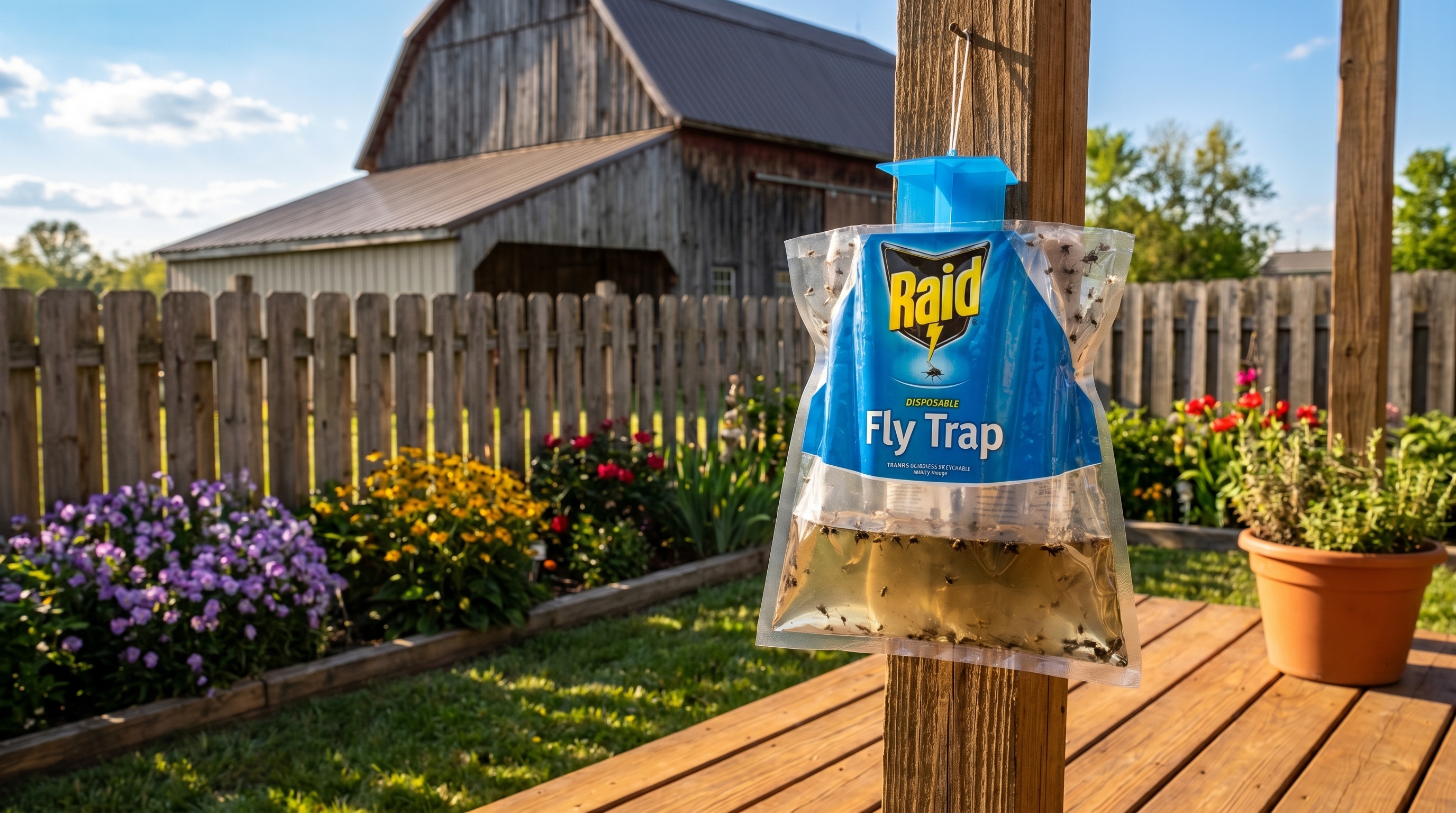
By the time fly season fully hits in May and June, most Ohio homeowners and farm operators have already tried the standard playbook: fly swatters, sticky tapes hanging from barn rafters, sprays applied to surfaces, citronella candles on the porch. They all work partially, temporarily, and in a very limited area — and then the flies come right back. The reason is simple: swatting and spraying address individual flies rather than the population. A disposable fly trap works differently. The Raid Disposable Fly Trap uses a water-soluble, food-based attractant lure to draw flies in from a wide area, and a custom entry funnel designed to let flies enter the bag but not find their way back out. You hang it, fill it with water to activate the lure, and let it do the work. No pesticides, no spraying, no cleanup — when it's full, you toss the whole thing. Liberty Farm, Home & Garden in Galion, Ohio carries the Raid Disposable Fly Trap so you can stop reacting to flies and start getting ahead of them.
Why Outdoor Fly Populations Get Out of Control So Quickly
A single female housefly can lay between 400 and 600 eggs during her lifetime — depositing them in batches of 75 to 150 at a time in any warm, moist organic material she can find. That includes manure, compost, garbage, standing water in containers, wet grass clippings, garden debris, and animal feed that has gotten damp. Under warm summer conditions, fly eggs hatch in as little as 12 to 24 hours, and the entire life cycle from egg to adult fly can complete in 7 to 10 days. A small initial population becomes enormous fast.
This reproductive speed is why surface sprays and swatters feel futile by midsummer. You're killing adult flies — a small fraction of the total population — while the eggs, larvae, and pupae developing in organic material nearby are invisible and untouched. Within a week, the adults that hatch from those developmental stages replace every fly you've killed, and the population continues to grow. The only way to interrupt this cycle meaningfully is to remove adult breeding-age females from the population before they lay their next batch of eggs. That's exactly what a well-placed attractant trap does.
Flies are also mobile. A fly attracted to your trash area or manure pile doesn't stay there — it moves between the barn, the patio, the house, and the garden, spreading bacteria picked up from one surface to the next. A trap placed near breeding and feeding areas intercepts this movement and removes flies that would otherwise migrate into spaces where you're trying to enjoy yourself or keep food clean.
How the Raid Disposable Fly Trap Works
The Raid Disposable Fly Trap is a single-use hanging bag trap that combines two elements to catch flies: an attractant lure and a mechanical entry system. Together, these two components make the trap far more effective than passive sticky tape or surface bait alone.
The lure is a water-soluble, food-based material that dissolves when you add water to the bag to activate the trap. Food-based attractants exploit the same instincts that draw flies to garbage, manure, and decaying organic matter — the smell signals a feeding and breeding opportunity, and flies approach from a significant distance to investigate. Unlike chemical attractants that lose potency quickly in open air, the water-dissolved food lure continuously releases odor as long as the solution is present, providing a sustained draw throughout the trap's useful life.
The entry mechanism is a custom-designed funnel. Flies are attracted by the lure smell and enter the bag through the funnel opening. Once inside, flies orient toward light and move upward — away from the water solution — rather than returning the way they entered. The funnel geometry exploits this behavior: the entry path is easy to find from the outside but difficult to reverse from the inside. The result is a one-way trap. Flies go in. They don't come out.
When the trap is full or the lure is exhausted, you dispose of the entire bag. There is no mechanism to empty, no bait to replace, and no surface to clean. The sealed bag contains everything, which keeps odors contained until it goes into the trash. For locations where smell management matters — like a patio close to a seating area — the sealed disposable design is an important practical advantage over open-container traps that release odor freely when you tend to them.
Where to Hang the Trap for Maximum Effectiveness
Trap placement is the variable most likely to determine whether a fly trap performs well or seems like it isn't working. The food-based lure is effective at drawing flies across a meaningful distance, but it can't compete with a closer, more concentrated food or breeding source nearby. Proper placement puts the trap between the fly population and the areas you want to protect, or as close as practical to the primary breeding and feeding areas where flies are concentrated.
Principles for effective placement:
- Hang near breeding sources, not in protected spaces. The trap works by drawing flies to the lure. If you hang it on your porch or patio where you want to be fly-free, the lure itself will attract flies to that space. Instead, hang the trap 20 to 30 feet from where you want protection, between the fly source and your activity area. The flies move toward the trap rather than toward you.
- Position near known congregating areas. Trash cans, compost bins, manure piles, animal pens, wet garden areas, and standing water containers are fly hotspots. A trap hung 10 to 15 feet from these sources intercepts flies that are already in the area before they disperse.
- Hang at fly-head height or slightly above. Flies move along horizontal planes at roughly body height when foraging — a trap hung at 4 to 6 feet intercepts flies moving through a space more effectively than one hung very high or placed on the ground.
- Provide sun exposure. Warm temperatures increase lure volatilization — the lure releases more odor in warm conditions, which increases its range and effectiveness. A sunny, sheltered location is better than deep shade.
- Use multiple traps for large areas. A barn, large patio, or farm property with multiple fly sources benefits from multiple traps placed strategically rather than one centrally located trap trying to cover everything.
Barn and Farm Applications: Why These Traps Belong in Every Livestock Area
For livestock owners and small farm operators, fly control isn't just about comfort — it's an animal health and productivity issue. Flies cause stress to horses, cattle, poultry, and other livestock through constant harassment, and they mechanically transmit bacterial pathogens between animals and between animals and feed or water sources. In a barn environment, fly populations can reach extraordinary densities in a short time due to the combination of manure, moist bedding, spilled feed, and warmth that creates ideal breeding conditions.
The Raid Disposable Fly Trap is specifically listed for outdoor use including barns, which makes it a practical part of a livestock fly management program. Unlike residual insecticide sprays that require protective equipment during application, leave chemical residue on surfaces, and require re-application on a schedule, a disposable bag trap requires no chemical handling, has no withdrawal implications for animals, and works passively once activated.
Placement in barn settings follows the same principle as residential use: hang traps near the areas where flies congregate most — near manure collection points, feeding areas, water troughs, and doorways where flies enter and exit. Multiple traps distributed through a barn address the population across the space rather than drawing flies from throughout the barn to a single central point.
The disposable format is particularly practical in barn environments where dedicated trap maintenance is difficult to schedule consistently. A trap that is simply hung, fills up, and gets replaced requires less management time than systems that require regular cleaning, bait replacement, and mechanical maintenance.
Flies Are Not Just Annoying — They're a Genuine Hygiene Problem
It's easy to frame fly control as a comfort issue — nobody wants to eat outside with flies landing on the food. But the hygiene implications of high fly populations in and around living and eating spaces are more serious than most people recognize. Flies do not bite or sting, but they are among the most effective vectors for surface contamination of any common insect.
A single fly that has spent time on manure, garbage, or rotting organic matter carries millions of bacteria on its body — on its legs, on the small hairs covering its body, and in its digestive system, which it partially regurgitates onto food when it lands and feeds. Common bacteria associated with flies include Salmonella, E. coli, Campylobacter, and Listeria — organisms responsible for food-borne illness in humans. Flies don't discriminate between a manure pile and the potato salad sitting on the picnic table; they move between both freely.
For households with young children, elderly family members, or immunocompromised individuals, this isn't a trivial concern. Controlling the fly population around outdoor eating and food preparation areas using a trap that draws flies away from those spaces and removes them from the environment is a practical public health measure, not just a comfort preference.
Comparing Fly Control Methods: Where the Disposable Trap Fits
Different fly control methods serve different purposes, and the Raid Disposable Fly Trap is best understood in the context of a broader fly management approach rather than as a standalone total solution. Here is how the main methods compare:
- Swatters and manual control. Effective on individual flies and useful indoors where a trap is impractical. No effect on population because eggs and larvae developing in nearby organic material are unaffected. Requires active effort with no lasting result.
- Sticky tape and ribbon traps. Catches flies passively but requires proximity and does not attract flies from a distance — flies must already be in the immediate area. Works well as a supplemental trap in enclosed spaces like barns or garages. Unattractive visually and difficult to dispose of without getting stuck.
- Surface residual sprays. Kills flies that contact treated surfaces. Requires periodic reapplication, may require protective equipment during application, and has chemical handling implications in food prep or animal feed areas. Not effective for eliminating population — kills adults on contact but doesn't attract flies for population reduction.
- Attractant bag traps (the Raid Disposable Fly Trap). Draws flies from a distance using food-based lure, captures large numbers in one unit, works passively without ongoing attention, uses no pesticides, and is fully disposable. Most effective when placed near fly sources and away from protected spaces. Best for outdoor use on patios, in barns, near trash areas, and in gardens.
- Breeding source reduction. The most effective long-term fly control: removing or managing manure, standing water, wet garbage, and other organic matter that serves as breeding material. Reduces the fly population at its source rather than catching adults. Complements trap use — traps are most effective when combined with source reduction rather than used as a substitute for it.
Seasonal Timing: When to Start Using Fly Traps in Ohio
In Ohio, fly season typically begins in earnest in May when consistent daytime temperatures reach the mid-60s Fahrenheit and accelerates through June, July, and August. The window from late April through May is the best time to establish fly control measures before the population has had time to build. Starting traps in May — when adult flies are just beginning to emerge from overwintering pupae and early-season breeding — interrupts the population before it has multiplied through multiple reproductive cycles.
A trap hung in late July when fly populations are at their seasonal peak will catch large numbers, but the population has already had weeks to reproduce. A trap hung in early May removes breeding-age females from a population that hasn't yet reached peak density. The cumulative effect of removing females early in the season is substantially greater than catching the same number of flies from an already-saturated midsummer population.
Ohio's fall fly resurgence in September and early October — when cooling temperatures push flies to seek warmth near structures, garbage, and compost — is a second window where traps are particularly useful. Flies congregating near home entries and garbage areas in fall are managed effectively with a trap placement near those entry points during the transition period.
Using the Raid Disposable Fly Trap Alongside Related Pest Control Products
The Raid Disposable Fly Trap is a focused tool for outdoor fly population reduction, and it works best as part of a broader pest management approach. Liberty Farm, Home & Garden carries a range of complementary pest control products for homeowners and farm operators dealing with multiple pest pressures simultaneously.
For outdoor areas where rodents and flies are both concerns — barns, grain storage areas, compost bins, and trash areas — pairing fly traps with rodent control products addresses both pest pressures in the same zone. The Tomcat Rat & Mouse Pelleted Place Packs and the Tomcat Advanced Formula Refillable Mouse Bait Station are both available at Liberty Farm, Home & Garden for areas where rodent pressure accompanies fly issues. For garden areas where insect pest pressure includes both flies and plant-damaging insects, Sevin Garden Insect Killer Ready to Use treats the full range of garden pest insects while the fly trap handles the fly population above ground.
| Specification | Details |
|---|---|
| Product | Raid Disposable Fly Trap |
| Brand | Raid |
| Attractant Type | Water-soluble, food-based lure — no pesticides |
| Activation | Add water to dissolve lure before hanging |
| Entry Mechanism | Custom one-way entry funnel — flies enter but cannot exit |
| Use Location | Outdoors only — patios, barns, trash areas, gardens |
| Disposal | Fully disposable — no cleanup, no emptying, no maintenance |
| Best Placement | 20–30 feet from protected areas; near fly breeding sources |
| Seasonal Use | May through October in Ohio; start early for best population control |
| Available At | Liberty Farm, Home & Garden, Galion, Ohio |
Stop by Liberty Farm, Home & Garden in Galion, Ohio to pick up the Raid Disposable Fly Trap before fly season hits full swing. Our team can help you find the right combination of pest control products for your patio, garden, or farm — everything in one place so you can get ahead of the season instead of spending it reacting.
Frequently Asked Questions
Keep Reading
Stop Mice Before Fall: A Practical Ohio Home and Outbuilding Guide
Mouse-proof your Ohio home, garage, barn, or feed shed before fall with practical exclusion, storage, trapping, and safe cleanup steps.
Fall Webworms in Ohio: What to Do About Those Late-Summer Tree Nests
Identify fall webworm nests in Ohio trees, distinguish them from tent caterpillars, assess damage, and choose safe late-summer management.