
The Growing Medium Built for Plants That Hate Wet Feet: A Complete Guide to Pro-Mix HP Mycorrhizae
How Pro-Mix HP Mycorrhizae's high-porosity formula delivers the drainage, air pockets, and root-zone biology that succulents, herbs, and root-rot-prone plants need — and why choosing HP over BX is the right call when drainage is the priority
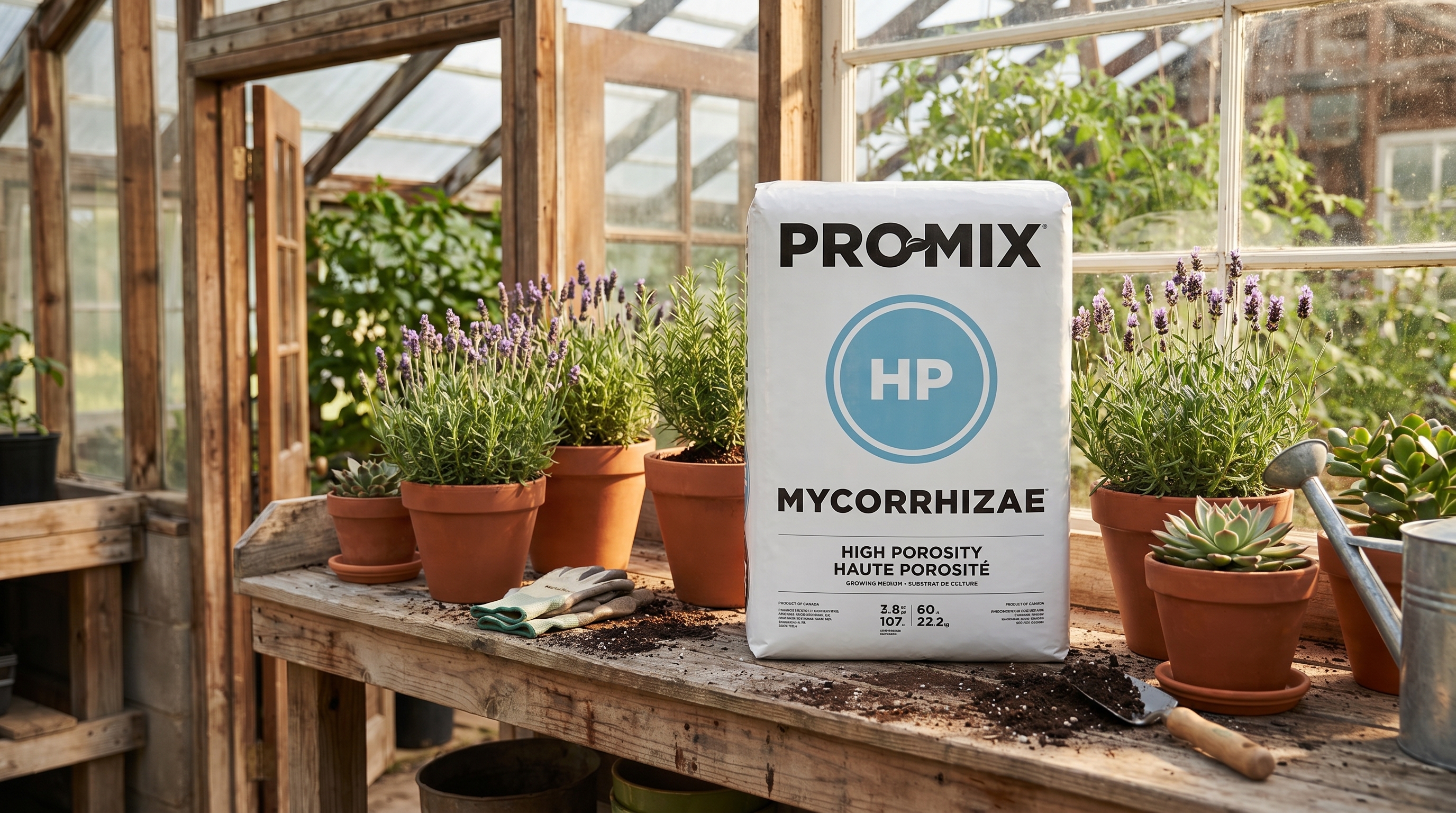
Most container and greenhouse growing media is formulated as a compromise: enough peat or coir to retain moisture for moisture-loving plants, enough perlite or vermiculite to prevent complete waterlogging. That compromise works reasonably well for the broad middle of the plant spectrum — impatiens, petunias, tomatoes, peppers — but it fails reliably for the plants that hate wet feet: lavender, rosemary, thyme, succulents, cacti, orchids, and anything that's ever died in a standard potting mix with roots that looked brown and soft at autopsy. Pro-Mix HP Mycorrhizae (3.8 cf), available at Liberty Farm, Home & Garden in Galion, Ohio, is not a compromise formula. The HP stands for high porosity, and that means more perlite, faster drainage, and more sustained air space around roots than the standard Pro-Mix BX formulation — making it the right choice whenever drainage is the priority and wet feet are the enemy.
What High Porosity Actually Means — and Why Some Plants Can't Survive Without It
Porosity in a growing medium refers to the ratio of air space to solid material. A high-porosity mix has a larger percentage of its volume occupied by air — before and after watering — than a standard mix. That air space does two things for plant roots that moisture cannot: it delivers oxygen, and it prevents the anaerobic (oxygen-deprived) conditions that pathogenic root rot fungi thrive in.
Root cells respire. They consume oxygen and release carbon dioxide just like the above-ground plant tissue does, and they need a continuous supply of oxygen in the root zone to drive the metabolic processes that power nutrient uptake, water transport, and cell division. When a growing medium stays saturated — either because it holds too much moisture, because the container drains poorly, or because the grower overwatered — the water fills the air spaces in the medium and the root zone becomes hypoxic. Roots under prolonged hypoxic stress stop functioning efficiently, become weakened, and become vulnerable to opportunistic pathogens like Pythium and Phytophthora — the organisms behind the vast majority of root rot events in containers.
High-porosity media addresses this by ensuring that even immediately after a thorough watering, the mix retains large pores filled with air rather than water. The water drains through and out; the air rushes back in. For the plants that evolved in fast-draining, rocky, or sandy soils — Mediterranean herbs, cacti, succulents, alpine plants — this cycle closely mimics what their root systems are adapted to. For cuttings and seedlings vulnerable to damping-off, it removes the saturated surface conditions that the causal fungi require.
Pro-Mix HP achieves its high-porosity profile primarily through an elevated perlite content compared to Pro-Mix BX. Perlite — the white, spongy volcanic glass particles visible in any good container mix — drains completely after watering and holds no water itself. It is purely a structural material that creates and maintains the macropore channels air fills after drainage. More perlite means faster drainage, higher post-drainage air content, and better long-term structural stability as the organic components in the mix decompose over time.
Pro-Mix HP vs. Pro-Mix BX: Choosing the Right Formula for Your Plants
Pro-Mix makes two core professional-grade growing media that gardeners and growers encounter most often: BX and HP. Both are peat-based professional growing media. Both contain perlite, vermiculite, limestone, a starter fertilizer charge, and Pro-Mix's proprietary MYCORRHIZAE inoculant. The difference is in the ratio of perlite to peat — and that difference determines which plants each formula suits best.
Pro-Mix BX is the standard formulation. It balances moisture retention and drainage in a way that works well for the broadest range of plants: bedding annuals, vegetables, perennials, most houseplants, and general container gardening applications. BX holds moisture long enough that you don't need to water twice a day in summer heat, but drains well enough that roots don't sit in standing water after a normal watering. It's the right choice when you want a single versatile mix that performs across a diverse mix of plants and containers.
Pro-Mix HP shifts the balance decisively toward drainage. More perlite means the mix drains faster and retains less moisture — after a thorough watering, HP reaches field capacity (the point where drainage stops and moisture remains) at a lower moisture content than BX. For plants that prefer dry-to-moist cycles over consistently moist conditions, that lower baseline moisture is exactly what they need. For growers who tend to overwater, the lower water-holding capacity of HP provides some forgiveness — the medium dries to a plant-safe moisture level faster than BX would, reducing the window during which roots sit in saturated conditions.
A practical guide to choosing between them:
- Choose HP when: You're growing succulents, cacti, lavender, rosemary, thyme, sage, oregano, hyssop, or other Mediterranean herbs. You're propagating cuttings and want to minimize damping-off risk. Your growing environment is humid, has limited air circulation, or you know from experience that you tend to overwater. You're growing in large containers that drain slowly. Your plants have ever died from root rot in a standard mix.
- Choose BX when: You're growing general annuals, vegetables, perennials, or tropical foliage plants that prefer consistent moisture. Your growing environment is hot and dry, and you need the mix to retain moisture between waterings. You're growing crops with high water demand like tomatoes, cucumbers, or basil. You water infrequently and need the medium to hold moisture through longer dry periods.
What's Inside Pro-Mix HP Mycorrhizae — and Why Each Ingredient Matters
Pro-Mix HP is a professional peat-based growing medium rather than a consumer potting mix. Understanding its ingredient list helps explain both its performance and the context in which it's most valuable.
The primary components:
- Canadian Sphagnum Peat Moss. The bulk of the medium by volume. Sphagnum peat is slightly acidic (pH 3.5–4.5 before amendment), has a fibrous structure that resists compaction, and provides a stable, long-lived organic component that holds some moisture while allowing air movement. The Canadian peat used in Pro-Mix is harvested from sustainable managed bog systems and is the standard base material for professional growing media globally.
- Perlite (elevated quantity vs. BX). The high-porosity element. Perlite is expanded volcanic glass heated until it pops into a lightweight, porous particle. It holds no plant-available water, drains completely after wetting, and creates permanent macropore channels in the mix that air re-occupies after drainage. The elevated perlite content in HP relative to BX is what produces the faster drainage and higher post-drainage air space that defines the HP formula.
- Vermiculite. Expanded mineral with a layered structure that holds some moisture and nutrients in the cation exchange positions between its layers. Unlike perlite, vermiculite does retain water and provides a modest reservoir of moisture and nutrients in the root zone. In HP, vermiculite is present at lower levels than in BX, consistent with the overall shift toward drainage over retention.
- Dolomitic and Calcitic Limestone. Amendments that raise the naturally acidic pH of peat to a range most plants can use effectively. Pro-Mix products are pH-adjusted to 5.5–6.5 — the range at which the widest spectrum of macro and micronutrients are available in solution for root uptake. Without the limestone amendments, peat-based media would be too acidic for most container plants.
- Starter fertilizer charge. A small amount of balanced starter fertilizer incorporated during manufacture to support initial establishment. This charge typically sustains plants for the first few weeks after potting; supplemental fertilization is required for ongoing nutrition as plants grow and the starter charge depletes.
- Pro-Mix MYCORRHIZAE inoculant. The fungi component that differentiates Pro-Mix from generic peat-perlite mixes. More on this in the following section.
Why Mycorrhizae Are Worth More Than a Marketing Label
The mycorrhizae in Pro-Mix HP are not a token addition or a marketing differentiator with no practical effect. Mycorrhizal fungi — specifically the Glomus intraradices (now reclassified as Rhizophagus irregularis) strain used in Pro-Mix — form a genuine symbiotic relationship with plant roots that measurably expands the plant's effective root surface area and access to water and nutrients.
The mechanism: mycorrhizal hyphae — fungal threads far finer than the smallest root hair — colonize the outer root cells and extend outward into the growing medium, exploring a volume of medium that root hairs physically can't reach. The hyphae access water and dissolved mineral nutrients (particularly phosphorus, which moves slowly through soil solution and is often the limiting nutrient in container situations) and translocate them back to the root interface. In exchange, the plant provides the fungus with sugars from photosynthesis — a true mutualistic exchange.
In practical container growing terms, mycorrhizal colonization translates to:
- More efficient water uptake, especially in high-porosity media where moisture drains quickly and is less available than in moisture-retentive mixes
- Improved phosphorus availability without increasing fertilizer input rates
- Faster establishment after transplanting — the expanded root zone provided by hyphae helps newly planted material recover from transplant stress faster than non-mycorrhizal plants
- Greater drought tolerance in containers — plants with well-established mycorrhizal networks maintain turgor and function at lower soil moisture levels than non-mycorrhizal equivalents
The caveat: mycorrhizal fungi are living organisms that can be suppressed or killed by certain soil drenches and fungicides, high phosphorus fertilizer rates, and poor handling. The inoculant in Pro-Mix is applied at manufacture and remains viable under normal storage conditions. For the colony to establish in the root zone, avoid high-phosphorus starter fertilizers or soil drench fungicides that target fungi broadly — these can prevent colonization from taking hold in the first weeks after planting when the relationship is initially forming.
Which Plants Thrive in Pro-Mix HP
The list of plants that genuinely benefit from Pro-Mix HP's high-porosity, fast-draining formulation is longer than many growers realize. It extends well beyond the obvious succulents-and-cacti category to encompass a broad range of culinary herbs, Mediterranean natives, woody ornamentals, and plants being propagated from cuttings.
Mediterranean culinary herbs. Lavender, rosemary, thyme, sage, oregano, marjoram, and hyssop all evolved in the rocky, shallow, fast-draining soils of the Mediterranean basin. In their native environments, they experience distinct wet and dry seasons — but even during the wet season, their root zones drain quickly because the substrate is largely mineral rather than organic. In Ohio containers filled with standard potting mix, these plants frequently develop root rot during Ohio's cool, wet springs when the medium stays moist for days between warmings. Pro-Mix HP's faster drainage cycle mimics the dry-between-rains pattern these plants evolved for. Basil, by contrast, prefers more consistent moisture and is better served by BX or a standard potting mix.
Succulents and cacti. The most classic high-porosity use case. Succulents and cacti store water in their leaves, stems, or roots precisely because their native habitats are episodically wet and then very dry. Their roots are adapted to brief saturation followed by extended dry periods, and they are highly susceptible to root rot when kept in persistently moist media. Pro-Mix HP drains fast enough and dries down fast enough to provide the soil cycle these plants require. For large succulent collections or serious cactus growers, the 3.8 cubic foot bag provides enough medium to fill a large number of individual containers without the per-bag cost of smaller specialty succulent mixes.
Orchids transitioning to terrestrial media. Epiphytic orchids (Phalaenopsis, Cattleya) typically grow in bark-based media rather than peat-based mixes, but semi-terrestrial orchids and orchids being grown in mixed media can benefit from HP's air porosity and fast drainage. Always verify the specific orchid type's requirements before switching media.
Propagation cuttings. Stem and leaf cuttings root best in high-porosity, low-nutrient media that maintains moisture without saturating. The moist-but-airy conditions HP provides reduce damping-off risk during the critical window when cuttings have no roots to supply water and are entirely dependent on stem moisture reserves. The starter fertilizer charge in HP is low enough that it doesn't burn the tender new root tissue that forms at cut surfaces.
Plants with known root rot susceptibility. Rosemary and lavender are the most commonly cited, but this group also includes: boxwood (susceptible to Phytophthora root rot in persistently wet media), ferns in poor drainage, clivias, many bulbs in containers where waterlogging causes basal plate rot, and annual herbs like parsley and cilantro that die abruptly in wet-footed container conditions.
Container trees and shrubs in large pots. Slow-draining large containers — where the sheer volume of media means the center of the container stays moist long after the surface dries — benefit from HP's faster overall drainage. Dwarf conifers, Japanese maples in containers, and citrus overwintered indoors are all candidates for HP to reduce chronic wet-root conditions in large-volume containers.
How to Use Pro-Mix HP: Setup, Filling, and First Watering
Pro-Mix HP is used directly as the growing medium in containers, raised planters, or propagation trays. It does not need to be blended with other soils for most applications — it is a complete growing medium, not an amendment to be mixed into native soil or a standard potting mix. Using it undiluted in containers gives you the full drainage and air-porosity benefit of the HP formulation; mixing it with a denser medium reduces its porosity and partially defeats the purpose of choosing HP over a standard mix.
- Choose a container with adequate drainage. Pro-Mix HP's drainage benefit requires that excess water actually exit the container. A container without drainage holes, or a container sitting in a saucer of standing water, negates the drainage performance of the mix. Use containers with at least one substantial drainage hole and elevate them slightly on pot feet or spacers so drainage exits freely rather than wicking back into the medium through capillary action at the base.
- Moisten the medium before filling if the bag is very dry. Dry peat-based media can be hydrophobic — water beads and runs off rather than being absorbed. If you open the bag and the medium feels bone dry (unusual for a fresh bag but possible if stored in very dry conditions for extended periods), lightly pre-moisten it in the bag or in a container before planting. Mix in small amounts of water and work it in until the medium is uniformly damp but not soggy. Most commercially packaged Pro-Mix is shipped at appropriate moisture content and does not require pre-moistening.
- Fill the container, leaving 1–2 inches of headspace below the rim. Tamp the medium lightly to close large air pockets — particularly the gaps that form along the container walls as you fill. Firm tamping is not needed and will reduce porosity. The goal is to eliminate cavities without compressing the medium's structure.
- Water immediately after planting. The first watering settles the medium around the root ball, wets the peat fibers, and drives out any remaining large air pockets in the root zone. Water until it flows freely from the drainage hole. With HP's fast drainage, this initial thorough watering should drain within a minute or two of application — if it takes significantly longer, check that the drainage hole is clear and functioning.
- Do not fertilize at transplanting. The starter charge in Pro-Mix HP provides adequate nutrition for the first few weeks. Adding fertilizer at planting increases salt concentration in the medium, which stresses transplant-sensitive root systems at the moment they need to recover from the disturbance of being moved. Begin a fertilization program two to three weeks after transplanting once establishment is evident.
Watering Plants in Pro-Mix HP: What Fast Drainage Changes
Pro-Mix HP dries down faster than a standard mix. That's the point — but it does change how you need to think about watering frequency and technique. The key adjustments:
Check soil moisture at depth, not just at the surface. HP dries from the top down. The top inch of the medium can look and feel dry while the root zone at 3–4 inches is still adequately moist. Especially for plants like succulents that should have the root zone dry out between waterings, checking moisture at depth is important — watering based on surface appearance alone will lead to overwatering in HP just as it does in any other medium.
The finger test works. Push your index finger 2–3 inches into the medium. If it's cool and slightly damp at that depth, the plant doesn't need water yet. If it's dry and at or near air temperature at 2–3 inches, it's time to water thoroughly. For succulents and Mediterranean herbs, let the medium dry completely at root depth between waterings — that full dry-down period is part of the plant's preferred cycle, not a problem to be prevented.
Water thoroughly when you do water. Apply enough water that it runs freely from the drainage hole. Shallow watering that only wets the top inch of the container keeps roots near the surface and does not flush accumulated salts that concentrate in the lower root zone over repeated fertilization cycles. Thorough, complete watering followed by good drainage is the ideal cycle for HP — the medium drains quickly enough that over-saturation from a thorough watering is brief and plants quickly return to an aerated root zone.
Expect increased watering frequency in summer heat. HP's lower water-holding capacity means the medium dries to the point of needing water sooner than BX or a standard mix would under identical conditions. In a hot, sunny Ohio July, containers in HP may need watering every day for high-demand plants in full sun. For drought-adapted plants like succulents and rosemary, more frequent monitoring replaces frequent watering — check often, water when the medium is dry at root depth.
Fertilizing Plants Grown in Pro-Mix HP
Pro-Mix HP is a growing medium, not a fertilizer. The starter charge built into the mix supports initial establishment for several weeks, but ongoing plant nutrition requires regular fertilizer application. The fast-draining nature of HP means nutrients are leached from the root zone somewhat faster than in a moisture-retentive mix — every time the medium is watered thoroughly, some dissolved nutrient from the previous fertilizer application exits with the drainage water. This is a feature of well-draining media (flushing prevents salt accumulation) but it does mean the fertilization schedule needs to be consistent.
Practical fertilization approach for plants in Pro-Mix HP:
- Balanced slow-release granular fertilizer at planting (2–3 weeks after transplanting). A slow-release granular like Osmocote or a similar polymer-coated product releases nutrients over 3–4 months, providing a consistent background nutrition level that doesn't depend on regular application. Work it into the surface of the medium at the label-recommended rate at the beginning of the growing season. This covers baseline nutrition for the season and reduces the risk of gaps between liquid fertilizer applications.
- Balanced liquid fertilizer every 2–3 weeks for actively growing plants. A balanced water-soluble fertilizer (roughly equivalent NPK, or slightly higher N for foliage plants) applied at half the label rate every two to three weeks supplements the slow-release base. Half-rate application with higher frequency is better practice in fast-draining HP than full-rate application at longer intervals — smaller doses delivered more often match the rate at which nutrients are available and leached more closely than infrequent large doses.
- Avoid high-phosphorus fertilizers for mycorrhizae-dependent plants. As discussed in the mycorrhizae section, elevated phosphorus suppresses the mycorrhizal relationship. Use balanced or low-phosphorus formulations for plants where the mycorrhizal partnership is important. Standard 20-20-20 balanced fertilizers are fine at label-recommended rates; the P levels in normal balanced fertilizers at recommended application rates do not suppress mycorrhizal colonization at the levels that high-P starter fertilizers or pure phosphorus supplements do.
- Succulents and cacti need significantly less fertilizer than most plants. These plants are adapted to low-nutrient substrates and accumulate mineral salts from fertilization faster than high-demand plants. Fertilize succulents and cacti no more than monthly during active growth (typically spring and summer) and not at all during dormancy (fall and winter). Use a cactus-specific or low-nitrogen fertilizer if available; otherwise use a balanced fertilizer at one-quarter the recommended label rate.
What Liberty Farm, Home & Garden Carries Alongside Pro-Mix HP
At Liberty Farm, Home & Garden in Galion, we carry a range of growing media, soil amendments, and garden products that complement Pro-Mix HP for container growing, herb gardening, and general landscape use:
- Top Soil — Cubic Yard — For in-ground bed building and landscape fill applications where Pro-Mix HP would be excessive for the application. Topsoil by the cubic yard is the practical choice for building raised beds, filling new garden areas, and amending native soil in landscape plantings. Not a substitute for Pro-Mix HP in containers — native topsoil compacts badly in pots — but the right product for ground-level soil improvement and bed construction.
- Top Soil Plus — Cubic Yard — An enriched topsoil blend with organic matter incorporated for improved structure and fertility compared to straight topsoil. Better for garden bed establishment than basic topsoil, and a cost-effective alternative to bagged potting mixes for large raised bed projects where you need cubic yards of growing medium rather than cubic feet.
- Nature's Blend Compost — Cubic Yard — Finished compost for amending in-ground garden beds, top-dressing lawn areas, and building long-term soil organic matter. While Pro-Mix HP is the right growing medium for containers and specialty plants, compost remains the foundational amendment for improving native soil in-ground. Working compost into existing garden beds every season builds the biological activity and structure that makes in-ground growing progressively easier over time.
- Earthgro Top Soil (40 lb) — A bagged topsoil option for smaller projects where bulk delivery is more than needed. Useful for patch-filling, small bed additions, and spot amendments. Like all topsoil products, it's for in-ground use rather than container growing — reserve Pro-Mix HP for containers where drainage and root aeration matter.
Stop in at Liberty Farm, Home & Garden in Galion or shop online at libertyfhg.com for our full selection of growing media, soil amendments, fertilizers, and container gardening supplies. We carry Pro-Mix HP alongside the full range of soil products to help you match the right growing medium to the right application.
| Specification | Details |
|---|---|
| Product Name | Pro-Mix HP Mycorrhizae |
| Size | 3.8 cubic feet (approx. 107 liters) |
| Formula Type | High-Porosity Peat-Based Growing Medium |
| Base Material | Canadian Sphagnum Peat Moss |
| Drainage Profile | Fast-draining — more perlite than Pro-Mix BX |
| Biological Additive | Mycorrhizae inoculant (Rhizophagus irregularis) |
| pH Range (adjusted) | 5.5–6.5 |
| Starter Fertilizer | Yes — supports initial establishment |
| Best For | Succulents, Mediterranean herbs, root-rot-prone plants, cuttings |
| HP vs. BX | HP = higher perlite, faster drainage; BX = more balanced moisture retention |
| Brand | Pro-Mix (Premier Tech Horticulture) |
| Available At | Liberty Farm, Home & Garden, Galion, Ohio |
Frequently Asked Questions
Keep Reading
Plant Cover Crops Now: An Ohio Home Garden Guide
Plant fall cover crops in an Ohio vegetable garden with practical guidance on timing, species, seeding, winter care, and spring termination.
Save This Summer’s Garden: A Practical Ohio Seed-Saving Guide
Save tomato, bean, pea, lettuce, marigold, zinnia, and other garden seeds with this practical late-summer guide for Galion and north-central Ohio.