
Traction Grit vs. Ice Melt: When to Use Each (and Why Your Driveway Needs Both)
A practical guide to staying safe on ice with Mastercraft Traction Grit & Fill — the chemical-free solution that works when ice melt can't
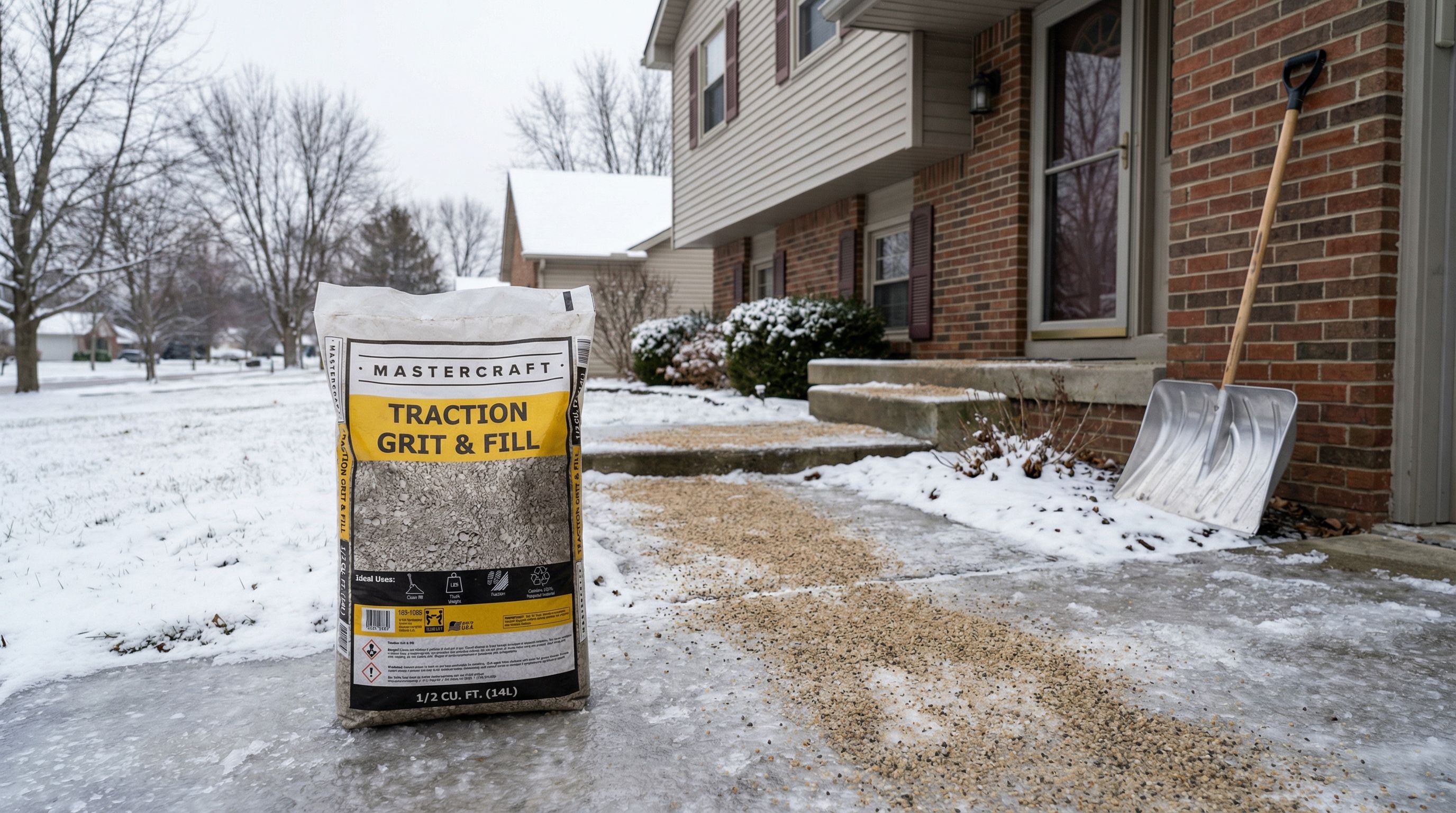
Every winter, the same scenario plays out in driveways across Ohio: you apply ice melt, wait, and the ice doesn't budge. Maybe it's 5°F and the calcium chloride is at the edge of its range. Maybe it's an old concrete driveway and you're trying to minimize chemical exposure. Maybe you just need grip right now — and ice melt takes time to work. That's exactly where Mastercraft Traction Grit & Fill (0.5 cf) earns its place in the winter toolkit. It doesn't melt ice — it gives you traction on top of it, immediately, without any chemical risk to your concrete or landscaping. We carry it at Liberty Farm, Home & Garden in Galion, Ohio.
Why Ice Melt Alone Isn't Always Enough
Ice melt products work by lowering the freezing point of water, causing the ice to melt from below. In the right conditions — temperatures above their effective range, time to work, thin ice layers — they're extremely effective. But they have real limitations that most people discover the hard way.
The biggest limitation is temperature. Each ice melt product has a lower working threshold:
- Rock salt (sodium chloride): Works to about 15°F — loses effectiveness quickly below that
- Magnesium chloride: Effective to about 0°F
- Calcium chloride: Rated to -25°F, but practically less effective below -10°F
Ohio winters routinely hit the single digits and below zero — especially overnight. At those temperatures, even the best ice melt products slow down dramatically or stop working entirely. You spread the product, wait, and the driveway is still a sheet of ice when you go to leave for work.
The second limitation is time. Ice melt is a slow process even under ideal conditions. A fresh ice melt application on thick ice takes 15–30 minutes to start softening the surface — longer at colder temperatures. If you need to get to your car, take the dog out, or help an elderly family member down the front steps right now, that wait isn't acceptable.
The third limitation is concrete. Ice melt chemicals — particularly chloride-based products — accelerate concrete deterioration over time. The freeze-thaw cycling that chlorides cause at the surface layer chips away at concrete, especially on driveways and steps less than five years old. For older decorative concrete, pavers, or any surface you want to preserve, reducing chemical ice melt use matters.
Traction grit addresses all three of these gaps. It doesn't care about temperature. It works in seconds. It has no chemical interaction with your concrete at all.
What Traction Grit Actually Does
Mastercraft Traction Grit & Fill is an angular mineral grit — the same principle as sand or gravel, but with angular particle geometry designed to grip and embed slightly into the ice surface rather than just sitting on top of it. When you spread traction grit on ice, the angular particles create contact points between your boots and the ice surface, dramatically reducing the slip risk even on a completely frozen, mirror-smooth sheet of ice.
This works because traction — the friction that prevents slipping — comes from surface contact. On bare ice, your boot's rubber sole has almost nothing to grip. A layer of angular grit gives that sole something to grab, the same way gravel gives tire treads something to dig into on a muddy road.
The mechanism is mechanical, not chemical. There's nothing to activate, nothing to wait for, and no temperature at which it stops working. Traction grit at -20°F works exactly the same way it does at 30°F. That's the fundamental advantage.
| Feature | Details |
|---|---|
| Product Type | Angular traction grit (non-chemical) |
| Coverage | 0.5 cubic feet per bag |
| Works at all temperatures | Yes — no temperature minimum |
| Safe for concrete | Yes — no chemical interaction |
| Works immediately | Yes — traction on contact |
| Safe for pets | Yes — no chemical components |
| Best Use Cases | Steps, walkways, driveways, loading areas |
| Can be combined with ice melt | Yes — works well in combination |
When to Reach for Traction Grit First
There are specific situations where traction grit is the right first move — either instead of, or before, applying ice melt.
Temperatures below 10°F. At these temperatures, ice melt products slow to a near-crawl. Spreading traction grit gives you immediate grip while any ice melt you apply works its way into the surface over a longer period.
Immediately after a freezing rain event. Freezing rain coats surfaces instantly and creates the most dangerous ice conditions — a thin, transparent glaze on every surface. Traction grit applied right after freezing rain stops can make a driveway and walkway navigable before the ice melt has time to work.
On steps and entrances. These are your highest-risk fall zones. Traction grit on steps gives grip underfoot immediately. Combined with a handrail, it makes the most dangerous part of a winter driveway navigable even in extreme cold.
When protecting concrete from chemical damage. If you have newer concrete (less than three years old), decorative pavers, or colored concrete, minimizing ice melt exposure protects the surface. Traction grit gives you the safety you need without the chemical trade-off. Save the ice melt for the driveway center and use grit on the areas where foot traffic is heaviest.
When you need a vehicle to get traction. Traction grit spread in front of drive wheels that are spinning on ice gives tires immediate grip — far faster than waiting for ice melt. Keep a bag in the car during winter for exactly this scenario.
Using Traction Grit and Ice Melt Together
For most Ohio winters, the optimal approach is to keep both products on hand and use them for what each does best. They're not competing solutions — they're complementary tools for a layered approach to winter safety.
A practical combination strategy:
- Apply ice melt proactively — before a storm or immediately after snowfall ends — to work on the ice layer over time
- Apply traction grit immediately for walkways, steps, and any area where foot traffic creates slip risk right now
- Use grit at the base of steps where ice pools from runoff, and along any slope where ice melt tends to wash away before it works
- Reapply grit after heavy traffic — foot traffic and shoveling displace the grit over time, especially on flat surfaces
Products that work well alongside Mastercraft Traction Grit include Prestone Driveway Heat Calcium Chloride Pellets (9.5 lb) for serious cold-temperature ice melt performance, and Peladow Calcium Chloride Pellets (50 lb) for properties with long driveways or heavy use that benefit from a larger supply on hand.
A True Temper Steel Snow Shovel (18") rounds out the winter safety toolkit — clearing snow down to the pavement surface first means both your ice melt and traction grit go further and work more effectively.
Coverage: How Much Do You Need?
One 0.5 cubic foot bag of Mastercraft Traction Grit covers a typical residential driveway apron and front walkway for multiple applications. Application thickness matters more than area — a thin, even spread of grit across the full surface is more effective than a heavy pile in one spot.
For a standard two-car driveway, a single bag provides enough grit for several meaningful applications of high-traffic zones (steps, the path to the car, the driveway entrance). For a larger property, a commercial driveway, or a home with an elevated fall-risk occupant, keeping two to three bags on hand through the winter is reasonable.
One important note on cleanup: traction grit does not disappear like ice melt. When the winter is over and the ice melts, the grit remains on the driveway surface and will wash into landscaping or accumulate at the edge of the pavement. A push broom or leaf blower makes spring cleanup straightforward. The grit that washes into grass and garden beds is inert and harmless — it's mineral material, not a chemical — so there's no concern about plant damage.
Pet and Landscape Safety
One of the underrated advantages of traction grit over chemical ice melt is its safety profile for pets and landscaping. Chloride-based ice melt products can irritate dogs' paw pads on contact, cause digestive upset if ingested, and damage grass and plants along walkway edges when they wash off. These aren't catastrophic risks, but they're real concerns for pet owners and gardeners who are careful about what they expose their yards to.
Traction grit has none of these concerns. It's angular mineral material — essentially coarse sand or crushed stone. Dogs can walk through it, track it inside, and even ingest small amounts without harm. It won't burn paw pads, won't cause lawn damage at the driveway edges, and won't affect pets who lick their feet after a winter walk.
For households with dogs who are sensitive to ice melt — or owners who prefer to minimize chemical use around their pets and landscaping — Mastercraft Traction Grit is a straightforward answer.
Traction Grit for Commercial and Farm Use
Residential driveways and front steps are the most common application, but traction grit has practical uses on farms and small commercial properties that ice melt doesn't cover as well.
Barn entrances, loading dock approaches, and the concrete aprons in front of outbuildings all get heavy foot and vehicle traffic in winter — and ice in these areas creates serious injury and liability risk. Traction grit applied to a barn concrete floor entrance or loading dock provides grip immediately and holds up under repeated foot traffic better than ice melt that tends to be tracked away quickly.
For equine facilities, chemical ice melt near horse traffic areas carries risks — horses that investigate the product or encounter it in concentrated runoff can experience hoof and skin irritation. Traction grit in these areas gives the necessary grip without any chemical exposure risk to animals.
Getting Traction Grit at Liberty Farm, Home & Garden
We carry Mastercraft Traction Grit & Fill (0.5 cf) at Liberty Farm, Home & Garden in Galion, Ohio, alongside our full winter safety selection including calcium chloride pellets, snow shovels, and windshield de-icer. If you're putting together a complete winter supply, stop in — we can help you figure out what combination of products makes sense for your driveway, your climate exposure, and your household's needs. You can also order online at libertyfhg.com.
Frequently Asked Questions
Keep Reading

Bring Houseplants Indoors Before the Chill: An Ohio Fall Transition Guide
Learn when and how to bring houseplants indoors in Ohio, inspect for pests, acclimate light, reset watering, and avoid common fall mistakes.

When Are Apples Ready? A North-Central Ohio Harvest and Storage Guide
Know when Ohio apples are ripe, how to pick them correctly, which fruit to store, and how to keep a backyard harvest crisp longer.