
The Low-Maintenance Ground Cover That Never Fades: A Complete Guide to New Plant Life Western Sunset Decorative Rock
How this desert-inspired orange, red, and charcoal landscape rock from Markman Peat transforms Ohio yards — and why it outperforms mulch for long-term curb appeal
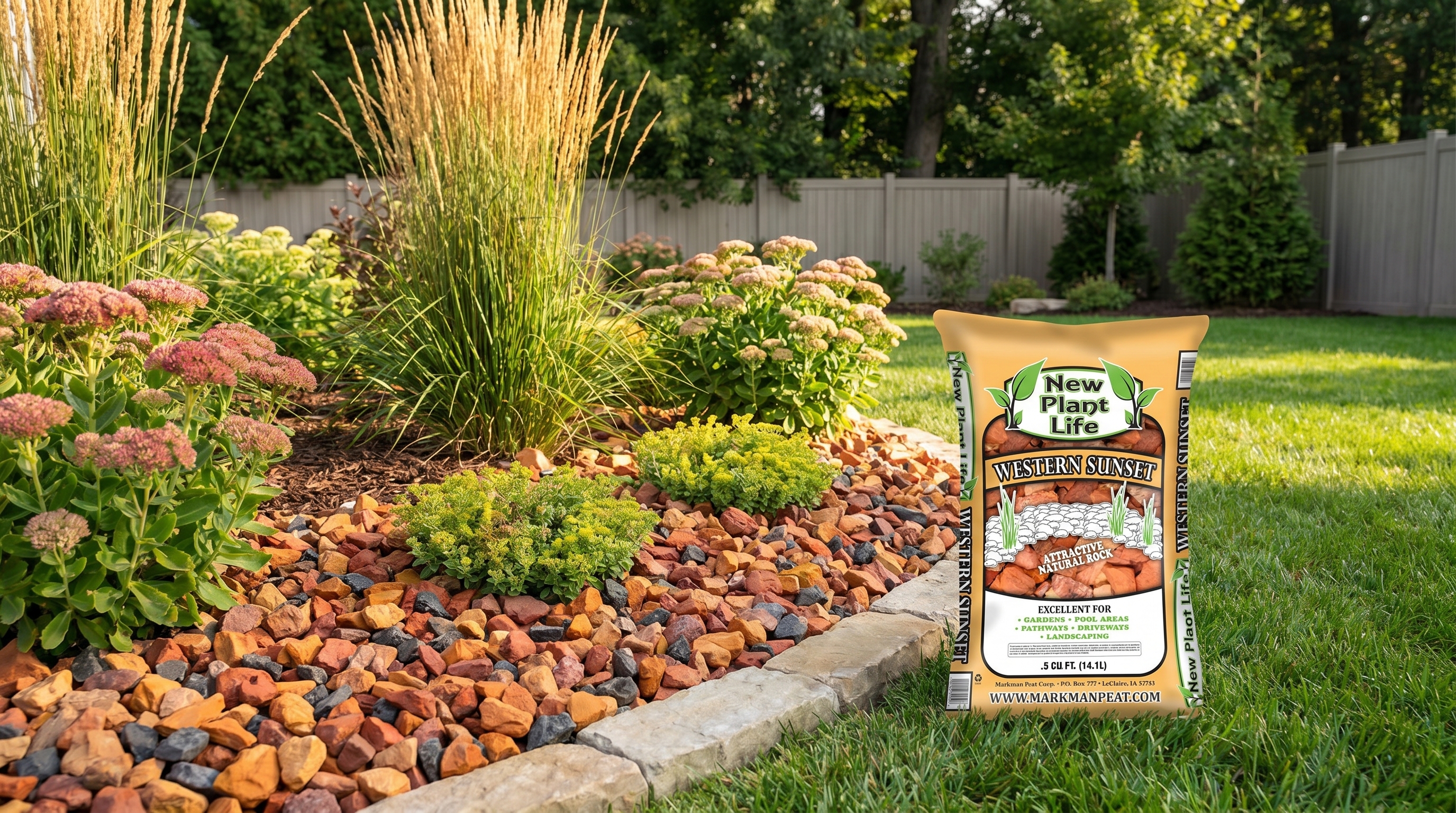
Every spring, the same ritual: drag out the bags of mulch, spread it around the beds, step back and admire the fresh look — and then watch it turn gray, wash down the driveway in the first heavy rain, and mat into a soggy layer that smothers plant roots by July. Organic mulch has its place in the landscape, but as a long-term ground cover solution, it demands constant reinvestment in both money and labor. Decorative rock does not. New Plant Life Western Sunset (0.5 cf) from Markman Peat is a natural decorative landscape rock that brings warm desert tones — bright orange, deep red, and dark charcoal — to Ohio beds, borders, and pathways without fading, floating, or decomposing. It's available at Liberty Farm, Home & Garden in Galion, Ohio, and it's built for homeowners who want a striking, low-maintenance ground cover they can install once and actually trust to stay put.
What Is New Plant Life Western Sunset? Understanding the Product
New Plant Life Western Sunset is a bagged decorative landscape rock sold in 0.5 cubic foot bags. The rock features a distinctive color palette inspired by western desert landscapes: bright orange, warm red, and dark charcoal tones mixed throughout each bag. These colors come from the natural mineral composition of the stone — they are inherent to the rock itself, not applied dyes or coatings.
That distinction matters a great deal. Dyed mulch and artificially colored decorative aggregates lose their color as the pigment leaches out and UV light breaks down the coating. Natural stone holds its color because the color is mineral composition, not surface treatment. The orange in Western Sunset looks like orange because of iron oxide and other mineral pigments embedded in the rock structure — they don't fade in sunlight, wash off in rain, or bleach out over Ohio's freeze-thaw winters.
Markman Peat is a well-established landscape material supplier with a product line focused on practical outdoor solutions — potting mixes, soil amendments, and decorative aggregates. The New Plant Life line is their decorative stone offering, designed for residential landscaping where appearance and longevity both matter.
Key product characteristics:
- Natural stone — not manufactured aggregate, not dyed material. The color is mineral-based and permanent.
- Warm desert color palette — bright orange, deep red, and dark charcoal tones mixed throughout. The visual effect is dramatic in direct sun and warm in shade.
- Weather-resistant — does not decay, fade significantly in sunlight, absorb water, or break down from freeze-thaw cycling. Ohio winters do not affect decorative rock the way they affect organic ground covers.
- Low-maintenance permanence — once installed, Western Sunset does not need seasonal replacement. It stays where you put it, holds its color, and requires only occasional rinsing or raking to look its best.
Why Organic Mulch Fails as a Long-Term Ground Cover (and What to Do Instead)
Organic mulch is not a bad product — it has legitimate applications, especially in vegetable gardens and new planting beds where decomposition adds organic matter to the soil. But as a permanent curb-appeal ground cover in landscaped beds, borders, and pathways, it has a set of structural problems that decorative rock sidesteps entirely:
- Color fade. Fresh mulch looks great for about six to eight weeks. After that, UV exposure turns most organic mulch gray regardless of the original color. Dyed mulch holds a bit longer but still fades within one season and loses color faster in wet climates. Ohio summers are sunny and humid — a combination that accelerates mulch color degradation.
- Displacement in rain. Mulch floats. A single heavy rainstorm can wash mulch off sloped beds, out of borders, and onto driveways, sidewalks, and lawn areas. This is particularly pronounced in Ohio's spring and fall, when heavy precipitation events are common. Decorative rock, at roughly 50 pounds per 0.5 cubic foot bag, stays where it's placed through essentially any rainfall event.
- Decomposition and mat formation. Organic mulch breaks down over one to three years, creating a mat layer that can impede water and air penetration to plant roots. As it decomposes, it also sinks and thins — requiring top-dressing or full replacement to maintain adequate depth. Rock does not decompose. Ever.
- Annual labor and cost. Mulch needs to be refreshed every one to three years in most Ohio landscapes. That means buying new bags, hauling them to beds, spreading, and disposing of the degraded old material. Decorative rock is an install-once project — the upfront effort pays dividends for decades.
- Pest harboring. Thick mulch provides excellent habitat for voles, slugs, and other garden pests that burrow beneath the surface. Decorative rock does not provide the same hospitable conditions, and many pest species avoid rocky ground cover.
The trade-off with decorative rock is that it does not contribute organic matter to the soil — so it's better suited to established plantings and ornamental beds where soil fertility is maintained through fertilization rather than decomposition. For beds with mature shrubs, perennial borders, pathways, and foundation plantings, it's typically the superior long-term choice.
Where Western Sunset Works Best: Landscape Applications in Ohio
The warm orange, red, and charcoal palette of Western Sunset is visually distinctive — it reads as warm and bold, particularly against green plantings or light-colored hardscape. The right application plays to those strengths:
- Foundation plantings. The strip of mulched bed along a house foundation is one of the highest-visibility landscaping areas — and one of the most labor-intensive to maintain with organic mulch, since it's typically close to the structure and hard to access. Western Sunset works beautifully here, especially against tan, gray, or brick home exteriors. The warm tones complement brick particularly well.
- Ornamental bed borders and islands. Rock-filled beds with ornamental grasses, yucca, sedum, or other drought-tolerant perennials look intentionally designed when the ground cover color coordinates with the plantings. Western Sunset's desert palette pairs naturally with ornamental grasses and native plantings that thrive in well-drained conditions.
- Pathway edging and infill. Decorative rock functions well as pathway infill or as the edging material along flagstone or paver paths. The bold color creates a clear visual boundary that guides foot traffic and frames the path.
- Slopes and erosion-prone areas. Beds on slopes are notoriously hard to mulch — the material migrates downhill with every rain. Rock stays put on moderate slopes without erosion control fabric (though fabric underneath is always a good idea on steeper grades).
- Rain garden borders and swale edges. In areas that receive concentrated water flow, rock ground cover performs far better than organic mulch, which would wash away. Decorative stone remains stable in areas of periodic water flow.
- Xeriscape and low-water planting areas. Ohio isn't a desert, but the principles of water-wise landscaping apply here — especially during August droughts. Decorative rock mulch reduces soil evaporation and is a natural aesthetic complement to drought-tolerant planting designs.
How to Calculate Coverage: How Much Western Sunset Do You Need?
Each 0.5 cubic foot bag of New Plant Life Western Sunset covers approximately 2 square feet at a 3-inch depth — the minimum recommended depth for effective weed suppression and a full coverage look. At 2 inches deep, coverage expands to about 3 square feet per bag. At 4 inches, coverage is closer to 1.5 square feet per bag.
The depth decision matters:
- 2 inches: Adequate for visual ground cover effect in established, low-weed beds. Minimal weed suppression. Not recommended as the primary weed management layer.
- 3 inches: The standard recommended depth. Provides good weed suppression, a full visual coverage effect, and enough depth to settle over time without becoming thin. Most residential landscape applications should target 3 inches.
- 4 inches: Maximizes weed suppression and gives the bed a lush, filled-in look. Appropriate for high-weed-pressure areas, newly prepared beds, or areas where maintenance access is difficult.
To calculate your bag count:
- Measure your bed length and width in feet. Multiply for square footage.
- For 3-inch depth: divide square footage by 2 to get bag count. Example: a 10 ft × 6 ft bed = 60 square feet ÷ 2 = 30 bags.
- Add 10% for settling, irregular bed edges, and overage. Round up to the next whole number.
- For irregular beds, estimate the rough square footage (length × average width is usually close enough for purchasing purposes).
A word on settling: decorative rock compacts over the first season as the individual stones nestle together and small particles filter down. A freshly installed 3-inch rock bed may settle to roughly 2.5 inches after the first summer. Planning slightly deeper than the minimum — and buying a few extra bags — is smart for any first-time installation.
Installation Guide: Putting Down Western Sunset Correctly
Decorative rock installation is a one-time job that determines how the bed looks and performs for years. Cutting corners during installation is the most common reason decorative rock beds become weed-infested or look patchy. Here's how to do it right:
- Clear the bed completely. Remove all existing mulch, weeds, grass, and debris. Weeds growing into rock from beneath the installation are far harder to manage than weeds germinating from seed on top — and they will be persistent if left in place. Pull by hand, use a hoe, or apply a pre-emergent herbicide before installation (follow label directions for timing relative to rock placement).
- Grade and shape the bed edges. A clean, defined edge makes the finished installation look intentional. Use a flat spade or edging tool to cut a crisp border between the bed and surrounding lawn or hardscape. Plastic or metal landscape edging is optional but helps contain rock from migrating into the lawn over time — particularly worth installing if you're working adjacent to turf.
- Install landscape fabric (weed barrier). This is the most important step for long-term weed suppression. Lay woven landscape fabric over the cleared bed, overlapping seams by at least 6 inches. Use landscape staples every 12 to 18 inches to secure the fabric, particularly at edges and around plant stems. Cut X-shaped openings for existing plants. Avoid cheap, non-woven fabric — it breaks down quickly and allows root penetration. A quality woven geotextile fabric lasts 10 to 15 years under decorative rock.
- Place rock at consistent depth. Pour bags and spread evenly with a rake. Work from the back of the bed toward you to avoid walking on freshly placed rock. Target your chosen depth consistently — patchiness in rock depth shows visually. Use a depth gauge (a marked stick works) to check periodically as you go.
- Tuck edges and clean up. Push rock firmly against edging, building structures, and plant stems. Sweep any displaced rock off adjacent hardscape immediately — rock on a walkway or driveway is a slip hazard and will damage lawn mower blades if it migrates to turf areas.
- Water in lightly. A light rinse after installation settles the rock, removes surface dust, and lets the colors show at their best. The orange and red tones of Western Sunset are particularly vivid when damp — this is a good preview of what the bed will look like after rain.
Maintaining a Decorative Rock Bed Over Time
One of the primary appeals of decorative rock is reduced maintenance compared to organic mulch. That said, "low maintenance" is not "no maintenance." Here's what a Western Sunset bed needs to look its best over the years:
- Occasional raking. Leaves, pine needles, and windblown debris collect in rock beds. A light raking in spring and fall removes organic matter before it breaks down and creates a seedbed for weeds on top of the rock surface. A leaf blower works well for clearing light debris from rock beds without disturbing the stone.
- Spot weed removal. Even with landscape fabric, some weed seeds will germinate in the organic layer that slowly accumulates on top of the rock. Catching weeds early — when they're small and roots are shallow — is far easier than managing established weeds that have rooted around the fabric. A quick walk-through every few weeks during the growing season keeps weed pressure minimal.
- Top-dressing as needed. Rock beds do not need annual replacement, but they can thin slightly over years as stones work their way into the soil at edges, are displaced by foot traffic, or are scattered by overly enthusiastic raking. Adding a partial bag of Western Sunset every few years maintains depth and keeps the bed looking full.
- Rinsing for color refresh. Natural stone looks its best when clean. A quick pass with a garden hose after a dry spell washes off dust and surface grime and brings the orange and red tones back to their full vibrancy. This takes five minutes and makes a noticeable difference in bed appearance.
Pairing Western Sunset with Plants and Other Materials
The warm desert palette of Western Sunset works best when the plants and surrounding materials are chosen thoughtfully. A few pairing principles that work well in Ohio landscapes:
- Ornamental grasses: The fine texture of grasses — Little Bluestem, Karl Foerster Feather Reed Grass, Blue Oat Grass — contrasts beautifully with the coarse texture of decorative rock. The orange-and-charcoal combination of Western Sunset plays particularly well with the bronze fall color of Little Bluestem.
- Sedum and stonecrop: Low-growing sedums are natural companions to decorative rock. They're drought-tolerant, spread to fill gaps, and their fleshy leaves read well against the angular rock texture. Dragon's Blood Sedum with its red foliage is a particularly effective combination with Western Sunset's warm tones.
- Yucca and agave-style ornamentals: Hardy yucca varieties thrive in Ohio and create the most literal desert garden effect when combined with Western Sunset rock. The bold sword-like foliage against orange and charcoal stone looks intentionally designed.
- Black-eyed Susans and coneflowers: Ohio's native prairie perennials in yellow and purple read vibrantly against warm-toned stone. A planting of these natives mulched with Western Sunset creates a naturalistic, low-maintenance bed that supports pollinators throughout the summer.
- Gray or charcoal concrete edging: Charcoal-toned concrete curb edging or pavers emphasize the dark charcoal component of Western Sunset and create a sophisticated, cohesive look. Avoid red brick edging — it can clash with the orange tones rather than complement them.
| Specification | Details |
|---|---|
| Product | New Plant Life Western Sunset |
| Brand | Markman Peat |
| Bag Size | 0.5 cubic foot (~50 lbs) |
| Color Palette | Bright orange, warm red, dark charcoal — natural mineral coloration |
| Coverage at 2 inches | ~3 sq ft per bag |
| Coverage at 3 inches | ~2 sq ft per bag |
| Coverage at 4 inches | ~1.5 sq ft per bag |
| Color Type | Natural mineral — will not fade or wash off |
| Decomposition | None — permanent ground cover material |
| Best Applications | Foundation beds, ornamental borders, pathways, slopes, xeriscape areas |
| Recommended Depth | 3 inches for standard installation |
| Available At | Liberty Farm, Home & Garden, Galion, Ohio |
Related Stone, Gravel, and Landscape Supplies at Liberty Farm, Home & Garden
Liberty Farm, Home & Garden carries a range of stone and landscape aggregate options for different applications:
- Hydrofarm GROW!T Clay Pebbles (10L) — 100% natural expanded clay aggregate in a 4mm–16mm size range. These pebbles are best known for hydroponic and container applications — they provide excellent drainage, air circulation, and root support without compacting. Also useful as a decorative topdress in container plantings and as a drainage layer beneath potting mix in deep containers.
- Hydrofarm GROW!T Clay Pebbles (40L) — The larger format for bigger hydroponic systems, raised bed drainage layers, or larger container applications. Same product, better value per volume for higher-quantity needs.
- #8 Gravel — Cubic Yard — Bulk gravel for driveway topping, drainage trenches, utility area ground cover, and large-scale landscape projects where bagged decorative rock would be impractical. If your project covers hundreds of square feet or you're doing a driveway or parking area, cubic yard quantities are the right scale.
- #8 Limestone — Cubic Yard — Crushed limestone aggregate for similar applications to #8 gravel. Limestone has the added benefit of slightly alkalizing soil over time as it weathers — useful in Ohio's naturally acidic soils if you're using it around plantings that prefer neutral to slightly alkaline conditions.
Frequently Asked Questions
Keep Reading
Plant Cover Crops Now: An Ohio Home Garden Guide
Plant fall cover crops in an Ohio vegetable garden with practical guidance on timing, species, seeding, winter care, and spring termination.

Save This Summer’s Garden: A Practical Ohio Seed-Saving Guide
Save tomato, bean, pea, lettuce, marigold, zinnia, and other garden seeds with this practical late-summer guide for Galion and north-central Ohio.