
Why Your Pond Turns Green Every Summer — and How Crystal Plex Liquid Algaecide Finally Fixes It
Why dry copper sulfate falls short for pond algae control, and how Crystal Plex Liquid Algaecide distributes evenly through the water column to eliminate filamentous, chara, and planktonic algae in ponds and lakes
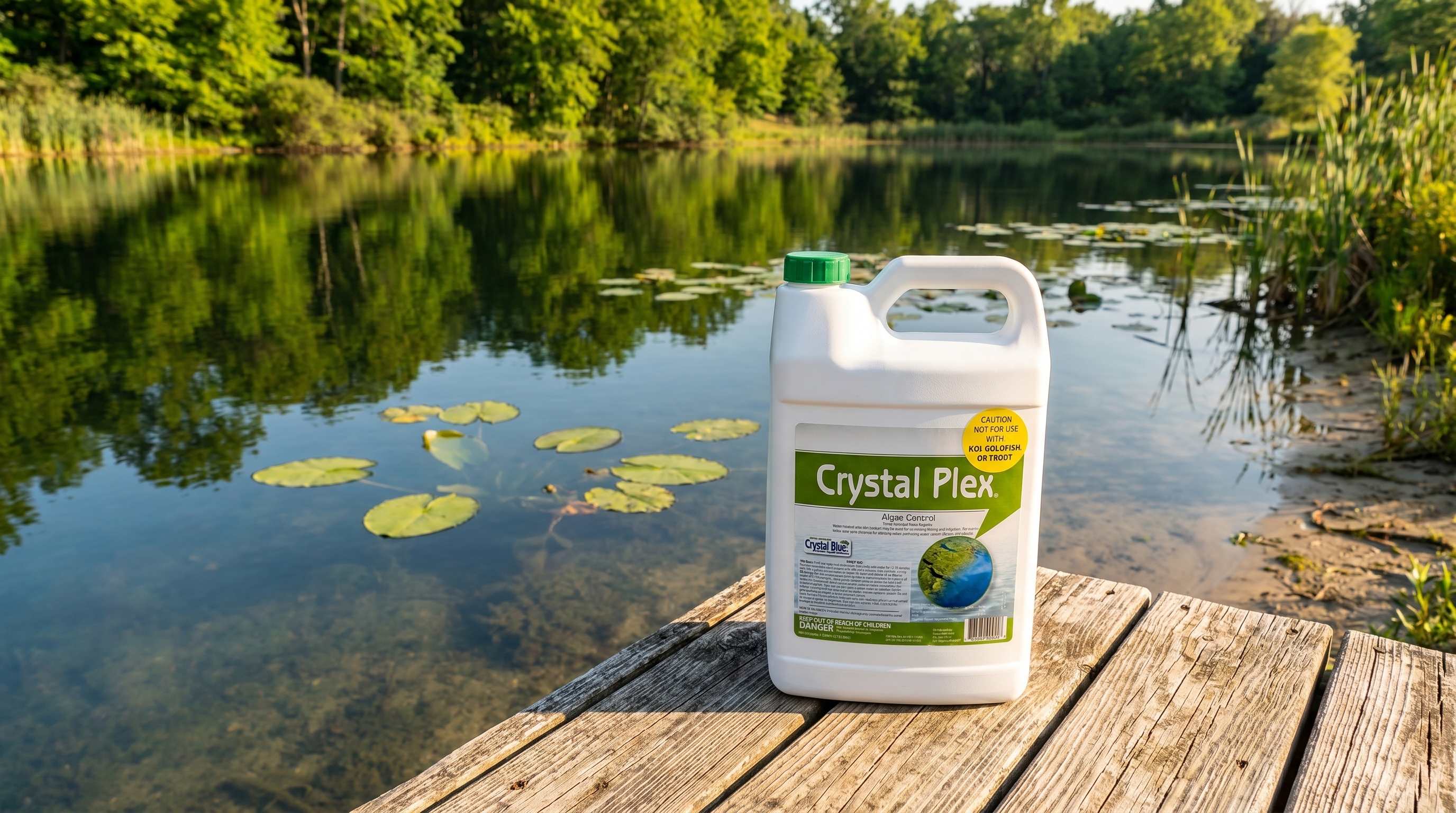
Every spring, Ohio pond owners watch the same slow-motion disaster unfold: water that was clear through winter turns hazy by April, develops a green tint through May, and becomes a thick, smelly mat of algae by June. By midsummer, the pond that was supposed to be a swimming hole, a fishing spot, or a livestock water source has turned into an eyesore that nobody wants to go near. The algae didn't appear overnight — it built up through weeks of warming temperatures, increasing sunlight, and nutrient loading from winter runoff — but by the time most people reach for a treatment, they're already behind. The challenge with treating pond algae isn't just choosing the right chemistry: it's getting that chemistry distributed evenly through the water where algae is actually growing. The Crystal Plex Liquid Algaecide from Sanco Industries solves that distribution problem directly — it's a professional-grade liquid copper sulfate solution that stays dissolved in the water column rather than sinking to the bottom, treating the full depth of your pond where algae lives and grows. Liberty Farm, Home & Garden in Galion, Ohio carries Crystal Plex Liquid Algaecide so farm pond owners, property managers, and rural homeowners can get ahead of algae season before it takes over.
Why Pond Algae Gets Out of Control So Fast
Algae are not plants in the traditional sense, but they behave like highly competitive plants when conditions favor them. They photosynthesize using sunlight and consume dissolved nutrients — primarily phosphorus and nitrogen — to grow. In most ponds, both sunlight and nutrients are available in abundance, especially from late spring through early fall. Winter ice cover limits algae growth significantly, but as water temperatures climb above 50°F in April and May, dormant algae spores and cells begin multiplying rapidly.
Nutrient loading accelerates this process. Every rain event washes fertilizer residue, agricultural runoff, decomposing leaves, and organic material into ponds from the surrounding watershed. Livestock that have access to the pond edge add waste directly to the water. The combination of warming temperatures, increasing day length, and elevated nutrients creates conditions where algae can double its population in less than a day under ideal circumstances.
There are three major categories of algae that affect Ohio farm ponds and lakes. Filamentous algae — the long, stringy, hair-like mats that accumulate along shorelines and at the surface — are the most visually obvious and most commonly reported problem. Planktonic algae are the single-celled varieties that turn water uniformly green or pea-soup colored without forming visible strands. Chara is a more complex algae often confused with aquatic plants — it forms dense underwater mats and has a distinctive musty smell. All three types respond to copper-based treatment, but only if that treatment reaches them where they're growing rather than sinking out of the water column before contact is made.
The Problem with Dry Copper Sulfate in Ponds
Copper sulfate is the most widely used algaecide chemistry for ponds and lakes, and it has a solid track record of effectiveness when it reaches the algae. The problem is delivery. Dry copper sulfate — the blue crystal or powder form most pond owners have encountered — has a fundamental physics problem: it's dense and it sinks. When granular or crystalline copper sulfate is broadcast across a pond surface, a portion dissolves in the upper water column, but a significant fraction sinks before fully dissolving and concentrates on the pond bottom where the most abundant algae growth often isn't located.
This creates uneven treatment. Surface planktonic algae and shallow filamentous mats may receive a therapeutic dose of copper, while deeper algae colonies remain untreated. Treatment zones near where dry copper sulfate was applied may be temporarily clear while areas at distance or at different depths show no improvement. The result is partial control at best — a week or two of improvement followed by rapid algae regrowth as untreated areas expand back into treated zones.
Dry copper sulfate also presents handling challenges. The crystals can be irritating to skin and eyes during broadcast application, and getting uniform distribution across an irregular pond surface from a boat or the pond edge is difficult. Clumping in humid conditions affects the consistency of application. These handling and distribution limitations add up to inconsistent results that frustrate even experienced pond owners who are doing everything right by the label.
How Crystal Plex Liquid Algaecide Solves the Distribution Problem
The Crystal Plex Liquid Algaecide is a professionally formulated liquid copper sulfate solution that is already dissolved when you apply it. Because it begins as a liquid rather than a solid, it disperses through the water column immediately on contact rather than requiring time to dissolve from granule form. The copper stays in solution in the water column — where algae lives and grows — rather than concentrating on the bottom.
This even distribution makes a measurable difference in treatment effectiveness. When copper is distributed through the water column rather than concentrated at the bottom, every cubic foot of water in the treatment zone receives a working dose of the algaecide. Planktonic algae suspended throughout the water column is exposed. Filamentous mats growing at multiple depths are reached. Chara growing across the bottom receives treatment from above through the water column rather than relying on bottom contact from settled granules.
Crystal Plex also controls certain aquatic weeds in addition to algae, which gives it broader utility in ponds where both algae and invasive vegetation are issues. The product is labeled for livestock watering and irrigation use when applied at label rates — a critical feature for farm ponds that serve dual purposes as livestock water sources and agricultural irrigation reservoirs. A treatment that requires removing livestock from the water source for weeks at a time creates operational problems that make algae treatment impractical; label compliance with Crystal Plex allows livestock watering to resume on a much more manageable schedule.
Types of Algae Crystal Plex Controls
Understanding which algae types Crystal Plex targets helps set accurate expectations for treatment and recovery timelines.
Filamentous algae are the stringy, matting algae that accumulate in visible clumps along pond shorelines, on the water surface, and tangled around aquatic plants. Common filamentous species include Spirogyra, Cladophora, and Pithophora. These are often the first algae type pond owners notice because the mats are physically obvious and can cover large surface areas rapidly. Crystal Plex is effective against filamentous algae when applied before mats become extremely thick — dense mats can partially shield interior cells from contact with the algaecide, which is why early-season treatment before mats consolidate produces better results.
Planktonic algae are the microscopic single-celled species that turn water uniformly green, yellow-green, or blue-green. Blue-green algae — technically cyanobacteria — are the most concerning planktonic variety because certain species produce toxins that can sicken livestock and wildlife. Planktonic algae treatment with liquid copper is particularly effective because the algae cells are suspended throughout the water column, already in direct contact with the dissolved copper solution as it distributes.
Chara is a more complex algae type that resembles a submerged plant but lacks true leaves, roots, and vascular tissue. It grows in dense underwater mats that can cover pond bottoms and crowd out beneficial submerged vegetation. Chara has a distinctive musty or sulfurous smell when disturbed. Copper-based treatment penetrates through the water column to reach chara growing below the surface, which is where the advantage of a solution over settled granules is most significant.
Application Timing: When to Treat for Best Results
Timing is one of the most important factors in pond algae treatment success. The biology of algae and the chemistry of copper-based treatments both respond to water temperature and dissolved oxygen levels in ways that make some application windows significantly more effective than others.
Early season treatment (late April through May in Ohio) is the most strategically sound approach. Algae populations are building but have not yet reached peak density. Treating a smaller population before it reproduces through multiple generations requires less product and produces cleaner results. Early-season water temperatures also help: below 70°F, the risk of oxygen depletion from algae die-off is lower because the rate of bacterial decomposition of dead algae material is slower in cooler water.
Avoid treating during oxygen-stressed conditions. When algae populations are extremely dense and water temperatures are high (above 75°F), a sudden mass algae kill can deplete dissolved oxygen as bacteria decompose the dead material rapidly. This can cause fish kills even when the copper treatment itself is applied correctly. In these conditions, treat in sections — no more than one-third of the pond at a time — and allow 7 to 10 days between sections for the system to stabilize before treating the next area.
Treat in the morning when dissolved oxygen levels are typically highest in the pond following overnight photosynthesis and before afternoon temperature peaks. Avoid treating on days with extremely high air and water temperatures. If possible, treat on calm days when wind-driven circulation won't concentrate the product in one area of the pond.
Reapplication. A single treatment in May may not control algae through the entire summer. Algae regrowth from surviving cells and spores typically begins within 4 to 8 weeks. Regular monitoring and reapplication as needed through the season — combined with nutrient management where possible — is the most effective long-term management approach.
Pond Volume Calculation: Getting Your Application Rate Right
The most common reason copper-based algae treatments fail isn't product quality — it's incorrect dosing based on surface area alone without accounting for pond depth. Algaecide rates are based on volume (acre-feet), not surface area (acres). Two ponds with the same surface area but different depths require dramatically different amounts of product. Treating by area alone in a deep pond under-doses the water column; treating by area alone in a shallow pond may over-dose and stress fish.
To calculate your pond's volume in acre-feet:
- Measure the pond's surface area in acres. A surface area of one acre equals approximately 43,560 square feet.
- Estimate the average depth by measuring depth at multiple points across the pond and averaging.
- Multiply surface area (acres) × average depth (feet) = volume in acre-feet.
- Consult the Crystal Plex label for the recommended application rate in fluid ounces, quarts, or gallons per acre-foot for your target algae type.
For irregularly shaped ponds, break the area into approximate geometric sections, calculate each, and add them together. A small pond of 0.25 acres with 4 feet of average depth contains 1 acre-foot of water. A larger farm pond of 2 acres with 6 feet of average depth contains 12 acre-feet. The difference in product needed between these two ponds is significant, and getting the calculation right before you treat is the difference between effective control and wasted product.
Complementary Pond Management Products at Liberty Farm, Home & Garden
Algae control with Crystal Plex works best as part of a complete pond management approach. Algaecides kill existing algae, but they don't address the nutrient loading and light penetration conditions that allow algae to grow in the first place. Liberty Farm, Home & Garden carries products that complement algaecide treatment to create a healthier pond long-term.
Pond dyes work by limiting the sunlight that penetrates into deeper water, reducing the light available to algae and submerged aquatic plants. Used alongside algaecide treatment, dyes help prevent algae from re-establishing in the deeper zones of the pond. The Farm General Blue Pond Dye (2.5-Gallon) and Pond2O Black Dye (1-Gallon) are both available at Liberty Farm, Home & Garden and can be integrated into a seasonal pond management program alongside Crystal Plex treatments.
For ponds with heavier aquatic weed pressure alongside algae issues, Weedtrine® D Aquatic Herbicide targets submerged and emergent aquatic weeds that Crystal Plex does not address. Combining an aquatic herbicide for weed control with Crystal Plex for algae treatment addresses both vegetation problems in the same management program. If you prefer granular copper sulfate for certain applications — shallow areas or spot treatments — Copper Sulfate (5 lb) is also available at Liberty Farm, Home & Garden for situations where granular application is preferred.
| Specification | Details |
|---|---|
| Product | Crystal Plex Liquid Algaecide (1-Gallon) |
| Brand | Sanco Industries |
| Active Ingredient | Liquid copper sulfate solution |
| Algae Types Controlled | Filamentous algae, planktonic algae (including blue-green), and chara |
| Key Advantage Over Dry Copper Sulfate | Stays dissolved in the water column for even distribution; does not sink and concentrate on the bottom |
| Also Controls | Certain aquatic weeds |
| Livestock Watering | Safe for livestock watering and irrigation at label rates |
| Application Method | Liquid — applied directly to pond surface or water column; sprayer, outboard motor drip, or shoreline pour |
| Dosing Basis | Volume (acre-feet), not surface area alone |
| Best Treatment Window | Late April through May in Ohio before algae reaches peak density; morning application preferred |
| Available At | Liberty Farm, Home & Garden, Galion, Ohio |
Stop by Liberty Farm, Home & Garden in Galion, Ohio to pick up Crystal Plex Liquid Algaecide and get your pond treatment on schedule before algae season hits full swing. Our team can help you identify the right products for your pond's specific algae situation and put together a complete management plan — from algaecide to pond dye — so you can enjoy clear water all season long.
Frequently Asked Questions
Keep Reading
Plant Cover Crops Now: An Ohio Home Garden Guide
Plant fall cover crops in an Ohio vegetable garden with practical guidance on timing, species, seeding, winter care, and spring termination.

Save This Summer’s Garden: A Practical Ohio Seed-Saving Guide
Save tomato, bean, pea, lettuce, marigold, zinnia, and other garden seeds with this practical late-summer guide for Galion and north-central Ohio.