
Why Your Tomatoes Keep Falling Over — and How the Right Hardwood Stake Finally Fixes It
A complete guide to using BigTree Packaged Hardwood Stakes (4 ft) in your vegetable garden — why height, wood quality, and stake count matter more than most gardeners realize
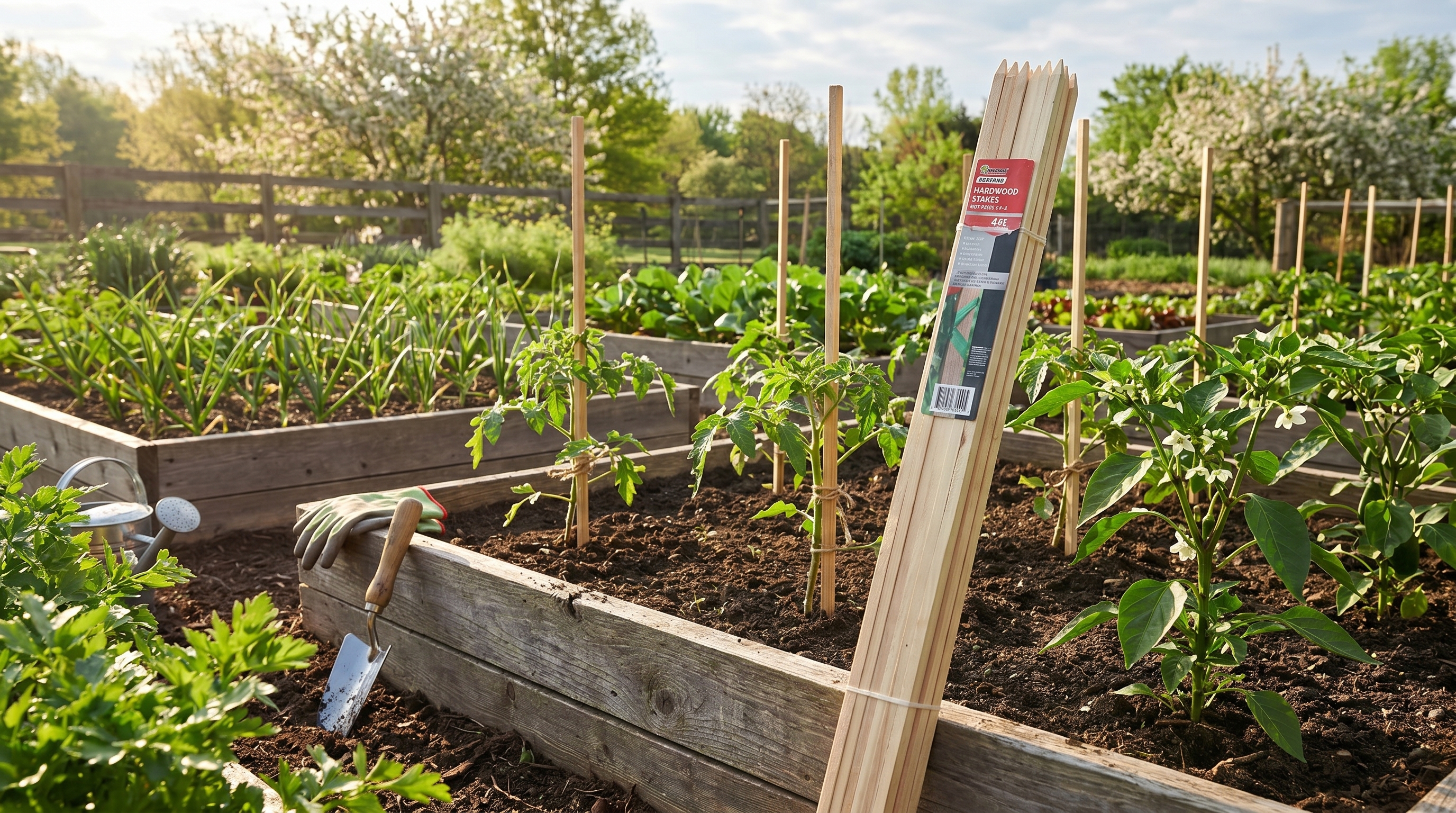
Every May in Ohio, the same avoidable disaster plays out in vegetable gardens across the state: a tomato plant loaded with fruit leans too far, snaps at the base, and takes weeks of growth with it. A pepper plant heavy with mature fruit tips sideways during a summer storm. A perennial you divided and replanted flops before it can establish. The cause in nearly every case isn't the plant — it's inadequate support installed too late, with stakes that weren't up to the job. BigTree Packaged Hardwood Stakes (4 ft) 6-Pack, available at Liberty Farm, Home & Garden in Galion, Ohio, is the straightforward answer to this perennial problem. Four-foot hardwood stakes give you enough height for most vegetable plants, the structural strength to hold them through Ohio's summer storms, and a 6-pack quantity that actually covers a full raised bed or a productive row without running short. This guide covers everything you need to know about using them well — from plant selection to staking technique to the situations where a cage or tower makes more sense.
Why Plant Support Is One of the Most Underrated Vegetable Garden Decisions
Most gardeners think about plant support as an afterthought — something to deal with once the plant is already flopping. That reactive approach is part of why it fails so often. Stakes driven into an established plant's root zone risk root damage. Ties added to a plant that's already leaning create stress points at the tie rather than distributing the load evenly. And by the time a plant is visibly struggling, it's already spent energy compensating for lack of support rather than producing fruit.
The smarter approach is installing support at planting time, or shortly after transplant, before the plant needs it. A 4-foot hardwood stake driven next to a freshly transplanted tomato doesn't constrain the plant — it creates the infrastructure the plant grows into, establishing the support relationship before fruit load and summer wind create the stresses that reveal insufficient support.
The timing argument matters especially in Ohio. North-central Ohio gets regular late-spring and summer convective storms — the kind with 30–40 mph gusts that arrive fast and hit hard. A tomato plant with no support and a full fruit load is a sail. The same plant tied to a solidly driven hardwood stake rides out those gusts with no damage. The five minutes it takes to stake at planting time is a reliable investment against the kind of damage that can cost a week of fruit production and the effort of significant cleanup and repair.
What Makes Hardwood Stakes Different from Bamboo or Metal
The garden stake market offers three main materials: bamboo, metal, and hardwood. Each has its context, but for Ohio vegetable gardens where stakes are expected to hold significant weight through a full growing season and ideally carry over into future seasons, hardwood has genuine advantages worth understanding.
Hardwood vs. bamboo: Bamboo stakes are light, inexpensive, and widely available, but they have a well-known failure mode — they snap under lateral load. A bamboo stake driven into soil and supporting a full-grown indeterminate tomato will often crack and fail under the weight of a loaded plant during wind. The hollow structure that makes bamboo light is also what makes it less resistant to the bending forces that a heavy plant exerts in a gusting wind. Hardwood stakes are solid throughout. The same stake diameter in hardwood carries significantly more load before failing, and when hardwood does fail it typically bends rather than snapping clean, which gives you time to intervene before the plant comes down.
Hardwood vs. metal: Metal stakes — typically coated steel or aluminum — are strong and long-lasting, but they conduct heat in direct summer sun, which can create localized stress at tie points and is occasionally a concern for sensitive plant tissue in contact with very hot metal. Metal stakes also cost more and add weight that makes them less practical for transport, storage, and seasonal turnover. For most vegetable garden applications, hardwood provides more than enough strength at lighter weight and lower cost.
Hardwood's durability profile: Quality hardwood stakes hold up for multiple growing seasons with basic care. At end of season, pull stakes, knock off soil, and store them dry. Hardwood that isn't constantly exposed to wet soil and standing moisture can last 3–5 seasons or longer, making the per-season cost substantially lower than purchasing bamboo stakes that need annual replacement.
Why 4 Feet Is the Right Height for Most Ohio Vegetable Gardens
Stake height is not a minor detail. A stake that's too short leaves the top third of the plant unsupported — which is exactly where most of the fruit load concentrates in indeterminate tomatoes. A stake that's too tall is unnecessary cost and may interfere with low-clearance growing structures like row covers or low tunnels.
Four feet hits the practical sweet spot for the vegetables most commonly grown in Ohio home gardens:
- Determinate tomatoes. Determinate (bush) tomato varieties — Roma, Celebrity, Rutgers — grow to a genetically fixed height, typically 3–5 feet. A 4-foot stake provides full-height support through the plant's mature form, and since determinate varieties ripen all their fruit within a concentrated window and then stop growing, the stake doesn't need to accommodate continued vertical extension. For most determinate varieties grown in Ohio home gardens, 4 feet is the right call.
- Indeterminate tomatoes at mid-season. Indeterminate varieties — Beefsteak, Cherokee Purple, Sun Gold, most heirlooms — continue growing all season and can reach 6–8 feet or taller. A 4-foot stake won't support an indeterminate tomato to its full height, but it provides structural support through the most critical phase of growth, when the plant is heavily loaded with immature and ripening fruit at mid-height. Many gardeners use 4-foot stakes for indeterminate tomatoes and manage vertical extension through aggressive pruning and side-shoot removal, keeping the plant within the stake's range.
- Bell and hot peppers. Most pepper varieties reach 2–4 feet at maturity. A 4-foot stake gives you full-height support for all common pepper types, from compact jalapeño plants to larger bell pepper varieties that become top-heavy when fully loaded. Peppers are brittle plants — their branches snap more easily than tomatoes under wind stress — making solid staking especially worthwhile.
- Perennials and small shrubs. Newly transplanted perennials — dahlias, delphiniums, peonies, tall coneflowers — frequently need support through their first season while root systems establish. A 4-foot stake provides the right support height for most tall perennials without overtopping the plant in a way that looks awkward.
If you're growing tall indeterminate tomato varieties that regularly exceed 5 feet, you may want to supplement with a cage for the lower structure and use longer stakes — or add a second stake and tie at height as the season progresses. For everything else the 4-foot stake handles reliably from transplant to harvest.
How to Properly Stake Tomatoes with Hardwood Stakes
The technique of staking a tomato plant matters as much as the equipment. A stake driven correctly provides solid support through the full season. A stake improperly installed or tied can cause the same physical damage it was meant to prevent. Here's the correct process:
Step 1: Drive the stake at planting time. Push the stake into the soil 3–4 inches away from the transplant's stem, on the side that prevailing winds come from in your area — typically the west or northwest in Ohio. Drive the stake 10–12 inches into the ground for stability. Most 4-foot stakes leave 36–40 inches of above-ground height when properly set, which covers the height range for determinate tomatoes and mid-season indeterminate growth.
Step 2: Use soft, figure-8 ties. Never tie the stake to the stem with rigid wire or cord pulled tight. Use soft plant tie material — cloth tape, foam ties, or even strips of old pantyhose — and form a loose figure-8 loop with the crossing point between stem and stake. The figure-8 prevents the tie from cinching against the stem as the plant grows. A loop that's tight at installation will be damaging in four weeks when the stem diameter has increased.
Step 3: Tie at multiple heights. One tie at the base of the plant isn't enough. For a plant that will reach 3–4 feet, plan on tying at 12 inches, 24 inches, and 36 inches as the plant grows into each height. You don't need all three ties in place at planting — add them as the plant extends into each range.
Step 4: Prune suckers for staked tomatoes. Staking works best when combined with some degree of sucker removal for indeterminate varieties. Suckers — the shoots that develop in the crotch between main stem and branch — will grow into full side stems if left unchecked, increasing the plant's mass and wind resistance beyond what a single stake can support well. Removing suckers below the first flower cluster keeps the plant to a manageable single or double stem that a stake handles effectively.
The Florida Weave: Using Multiple Stakes for an Entire Row
If you're growing tomatoes in a row — either in ground beds or a long raised bed — the Florida weave is the most efficient staking method for the 6-pack quantity the BigTree package provides. It supports an entire row of plants with one stake between every two plants, and it's faster to install and maintain than individual plant stakes at each position.
The Florida weave works like this:
- Drive a stake between every two plants in the row, plus one stake at each end. For a row of six tomato plants, you need four in-row stakes plus two end stakes — six total, which the BigTree 6-pack covers exactly for a standard six-plant row. End stakes should be driven especially deep (12–14 inches) because they anchor the tension of the entire weave.
- Run twine along one side of the row, weaving in front of one plant, behind the next, in front of the next, and so on, looping around each stake as you go. Pull the twine taut but not drum-tight between stakes.
- Return on the other side of the row with a second pass of twine, weaving opposite to the first pass so plants are held between the two strands. The result is that each plant is sandwiched between front and back twine strands, held upright without any individual ties to each plant.
- Add additional rows of twine every 8–10 inches as plants grow taller through the season, building the weave upward rather than installing all rows at once.
The Florida weave is faster per plant than individual tying, handles the full row with the same number of stakes, and is very well suited to the 6-pack quantity — a 6-plant tomato row is one of the most common configurations in Ohio home vegetable gardens.
Staking Peppers, Perennials, and Other Vegetables
Hardwood stakes are more versatile than their association with tomatoes suggests. Across the vegetable garden and the ornamental border, several other plants benefit from exactly the kind of support a 4-foot hardwood stake provides:
Bell and hot peppers: Pepper plants have a woody but brittle stem structure. Loaded bell pepper plants — carrying 8–12 full-size peppers — become extremely top-heavy and can tip, lean, or snap a main stem under those conditions. A single stake driven at planting and tied at mid-height and near the top of the plant prevents the leaning and breakage that regularly damages unsupported pepper plants in Ohio's summer thunderstorm season. Unlike tomatoes, peppers don't need sucker removal — just one or two tie points and a solid stake handle the plant's support needs through the full season.
Eggplant: Like peppers, eggplant develops a heavy fruit load relative to its stem diameter. Full-size Japanese or Italian eggplant varieties carrying multiple large fruits can lean significantly. Single-stake support at mid-height is usually sufficient for most eggplant varieties.
Tall perennials: Dahlias, delphiniums, tall garden phlox, and late-season coneflower varieties all benefit from support through their first season in a new location, and dahlias in particular need reliable support every season. A 4-foot hardwood stake at planting provides the height and strength these plants need. For dahlias, drive the stake at the same time as the tuber to avoid root damage.
Young trees and shrubs: Newly planted small trees and shrubs in exposed locations sometimes need temporary staking through their first season while roots establish. Two hardwood stakes on opposite sides of the root ball, loosely tied to the trunk with a soft figure-8 loop, provide the stability a young tree needs without restricting the natural movement that stimulates trunk development. Remove staking after one full season — leaving stakes on longer can actually impair the trunk taper development that gives the tree its long-term strength.
How Many Stakes You Need: Planning for a Raised Bed or Vegetable Row
The 6-pack quantity in the BigTree package is deliberate — it matches the most common planting configurations in Ohio home vegetable gardens. Thinking through your stake needs before the season starts prevents the frustrating mid-May situation of running out of stakes with plants still unstaked.
Stake planning by planting configuration:
- Standard 4×8 raised bed with tomatoes: A 4×8 raised bed typically holds 4–6 tomato plants at proper spacing. Using individual plant staking, that's 4–6 stakes. The 6-pack covers the full bed. If you're using the Florida weave in a 4×8 bed with two parallel rows, you might use 4 stakes for one row of 3 plants (3 in-row stakes plus 1 end stake per side = 4 total per 3-plant row).
- Single row of 6 tomato plants: Florida weave for a 6-plant row uses 6 stakes exactly — one between every two plants plus two end stakes. The 6-pack is matched perfectly to this configuration.
- Mixed pepper and tomato bed: A typical mixed planting of 3 tomatoes and 4–6 pepper plants uses 7–9 individual stakes. The 6-pack covers the tomatoes with individual staking and the peppers share stakes if planted in pairs, or you purchase a second pack to fully cover all plants individually.
- Perennial border: Perennial support needs vary by species, spacing, and exposure. A figure of one stake per large perennial plant (dahlia, delphinium, tall phlox) in a newly planted section gives you a reasonable planning number. Six dahlias or six delphiniums — a common planting block for cut flower production or border display — is exactly one 6-pack.
The consistent theme: the 6-pack gives you enough for a complete task rather than leaving you one or two stakes short. That matters because buying stakes in mid-season is an interruption, and leaving even one or two plants unstaked while others are supported creates the exact situation where the one unsupported plant is the one that goes down in a storm.
Hardwood Stakes vs. Cages vs. Towers: When to Use Each
Stakes, cages, and towers all solve the plant support problem in different ways. Understanding when each approach is the right tool prevents the frustration of using the wrong method for the plant and the situation.
Stakes work best when: You're growing a single-stem or pruned tomato in a row or dense bed. You want to use the Florida weave method for a row of plants. You're supporting peppers, eggplant, or perennials that need a single vertical guide rather than an enclosing structure. You have limited horizontal space — a cage or tower requires space around the plant that a stake doesn't. You want support that can be stored flat and reused easily across seasons.
Cages work best when: You're growing determinate or medium-sized indeterminate tomato varieties and want a low-maintenance set-it-and-forget-it support structure. The Galvanized Tomato Cage (42 in) and Galvanized Tomato Cage (54 in) provide a surrounding support structure that works well for larger determinate varieties that branch heavily in multiple directions — where a single center stake would miss multiple major branches. Galvanized cages are durable enough to store and reuse indefinitely, and for the right plant type they require less ongoing tying and management than stakes.
Towers work best when: You're growing compact or mid-size indeterminate tomatoes where you want the containment benefit of a cage combined with better height management. The Panacea Square Folding Tomato Tower (44 in) is a good example — its square, folding design provides a structured growing frame and stores flat at the end of the season. Square towers are particularly useful in raised beds where the corners can anchor against the bed frame for added stability. For smaller-space gardens where cage sprawl is a concern, a tower's more compact footprint is an advantage.
When to combine approaches: Many experienced tomato growers use a cage placed at the base of the plant during early season — when the plant is branching and bushy in the lower section — and add a center stake that rises above the cage as the plant grows taller. The cage handles lower branching; the stake extends support into the upper zone. This hybrid approach works particularly well for large-fruited indeterminate heirlooms that produce heavy loads at every height.
Caring for and Reusing Hardwood Stakes
Hardwood stakes represent a small seasonal investment that compounds in value when you handle them properly across multiple seasons. Unlike bamboo stakes, which often fail within a season or two and need full annual replacement, quality hardwood maintained correctly can serve reliably for 3–5 growing seasons or more.
End-of-season care:
- Pull stakes before ground freeze. Stakes left in frozen ground are harder to extract without damage. Pull them in fall after plants are removed from the garden, while soil is still workable.
- Clean soil from the base. Soil packing around the buried section of the stake is the primary source of moisture retention that accelerates wood decay. Knock off adhered soil from the base after pulling, and brush off any remaining debris.
- Dry before storage. Lay stakes in a single layer in a dry location — a shed, garage, or barn — for a few days before bundling them for storage. Bundling wet stakes together creates the humid, stagnant conditions that promote fungal decay. A week of drying prevents years of accelerated rot.
- Store elevated off ground. Stack stakes horizontally on a shelf, rack, or pallet — not on a concrete floor or soil where moisture can wick up through the wood. Good airflow around stored stakes significantly extends their useful life.
- Inspect at start of next season. Before driving a previously used stake into the ground, check the buried end for soft spots or visible decay. A stake that flexes easily near the soil-line end should be retired rather than trusted with a full season's worth of plant weight.
| Specification | Details |
|---|---|
| Product Name | BigTree Packaged Hardwood Stakes (4 ft) 6-Pack |
| Brand | BigTree |
| Height | 4 feet (48 inches) |
| Material | Durable hardwood |
| Pack Quantity | 6 stakes per package |
| Best For | Tomatoes (determinate and pruned indeterminate), peppers, eggplant, perennials, small shrubs |
| Planting Method Compatibility | Individual plant staking, Florida weave row method, cage supplement |
| Recommended Planting Depth | 10–12 inches for standard use; 12–14 inches for Florida weave end stakes |
| Reusability | Multiple seasons with proper end-of-season care and dry storage |
| Available At | Liberty Farm, Home & Garden, Galion, Ohio |
Other Plant Support Options at Liberty Farm, Home & Garden
We carry a full range of tomato and plant support options at Liberty Farm, Home & Garden in Galion to match every growing method, plant type, and garden size:
- Galvanized Tomato Cage (33 in) — The right size for compact determinate tomato varieties, most pepper plants, and eggplant. The 33-inch galvanized cage holds up season after season without rusting and provides full surrounding support for plants that branch heavily in the lower section.
- Galvanized Tomato Cage (42 in) — A step up in height for larger determinate varieties and branchy mid-size tomato plants. Works as a standalone support for plants in the 3–4 foot range and can be used alongside a hardwood stake for larger plants that need both surrounding and vertical support.
- Galvanized Tomato Cage (54 in) — The tallest galvanized cage option for larger indeterminate varieties in raised beds or ground plots. The 54-inch height handles most mid-size indeterminate tomatoes through their full season without requiring supplemental staking. Durable galvanized construction, reusable for years.
- Panacea Square Folding Tomato Tower (44 in) — A square-profile tower with a flat-fold design for compact off-season storage. The square footprint anchors well in raised beds and provides a structured growing frame for compact indeterminate and larger determinate varieties. A practical option for gardeners who want the support benefits of a cage with easier storage and a tidier in-garden profile.
Shop in-store at Liberty Farm, Home & Garden in Galion or online at libertyfhg.com. BigTree Hardwood Stakes are available in the 4 ft 6-pack alongside our full selection of tomato cages, towers, and plant support products — everything you need to get your vegetable garden set up for a productive Ohio summer season.
Frequently Asked Questions
Keep Reading
Plant Cover Crops Now: An Ohio Home Garden Guide
Plant fall cover crops in an Ohio vegetable garden with practical guidance on timing, species, seeding, winter care, and spring termination.

Save This Summer’s Garden: A Practical Ohio Seed-Saving Guide
Save tomato, bean, pea, lettuce, marigold, zinnia, and other garden seeds with this practical late-summer guide for Galion and north-central Ohio.