
6 Months of Flea & Tick Protection in a Collar: A Complete Guide to Adams Plus for Small Dogs
Why small dogs face real flea and tick exposure, how the Adams Plus Collar delivers continuous protection using two active ingredients, and what Ohio small-dog owners should know before flea season peaks
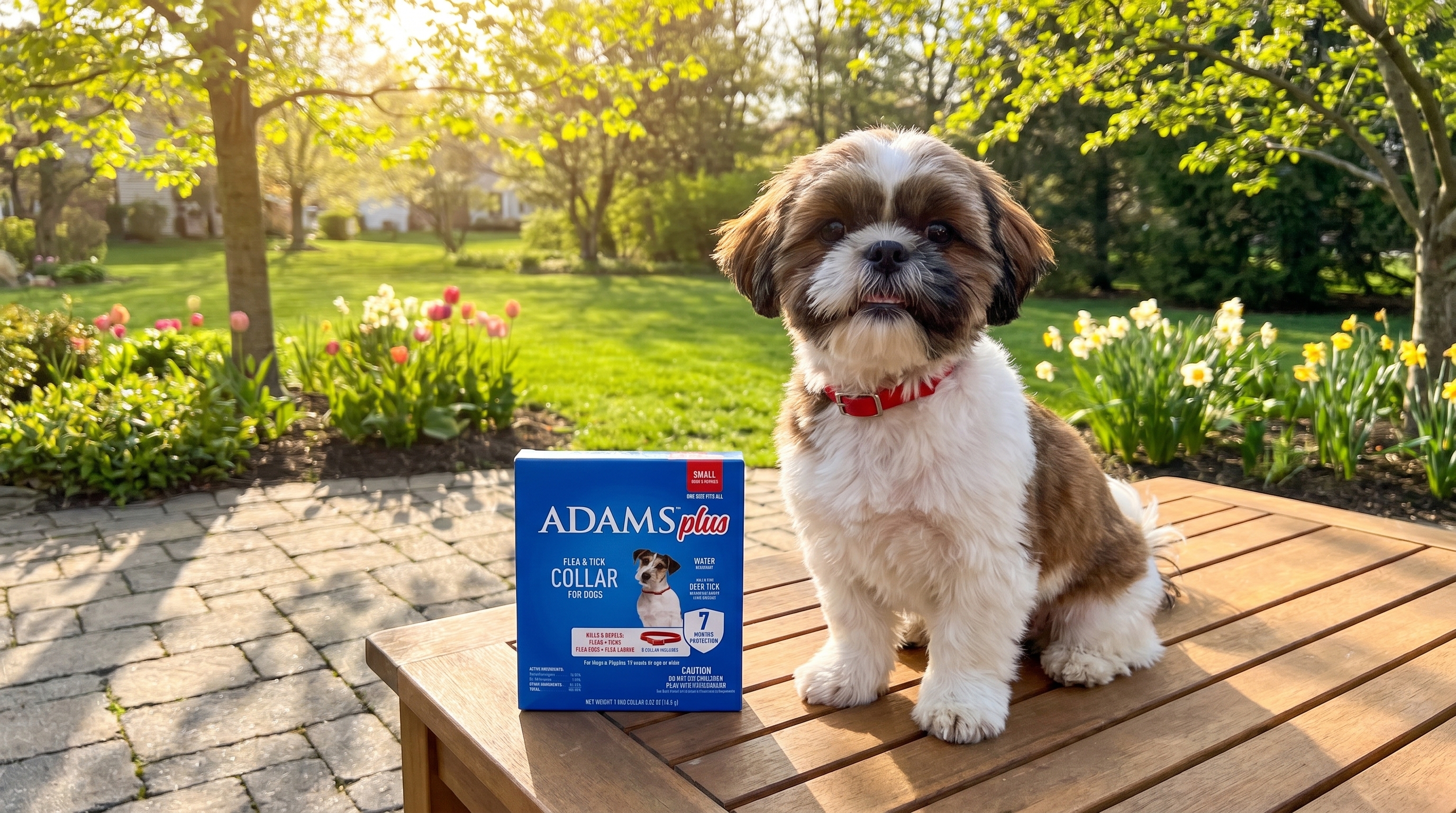
Small dogs get overlooked in flea and tick conversations — the assumption being that size somehow reduces risk. It doesn't. A Beagle or Shih Tzu walking through the same Ohio yard as a Labrador encounters the same ticks, the same flea populations, and the same mosquitoes. In some respects, small dogs are more exposed: their bellies are closer to the ground, their shorter legs put them in direct contact with grass and leaf litter, and their smaller body mass means a flea infestation has proportionally more impact than it would on a 70-pound dog. Adams Plus Flea & Tick Collar for Dogs (Small) is built for exactly this dog — delivering up to 6 months of continuous, dual-ingredient protection in a water-resistant collar available at Liberty Farm, Home & Garden in Galion, Ohio.
Why Small Dogs Have a Flea and Tick Problem of Their Own
Body surface area relative to body weight is higher in small dogs than in large ones. That means more skin and coat exposed per pound — a meaningful difference when fleas are looking for a host. A flea infestation that represents a minor nuisance on a 90-pound dog can rapidly become a serious problem on a 12-pound dog, where the parasite burden is proportionally enormous.
Ticks present a similar picture. Small dogs moving through tall grass, brush edges, or wooded areas make the same contact opportunities for ticks as larger dogs. But on a Chihuahua or a Dachshund, a tick on the belly or leg may be significantly harder to find during a routine once-over, especially in dogs with long or dense coats. Missed ticks mean longer attachment times — and longer attachment times increase the risk of disease transmission.
Mosquito exposure is another variable worth noting. Ohio has an active mosquito population from late spring through early fall, and mosquitoes can transmit heartworm to dogs of any size. While heartworm prevention is a separate product category, a collar that also repels mosquitoes adds a layer of protection that's meaningful for small dogs spending time outdoors.
The takeaway is that small dogs need flea and tick protection just as much as large dogs — and products designed specifically for the small-dog weight range ensure the active ingredient delivery is appropriate for their size.
How the Adams Plus Collar Works: Deltamethrin and Pyriproxyfen
The Adams Plus Flea & Tick Collar for Small Dogs uses two active ingredients that work together to address flea and tick infestations at different life stages:
- Deltamethrin is a synthetic pyrethroid — a class of insecticides modeled on the natural compounds found in chrysanthemum flowers. It works by disrupting the nervous systems of insects on contact, killing adult fleas, ticks, and mosquitoes that come into contact with the collar's active release zone around the dog's neck, head, and coat. Deltamethrin is highly effective against adult pests and is the primary killing mechanism in the collar.
- Pyriproxyfen is an insect growth regulator (IGR). Unlike deltamethrin, pyriproxyfen doesn't kill adult insects directly — it interferes with the development of flea eggs and larvae, preventing them from maturing into breeding adults. This is a critical addition: a collar that only kills adult fleas still leaves flea eggs in the environment to hatch into a new generation. Pyriproxyfen breaks the flea life cycle before it restarts.
These two mechanisms work in combination. Deltamethrin handles the adult pests that are currently on the dog. Pyriproxyfen handles the eggs that adult fleas lay — preventing the next generation before it emerges. Together, they address both the immediate infestation and the environmental reservoir that keeps flea problems cycling back.
What "Up to 6 Months" Actually Means
The 6-month protection claim on the Adams Plus collar reflects the slow-release design of the collar material itself. The active ingredients are embedded in the collar polymer and release continuously over time — moving through the dog's natural skin oils to distribute across the coat. This is a different mechanism than a monthly topical, which requires a fresh application each month to maintain protection.
A few factors influence how close to the full 6 months your dog actually receives:
- Water exposure. The collar is water-resistant — it continues working through rain, brief immersion, and normal outdoor activity. However, dogs that swim frequently or receive frequent baths may exhaust the collar's active ingredient reserves faster than a dog with minimal water exposure. Water-resistant is not the same as waterproof.
- Storage before use. If the collar has been on the shelf for an extended period before being opened, the useful active life begins from the day it is put on the dog, not the manufacturing date. Buy from a store with reasonable inventory turnover.
- Fit. A loose collar doesn't stay in consistent contact with the neck and coat, which reduces distribution of the active ingredient. A properly fitted collar — snug enough that you can fit two fingers between the collar and the dog's neck, but no more — maintains the contact needed for effective release.
In practice, most dogs receive strong protection through the first 5 to 6 months of use under normal conditions. Some owners operating in high-flea-pressure environments or with dogs that swim frequently choose to replace the collar closer to the 5-month mark to ensure consistent efficacy through the end of flea season.
Small Dogs and Tick Risk in Ohio
Central Ohio has a documented tick burden that starts earlier in the year than most dog owners expect. The black-legged tick (deer tick) — the primary vector for Lyme disease in Ohio — becomes active when temperatures consistently reach 35–40°F. In Galion and the surrounding Crawford County area, that typically means late March or early April. By May, both deer ticks and American dog ticks are active across wooded lots, suburban yards with tree cover, field margins, and anywhere deer move through.
Small dogs in this environment face several challenges beyond just exposure frequency. Their lower clearance to the ground means closer contact with leaf litter — where unfed deer tick nymphs (the most common Lyme-transmitting life stage) concentrate in spring and early summer. Nymphs are small enough to hide easily in a small dog's coat and are frequently missed on visual checks.
Starting a collar in March or April — before tick season peaks — is more effective than waiting until the first tick is found on the dog. Protective concentrations need a day or two to distribute from the collar across the coat, and waiting for evidence of exposure means the dog was unprotected during at least some of the active tick period.
The Water-Resistant Advantage
Water-resistance is a more meaningful feature than it might initially appear. A flea collar that loses efficacy every time a dog gets wet would be functionally impractical for most active dogs — rain, damp grass, morning dew, and the occasional puddle investigation are routine for dogs that spend time outdoors.
The Adams Plus collar's water-resistant formulation is designed to maintain active ingredient release through normal environmental moisture and incidental water contact. The active ingredients remain in the collar polymer and continue releasing through normal moisture conditions. This makes the collar practical for year-round active small dogs in Ohio's variable climate — spring rain, summer humidity, fall damp.
The important distinction is that water-resistant is not waterproof. Dogs that swim regularly, or who receive frequent shampooing (common for certain small breeds like Maltese, Shih Tzus, and Bichon Frises that visit groomers monthly), will accelerate depletion of the collar's active reserves. If your small dog swims or is bathed more than once monthly, monitor the collar's odor and condition as an informal indicator of remaining efficacy, and plan to replace it closer to the 5-month mark rather than the 6-month mark.
How to Fit and Use the Adams Plus Collar Correctly
Getting the collar on correctly matters for both safety and efficacy. Here's what to know:
- Measure fit with the two-finger test. After fastening, slide two fingers between the collar and the dog's neck. If you can fit two fingers easily but not three, the fit is correct. Too loose and the collar won't maintain adequate skin contact for active ingredient distribution. Too tight and it becomes a comfort and safety issue.
- Trim the excess length. After fitting, trim the collar to within about an inch of the buckle. Excess collar hanging off the dog's neck can be chewed — both a safety hazard and a reduction in collar material and active ingredient remaining.
- Allow a few days for full distribution. The active ingredient takes 24–48 hours to begin spreading meaningfully from the application zone at the collar into the coat. Full distribution across the dog's body takes a few days. Don't expect instant full-body coverage from the first hour of wear.
- Check the collar periodically. As small dogs grow or as the collar ages, fit can change. A monthly check of the fit and condition of the collar ensures it remains correctly positioned and structurally intact.
- Keep the collar on consistently. Removing the collar for baths or other reasons interrupts the continuous release cycle and reduces the effective protection period. If your groomer removes the collar during bathing, replace it as soon as possible after the appointment.
- Wash hands after handling. Standard precaution with any pesticide-containing product — wash hands with soap and water after fitting or adjusting the collar.
Adams Plus Collar vs. Monthly Topical Treatments for Small Dogs
Both collars and topicals are effective when used correctly. The choice often comes down to the dog's lifestyle and the owner's management preference:
- Adams Plus Collar: One application lasts up to 6 months. No monthly reapplication required, no dry window after application, and no mess associated with topical liquids. The continuous passive release makes it easy to maintain consistent protection without remembering monthly treatment dates. Best for dogs with normal outdoor activity who don't swim frequently. Also repels mosquitoes in addition to killing fleas and ticks.
- Monthly topical treatments: Applied once a month to the skin between the shoulder blades. Highly effective and fast-acting. Requires strict monthly compliance — a missed or late treatment leaves gaps in protection. May have a 24–48 hour post-application dry window. Can be a better fit for dogs that swim regularly or who receive frequent baths, since the topical dose is refreshed each month regardless of water exposure history.
- Oral chewables: Systemic protection requiring the parasite to bite to be affected. Prescription required in most cases. Works regardless of bathing or swimming. Higher cost per dose for small dogs is usually less pronounced than for giant breeds, but still a factor for year-round use.
For many small-dog owners, the Adams Plus collar's 6-month duration and mosquito protection represent a strong combination — particularly in Ohio where the outdoor season runs April through October and consistent monthly compliance with a topical can be challenging to maintain.
| Specification | Details |
|---|---|
| Product Type | Flea & tick collar |
| Size | Small (for small-breed dogs) |
| Protection Duration | Up to 6 months |
| Active Ingredients | Deltamethrin (kills adults), Pyriproxyfen (insect growth regulator) |
| Target Pests | Fleas, flea eggs, ticks, mosquitoes |
| Water Resistance | Water-resistant |
| Safe For | Small dogs and puppies 12 weeks and older |
| Application | Single application, wear continuously for up to 6 months |
| Brand | Adams |
| Available At | Liberty Farm, Home & Garden, Galion, Ohio |
When to Use Adams Plus: Puppies, Senior Dogs, and High-Exposure Dogs
The Adams Plus Flea & Tick Collar for Small Dogs is labeled safe for puppies 12 weeks of age and older. This makes it a practical option for young dogs entering their first flea and tick season — as long as the puppy has reached the minimum age on the label. Always check the current product label before use, as formulations and label requirements can be updated.
For senior small dogs, the collar format offers a management advantage over topicals: there's no monthly compliance burden, no need to apply liquid to sensitive older skin, and no dry window post-application that requires monitoring. A senior Beagle or Dachshund that's mostly in the yard and not swimming is an ideal collar candidate.
High-exposure dogs — those that frequent wooded trails, rural properties, or farm environments with heavy flea and tick pressure — benefit from the dual-ingredient approach. The insect growth regulator component is especially important when a dog routinely re-enters flea-heavy environments, since breaking the flea life cycle on an ongoing basis reduces the environmental burden that would otherwise keep reinfesting the dog from bedding, carpeting, and yard soil.
Other Pet Supplies at Liberty Farm, Home & Garden
We carry a range of everyday pet care supplies for small dogs and all sizes at Liberty Farm, Home & Garden in Galion. A few worth knowing about alongside your flea and tick collar:
- Adams Ear Mite Treatment (0.5 fl oz) — From the same Adams brand, this ear mite treatment is effective for dogs and cats. Small breed dogs that spend time outdoors are at real risk for ear mites, especially if they interact with other animals. Easy to apply and fast-acting — worth keeping alongside your flea collar in the pet care cabinet.
- Wrap-It-Up Flexible Bandage (4 in x 5 ft) — A self-adhering flexible bandage for minor wound care. Small dogs can be surprisingly active and injury-prone, especially on rough terrain. Having a basic bandaging supply in your pet first aid kit is practical year-round.
- Mclovin's Single Door 18" Folding Metal Pet Crate — An 18-inch folding crate sized for small dogs. Useful for travel, crate training, or providing a secure sleeping space. The folding design makes it easy to store when not in use — practical for small households.
Stop in at Liberty Farm, Home & Garden in Galion or shop online at libertyfhg.com. We stock the Adams Plus collar in the small size and can help you find what you need to keep your small dog protected through Ohio's full flea and tick season.
Frequently Asked Questions
Keep Reading

Back-to-School Routine Changes: Helping Dogs Adjust to More Time Alone
Prepare your dog for back-to-school schedule changes with gradual departures, safe enrichment, camera checks, and veterinarian-backed warning signs.

Ohio Flea Season Peaks in June — Why Your Small Dog Needs Protection on Before It's Too Late
June marks the annual turning point when Ohio's flea and tick populations reach peak activity. Here's what's happening in your yard right now, why small dogs are especially vulnerable, and why the Adams Plus Flea & Tick Collar for Small Dogs is the simplest way to stay ahead of an infestation before it starts.