
Why Your Tomato Plants Keep Falling Over — and How Professional Trellis Netting Finally Solves It
The complete guide to vertical growing with the Tenax Hortonova Trellis Net — 79 inches of professional-grade support netting across 100 feet of garden row, built for the crops that outgrow every cage you've ever tried
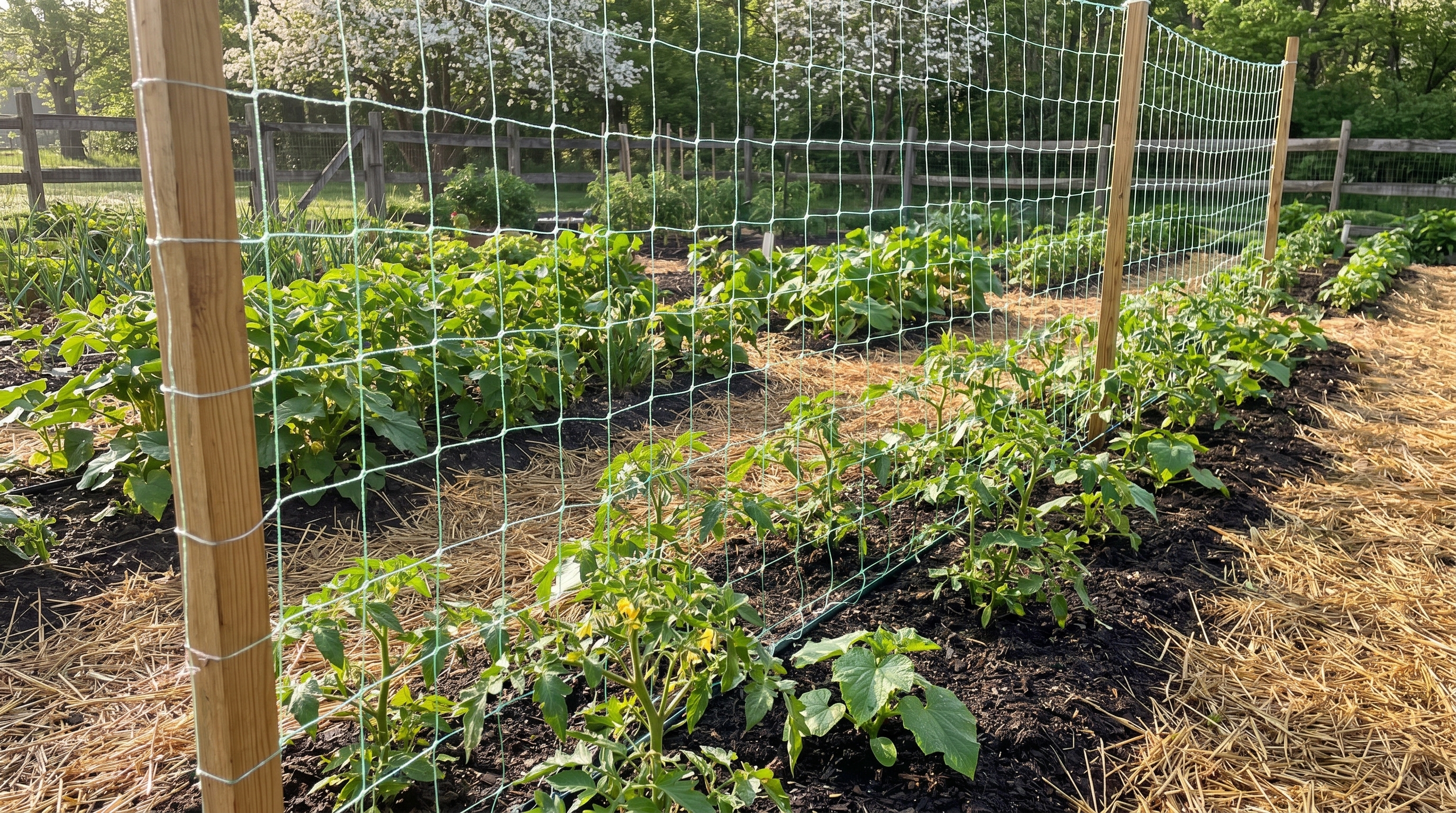
If you've grown tomatoes for more than one season, you know exactly how this goes. You cage the transplants in late May, everything looks orderly through June, and then July arrives and your indeterminate plants turn into eight-foot towers of foliage that have bent every cage wire, sprawled across the mulch, knocked their neighbors flat, and buried half the fruit in a jungle of stems that's impossible to reach into without damaging something. The problem isn't your plants — they're doing exactly what tomatoes, cucumbers, pole beans, and other climbing crops are supposed to do. The problem is that the support system you chose can't keep up with them. The Tenax Hortonova Trellis Net (79 in x 100 ft) is the professional-grade solution that commercial vegetable growers and serious home gardeners use to give climbing crops the vertical support they actually need — the full height, the full row length, and the structural integrity to hold the weight of a heavy-producing plant through an entire Ohio growing season. Available at Liberty Farm, Home & Garden in Galion, Ohio.
Why Climbing Vegetables Are Designed to Grow Up — and What Happens When You Don't Let Them
Tomatoes, cucumbers, pole beans, peas, melons on compact varieties, and a long list of other garden vegetables have one thing in common: they evolved to grow vertically, climbing through surrounding vegetation in their natural habitat, using neighboring plants for support as they reach upward toward light. Every physiological process in these plants is optimized for vertical growth — the way they set flowers, the way they direct energy into fruit production, the way they shed excess moisture from their foliage to reduce disease pressure.
When you force climbing plants to grow horizontally — either because your support system failed or because you didn't install one at all — several things go wrong simultaneously. First, fruit that lies on the ground or on mulch develops ground rot on the contact surface, reducing quality and shortening the harvest window. Second, dense foliage that piles on itself creates the humid, still-air conditions that fungal diseases like early blight, septoria leaf spot, and powdery mildew need to establish and spread. Third, plants that are not properly supported dedicate resources to growing stouter, woodier stems to hold themselves up, rather than directing those resources into the flower and fruit production you actually want from the plant. Fourth, harvesting becomes a physical ordeal — you're bending, searching, reaching deep into a tangled mass of vegetation instead of scanning along a clean vertical plane of foliage and spotting ripe fruit from an upright position.
None of these problems require exceptional growing skill to solve. They require the right support structure, installed before your plants need it, with enough height to accommodate the plant's actual mature size rather than the size it was when you set it in the ground as a six-inch transplant in late May.
The Problem with Tomato Cages on Indeterminate Varieties
The standard wire tomato cage — whether it's the short cone-shaped type you find in packs of four or the heavier galvanized cylinder — works well for one specific use case: determinate tomato varieties. Determinate tomatoes are bred to grow to a fixed height, set all their fruit within a concentrated window, and stop growing once the terminal bud produces a flower cluster. They reach 3 to 4 feet, bush out, produce their crop, and they're done. A Galvanized Tomato Cage (42 in) or Galvanized Tomato Cage (33 in) is correctly sized and appropriately structured for a determinate plant. The cage holds the compact bush in shape, the fruit hangs clear of the ground, and the whole thing is stable through harvest.
Indeterminate tomato varieties are different in almost every way that matters to support planning. They keep growing — continuously — from transplant in late May through the first killing frost in October or November. They don't stop at 4 feet. A well-fed, well-watered indeterminate tomato in Ohio's July and August heat can easily reach 7, 8, or even 10 feet of total vine length. Popular indeterminate varieties like Beefsteak, Cherokee Purple, Sun Gold, Brandywine, Big Boy, and most heirloom types are all continuous climbers. When you put a standard tomato cage around one of these at transplant time, you are providing support for the first three feet of the plant's eventual growth. What happens above the cage top — which is where the majority of the plant's fruiting production occurs by August — is unsupported, and that unsupported weight is what eventually tips the cage, bends its wires, and brings the whole structure down.
Even the heaviest-gauge cages available at retail — the Galvanized Tomato Cage (54 in) is among the tallest options — top out at 4.5 feet, which gets you into July with a well-grown indeterminate variety before the plant is exceeding the structure. A Panacea Square Folding Tomato Tower (44 in) provides excellent structural support for mid-size plants and can be stacked with additional rings to extend height, which is a real solution for some growers. But for a full row of indeterminate tomatoes, cucumbers, or pole beans that need 6 to 8 feet of support across 30 or 40 or 100 feet of garden row, individual cages and towers require significant per-plant investment, are difficult to store in the off-season, and still don't give you the full height that professional trellis netting provides.
The correct tool for growing a row of indeterminate tomatoes, cucumbers, or pole beans to full potential is trellis netting — and the correct trellis netting for serious production is the Tenax Hortonova.
What Makes the Tenax Hortonova Trellis Net the Professional Standard
The Tenax Hortonova Trellis Net (79 in x 100 ft) is not a product that was designed for the retail garden center shelf. It is a product that was designed for professional vegetable production — commercial tomato greenhouses, field cucumber operations, specialty crop farms — and it has made its way into serious home gardens because nothing else at any price point provides the same combination of height, coverage, and durability.
The Tenax name means structural engineering. Tenax is an Italian company with decades of history in technical extruded plastic netting across agricultural, construction, and infrastructure applications. The same engineering principles that go into Tenax erosion control netting and deer fence products go into the Hortonova: the material is selected for UV resistance and multi-season durability, the mesh geometry is designed to carry load evenly across the structure, and the manufacturing tolerances are held to professional-grade standards rather than the loosest specifications that allow a product to ship in a pretty package.
Hortonova mesh is designed for the way plants actually attach. The standard Hortonova mesh opening is approximately 4 inches by 6 inches — large enough that plants can be woven through the mesh by hand as they grow, shoots and stems can be tucked in quickly during a weekly training session, and fruit can hang freely without restriction. It's also small enough that the plant has multiple attachment points at every foot of height, so the weight of a heavily fruiting vine is distributed across dozens of contact points rather than concentrated at a few support ties the way individual-stake support systems work. Plants woven into Hortonova netting self-support to a remarkable degree — the mesh catches the growing tips of tomato suckers, cucumber tendrils, and bean shoots without you doing much of anything, especially once the plant is established in the lower portion of the net.
The polypropylene construction is built for repeated use. Cheap garden netting — the kind sold in rolls at big-box stores for a few dollars — is made from light-gauge material that degrades quickly under UV exposure, tears when you try to untangle end-of-season vines from it, and is genuinely single-season in practice. Hortonova is a different class of product. The extruded polypropylene is UV-stabilized to resist the breakdown that sunlight causes in ordinary plastics, and the material has enough body that you can remove dried vines from it at the end of the season and roll it up for storage without tearing. Professional greenhouse growers who trellis tomatoes and cucumbers on Hortonova routinely get three to five growing seasons from the same net before replacement becomes necessary. For a home garden, a single roll can represent a decade of reliable service with proper care.
The 79-Inch Height: Why This Dimension Is the One That Matters
Seventy-nine inches is 6 feet and 7 inches. It is the height specification that makes the Tenax Hortonova actually useful for full-season indeterminate tomato production rather than just theoretically adequate. Here is why that number matters so much in practice.
A typical indeterminate tomato transplanted in Ohio in late May reaches its support stakes or trellis post tops by late July if the growing season is productive. From late July through the first frost — which in north-central Ohio typically falls between late September and mid-October — the plant is still growing vertically, still producing new flower clusters, and still setting and maturing fruit. The fruiting period for an indeterminate variety extends for three to four months after the plant begins producing, and the upper portion of the plant — the last two feet of height — is where much of the late-season production comes from.
A 5-foot support system gets you to early August on a vigorous plant. A 6-foot system gets you to mid-August. The Hortonova's 79-inch net height — with posts set 12 to 18 inches into the ground — gives you a working trellis height of 5.5 to 6 feet above the soil surface after installation, which accommodates full-season indeterminate growth through October for most Ohio varieties. That extra 18 to 24 inches compared to a standard 4-foot cage is the difference between having supported plants through the end of the season and having unsupported plants in collapse during your heaviest production period.
For cucumbers, the height advantage is equally significant. Cucumber vines grown vertically produce straighter fruit, with better color and texture than cucumbers grown on the ground. More importantly, cucumbers grown vertically are dramatically easier to find and harvest — you walk along the row and scan, rather than lifting vines and searching under dense ground cover. At full season production, a cucumber plant at peak output needs harvesting every two to three days to keep the plant producing. If harvesting requires bending to ground level and searching under a mat of vines, it doesn't get done as consistently as it should — and missed cucumbers that overmature on the vine suppress the plant's continued production. Vertical growing on a tall trellis net solves the harvesting problem as much as the support problem.
100 Feet of Coverage: Planning Your Garden Row Layout
The 100-foot length of the Tenax Hortonova roll is a specification that reflects real commercial growing needs, and it has practical implications for how home gardeners should think about row layout and garden planning.
One hundred feet is a full garden row — or two 50-foot rows, or four 25-foot rows, depending on how you choose to divide it. For a gardener growing a serious quantity of tomatoes, cucumbers, or pole beans, a single roll of Hortonova covers the full trellised area in a single installation, with a continuous net running the entire row length supported by posts at regular intervals. There are no gaps, no overlapping sections, no splice points — the support structure is uniform from one end of the row to the other, which means every plant along the row has equal access to the netting structure and no plant is disadvantaged by a gap or a weak splice point between two sections of shorter net.
For a smaller home garden where 100 feet is more than one season's trellised row, the net can be cut to length — Hortonova cuts cleanly with ordinary scissors or pruning shears — and the remaining material rolled and stored for future use. Unlike some woven fabric products, Hortonova polypropylene netting does not unravel when cut; the mesh structure holds at the cut edge without fraying, which makes sizing to a shorter row straightforward.
If you're planning a new garden layout around a trellis system, the standard approach is to orient your main growing rows north to south so that the trellis net doesn't create a shadow wall that blocks afternoon sun from adjacent beds. The netting itself admits significant light through its large mesh openings, but the foliage of a full-production tomato row can create a significant shade zone on the east side of the row in afternoon hours. North-south rows keep that shadow falling on the row itself rather than on adjacent crops. For east-west rows, orient shorter crops on the south side of the trellis so they receive full sun exposure and the trellis row shades only the north side.
How to Install Tenax Hortonova Trellis Netting Step by Step
Installing Hortonova netting is straightforward work that requires basic materials and an hour or two of setup time for a full row. The result is a permanent-for-the-season trellis structure that requires no further adjustment or re-tensioning once it's in place.
What you need:
- Tenax Hortonova Trellis Net (cut or rolled to your row length)
- T-posts, wooden stakes, or rebar sections — one per 6 to 10 feet of row length, plus corner posts
- A post driver or hammer (for driving posts)
- Zip ties, baling twine, or wire to attach the net to the posts
- Wire cutters or scissors
- A measuring tape
Step 1: Mark your row and set corner posts. Determine the full length of your trellised row and drive your end posts first. End posts bear the most tension load from the hung net, so they should be driven deeper — 18 to 24 inches into the ground — and should be the heaviest material you're using for the row. A T-post at 5 to 6 feet length (above ground) or a treated 2x2 or 2x4 wooden stake at 7 to 8 feet total length works well for end posts. For very long rows over 50 feet, angle your end posts slightly away from the row (outward) or brace them with a diagonal stake so they don't pull inward when the net is under tension.
Step 2: Set interior posts at regular intervals. Drive intermediate support posts every 6 to 10 feet along the row. The spacing depends on the weight of the crop you're growing: heavy indeterminate tomatoes benefit from a post every 6 feet; lighter crops like cucumbers, beans, or peas can use posts every 8 to 10 feet. Intermediate posts don't need to be driven as deep as end posts — 12 inches is sufficient — but they should all be driven to the same height so your net hangs level along the row.
Step 3: Attach the top of the net to the posts. The most durable attachment method is to run a horizontal wire or rope through the top edge of the Hortonova net — through the top row of mesh openings — across the full row length, then tie or clip this wire to each post top. This distributes the load across the top wire rather than creating stress points at individual attachment locations. Alternatively, you can attach the net directly to each post with zip ties or baling twine at the top edge, spacing the ties every 12 to 18 inches. Either method works; the top-wire method is what commercial operations use for maximum durability under heavy crop loads.
Step 4: Hang the net and secure the bottom. Unroll the Hortonova net along the row from one end post, letting it hang from the top attachment. Pull the bottom of the net taut and secure it to stakes or clips at ground level, or simply let it hang freely. For tomatoes grown as single leaders (one main stem trained up the net), the bottom doesn't need to be staked tightly. For cucumbers and beans, a lightly tensioned bottom edge gives plants a starting point to attach onto in the lower portion of the net.
Step 5: Plant and begin training immediately. As soon as your transplants are in the ground, begin weaving or tucking the growing tip of each plant through the lower mesh openings of the net. This early training — done weekly as the plant adds a foot of growth — establishes the plant's relationship with the netting and prevents it from sprawling away from the support structure before it's tall enough to lean naturally against the net. For cucumbers and beans, the plants will self-attach as their tendrils find the mesh; a minimal amount of directional guidance in the first two weeks is all that's needed.
What Grows Best on Hortonova Trellis Netting
The Tenax Hortonova's 4-by-6-inch mesh opening and 79-inch height make it suitable for a wide range of climbing and vining crops. Here is how each major crop type interacts with the netting structure:
Indeterminate tomatoes. The primary crop for which Hortonova is best known in professional production. Single-leader tomato training — removing all side suckers and training one main stem up the trellis — produces the highest yields per plant in concentrated rows and is the standard commercial method. Home gardeners often prefer to leave two or three leaders per plant, which produces a more bush-like appearance and higher per-plant yields at the cost of slightly more crowded spacing. Both methods work with Hortonova; the net has mesh openings wide enough to accommodate either the clean single-stem commercial style or the fuller two-to-three-leader home garden style.
Cucumbers. Trellised cucumbers are one of the biggest productivity gains available to home gardeners who currently grow cucumbers on the ground. Cucumber vines woven through or draped over Hortonova netting produce fruit that hangs freely in the air — straight, uniform, and fully colored — and that is easy to spot and harvest at the right size before overmaturation. Disease pressure from soil-borne fungal pathogens drops significantly when cucumber foliage is lifted off the ground and spaced along a vertical plane where airflow reaches all surfaces. A single 25-foot section of Hortonova supports six to eight cucumber plants with room to grow through the full Ohio season.
Pole beans. Pole beans are vigorous climbers that actively seek attachment points and grow fast — a healthy pole bean vine can put on 6 inches of growth in a single warm day during peak summer. Hortonova's mesh gives pole beans plenty of attachment opportunities without the gaps that wider-spaced strings or horizontal wires create. A section of Hortonova set up for pole beans typically requires no individual plant training after the first week — the plants find the mesh and climb it with minimal guidance. Direct-sow pole beans in front of a pre-installed Hortonova net and they'll be climbing within two weeks of germination.
Peas. Spring peas are the earliest users of a trellis net setup in Ohio gardens, going in as soon as the soil can be worked in March or April and finishing before summer heat shuts them down in June or early July. The same Hortonova net can support a spring pea crop followed immediately by a planted summer bean or cucumber — simply cut the dried pea vines off at soil level in June, remove them from the netting, and plant your summer crop at the base of the same net. Two-crop use of a single trellis setup is a practical way to get maximum productivity from garden space.
Specialty crops. Squash, gourds, and climbing flowers like morning glories and climbing zinnias all do well on Hortonova netting when managed appropriately. Small winter squash varieties grown vertically on a sturdy net produce well-supported fruit — fruit that would be heavy enough to require sling support on weaker netting but can hang freely from Hortonova given its structural capacity. Large-fruited crops like pumpkins and full-size butternut squash should not be trellised vertically without individual fruit slings.
Vertical Growing and Disease Management: The Airflow Advantage
One of the most significant and least-discussed benefits of growing tomatoes and cucumbers on a tall trellis net is the effect on disease pressure. Ohio summers are warm and humid — exactly the conditions that tomato diseases like early blight, septoria leaf spot, and late blight use to move through a garden. These diseases spread via spore-laden water droplets from rain splash and irrigation, which carry pathogens from the soil surface up onto lower foliage. In a garden row where plants are lying on the ground or supported on short cages with dense overlapping foliage, disease establishment and spread happens faster because foliage is closer to the soil, more densely packed, and slower to dry after rain.
A tall trellis system changes the disease math in several meaningful ways. First, the foliage is lifted completely off the soil surface — there is no low-canopy zone where rain splash from the soil surface hits leaves directly. Second, the plants along the row are trained in a single vertical plane rather than a dome shape, which means wind moves freely through the row and foliage dries faster after rain or morning dew. Faster drying means less time in the surface moisture conditions that fungal spores need to germinate and penetrate leaf tissue. Third, the open mesh structure of the Hortonova net itself creates no impediment to airflow — the row breathes as well as if there were no support structure at all.
This doesn't mean that trellised tomatoes and cucumbers never get fungal diseases — they do, particularly in wet seasons. But the disease onset is typically later in the season, the spread is slower, and the plants maintain productive foliage for more of the growing season than ground-grown plants in the same conditions. For a gardener who has struggled with early blight wiping out their tomato plants by August, converting to tall trellis net growing is a genuine game changer.
End-of-Season Cleanup and Reuse: Getting Multiple Years from Hortonova
The end-of-season management of your Hortonova net determines how many growing seasons you get from it. Proper cleanup and storage is straightforward but requires doing it at the right time — before dried vines have become so brittle and tangled that removal is difficult.
Remove plants from the netting while still somewhat pliable. The ideal time to strip end-of-season tomato, cucumber, and bean vines from your Hortonova net is after the first frost has killed the foliage but before it has dried into a crackling, brittle mass that breaks apart and leaves bits embedded in every mesh opening. At this stage — typically late October in north-central Ohio — the vines are dead but still flexible enough to unwind from the netting in long sections. Start at one end of the row, detach the plant at the base, and pull the vine along the netting rather than straight off it. Most of the vine comes away cleanly in one or two pulls per plant.
Don't cut the netting to remove plants. The temptation when vines are well-established in the mesh is to cut them out with pruning shears — but this creates holes in the netting that compromise structural integrity in future seasons. Patient manual removal, starting at the stem base and working upward, preserves the net intact for reuse.
Remove posts and roll the net for storage. After the plants are stripped, detach the Hortonova from the posts, starting at one end. Roll it loosely — not tightly wound — onto a cardboard tube or roll it flat and fold it. Store in a garage or shed out of direct UV exposure and away from rodents that might chew it for nesting material. Hortonova rolled and stored properly requires no special conditions — a cool, dry garage shelf is ideal.
Inspect and repair before reinstalling. Before hanging the net for a new season, unroll and inspect it for any holes or tears. Small holes can be repaired by threading a length of polypropylene twine through the surrounding mesh openings in a figure-eight pattern to restore structural continuity. A net with a few small repairs is functionally equivalent to an undamaged one for another full growing season.
| Specification | Details |
|---|---|
| Product | Tenax Hortonova Trellis Net (79 in x 100 ft) |
| Brand | Tenax |
| Dimensions | 79 inches tall x 100 feet long |
| Mesh Opening | Approximately 4 in x 6 in — plant-weaving size |
| Material | UV-stabilized polypropylene — multi-season reusable |
| Best Crops | Indeterminate tomatoes, cucumbers, pole beans, peas |
| Post Spacing | Every 6–10 ft depending on crop weight |
| Post Height Required | 7–8 ft total (12–18 in below ground) |
| Expected Service Life | 3–5+ growing seasons with proper storage |
| Available At | Liberty Farm, Home & Garden, Galion, Ohio |
The Tenax Hortonova Trellis Net (79 in x 100 ft) is available at Liberty Farm, Home & Garden in Galion, Ohio, along with the full range of tomato cages, stakes, and garden support products to complete your trellis setup. If you're setting up a garden row this season and want to grow tomatoes, cucumbers, or pole beans the way professional growers do, stop in and pick up a roll — our team can help you plan your post spacing and layout for the crops you're growing.
Frequently Asked Questions
Keep Reading
Plant Cover Crops Now: An Ohio Home Garden Guide
Plant fall cover crops in an Ohio vegetable garden with practical guidance on timing, species, seeding, winter care, and spring termination.

Save This Summer’s Garden: A Practical Ohio Seed-Saving Guide
Save tomato, bean, pea, lettuce, marigold, zinnia, and other garden seeds with this practical late-summer guide for Galion and north-central Ohio.