
Beat the July Heat: Complete Summer Lawn Care Guide for North-Central Ohio
Mid-July is crunch time for Ohio lawns. Heat, drought, and weeds all peak at once — here's how to manage all three and come out ahead when cooler weather returns.
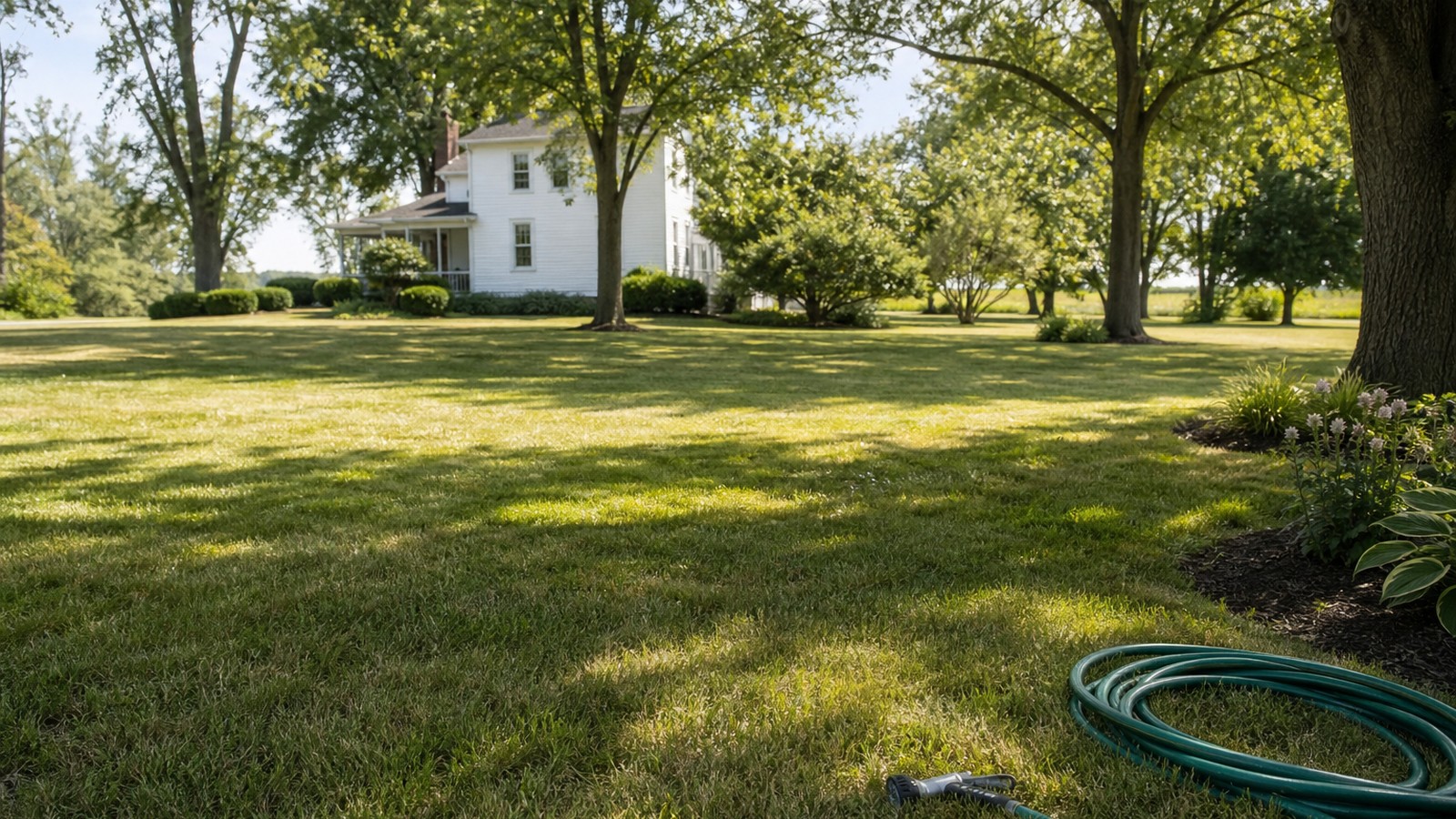
By mid-July in north-central Ohio, your lawn is under more stress than at any other point in the year. Daytime temperatures regularly climb into the upper 80s and low 90s, soil moisture evaporates faster than most grass can replenish it, and cool-season turf like tall fescue and Kentucky bluegrass — the backbone of most Crawford County lawns — begins to slip into summer dormancy whether you want it to or not. Add relentless weed pressure, compacted soil from summer foot traffic, and the temptation to mow short so you mow less often, and it's easy to make small mistakes that cost you big come September. This guide walks you through exactly what your lawn needs right now: smart watering schedules, correct mowing heights, targeted weed control, and a realistic plan to carry your grass through to fall recovery.
Understanding What's Happening to Your Ohio Lawn in July
Most lawns in the Galion area and across north-central Ohio are planted with cool-season grasses — most commonly tall fescue, Kentucky bluegrass, or perennial ryegrass blends. These species evolved to thrive when soil temperatures are between 50°F and 65°F. By mid-July, your soil surface temperature is likely sitting somewhere between 80°F and 95°F. That gap is the root of almost every problem you're dealing with right now.
When soil temperatures push past 75°F for an extended period, cool-season grasses throttle back. Root growth essentially stops. Photosynthesis slows. The plant draws on stored energy reserves to stay alive rather than to grow new tissue. This state is called summer dormancy, and it's a survival mechanism, not a disease. A dormant lawn looks straw-colored or tan and may feel crunchy underfoot, but the crowns (the growing points just above soil level) are still alive as long as they receive some moisture.
The key mistake homeowners make in July is panicking and overcorrecting — either watering too frequently and shallowly, mowing too short to "clean things up," or applying fertilizers that push tender new growth during the hottest weeks. Any of these responses can cause more damage than the heat itself. Understanding that your lawn is conserving energy, not dying, reframes your entire approach for the next six to eight weeks.
Zone 6 conditions in Crawford County also mean high humidity most of July, which creates a second threat: fungal disease. Brown patch and dollar spot are the two most common fungal culprits in Ohio summer lawns. They thrive when nighttime temperatures stay above 70°F and humidity is high — exactly the conditions Galion sees throughout July and into August. Recognizing these as separate problems from heat dormancy helps you treat them correctly rather than watering more when more water is the last thing a fungal outbreak needs.
Mowing Height and Frequency: The Most Important Variable You Control
If you do nothing else on this list, raise your mower deck. This single adjustment does more to protect a stressed Ohio lawn in July than any product you can buy.
For tall fescue, Kentucky bluegrass, and perennial ryegrass, the recommended mowing height from late June through August is 3.5 to 4 inches. Most homeowners mow somewhere between 2 and 2.5 inches year-round, which is fine in spring and fall but becomes genuinely damaging in summer heat. Taller grass blades shade the soil surface directly beneath the turf, which can lower soil temperature by 5°F to 10°F — a meaningful difference for root survival. Taller grass also shades out weed seeds trying to germinate, reducing competition without any chemical input.
Here's how to raise your deck correctly:
- Measure before you adjust. Park your mower on a flat surface, like a driveway, and measure from the ground to the bottom of the cutting blade. Most homeowner mowers have 5 to 7 height positions. Know what height each position actually delivers — the numbers on the dial often don't match real-world blade height.
- Never remove more than one-third of the blade height in a single mow. If your grass has gotten tall during a wet week, mow once at an intermediate height, then mow again a few days later to reach your target. Removing more than one-third causes scalping and dramatically increases stress.
- Keep your blades sharp. Dull blades tear grass rather than cutting it cleanly, leaving ragged tips that turn brown and become entry points for fungal disease. Sharpen or replace blades at least once during the mowing season, and mid-summer is a good checkpoint.
- Mow in the evening if possible. Mowing in midday heat adds mechanical stress to already-stressed plants. Evening mowing, once temperatures drop below 85°F, is easier on the turf and on you.
- Leave clippings on the lawn. In summer, grass clippings decompose quickly and return nitrogen to the soil without the risk of thatch buildup at high mowing heights. You can safely skip bagging from June through August.
In terms of frequency: let your lawn tell you when to mow, not your calendar. A dormant or semi-dormant lawn in a dry July stretch may only need mowing once every 10 to 14 days. Mowing on a rigid weekly schedule when grass isn't actively growing just adds unnecessary stress.
Watering Your Lawn in July: Deep, Infrequent, and Early
The single biggest watering mistake Ohio homeowners make in July is running sprinklers for 10 to 15 minutes every evening. This shallow, frequent approach keeps the top inch of soil damp but never allows moisture to penetrate to the root zone, which sits 4 to 6 inches deep in established cool-season turf. Grass roots follow moisture. If moisture only exists at the surface, roots stay shallow and the lawn becomes even more vulnerable to heat and drought.
The correct approach is deep and infrequent:
- Water 1 to 1.5 inches per week total, including any rainfall. In a typical dry July week in north-central Ohio with no significant rain, you'll need to apply that entire amount artificially.
- Apply water in 2 to 3 sessions per week, not daily. For example, water Sunday, Wednesday, and Friday. Each session should deliver about one-third to one-half inch of water.
- Measure your output. Place a few empty tuna cans or straight-sided containers around your lawn while the sprinkler runs. Time how long it takes to collect half an inch. That's your session duration. Most oscillating or impact sprinklers take 20 to 45 minutes to deliver half an inch, depending on water pressure and head coverage.
- Water between 4 a.m. and 9 a.m. Early morning watering lets the grass blades dry during the day, dramatically reducing fungal disease risk. Evening watering leaves moisture on blades overnight — exactly what brown patch and dollar spot need to establish. Early morning also reduces evaporative loss compared to midday irrigation.
- If your lawn is already dormant and you choose not to water, apply at least half an inch every 2 to 3 weeks to keep the crowns alive. Full, complete dormancy with zero moisture can kill lawns during extended heat above 90°F, even in Zone 6.
A note on clay soil, which is common throughout Crawford County: clay holds water well but drains slowly. If you see water pooling or running off before it soaks in, break your watering session into two cycles — water for 15 minutes, pause for an hour to allow infiltration, then water for another 15 minutes. This "cycle and soak" method prevents runoff and gets water deeper into the profile.
Identifying and Managing Lawn Weeds in Mid-July
July is peak season for several of the most stubborn warm-season weeds in Ohio lawns. The good news is that at 3.5 to 4 inches mowing height, you're already suppressing a significant portion of weed seed germination just through shade. But some species are well past germination now and actively competing with your turf.
The Weeds You're Likely Seeing Right Now
Crabgrass is the dominant summer annual in north-central Ohio. It germinates when soil temperatures reach 55°F in spring and hits peak growth in July. If crabgrass wasn't controlled with a pre-emergent in April or May, you're dealing with established plants now. Large crabgrass can be hand-pulled effectively after a rain when soil is loose, but chemical control with a post-emergent crabgrass killer is more practical for widespread infestations. Look for products containing quinclorac or fenoxaprop-p-ethyl, applied when temperatures are below 85°F to avoid turf injury.
Yellow nutsedge stands out clearly in mid-July — it's the grass-like plant growing noticeably faster and taller than your lawn, with a triangular stem and glossy, yellow-green leaves. Nutsedge thrives in wet, poorly drained areas and is nearly impossible to control by pulling (the underground nutlets simply re-sprout). Selective herbicides containing halosulfuron-methyl are the most effective approach and are safe for use on established cool-season turf.
Broadleaf weeds like spurge, prostrate knotweed, and ground ivy are also active in July. These can be spot-treated with a selective broadleaf herbicide containing 2,4-D, dicamba, or triclopyr. Avoid applying any broadleaf herbicide when temperatures exceed 85°F or when your lawn is under severe drought stress — the chemical uptake is unpredictable and turf injury risk rises sharply in heat.
A General Herbicide Timing Rule for Ohio Summers
Aim to apply any post-emergent herbicide in the morning, when temperatures are below 85°F, on a day with no rain forecast for 24 hours. Mow two to three days before application (not after), and water the lawn lightly the day before to ensure weeds are hydrated and actively taking up chemistry. Stop watering for 24 hours after application.
For a good selection of selective herbicides suited to Ohio lawn conditions, stop by Liberty Farm, Home & Garden in Galion — the staff can help you identify your specific weed and point you to the right product type for your lawn grass variety.
| Weed / Issue | Peak Season | Recommended Control Type | Temperature Limit for Application |
|---|---|---|---|
| Crabgrass (established) | July–August | Post-emergent crabgrass herbicide (quinclorac) | Below 85°F |
| Yellow nutsedge | June–August | Selective sedge herbicide (halosulfuron-methyl) | Below 90°F |
| Broadleaf weeds (spurge, knotweed) | June–September | Selective broadleaf herbicide (2,4-D blend) | Below 85°F |
| Heat dormancy (browning) | July–August | Deep infrequent watering; no herbicide needed | Not applicable |
| Brown patch fungus | July–August | Preventive or curative fungicide (azoxystrobin) | Apply any time; avoid leaf wetness |
| Dollar spot fungus | June–September | Fungicide + reduce nighttime moisture | Apply in morning |
| General weed suppression | Year-round | Raise mowing height to 3.5–4 inches | Not applicable |
| Product | Selective herbicides, fungicides, and lawn care supplies available in-store | ||
| Available At | Liberty Farm, Home & Garden - Galion, Ohio | libertyfhg.com | ||
Fertilizing in July: What to Do (and What to Skip)
This is the section where the advice runs counter to what feels instinctive. Your lawn looks rough in July — pale, thin, maybe dormant in spots. The impulse is to feed it. In most cases, you should resist that impulse until late August or early September.
Here's why: applying a standard nitrogen-heavy lawn fertilizer in mid-July pushes new, tender foliar growth during the hottest, most stressful period of the year. That new growth has a higher water demand than established tissue, it's more susceptible to fungal disease, and the roots aren't functioning well enough to support it adequately. The result is often burned turf, increased disease pressure, and wasted product.
What you can do safely in July:
- Apply a light application of slow-release nitrogen only if your lawn is not dormant, is being consistently watered to 1 to 1.5 inches per week, and you haven't fertilized since early June. Use no more than 0.5 pounds of actual nitrogen per 1,000 square feet — roughly half the rate of a typical spring application. Look for fertilizers with a high percentage of slow-release or polymer-coated nitrogen sources.
- Apply iron if your lawn is yellowing but not dormant. Iron sulfate or chelated iron products can provide a green color boost without pushing growth. They're safe to apply in summer and won't cause the surge-and-crash cycle of high nitrogen.
- Do not apply any phosphorus-heavy starter fertilizer. Starter fertilizers are for seeding season (late August through October). They have no useful role in mid-summer lawn maintenance.
- Mark your calendar for late August. The most impactful fertilizer application of the entire year for Ohio cool-season lawns is a full-rate nitrogen application around Labor Day weekend — roughly August 28 to September 7. Soil temperatures are dropping back into the turf's comfort zone, roots are recovering, and the grass will use that nitrogen aggressively to thicken up before winter.
If your lawn is in full dormancy and you've made the deliberate choice not to water it through the summer, skip fertilizer entirely until the fall feeding. A dormant lawn cannot use nutrients effectively and the product will be largely wasted.
Dealing with Lawn Fungal Disease in July
Two diseases account for the majority of summer lawn damage calls in Ohio: brown patch and dollar spot. Both are fungal, both peak in July, and both are often misdiagnosed as drought damage or grub activity.
Brown patch appears as roughly circular patches of tan or brown grass, typically 6 inches to 3 feet or more in diameter. Look closely at the perimeter of the patch at dawn — you'll often see a darker, water-soaked ring of grass (the "smoke ring") before the dew dries. Brown patch is caused by Rhizoctonia solani and explodes when nighttime temperatures stay above 70°F and humidity is high. It's most severe in tall fescue and ryegrass. Overwatering, especially evening watering, is the primary driver in residential lawns.
Dollar spot appears as small, silver-dollar-sized spots (2 to 4 inches across) of bleached or tan grass. Individual blades show an hourglass-shaped lesion with a reddish-brown border. Dollar spot tends to occur in patches scattered across the lawn rather than one large area. It's more associated with low nitrogen levels and overnight dew than with overwatering.
Management strategies for both:
- Switch all irrigation to early morning (4–9 a.m.) immediately. This is the single most effective cultural change you can make.
- Avoid walking through affected areas when grass is wet, which spreads fungal spores on feet and equipment.
- Core aerate in early fall to improve drainage and airflow in the thatch layer where fungal spores overwinter.
- Apply a lawn fungicide containing azoxystrobin, propiconazole, or thiophanate-methyl for active or severe infections. Preventive applications (before symptoms appear) are more effective than curative ones but require knowing your lawn's history.
- For dollar spot specifically, a light nitrogen application can reduce disease severity by strengthening tissue. This is one case where modest summer fertilization is defensible.
If you're unsure whether you're looking at drought dormancy or fungal disease, scratch the base of a few affected plants at soil level. Dormant grass pulls out cleanly at the crown with light pressure and the crown tissue looks whitish-tan but intact. Fungal disease causes the base of the stems to appear water-soaked, darkened, or rotted.
Grub Watch: Mid-July Is When the Damage Starts
Japanese beetle grubs hatch from eggs laid in July and begin feeding on grass roots in earnest from mid-July through September. In north-central Ohio, this is one of the most common causes of large-scale lawn decline that homeowners misattribute to drought or disease. The timing overlap with summer heat makes it easy to miss.
Early signs of grub damage look almost identical to drought stress: irregular patches of wilting, browning turf that doesn't green up after watering. The distinguishing test is simple — grab a patch of brown grass and tug firmly. Drought-stressed turf resists. Grub-damaged turf peels back like loose carpet, because the roots have been severed at the soil surface.
To confirm grubs: cut three sides of a 12-inch square of sod with a flat spade in a damaged area and fold it back. Count the C-shaped, cream-white grubs with tan heads in the top 2 to 3 inches of soil. A threshold of 10 or more grubs per square foot indicates economic damage that warrants treatment.
Treatment timing matters enormously. Young, newly hatched grubs in July and August are close to the soil surface and actively feeding — this is the window when contact insecticides and biological controls work best. Products to look for:
- Imidacloprid or chlorantraniliprole (systemic insecticides): most effective when applied in late June through August, before grubs reach their third instar (mid-September). Water in thoroughly after application.
- Trichlorfon (contact insecticide): faster-acting than systemics and useful for rescuing lawns with active, late-season damage; apply July through September.
- Beneficial nematodes (Heterorhabditis bacteriophora): a biological option that works well in moist, warm Ohio soil. Apply in the evening, keep soil moist for two weeks after application, and soil temperature should be above 60°F — all conditions that July in Galion satisfies.
If you treat for grubs, plan to overseed the damaged areas in late August or early September once the soil cools. Grub damage doesn't repair itself; the severed root zones need new seed to recover.
For grub control products and help identifying what you're dealing with, visit Liberty Farm, Home & Garden at 222 S. Liberty St. in Galion — they carry a range of lawn insect control options suited to Ohio conditions.
Planning Ahead: What You Do in July Determines Your Fall Lawn
July isn't just about surviving. It's about setting yourself up for the most important lawn care window of the year: late August through October. Cool-season turf in Ohio recovers, thickens, and builds root reserves during fall in a way it simply cannot do in spring or summer. Everything you do (or don't do) now directly influences how much recovery potential your lawn has in eight weeks.
Here's your July-to-fall transition checklist:
- Keep at least half an inch of water on the lawn every 2 to 3 weeks even if you've let it go dormant. This preserves the crown tissue you'll need for fall recovery.
- Mow at 3.5 to 4 inches through August, then drop to 3 inches in September once temperatures moderate and active growth resumes.
- Identify your thin spots now. Walk the lawn, take photos, note which areas are consistently bare, compacted, or poorly drained. These are your overseeding targets for late August. Tall fescue overseed window in north-central Ohio is August 20 through September 20 — the earlier in that window, the better germination you'll get before cold settles in.
- Schedule core aeration for late August or early September. Aeration is most beneficial when done just before or alongside overseeding. It relieves compaction built up from summer foot traffic, improves water infiltration, and creates ideal seed-to-soil contact for new grass.
- Plan your fall fertilizer applications. Two applications are ideal: one around Labor Day (roughly September 1) with a balanced slow-release fertilizer, and one "winterizer" application in late October or early November with a higher potassium ratio to strengthen root reserves before freeze-up.
- Order or purchase seed early. Tall fescue seed for overseeding sells out at local stores in August every year. If you know you have thin spots, pick up your grass seed in July while selection is good. Stop into Liberty Farm, Home & Garden in Galion to see what cool-season seed varieties they have in stock this season.
The homeowners whose lawns look best every September are the ones who didn't overreact in July. They watered deeply and infrequently, mowed tall, held off on nitrogen, and stayed patient. That patience pays off fast once the first cool nights of late August arrive and your turf, rested and alive, surges back to life.
Frequently Asked Questions
Keep Reading
Plant Cover Crops Now: An Ohio Home Garden Guide
Plant fall cover crops in an Ohio vegetable garden with practical guidance on timing, species, seeding, winter care, and spring termination.

Save This Summer’s Garden: A Practical Ohio Seed-Saving Guide
Save tomato, bean, pea, lettuce, marigold, zinnia, and other garden seeds with this practical late-summer guide for Galion and north-central Ohio.