Stop Guessing When to Water: A Complete Guide to the Rapitest Decorative Rain Gauge for Ohio Lawns and Gardens
Overwatering wastes money and drowns roots. Underwatering stresses plants and invites disease. A simple, accurate rain gauge solves both problems permanently — and the Rapitest Decorative Rain Gauge with Stake makes it easy to install, read, and rely on anywhere in your yard or garden.
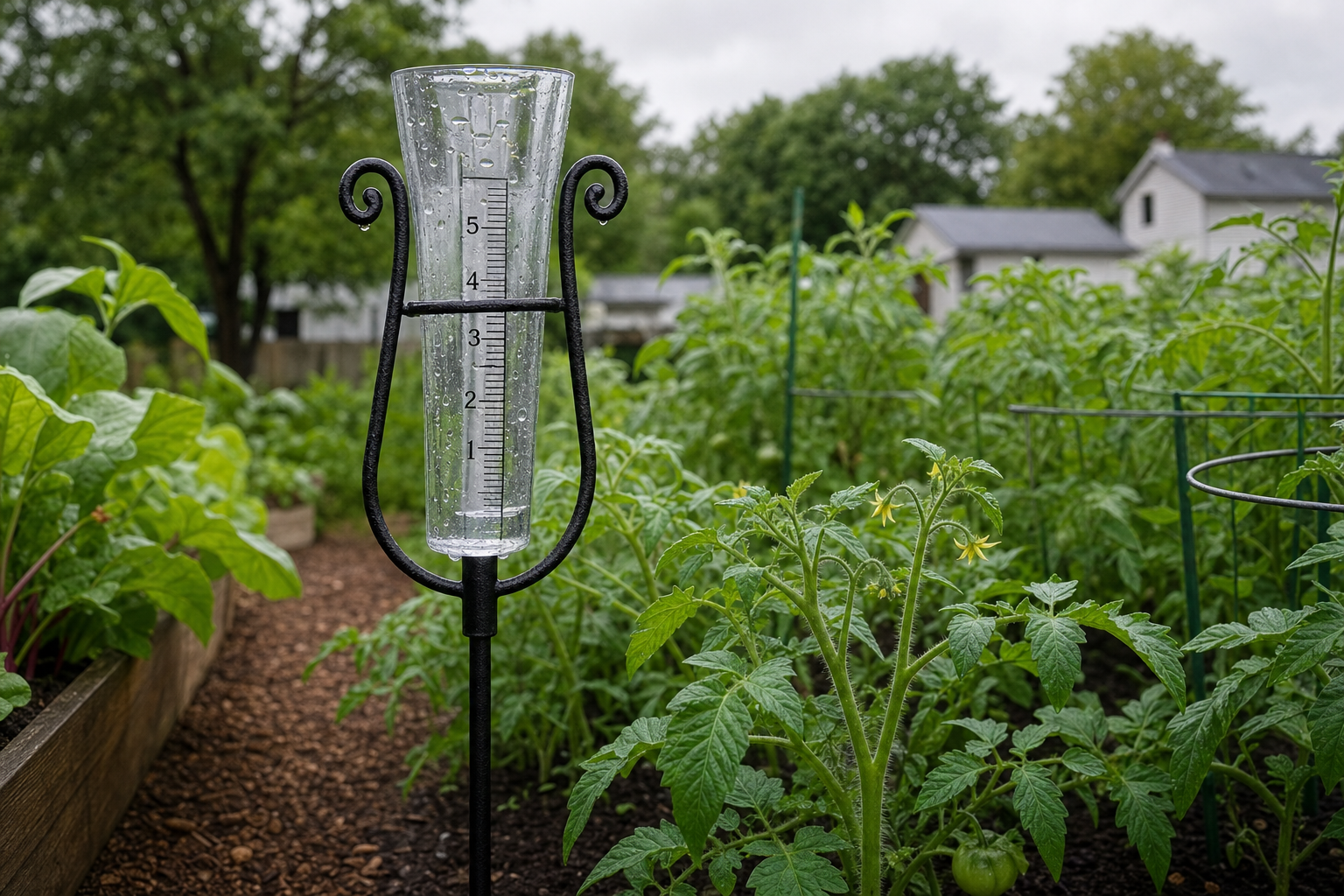
Every summer across north-central Ohio, the same scene plays out in thousands of home gardens: a homeowner runs the sprinkler for an hour the evening after a rainstorm because the soil looks a little dry on the surface, while the root zone three inches down is already waterlogged from the afternoon's rain. Or the opposite — a homeowner skips watering for four days after a brief shower that only delivered a quarter inch, while the tomatoes wilt under 88-degree heat and the lawn goes dormant from actual drought stress. Both mistakes are costly, one in wasted water and stressed plant roots, the other in lost plants and dead lawn patches. Both share the same root cause: not knowing how much rain actually fell. A Rapitest Decorative Rain Gauge with Stake, available at Liberty Farm, Home & Garden in Galion, Ohio, eliminates the guesswork completely. With a clear, easy-read cylinder graduated in both inches and centimeters, an adjustable metal stake that positions the gauge at the right height anywhere in the yard, and a removable cylinder for quick, clean emptying, it is the most practical tool a home gardener can add to the landscape this growing season.
Why Guessing About Rainfall Is Costing You Money, Time, and Plants
The human intuition for rainfall amounts is remarkably poor. A brief, heavy downpour that leaves puddles on the driveway and mud on the lawn can feel like it delivered a substantial amount of water — and sometimes it does. But an intense ten-minute thunderstorm that saturates the top half-inch of soil and sends the rest down the storm drain can deliver only a third of an inch of measurable rainfall. Conversely, a slow, steady, gray-sky soaker that looks light and feels unremarkable can deliver an inch or more over several hours, fully saturating the root zone of even deep-rooted landscape plants.
Without measurement, the gardener is responding to visual cues — puddling, dry-looking soil surface, wilted foliage — that are imperfect proxies for actual soil moisture at root depth. The result is systematic watering errors that compound over a growing season:
Overwatering after storms. When a storm delivers a visible amount of water — enough to run off driveways and create temporary puddles — the intuitive response is to skip irrigation for several days. But if the storm only delivered half an inch and your lawn needs an inch per week to stay healthy in June heat, that means you are already behind by half an inch before the dry stretch even begins. Knowing the actual amount allows you to make that calculation explicitly rather than relying on a gut feeling.
Underwatering after significant events. When a storm delivers a genuine inch or more of rainfall, continuing to irrigate on a fixed schedule wastes water and risks root oxygen stress. Saturated soil has reduced oxygen availability in the pore spaces, and roots in persistently wet conditions are susceptible to fungal pathogens, including the Phytophthora species that cause root rot in tomatoes, peppers, and ornamental plants. Knowing that the garden received a full inch means you can confidently skip scheduled irrigation for the next several days without stress or guesswork.
Watering decisions disconnected from actual need. Fixed irrigation schedules — run the sprinkler every Tuesday and Friday regardless of conditions — are one of the most common and wasteful approaches to home garden watering. A simple rain gauge creates a feedback loop between actual rainfall and irrigation decisions, allowing even a beginner gardener to shift toward need-based watering that is better for plants and significantly more water-efficient than schedule-based approaches.
The time investment required to shift from guessing to measuring is genuinely minimal: glance at the gauge after each rain event, note the measurement, empty the cylinder, and adjust your irrigation plans accordingly. The Rapitest Decorative Rain Gauge makes all three of those steps — reading, noting, and emptying — as quick and easy as possible.
What the Rapitest Decorative Rain Gauge Includes and How It Works
The Rapitest Decorative Rain Gauge with Stake is a well-designed, practical tool that handles everything a home gardener needs from a rain measurement instrument without unnecessary complexity.
The measurement cylinder. The gauge features a clear polystyrene cylinder that catches and holds rainfall for measurement. The cylinder is graduated in both inches and centimeters, with clear markings that are easy to read from standing height without needing to crouch down or get close to the gauge. The 5-inch rainfall capacity handles even the heaviest Ohio storm events — the state record for a single-day rainfall is well above 5 inches, but events above 5 inches in a single storm are genuinely rare in Crawford County conditions, meaning the gauge will accurately capture the vast majority of measurable rainfall events you will encounter across an Ohio growing season.
The lift-out cylinder design. One of the most practical features of the Rapitest gauge is that the polystyrene cylinder lifts out of the decorative holder for reading and emptying. You do not need to tilt the whole assembly, crouch to read a gauge mounted at a fixed height, or struggle with a stuck tube. Lift the cylinder, read the measurement at eye level if you prefer, record what you got, and then empty it cleanly. The cylinder goes back in the holder and the gauge is immediately ready for the next event.
The adjustable metal stake. The gauge mounts on a vinyl-coated metal stake with an adjustable height of up to 36 inches. This adjustability matters because proper rain gauge placement requires getting the cylinder opening above surrounding vegetation — a gauge surrounded by tall grass, dense perennials, or positioned too close to a fence or structure will give inaccurate readings because the surrounding objects either intercept rainfall (giving low readings) or channel water into the gauge (giving high readings). The 36-inch maximum height gives you enough adjustment range to clear most garden vegetation and position the gauge correctly for accurate measurement.
The decorative holder. The black plastic holder that secures the cylinder is designed to be visually unobtrusive in a garden setting. Unlike purely functional rain gauges that look like lab equipment, the Rapitest unit has a finished appearance that sits appropriately in a flower bed, vegetable garden border, or lawn area without looking out of place. This is a practical consideration for gauges positioned in visible landscape areas — the gauge is more likely to stay in a useful location (properly sited for accurate readings) if it looks appropriate there rather than looking like it was placed by accident.
Siting Your Rain Gauge for Accurate Readings: The Rules That Matter
A rain gauge is only as useful as its placement is accurate. A poorly placed gauge can give readings that are significantly different from actual rainfall — leading to exactly the overwatering or underwatering errors you installed the gauge to avoid. Proper siting follows a small set of rules that are easy to apply in a home landscape setting.
Clearance from obstructions. The gauge should be positioned so that no overhead obstruction — tree canopy, roof overhang, pergola, arbor — is within a reasonable distance of the collection opening. The conventional guideline is that the distance to any obstruction should be at least twice the height of that obstruction. In practical terms: if your gauge is near a 15-foot tree, the gauge should be at least 30 feet away from the trunk. If that is not possible in your yard layout, choose the most open location available and note that readings may be slightly influenced by nearby canopy during diagonal rainfall events.
Clearance from structures. Do not mount the gauge directly against a fence, shed wall, or house wall. Structures create turbulence in wind-driven rain and can also create artificial drip zones from roof runoff during heavy events. Position the gauge in an open area at least several feet from any vertical structure.
Clearance from surrounding vegetation. The cylinder opening should be above the surrounding vegetation. This is why the adjustable stake height matters — in a vegetable garden where plants may reach 3 or 4 feet tall by midsummer, you may need to extend the stake to its maximum height or position the gauge in a pathway or at the garden edge where vegetation does not surround it.
A representative location. Ideally, your gauge is in the part of your yard or garden that is most representative of where you are making watering decisions. If you are primarily concerned with your vegetable garden, position the gauge in or adjacent to the vegetable garden. If you are tracking lawn irrigation needs, position it in the open lawn area you are irrigating. In large properties where different areas may receive meaningfully different rainfall due to topography or tree coverage, a second gauge in the other critical area provides useful additional data.
Read and empty after every rain event. A rain gauge that is allowed to accumulate water across multiple events without being emptied between them is telling you the total rainfall over that period, not the rainfall from individual events. For watering decisions, per-event rainfall amounts are more useful than cumulative totals, and the easy-lift cylinder design of the Rapitest gauge makes emptying after each event a quick, routine step.
Watering Benchmarks for Ohio Lawns and Gardens: What to Do With Your Measurement
Having an accurate rainfall measurement is only useful if you know what to do with the number. Understanding the water needs of the plants you are managing transforms the rain gauge reading from a data point into an actionable irrigation decision.
Cool-season lawn grasses (tall fescue, Kentucky bluegrass, perennial ryegrass). Ohio's cool-season lawn grasses need approximately 1 to 1.5 inches of water per week during the active growing season to maintain green, actively growing turf. During periods of extreme summer heat (above 90°F), this requirement increases or the grass may naturally enter a dormancy period where water requirements decrease temporarily. The practical watering decision is straightforward: if your rain gauge shows that the week's rainfall is below 1 inch, supplement with irrigation to reach that target. If rainfall has reached 1 inch or more, skip scheduled irrigation without guilt.
Vegetable gardens. Most vegetable crops need 1 to 2 inches of water per week, with the higher end of that range applying during fruit development stages — tomatoes setting and sizing fruit, cucumbers sizing rapidly, beans filling pods. Consistent soil moisture during fruit development is particularly important for preventing blossom end rot in tomatoes and peppers (which is a calcium transport problem triggered by inconsistent moisture) and bitter cucumbers (which result from drought stress during sizing). Tracking weekly rainfall against a 1- to 1.5-inch target for most of the season, and supplementing as needed, is an effective approach that the Rapitest gauge makes straightforward.
Newly planted trees and shrubs. Newly planted woody plants need consistent soil moisture in the root ball and surrounding soil during their first one to three growing seasons as they establish their root systems in the new location. A general guideline is to water the root zone area whenever rainfall has not delivered at least an inch in the past week, and to water deeply (enough to wet the soil 12 to 18 inches deep at the planting zone) rather than frequently and shallowly. Monitoring with a rain gauge lets you accurately track rainfall deficits and supplement appropriately without either neglecting newly planted stock or waterlogging them.
Established perennial beds. Well-established perennial plantings in mulched landscape beds are more drought-tolerant than vegetable crops or new plantings, but they still benefit from monitoring during extended dry spells. Most established perennials begin showing drought stress after two or more weeks with less than a half inch of total rainfall during summer heat. Using your rain gauge to track weekly totals lets you identify when a landscape bed is moving into genuine deficit and needs supplemental water before visible wilting stress occurs.
Container plants. Container plants dry out faster than in-ground plantings because the limited soil volume cannot buffer against heat and wind the way a large soil mass can. Rainfall readings are less useful for container care — a rain event needs to be substantial and of long enough duration to penetrate the potting mix through the container drainage holes before it provides meaningful benefit to the root zone. For containers, direct soil-moisture checking (sticking your finger into the potting mix) is more reliable than rainfall measurement. Use your rain gauge for in-ground plants and supplement container care with direct moisture checking.
| Plant Type | Weekly Water Need | Irrigation Action | Monitoring Priority |
|---|---|---|---|
| Cool-Season Lawn (tall fescue, bluegrass) | 1.0–1.5 inches/week | Supplement when gauge shows weekly total below 1 inch | High — lawns show stress quickly in summer heat |
| Vegetable Garden (tomatoes, peppers, cucumbers) | 1.0–2.0 inches/week | Track weekly totals; irrigate to maintain 1–1.5 inch minimum | High — fruit set and quality depend on consistent moisture |
| Newly Planted Trees & Shrubs | ~1 inch/week at root zone | Water deeply whenever weekly rainfall is below 1 inch | Very High — establishment period is most vulnerable |
| Established Perennial Beds (mulched) | 0.5–1 inch/week | Supplement during extended dry spells; less urgent than crops | Moderate — mulched beds buffer moisture loss significantly |
| Annual Flower Beds | 1.0 inch/week | Supplement when weekly total falls short; consistent moisture for blooming | Moderate — annuals bloom more consistently with steady moisture |
| Established Native Plants & Ornamental Grasses | 0.25–0.5 inch/week once established | Rarely need supplemental water once established; monitor during extreme drought | Low — drought tolerance is their main advantage |
| Container Plants | Varies — check soil directly | Use direct moisture check rather than gauge reading | High — containers dry out faster than in-ground plantings |
Tracking Ohio Weather Patterns With Your Gauge: What June Through August Looks Like
Understanding the typical rainfall patterns in Crawford County across the summer growing season helps put individual gauge readings into context and makes irrigation planning more proactive rather than reactive.
June in north-central Ohio is typically the second wettest month of the year, with average monthly rainfall around 4 inches distributed across a mix of frontal systems, afternoon convective thunderstorms, and occasional slow-moving low-pressure events. The challenge with June rainfall is the extreme variability in distribution: one week can bring 2 inches across three rain events, and the following week can be completely dry with temperatures in the upper 80s. Average monthly totals can obscure this within-month variability, which is why gauge readings after individual events matter more than tracking monthly averages for making watering decisions.
July and August shift toward a drier pattern on average, with convective afternoon and evening thunderstorms becoming the dominant precipitation mechanism. These summer storms are highly localized — a thunderstorm can dump an inch of rain on the west side of Galion while the east side receives nothing. This localization makes regional weather station data or phone weather app precipitation reports particularly unreliable for individual property irrigation decisions. Your rain gauge, positioned in your specific yard, captures the actual precipitation that fell on your property — not what fell on the Galion ASOS weather station or what a weather model predicted for your zip code.
This localization problem is one of the most compelling practical arguments for having your own rain gauge rather than relying on reported precipitation data. In any given summer week in Crawford County, the difference between actual rainfall at your property and reported rainfall for the nearest weather station could easily be a half inch or more — enough to shift a lawn watering decision from “skip this week” to “definitely irrigate today.”
Tracking your gauge readings across the season also builds a useful record of your property's microclimate patterns. If you notice that your gauge consistently reads higher than regional weather reports during summer storms, you may be in a topographic pocket that captures more than average rainfall. If you consistently read lower, your property may be in a drier microclimate or sheltered from prevailing storm tracks by terrain or structures. This property-specific rainfall history is genuinely useful for calibrating long-term irrigation planning and understanding why some seasons are harder on your lawn and garden than others.
Maintaining Your Rapitest Rain Gauge for Long-Term Accuracy
The Rapitest Decorative Rain Gauge is a simple, low-maintenance tool, but a few care practices ensure it continues giving accurate readings across multiple growing seasons.
Keep the cylinder clean. Airborne debris — pollen, dust, small leaves, insect material — can accumulate in the collection cylinder over time, particularly during spring when pollen loads are high. Rinse the cylinder with clean water when you empty it after each rain event. If debris has accumulated inside, rinse it out before the next reading to ensure the measurement markings remain fully visible and the cylinder walls are clean enough for accurate meniscus reading.
Check the stake for shifting. In Ohio's clay-heavy soils, frost heaving in early spring and soil shrinkage during summer drought can gradually shift the stake from vertical to a slight lean. A noticeably tilted gauge will collect rainfall at a slight angle, which can introduce minor measurement error. Check the stake orientation occasionally and reset it to vertical as needed.
Store or protect the cylinder in winter. Polystyrene is susceptible to cracking from freeze-thaw cycles if water is left standing in the cylinder when temperatures drop below freezing. Empty the cylinder before the first hard freeze in fall and either remove the cylinder for indoor storage or leave it in place but dry through the winter. The vinyl-coated metal stake can remain in place year-round without damage.
Replace the cylinder if cracked or clouded. A cracked cylinder will give inaccurate readings because water can seep out between events. A heavily clouded or scratched cylinder makes reading the measurement markings difficult. Replacement cylinders are available, and given how inexpensive the gauge is to begin with, replacing the entire unit is often the practical choice if the cylinder is significantly degraded after several seasons.
The Rapitest Brand and the Tools That Back It Up
Rapitest is the garden testing brand under Luster Leaf Products, a company that has been manufacturing home garden testing and measurement tools since 1973. Their product line covers soil testing kits, pH meters, moisture meters, and weather instruments — tools built for the home gardener who wants reliable, easy-to-use equipment without the cost or complexity of professional-grade instruments.
The Rapitest approach is straightforward: garden measurement tools should be accurate enough to support good decisions, simple enough that they get used consistently, and durable enough to last multiple seasons. The Decorative Rain Gauge with Stake embodies that design philosophy — it is not a precision meteorological instrument, but it does not need to be. For home garden watering decisions, knowing whether you received a quarter inch, a half inch, three-quarters of an inch, or a full inch or more after a storm is actionable information that changes what you should do next with your irrigation. The Rapitest gauge gives you that information reliably and quickly.
For gardeners who want to expand their measurement capability, the Liberty Farm, Home & Garden tools section carries additional Rapitest and Luster Leaf products including soil test kits that measure pH, nitrogen, phosphorus, and potassium — the four key metrics for fertilizer decisions — as well as moisture meters for in-soil moisture checking. Together, these tools replace guesswork across the most impactful dimensions of home garden management: rainfall, soil moisture, and soil fertility.
Where Rain Gauges Fit Into a Smarter Ohio Garden System
The Rapitest Decorative Rain Gauge with Stake is the entry point into evidence-based garden management, and the changes it enables cascade through the rest of the growing season.
When you know exactly how much rain fell, you can make better decisions about when to water — and those better watering decisions interact with every other garden input. Consistent, appropriate soil moisture means fertilizer applications are taken up more efficiently (plants in drought stress have reduced nutrient uptake). It means disease pressure is lower (both overwatered and underwatered plants are more susceptible to pathogen attack). It means newly transplanted vegetables and annuals establish their root systems faster and with less setback from moisture stress. It means your mulch, once applied at the right depth, is doing the job you intended it to do rather than being undermined by irregular irrigation that produces soil moisture swings the mulch cannot fully buffer.
Ultimately, the value of a rain gauge is not just knowing how many inches of rain fell — it is the confidence that comes from knowing what your garden actually received and making your irrigation decisions from a position of accurate information rather than hope and approximation. Stop in at Liberty Farm, Home & Garden in Galion, Ohio, or order online at libertyfhg.com, to pick up the Rapitest Decorative Rain Gauge with Stake and start the rest of this growing season knowing exactly where you stand after every rain event.
Frequently Asked Questions
Keep Reading
Plant Cover Crops Now: An Ohio Home Garden Guide
Plant fall cover crops in an Ohio vegetable garden with practical guidance on timing, species, seeding, winter care, and spring termination.
Save This Summer’s Garden: A Practical Ohio Seed-Saving Guide
Save tomato, bean, pea, lettuce, marigold, zinnia, and other garden seeds with this practical late-summer guide for Galion and north-central Ohio.