
Why Deer and Rabbits Keep Coming Back to Your Garden — and How Liquid Fence Finally Stops Them
A complete guide to using Liquid Fence Ready-to-Spray Concentrate Deer and Rabbit Repellent — how scent-based deterrence works, how to apply it correctly, and why the conditioning phase makes or breaks your results
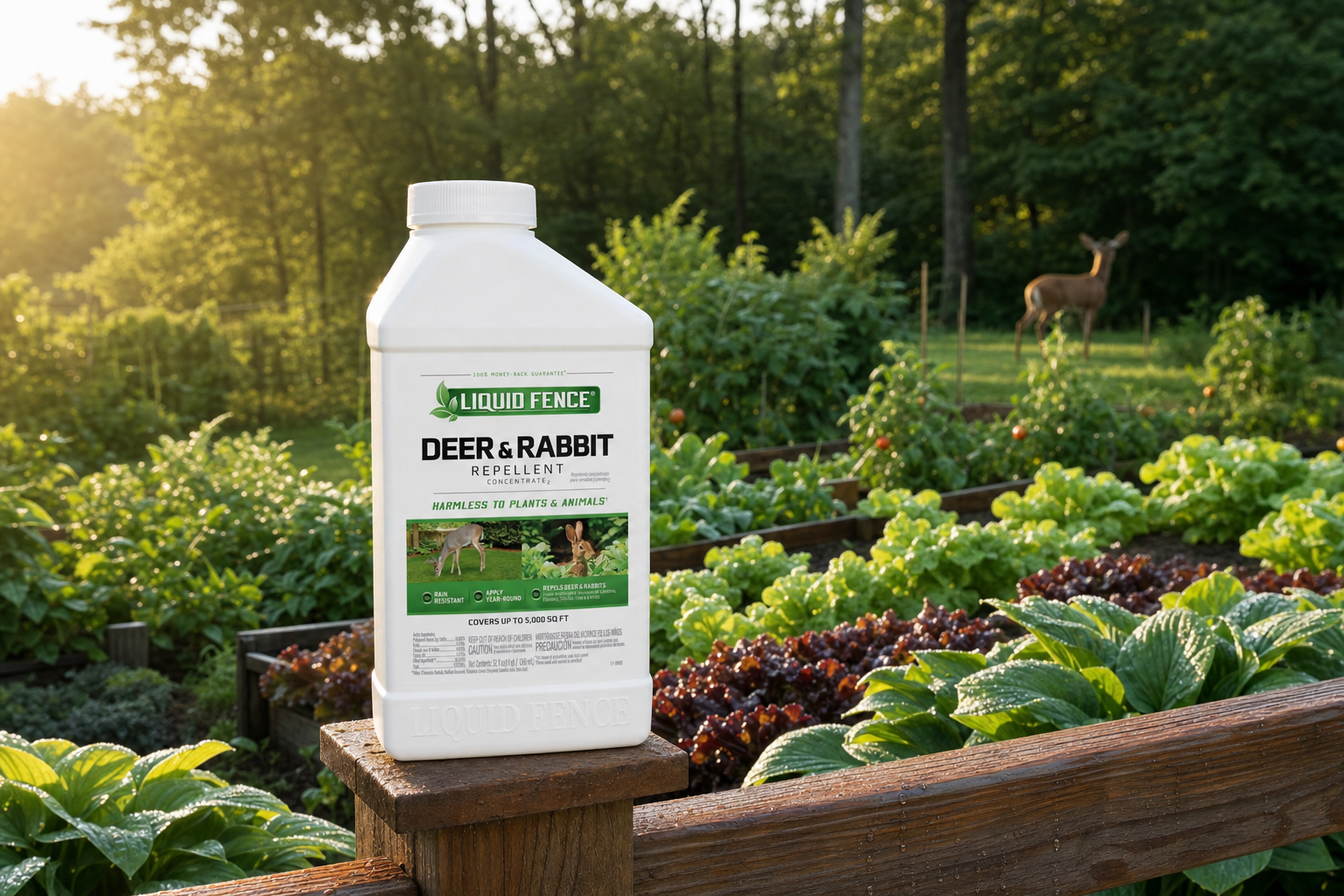
Every gardener in Ohio knows the scene: you go out in the morning to check on the hostas or the vegetable bed and find the stems chewed to stubs, the lettuce leveled overnight, the young tulips gone. Deer and rabbits are relentless, and most of the common approaches — motion lights, wire cages, spray repellents that smell like spoiled eggs — either don't work consistently or require more labor than most people are willing to keep up with. The Liquid Fence Ready-to-Spray Concentrate Deer and Rabbit Repellent (32 oz) works on a different principle than most repellents, and that difference matters. It triggers a fear response through scent before the animal ever touches your plants — which means it stops damage rather than just making it less appealing after the fact. At Liberty Farm, Home & Garden in Galion, Ohio, we carry it because it's one of the products that actually does what it claims when used correctly.
How Scent-Based Repellents Work Differently Than Taste Deterrents
Most repellents on the market are taste deterrents — they coat plant surfaces with something bitter, hot, or unpleasant, so that when an animal takes a bite, it recoils and (ideally) learns to avoid that plant. The problem with this approach is built into the mechanism: the animal has to bite first. By the time the deterrent is doing its job, you've already lost foliage. For annuals, a single deer visit that removes new growth can set back the entire plant by weeks or kill it outright. For vegetables at a critical growth stage, there's no recovery.
Liquid Fence works through scent, not taste. The formula contains sulfur-based compounds — specifically putrescent whole egg solids and garlic — that trigger an instinctive avoidance response in deer and rabbits before they reach the plant. These animals rely heavily on smell to evaluate whether an area is safe to feed in. When an area smells like the compounds Liquid Fence uses, the instinctive response is to avoid it entirely and find a food source that doesn't set off alarm signals. This is the same mechanism used by predator urine repellents, but Liquid Fence's specific formulation has been refined over years of commercial production to be more consistent and longer-lasting than most DIY or bulk approaches.
The practical result: treated plants don't get sampled. Animals that encounter the scent perimeter turn away before reaching the foliage — which means no bite marks, no chewed stems, no partial damage that leaves the plant alive but disfigured.
What the Hose-End Applicator Actually Does — and Why It Matters for Coverage
The "ready-to-spray" designation on this product refers specifically to the hose-end applicator that comes with the 32 oz bottle. The concentrate inside the bottle is mixed and dispensed at the correct dilution rate as you spray — you attach a standard garden hose, turn on the water, and the applicator meters the concentrate into the water stream at the right concentration as it sprays.
This matters practically in two ways. First, it eliminates the need to measure and pre-mix concentrate in a separate sprayer, which is where most people make application errors with concentrated repellents — either mixing too weak to be effective or too strong, which can cause phytotoxicity (leaf damage) in sensitive plants. The hose-end applicator handles the ratio automatically.
Second, it makes coverage of large areas fast and practical. A 32 oz hose-end bottle covers substantially more ground than what you could treat by hand with a pump sprayer in the same amount of time. For properties with large ornamental beds, tree lines that deer enter from, perimeter hedgerows, or extended vegetable gardens, this is the difference between a repellent that's practical to apply thoroughly and one that gets used once and abandoned because the process is too slow to cover the area that needs protection.
The Initial Conditioning Phase: Why the First Two Weeks Are Critical
Liquid Fence has a conditioning protocol that most people skip or do poorly, and it's the single biggest reason people report mixed results with this product. The label calls for more frequent applications during an initial establishment period — typically three applications in the first two weeks — before dropping to the monthly maintenance schedule.
This initial conditioning phase matters because you're not just making the treated area smell like a threat on a given day. You're establishing a learned avoidance behavior in the animals that use your property regularly. Deer and rabbits are creatures of habit — they develop feeding routes and return to the same locations repeatedly unless something disrupts the pattern. A single application creates a one-time scent barrier. Three applications in close succession create a consistent, repeating signal that trains the animal to associate your garden area with danger and route around it entirely.
| Application Phase | Timing | Purpose |
|---|---|---|
| Initial Application 1 | Day 1 — first day of use | Establishes scent barrier; first exposure for local animals |
| Initial Application 2 | Day 7 — one week after first | Reinforces barrier before first application fully fades; begins conditioning feeding route avoidance |
| Initial Application 3 | Day 14 — two weeks after first | Completes conditioning phase; animals that tested the perimeter in week one are now consistently avoiding |
| Maintenance Applications | Once per month thereafter | Keeps scent barrier fresh; addresses rain weathering and natural dissipation |
| Post-Heavy Rain Supplement | After any week with more than 1 inch of rain | Rain resistance has limits; unusually heavy or extended rainfall may require an additional application mid-cycle |
If you're starting Liquid Fence mid-season after damage has already begun, complete the full three-application conditioning sequence before evaluating results. Judging the product after a single application is the most common reason people conclude it doesn't work — they're measuring a product designed for three-application establishment against a one-application trial.
Rain Resistance: What "Withstands Up to 1 Inch of Rain Per Week" Actually Means
The rain resistance specification on Liquid Fence is more precise than most repellent labels — it names an actual measurement rather than vague terms like "rain-resistant" or "weatherproof." Understanding what it means in practice helps you plan your reapplication schedule realistically.
The 1 inch per week specification means that after the application has dried (typically 4–6 hours in normal conditions), the product has been formulated to retain effective scent levels through a week with up to 1 inch of total rainfall. This covers the average weekly precipitation for Ohio through the growing season — the state averages roughly 0.8 to 1.2 inches per week from April through September, depending on year and region.
What it doesn't mean: that any amount of rain leaves the product fully intact. Heavy or concentrated rainfall in a short period is more erosive than the same total volume spread across multiple days. A single 2-inch rainfall event in one afternoon will degrade the application more than a week of light daily drizzle adding up to 2 inches total. In a wet week or after a significant storm, you may need to reapply earlier than the normal monthly cycle rather than waiting out the full 30 days.
Where to Apply Liquid Fence — and Just as Important, Where Not To
Effective application is less about saturating every plant and more about understanding how deer and rabbits approach an area and treating the approach vectors. Deer especially follow the same entry routes repeatedly — they're not random — so knowing where they enter your property tells you where the scent barrier needs to be strongest.
Apply to:
- The foliage of target plants — hostas, tulips, garden vegetables, young trees, and any ornamentals with documented deer or rabbit pressure in your yard. Focus on the leaf surfaces and stems the animal would encounter first
- The perimeter vegetation adjacent to entry points — tree lines, fence lines, and shrub borders that deer and rabbits pass through when entering the property. Creating a scent barrier along the approach route is as important as treating the destination
- Low-growing vegetation around the garden bed — rabbits especially work along ground level; treating the border plants and ground-level foliage immediately surrounding the target garden zone addresses their typical approach pattern
- Newly planted material — young plants with soft, new growth are the most attractive to both deer and rabbits and the most vulnerable to a single browsing event. Treat transplants immediately after planting
Be thoughtful about:
- Edible crops you'll harvest without washing — Liquid Fence is not labeled for direct application to edible crop surfaces that will be consumed without washing. For vegetable gardens, treat the perimeter and surrounding foliage rather than spraying directly on food crops; the scent barrier effect carries into adjacent areas
- Newly seeded areas — concentrated application directly to bare soil or emerging seedlings can be harsh; focus on established plant surfaces for vegetable and flower areas
Deer vs. Rabbit Damage: How to Tell Which Animal You're Dealing With
Liquid Fence is formulated and labeled for both deer and rabbits, but knowing which animal is your primary problem helps you focus your application strategy appropriately. Deer and rabbits feed differently and damage plants in recognizable ways.
| Characteristic | Deer Damage | Rabbit Damage |
|---|---|---|
| Cut type | Ragged, torn edges — deer lack upper incisors and tear foliage rather than cutting cleanly | Clean, precise diagonal cut — rabbits have sharp incisors and cut through stems like scissors |
| Height of damage | From ground level up to 5–6 feet; deer can reach high into shrubs and small trees | Ground level to about 18–24 inches; rabbits rarely reach higher |
| Track evidence | Cloven hoof prints, typically 2–3 inches long, often in pairs | Small, paired front-foot prints with larger hind prints; track pattern shows bounding gait |
| Droppings | Oval pellets, roughly ¾ inch long, often scattered broadly through the feeding area | Small round pellets, about ¼ inch diameter, often concentrated near the feeding site |
| Feeding timing | Predominantly dawn and dusk; can also feed at night | Most active at dawn and dusk; also frequently active overnight |
| Damage pattern | Broad coverage across a wide area; a deer can strip significant foliage in one visit | More localized; tends to focus on one plant or plant cluster at a time before moving |
If you're seeing both patterns — ragged high damage alongside clean low cuts — you likely have both animals using your property, which is common in Ohio's mixed residential-rural edge habitat. In that case, the full perimeter-plus-foliage application strategy that works for deer also covers rabbits, though you'll want to make sure your ground-level coverage is thorough given how closely rabbits work to soil level.
Timing Your Liquid Fence Applications Through the Ohio Growing Season
Ohio's deer and rabbit pressure isn't constant year-round — it peaks in predictable windows that should influence when you invest the most effort in repellent application. Understanding those windows helps you allocate the product efficiently and maintain your garden through the highest-risk periods.
The highest-pressure windows in Ohio are:
- Early spring (March–May) — As winter food sources disappear and plants emerge, deer and rabbits are most actively seeking fresh foliage. New growth on hostas, tulips, daylilies, vegetable seedlings, and young shrubs is extremely attractive. Damage in this window is particularly harmful because it hits plants at their most vulnerable growth stage.
- Midsummer (June–July) — Vegetable gardens are at peak production and attractiveness. Deer pressure on vegetable beds intensifies as natural browse becomes drier and less palatable. Rabbits concentrate on low-growing edibles — lettuce, beans, herbs, and pepper transplants — during this window.
- Fall (September–November) — Pre-winter feeding intensifies as deer build fat reserves. Ornamental plantings, late-season vegetables, and any remaining garden growth receive heavy pressure. This is also when deer are most likely to browse on woody plant stems and bark, which can kill young trees and shrubs outright.
During lower-pressure periods (winter in particular), monthly applications can be spaced to the longer end of the window. During the high-pressure windows above, maintain the 30-day cycle strictly and reapply after significant rainfall regardless of where you are in the cycle.
Combining Liquid Fence With Other Garden Protection Strategies
Liquid Fence works best as part of a layered approach rather than as a standalone solution. No single repellent eliminates all risk from determined or hungry animals, and the most resilient garden protection combines scent deterrence with at least one physical or additional chemical barrier for high-value plants.
Physical barriers that complement scent-based repellents well:
- Individual wire cages — For newly planted perennials, young trees, or high-value specimens, a wire cage during the first one to two growing seasons protects the plant while it establishes. Liquid Fence on the surrounding area reduces deer and rabbit traffic near the caged plants even before the plant is large enough to survive browsing.
- Row covers on vegetable beds — Lightweight fabric row cover prevents physical access to vegetables during peak pressure periods, and the covered plants don't need to be within the Liquid Fence spray zone. Apply Liquid Fence to the uncovered areas of the garden and the row covers handle the rest.
- Perimeter fencing for high-value areas — For areas of the garden that justify the investment, a 7–8 foot fence is the only method that reliably excludes deer from a defined zone. Liquid Fence is more practical for large perimeters and areas that can't be fully fenced.
At Liberty Farm, Home & Garden, we carry additional pest management products that address different layers of the same problem:
- Sevin Garden Insect Killer Ready to Use (1.33-Gallon) — For insect pressure on the same beds you're protecting from deer and rabbits. Deer and rabbit damage often gets noticed first, but the same vegetables are frequently under simultaneous insect attack; a broad-spectrum insect killer addresses the second problem while Liquid Fence handles the first.
- BioAdvanced All-in-One Rose and Flower Care Concentrate (32 oz) — Roses are among the most deer-browsed plants in residential gardens. This product addresses disease and insect pressure on roses while Liquid Fence handles deer deterrence — two different threat vectors that both need to be managed for roses to thrive in deer country.
- Tomcat Rat & Mouse Pelleted Place Packs (22 ct) — While Liquid Fence addresses deer and rabbits at the garden level, rodent pressure from rats and mice in the garden shed, garage, or outbuildings is a separate problem that often coexists with deer pressure on properties with the same habitat characteristics that attract all of them.
Getting Results: What Success Looks Like — and What's Normal
Knowing what to expect after applying Liquid Fence prevents the most common reason people give up on the product prematurely: expecting immediate, perfect results during an establishment period that requires patience.
In the first week after your first application, some browsing may continue. Animals that have been using your garden as a food source regularly have an established pattern that doesn't break on the first day of deterrence. They may approach the treated area, encounter the scent, pull back — and then try again from a different angle. This is normal behavior during the conditioning phase.
By the end of the third application (week two), most users see a clear reduction in browsing activity. Animals that were visiting daily or every few days either stop entirely or reduce frequency significantly. Occasional new animals that are unfamiliar with your property may still test the boundary until they encounter the scent, which is why maintaining consistent monthly applications is important — it handles both the conditioned local population and newcomers.
Stop in at Liberty Farm, Home & Garden in Galion, Ohio — we carry Liquid Fence and can help you put together a complete approach to deer and rabbit protection for whatever you're growing.
Frequently Asked Questions
Keep Reading
Stop Mice Before Fall: A Practical Ohio Home and Outbuilding Guide
Mouse-proof your Ohio home, garage, barn, or feed shed before fall with practical exclusion, storage, trapping, and safe cleanup steps.
Fall Webworms in Ohio: What to Do About Those Late-Summer Tree Nests
Identify fall webworm nests in Ohio trees, distinguish them from tent caterpillars, assess damage, and choose safe late-summer management.