
Late-Summer Pasture Checkup: Repair, Reseed, or Rest Your Ohio Fields?
Walk your pasture before fall and decide what each field actually needs: rest, soil correction, targeted repair, or a planned late-summer reseeding.
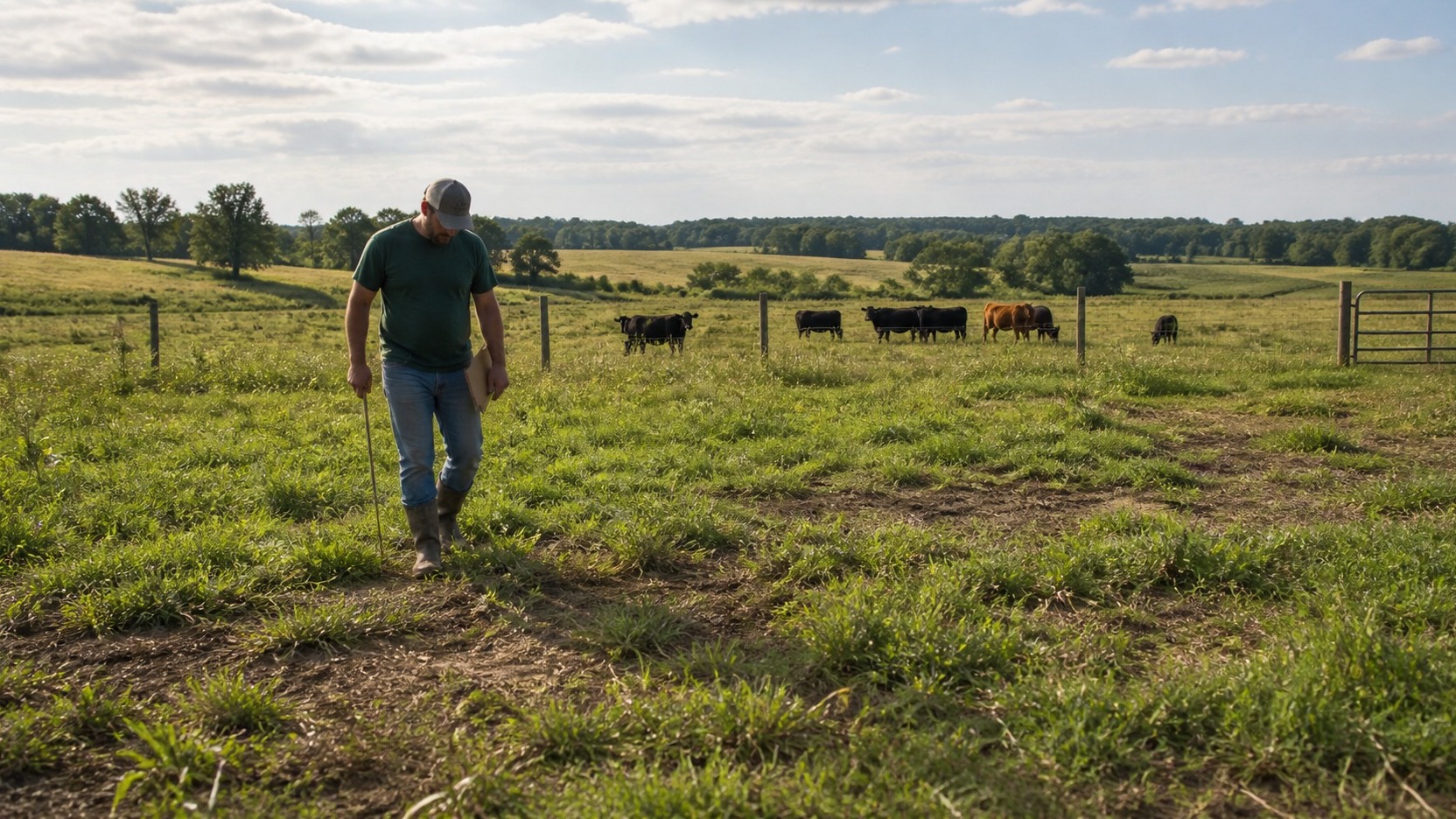
By the third week of August, a pasture tells the truth. The spring flush is long gone, the strongest plants are carrying the stand, and every thin patch, weed pocket, traffic lane, and overused corner is easy to see. That makes late summer one of the most useful times to walk a field in north-central Ohio—not simply to decide what to seed, but to decide whether seeding is the right answer at all.
A tired pasture may need rest more than seed. Another may need lime or nutrients based on a soil test. A few bare lanes may call for targeted repair, while a field with little desirable forage left may justify a planned renovation. The expensive mistake is treating all four situations the same. This guide gives cattle, horse, sheep, and goat owners a practical way to inventory each field, match the repair to the actual problem, and protect new growth through fall.
Why August is the decision window
Ohio State University Extension describes April and August as the two main windows for establishing the cool-season grasses commonly used in Ohio pastures and hayfields. August can also be useful for filling gaps in spring seedings. The opportunity comes with a condition: seed must have enough moisture to germinate and enough growing time to establish before cold weather.
That is why an August pasture project should begin with observation, not a seed bag. The calendar may be favorable while a particular field is not. Dry soil, a poor short-term rain outlook, heavy weed competition, compacted traffic areas, or livestock that cannot be kept off the new stand can turn a timely seeding into a weak one. Conversely, a field with good desirable-plant density may recover with rest, corrected fertility, and better grazing control without the cost of starting over.
Late summer also exposes the season's management patterns. Grass around water, gates, shade, and feeding areas often takes more pressure than the rest of the field. Taller rejected patches may sit beside repeatedly grazed plants. Bare ground may reveal erosion, hoof traffic, drought injury, or simply too little recovery time. Map those patterns now. They are more useful than a general impression that the field looks rough.
For Galion-area farms, the practical goal is not to make every acre look uniform by September. It is to enter fall with a field-by-field plan: protect the ground that can recover, repair the places where desirable forage is still present, and renovate only where the stand no longer justifies lighter measures.
Start with a repeatable pasture inventory
A quick windshield judgment tends to overvalue the greenest parts of a field and miss what is happening under the canopy. Walk a consistent route instead. Ohio State Extension recommends looking at 10 to 15 randomly selected one-square-foot areas and recording desirable plants, weeds, and bare ground. That simple sample turns a vague concern into evidence you can compare next spring.
At each stop, separate what you see into four buckets:
- Desirable forage: grasses and legumes you intentionally want livestock to graze.
- Undesirable plants: weeds, brush seedlings, or species that are taking space from useful forage.
- Bare or weak ground: open soil, sparse seedlings, dead residue, and areas where roots no longer hold a continuous cover.
- Physical damage: ruts, compaction, erosion, pugging, and repeated hoof traffic.
OSU's 2026 pasture-repair guidance offers useful screening questions: are there at least five desirable plants per square foot, are at least two legume plants present per square foot, and is less than 10 percent of the soil bare? Those are evaluation prompts rather than a universal prescription. Species, field use, slope, drainage, and livestock class still matter. A sacrifice lot should not be judged like a productive grazing paddock, and a horse pasture may have different species goals from a beef-cattle field.
Take photos from the same marked locations and note the date, recent grazing, and weather. Include gates, water points, shade, slopes, and low spots. A field map with three colors—sound stand, repair area, and major renovation candidate—is often enough to keep the next steps focused.
Use the evidence to choose rest, repair, or renovation
Not every thin field needs a complete reset. Match the response to the amount of desirable forage that remains and to the cause of the damage.
| What the walk shows | Likely first move | Why |
|---|---|---|
| Good desirable-plant cover with uneven height and few bare spots | Rest and improve grazing rotation | Existing plants may thicken when given leaf area and recovery time. |
| Desirable forage remains, but there are scattered thin patches | Correct fertility issues, control competition, and plan targeted interseeding | Repair preserves the useful stand and concentrates cost where it is needed. |
| Bare lanes cluster near gates, water, shade, or feeding areas | Address traffic and drainage before seeding | New seed will fail if the original pressure continues unchanged. |
| Large portions have few desirable plants and heavy weed pressure | Build a full renovation plan | A weak base stand may not justify repeated spot fixes. |
| Soil is dry and dependable moisture is not in the outlook | Delay seeding and protect remaining cover | Late-summer establishment depends heavily on moisture after planting. |
Rest means more than moving animals for a weekend. The field needs enough recovery time to rebuild leaf area and roots. If there is no alternate paddock, a sacrifice area or hay may be less costly than repeatedly grazing weakened plants down to the crown.
Repair works where useful forage still occupies much of the field. The job may combine targeted weed management, soil amendments based on a test, traffic changes, and interseeding. Renovation is the larger decision: suppressing or removing the failing stand, preparing a seedbed or no-till plan, choosing species for the site's use, and keeping livestock off until establishment. It should be treated as a multi-step investment, not a one-day pass with a seeder.
Test the soil before buying a fertility solution
A pasture can look hungry, but appearance alone cannot tell you whether the limiting issue is pH, phosphorus, potassium, another nutrient, moisture, compaction, or grazing pressure. A laboratory soil test provides the starting point. OSU Extension's 2026 pasture guidance says that if a pasture has not been tested in the past three years, it is time to test again.
Sample management areas separately. A hillside, a wet bottom, an old feeding area, and a normal grazing paddock may not belong in one composite sample. Avoid unusual spots unless you are testing them as their own problem area. Follow the selected laboratory's instructions for sampling depth, number of cores, packaging, and field history; consistency matters more than improvising a homemade method.
The report should guide lime and nutrient decisions rather than serving as permission to apply everything. OSU's soil-testing guidance emphasizes that recommendations based on test results can save money and reduce the environmental cost of excess fertilizer. Soil pH is especially important because it influences nutrient availability and the competitiveness of desired plants.
Do not assume that more fertilizer will overcome a damaged stand. Fertility cannot repair uncontrolled traffic, continuous overgrazing, a drainage failure, or poor seed-to-soil contact. OSU also cautions that when a soil test calls for large nutrient additions, splitting applications may improve nutrient-use efficiency and reduce risks associated with a single heavy application. Work from the lab recommendation and, when the result is unclear, review it with your county Extension educator or another qualified forage adviser.
The useful order is simple: test, interpret, correct what the test supports, and then judge whether the stand still needs seed. That sequence prevents a weak field from becoming an expensive weak field.
Control competition without creating a second problem
Weeds are often the most visible symptom in a thin pasture, but they may not be the original cause. OSU Extension notes that drought and weak forage open the canopy, allowing sunlight to reach bare ground and giving weeds room to establish. A dense, well-managed forage stand is therefore part of long-term weed control.
Identify the plant before choosing a response. Annual and perennial weeds do not share one ideal timing, and mowing, grazing management, hand removal, spot treatment, or a labeled herbicide may each fit different species and field conditions. If identification is uncertain, photograph the whole plant, leaf arrangement, stem, flower or seed head, and growth location. Ask Extension for help rather than treating a guess.
Pay attention to legumes. A broad pasture treatment may remove clover and other desirable broadleaf forage along with weeds. Any herbicide decision must follow the current product label, including the labeled site, target species, application timing, livestock restrictions, reseeding interval, protective equipment, and environmental precautions. The label—not a blog post—is the legal direction for use.
Mechanical control also needs timing. Repeatedly clipping mature weeds after they have already set viable seed may improve appearance without reducing next year's seedbank. Mowing too low can also remove the leaf area that desirable grasses need for recovery. The goal is to reduce competition while preserving the plants you want.
Finally, fix the opening that weeds exploited. If bare ground came from livestock congregating under one shade tree, a herbicide cannot redistribute pressure. If the stand was grazed continuously without recovery, seed alone will not change that pattern. Weed control and pasture repair should be designed as one plan.
Plan late-summer seeding around moisture and establishment
When the inventory supports repair or renovation, August offers a real opportunity—but not a guarantee. OSU's forage guidance identifies adequate soil moisture and rainfall in the weeks after seeding as the primary factors in late-summer establishment. Watch the forecast, check moisture below the surface, and be willing to postpone rather than place seed into dust simply because the date looks right.
Choose species for the field, not for the front of the seed tag. Consider drainage, soil pH, intended livestock, grazing intensity, hay use, winter hardiness, and whether the field will be managed as a mixed stand. OSU's planning sequence is practical: choose a dominant grass, companion cool-season grasses, legumes, any minor species, appropriate seeding rates, and improved varieties. Local Extension guidance is useful because a mix that fits southeastern Ohio, another state, or a hay-only system may not be the best fit for a Galion-area grazing field.
Seed placement matters. Small forage seed generally needs shallow, consistent placement and firm seed-to-soil contact; burying it too deeply can reduce emergence. Calibrate the actual seeder with the actual seed rather than trusting a generic setting. For no-till work, OSU notes that the method can conserve soil moisture, but the field surface should be acceptably smooth because existing roughness will remain.
Control competition before emergence and arrange equipment early. Rental seeders can be booked during the same narrow weather window. Your county Soil and Water Conservation District may be able to identify local equipment options, but availability should be confirmed before the field is prepared.
After seeding, keep livestock off until plants are well anchored and able to tolerate grazing. A seedling that pulls from damp soil with the first bite is not established. The exact waiting period varies with species, weather, and growth, so judge the stand rather than following a fixed number of days.
Protect the stand with a fall grazing plan
A successful repair can still be lost if grazing resumes on the old schedule. New seedlings and recovering perennial plants need leaf area to build roots. Existing plants also need enough residual cover to protect soil and capture sunlight going into colder weather.
Start by identifying where animals linger. Water, mineral locations, shade, gates, and hay rings concentrate hoof traffic and grazing. Moving a portable feature, changing an entry point, adding a temporary lane, or dividing a large field can reduce repeated pressure. The right change depends on the farm, but the principle is consistent: do not reseed a traffic pattern without changing the traffic pattern.
Use recovery—not a rigid calendar—as the return signal. Growth slows as days shorten and temperatures fall, so a rest period that worked in May may be too short in September. Rotate animals before the most desirable plants are repeatedly bitten close while less desirable patches remain tall. If forage supply does not match stocking pressure, reduce time on the field, use another paddock, or feed hay in a designated area that you are willing to protect or repair separately.
Keep records simple enough to use: turnout date, move date, estimated entry and exit height, rainfall, and a few repeat photos. The purpose is not perfect measurement. It is to see whether the field is gaining cover or losing it.
For horse owners, protect against selective grazing by watching both close-cropped areas and tall refusal zones. For mixed livestock or small ruminants, species preferences may change which plants receive pressure, but they do not eliminate the need for recovery. Every pasture benefits when grazing demand is matched to current growth rather than to the way the field looked in spring.
A practical plan for the next 30 days
Turn the field walk into a short, ordered work list. Trying to seed, fertilize, control weeds, and change grazing all at once can hide which action helped.
- Walk and score each field. Sample 10 to 15 square-foot locations, photograph problem areas, and mark sound, repair, and renovation zones.
- Name the cause. Separate drought injury, overgrazing, traffic, drainage, fertility, weeds, and physical damage. More than one may be present.
- Submit soil samples. Keep unlike management areas separate and request recommendations for the intended forage use.
- Identify weeds. Choose control only after identification, and follow every label restriction if a herbicide is used.
- Check moisture and forecast. Do not force a late-summer seeding into an unsuitable field.
- Choose repair or renovation. Preserve a worthwhile stand; start over only when the inventory supports that cost.
- Arrange seed and equipment. Select species for the site and livestock, calibrate the seeder, and plan for shallow placement and firm contact.
- Protect recovery. Keep animals off seedlings, lengthen rest as growth slows, and redirect concentrated traffic.
- Recheck in fall and spring. Repeat photos and square-foot observations to see whether cover, desirable plants, and bare ground are moving in the right direction.
There is no prize for doing the most work. A pasture that needs rest should be rested. A field that needs a soil correction should be corrected from a test. A thin but valuable stand should be repaired carefully. A failing field should be renovated with enough planning to protect the investment.
If you want a second set of eyes on a species list or field plan, start with your county Extension office and Soil and Water Conservation District. When you stop at Liberty Farm, Home & Garden in Galion, bring the soil report, field acreage, livestock type, and a few clear photos. Good questions begin with good field information.
Frequently Asked Questions
Keep Reading
Molting Season Prep: How to Support Your Chickens Through the August Transition
Learn how to recognize and support your chickens through their annual molt in late summer and early fall. This seasonal guide from Liberty Farm, Home & Garden in Galion, Ohio covers nutrition, management, and timing for north-central Ohio flocks.
Beat July Fly Season: The Complete Guide to Horse Fly Control with Pyranha Wipe N' Spray
July is peak fly season for Ohio horses — learn how to use Pyranha Wipe N' Spray RTU to kill and repel flies, gnats, and mosquitoes this summer, available at Liberty Farm, Home & Garden in Galion, Ohio.