
Fall Webworms in Ohio: What to Do About Those Late-Summer Tree Nests
Spotted a silky nest at the end of a tree branch? Learn how to identify fall webworms, judge the damage, and choose a safe, proportionate response in Ohio.
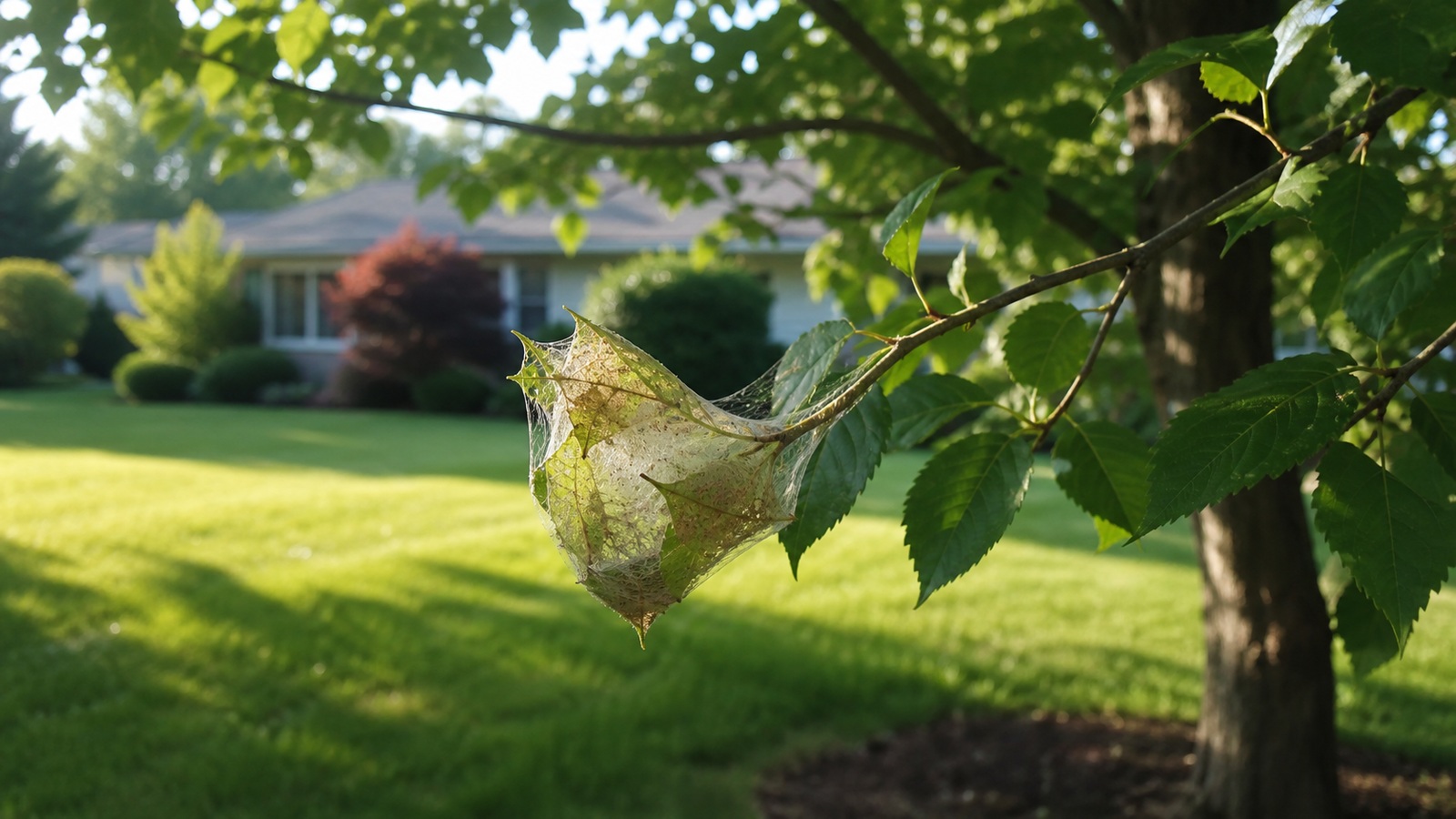
In August, a white web wrapped around a leafy branch can make a healthy yard tree look suddenly sick. Before reaching for a saw or spray, take a closer look from the ground. The nest’s location, the leaves inside it, and the time of year can tell you whether you are seeing fall webworm—and whether the tree needs action at all.
What that webbed branch is telling you
A pale web wrapped around the leaves at the end of a branch can look alarming, especially when it seems to appear between one mowing and the next. In late summer, one likely culprit in Ohio is the fall webworm. Its caterpillars live and feed together inside silk that encloses the foliage. As they grow and consume more leaves, they extend that silk over additional leaves.
The timing and location are useful clues. Fall webworm nests become conspicuous in summer and often grow larger toward fall. They usually sit at or near the ends of branches, and the web contains leaves, shed skins, droppings, and feeding caterpillars. Ohio State University Extension notes that Ohio typically sees two generations and sometimes three, so later nests can be the largest and easiest to notice.
That does not automatically mean a mature shade tree is in serious trouble. A nest can be ugly while causing limited harm to an otherwise healthy, established tree. The right response begins with identification, the tree’s condition, the amount of canopy affected, and whether the nest can be reached safely. A small nest on one low limb calls for a different decision than extensive webbing on a young tree or a nest beside utility lines.
Fall webworm or eastern tent caterpillar?
People often use “tent caterpillar” for any caterpillar that makes silk in a tree, but the two common sights differ in season and construction. Correct identification prevents an August nest from being treated as if it were an early-spring problem.
| Clue | Fall webworm | Eastern tent caterpillar |
|---|---|---|
| Typical timing | Summer into fall | Early spring |
| Web location | Ends of branches | Branch crotches and forks |
| Leaves inside web? | Yes; caterpillars feed within the expanding nest | No; caterpillars leave the tent to feed |
| Common first impression | A baglike or loose mass enclosing browned or skeletonized leaves | A silk tent stretched where limbs meet |
University of Kentucky Extension describes this distinction directly: fall webworm nests occur later, at branch ends, and enclose foliage; eastern tent caterpillar tents are built in limb crotches. Bagworms are different again. Their larvae carry individual spindle-shaped bags made with bits of plant material rather than sharing one large silk nest.
Look from a sensible distance before touching anything. Fall webworm caterpillars can vary in color, and Ohio has both black-headed and red-headed forms. Color alone is therefore less reliable than the combination of season, nest placement, and enclosed leaves. If the growth is a normal spider web without enclosed foliage or a single compact bag hanging from a twig, it is not the communal fall webworm nest described here.
Why the nests show up now in Ohio
Fall webworm is native to North America. The adult is a moth, but the leaf-feeding caterpillar stage makes the structure homeowners notice. Female moths lay eggs on leaves. Newly hatched caterpillars begin covering the leaves around them with silk, then enlarge the enclosure as their colony needs more food and room.
Ohio State’s Buckeye Yard and Garden Line reported second-generation nests in southwest Ohio in early August 2025 and explained that Ohio commonly has two generations, with a third sometimes possible. Galion is not southwest Ohio, so that observation is not a precise emergence forecast for Crawford County. It is, however, strong Ohio evidence for why a new nest in August fits the insect’s seasonal pattern.
The two Ohio color forms do not always behave alike. Ohio State reports that red-headed colonies can make large communal nests and may cause heavier defoliation, while black-headed colonies often make smaller, wispy nests. Population levels can also swing sharply from year to year. One webbed branch is not proof that every tree in the neighborhood will be covered, and the absence of nests last year does not rule them out this year.
Weather, host trees, moth activity, and natural enemies all influence what becomes visible in a particular yard. Rather than treating the calendar as a spray schedule, use August as a reminder to walk the property, inspect young and recently stressed trees, and make decisions from what is actually present.
How much damage can a nest do?
The caterpillars eat the leaves within their shelter. Young larvae may leave a lace-like skeleton; larger larvae consume more tissue while leaving coarse veins and leaf stalks. The visible nest expands as feeding continues. A colony can strip the enclosed branch tip, and several colonies can make a tree look much worse.
For a healthy mature tree, modest late-season defoliation is often more cosmetic than catastrophic. By August, the tree has already had much of the growing season to photosynthesize. That does not make every infestation harmless. Young trees have less leaf area and fewer reserves. A tree already stressed by drought, root injury, construction, disease, or repeated defoliation deserves closer attention. Heavy webbing over a substantial part of the canopy is different from one nest on a peripheral limb.
Use a simple triage check:
- Count the nests. One isolated colony is easier to manage and less consequential than webbing scattered across the canopy.
- Estimate canopy affected. Look at the whole tree, not just the most obvious white patch.
- Consider tree age and health. Recently planted, drought-stressed, or declining trees have less margin.
- Check access. A reachable branch can allow a low-risk physical response. A high branch or utility-line conflict changes the plan.
- Watch the trend. Photograph the nest from the same safe spot and compare it after several days.
If foliage loss is extensive, the tree is valuable or already declining, or identification remains uncertain, ask an ISA Certified Arborist or Ohio State University Extension professional to assess it. The goal is not simply to erase the web; it is to protect the tree without creating a bigger safety or pesticide problem.
Start with the least disruptive response
Natural enemies do a great deal of fall webworm control. Ohio State cites more than 50 parasitoids and 36 predator species associated with keeping populations in check, along with disease organisms. Broadly killing insects around a nest can remove some of those helpful organisms as well as the target caterpillars.
When a small nest is safely reachable, physically breaking open the silk can expose caterpillars to birds, predators, weather, and parasites. A long pole or similar tool can be used from the ground only when there are no electrical hazards and the branch can be reached without overreaching. Do not stand on an improvised platform or work beneath traffic. Wear eye protection and gloves, and avoid dropping debris onto people or pets.
A small infested twig at the outer edge of a branch may be pruned out if that cut will not damage the tree’s structure. Cut according to sound pruning practice rather than hacking off a large limb merely to remove silk. Sealants and wound paint are not a substitute for a proper cut. Dispose of the clipped nest so the caterpillars do not simply crawl back onto the tree.
Do not burn a nest. Fire can injure bark, ignite dry material, and turn a cosmetic tree problem into an emergency. Do not blast a high nest with a pressure washer, climb beyond your ability, or place a ladder near overhead wires. If the colony is high, the tree is large, or access is awkward, observation or professional help is safer than a risky do-it-yourself removal.
When a pesticide may—and may not—fit
Pesticide treatment is rarely improved by waiting until a nest is large, dense, and full of mature caterpillars. Products based on Bacillus thuringiensis subsp. kurstaki (Btk) act on caterpillars and work best on young larvae that eat treated foliage. Ohio State also lists limited-spectrum options such as spinosad, azadirachtin, chlorantraniliprole, and tebufenozide, but that is not a recommendation to use any particular product on any particular tree.
The current product label must list the pest or applicable site and must be followed exactly. The U.S. Environmental Protection Agency explains that pesticide labels are legally enforceable and define where, how, how much, and how often a product may be used. Check precautions, protective equipment, wind and temperature restrictions, water setbacks, pollinator language, and reentry directions. “Natural” is not a permission to ignore the label.
Coverage matters because silk can shield caterpillars, and spraying a tall canopy from the ground can lead to drift and poor control. Do not improvise a stronger mix. Do not apply when wind could carry droplets onto people, pets, vegetables, flowering plants, ponds, or a neighbor’s property. Avoid broad-spectrum treatment when the problem is limited and physical management is practical; those products may affect beneficial insects that help suppress future colonies.
If treatment would require reaching a large tree, working near power lines, or using equipment you do not understand, hire a properly qualified tree-care or pest-management professional. Bring a clear photo or a clipped sample sealed in a container when seeking identification help. Liberty Farm, Home & Garden can help you read a product label and find application supplies, but the label—not a blog post or shelf conversation—controls legal use.
A practical inspection plan for a Galion yard
Choose a calm, dry morning or evening and walk the property from a distance first. Scan branch tips against the sky; silk catches side light and may be easier to see before you stand under the canopy. Pay extra attention to young landscape trees, trees beside drives or play areas, and any specimen already showing stress.
- Confirm the pattern. Look for late-summer silk enclosing leaves at a branch end.
- Photograph it. Take one view of the whole tree and one closer view using zoom rather than a risky climb.
- Mark the extent. Record the number of nests and the rough share of canopy involved.
- Check the tree. Note sparse foliage, dead branches, trunk damage, recent planting, or dry soil.
- Choose the lowest-risk response. Monitor, disrupt a reachable nest, make a small proper pruning cut, or call a professional.
- Recheck. Return in several days and after storms to see whether the colony expanded or natural enemies reduced it.
Do not diagnose from webbing alone if the pattern does not fit. Silk across a trunk crotch in spring suggests eastern tent caterpillar. A tight web containing many tiny caterpillars on a shrub may involve another web-making species. Webbing that coats an entire plant along with fine stippling can point to spider mites rather than caterpillars. A close, focused photo of the nest location, foliage, and caterpillar is much more useful than a white blur from across the yard.
For local assistance, Crawford County residents can use Ohio State University Extension resources, consult a certified arborist, or bring good photos when shopping in Galion. If you need a long-handled tool, gloves, eye protection, a sprayer, or a label-approved control, Liberty can help you compare the practical options without pretending every webbed branch needs a chemical response.
What to do after the caterpillars are gone
An old nest may remain visible after feeding ends. Removing reachable silk and dead leaf material can improve appearance, but do not damage live bark or make unnecessary structural cuts. High abandoned webbing can be left to weather away when removal creates more risk than benefit.
Continue ordinary tree care rather than trying to “feed away” defoliation. During dry periods, water a young or stressed tree deeply and slowly over its root zone according to its actual soil moisture; avoid frequent shallow sprinkling and avoid keeping the trunk constantly wet. Maintain mulch in a broad, shallow layer while keeping it pulled back from the trunk. Do not pile on fertilizer merely because leaves were eaten. Excess fertility can create unwanted growth and does not instantly replace stored energy.
Keep the photos and note the date. They give you a baseline for next summer and help a professional understand whether the same tree is being hit repeatedly. Check again earlier in the season next year, when small colonies are easier to see and manage. Also remember that a yard with birds, predatory insects, parasitoids, and a variety of plants supports the natural controls Ohio State describes.
Think about the tree’s recent history when you review those notes. A mature tree that carried one peripheral nest and kept a full canopy is not in the same category as a newly planted tree that struggled through dry soil, transplant stress, and repeated leaf loss. Record unusual weather, watering, construction near the roots, and any major pruning. Those details make next year’s comparison more useful than the simple statement that “the webworms came back.” They also help an arborist separate insect feeding from an underlying tree-health problem.
Good follow-up care protects roots as well as leaves. Keep string trimmers and mower decks away from the trunk, because repeated bark wounds create a separate and more durable injury. Avoid trenching, piling soil, or parking heavy equipment over the root zone. If mulch has formed a volcano against the trunk, pull it back until the root flare is visible. These unglamorous steps often do more for long-term resilience than an unnecessary late-season fertilizer or broad pesticide application.
Property-wide prevention does not mean trying to eliminate every moth or caterpillar. Fall webworm is a native insect and part of the food web. The practical aim is to notice colonies while they are small, protect vulnerable trees, and tolerate limited cosmetic feeding where the tree can handle it. Preserve plant diversity, avoid routine calendar spraying, and leave pesticide decisions tied to a confirmed pest and an actual management need.
If several neighboring trees show nests, compare notes before assuming a single treatment should cover them all. Tree species, size, condition, nest height, and amount of feeding can differ from yard to yard. Never treat across a property line without permission, and remember that drift does not respect fences. Coordinated observation can be useful; indiscriminate neighborhood spraying is not.
By the next spring, inspect branch structure and bud break rather than searching for the old silk alone. An abandoned nest can persist after the caterpillars are gone, while healthy buds and normal leaf-out show that the tree moved through the episode. If a branch fails to leaf out, look for pruning damage, cankers, breakage, or other causes instead of assigning every dead twig to last summer’s webworms.
The sensible late-summer goal is proportionate care: identify the insect, protect people and the tree, preserve helpful organisms where possible, and escalate only when the amount of damage or the difficulty of access justifies it. One silk nest can be a useful prompt to inspect the yard—not a reason to panic.
Frequently Asked Questions
Keep Reading
Stop Mice Before Fall: A Practical Ohio Home and Outbuilding Guide
Mouse-proof your Ohio home, garage, barn, or feed shed before fall with practical exclusion, storage, trapping, and safe cleanup steps.

Yellowjackets in Ohio: A Practical Late-Summer Guide to Picnics, Nests, and Stings
Handle Ohio's late-summer yellowjackets safely with practical tips for outdoor meals, nest awareness, sting response, traps, and professional removal.