
The OMRI-Listed Potting Mix Built for Containers, Raised Beds, and Indoor Plants: A Complete Guide to Espoma Organic Potting Mix
How Espoma Organic Potting Mix's Myco-tone mycorrhizal technology, OMRI-listed organic certification, and expertly balanced drainage and moisture retention make it the go-to bagged mix for gardeners who want healthy roots without synthetic inputs
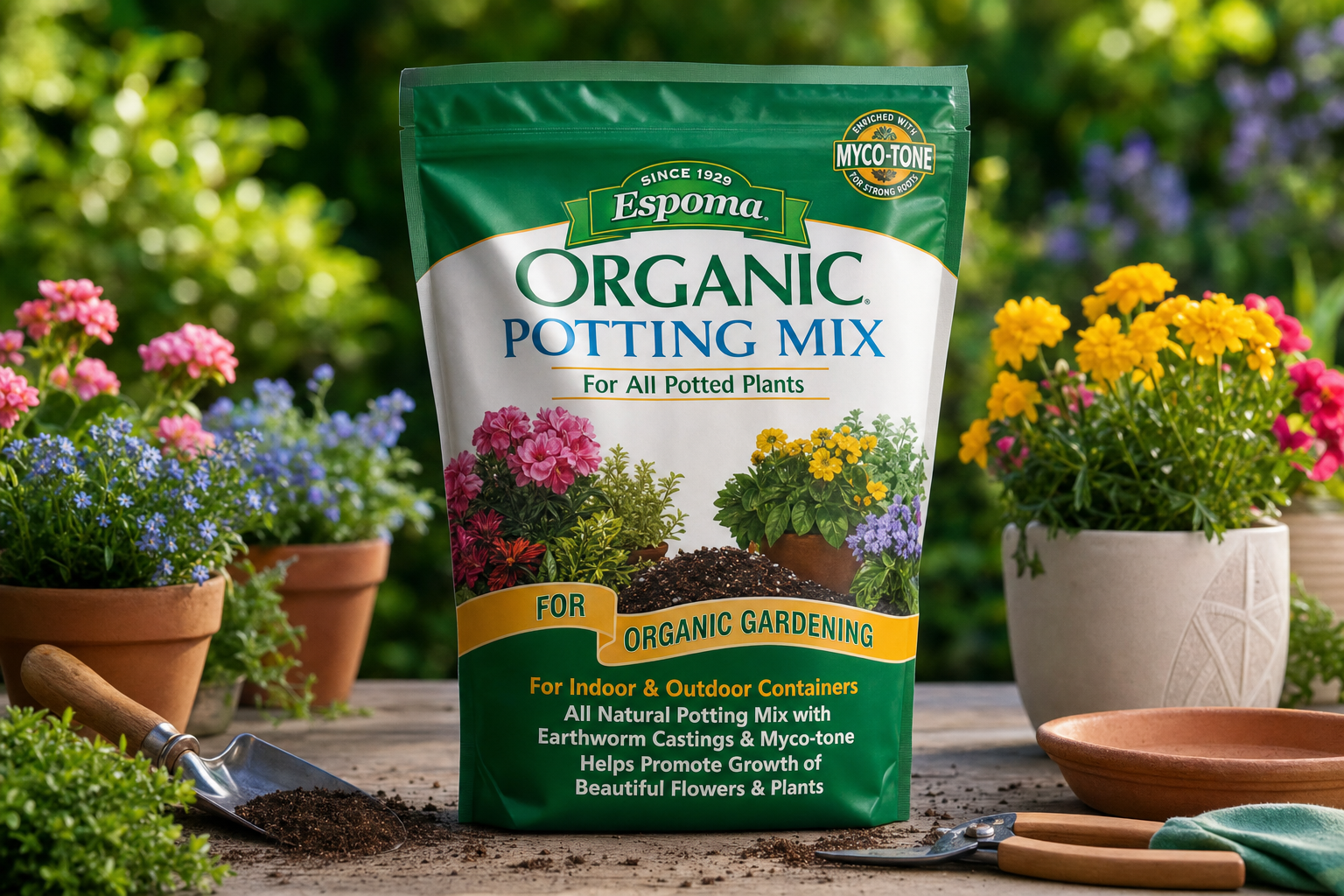
Walk through the potting mix aisle at any garden center and you will find bags that promise rich color, moisture control, and healthy growth — but very few that back those promises with third-party organic certification and a documented mycorrhizal inoculant system built into the mix. Espoma Organic Potting Mix (8 qt), available at Liberty Farm, Home & Garden in Galion, Ohio, is one of them. The OMRI listing means every ingredient has been reviewed and approved for certified organic use. The Myco-tone proprietary mycorrhizal blend means the mix contains living fungal inoculants that colonize root systems and expand the plant's access to water and nutrients beyond the reach of the roots themselves. And the formulation — sphagnum peat, perlite, worm castings, compost, and alfalfa meal — delivers the moisture balance that containers and indoor plants need: enough retention so you're not watering twice a day, enough drainage that roots never sit in standing water. This guide explains how to get the most out of every bag.
Why OMRI Certification Matters — Even If You're Not Running a Certified Organic Operation
OMRI — the Organic Materials Review Institute — is an independent nonprofit that evaluates products against the USDA National Organic Program standards and publishes a list of approved materials. When a potting mix carries the OMRI Listed seal, it means a third party has reviewed the formulation, verified the ingredient sources, and confirmed the product meets the standards required for use in certified organic production.
For the home gardener, OMRI certification communicates something more practical than compliance status: the mix does not contain synthetic fertilizers, synthetic wetting agents, or other petroleum-derived inputs that you might prefer to avoid in a container used for edible plants. Conventional potting mixes often incorporate slow-release synthetic fertilizer pellets, synthetic polymer moisture crystals, or synthetic surfactants — ingredients that are effective but that some gardeners prefer not to use for herbs, salad greens, or edible crops grown in containers near the kitchen.
Espoma Organic Potting Mix's OMRI listing means none of those synthetic inputs are present in the formulation. The nutrients it contains come from organic sources: worm castings provide gentle slow-release nutrition from biological activity; alfalfa meal adds nitrogen, potassium, and the natural growth stimulant triacontanol; compost contributes humic acids, beneficial microbial activity, and a broad spectrum of trace minerals from organic matter decomposition. The result is a biologically active mix that feeds the soil food web rather than bypassing it with synthetic salts — an approach that builds the root zone environment plants thrive in over the whole growing season rather than just delivering an initial nutrient charge.
Whether or not your garden carries organic certification, choosing an OMRI-listed potting mix for containers with edible plants is a practical form of precaution. You know what you're growing in, and you know every input in the bag was reviewed against a documented standard.
What's Inside Espoma Organic Potting Mix — and What Myco-tone Actually Does
Espoma Organic Potting Mix draws its performance from a combination of organic base ingredients and a proprietary mycorrhizal technology that Espoma calls Myco-tone. Understanding what each component contributes helps explain why the mix performs as consistently as it does across the wide range of applications it handles.
Sphagnum peat moss. The primary structural component. Sphagnum peat provides the fibrous, slightly acidic matrix that forms the backbone of virtually all professional-grade potting mixes. It resists compaction over the course of a growing season, which is critical in containers where the weight of the plant and repeated watering can compress lesser media until drainage degrades. Peat holds moisture in its fibrous cell structure and releases it to roots as the mix dries, providing a buffer against brief drying between waterings. It is not a nutrient source in itself — its value is structural and moisture-related.
Perlite. The drainage and aeration component. Perlite is expanded volcanic glass that holds no water and drains completely after wetting, creating the air channels that roots need for oxygen access. The perlite in Espoma Organic Potting Mix is sized and distributed to ensure the mix provides adequate drainage for most container applications — enough to prevent standing water at the root zone, while balancing with the moisture-holding peat so the mix doesn't dry out too rapidly for moisture-sensitive plants.
Earthworm castings. One of the most biologically active organic soil amendments available. Worm castings provide a broad-spectrum slow-release nutrient profile, are rich in humic acids that improve soil structure and nutrient availability, and contain beneficial microbial populations that contribute to a healthy root-zone food web. Unlike synthetic fertilizer salts, worm castings cannot burn roots regardless of application rate — they release nutrients slowly as microbial activity processes them, providing a gentle, sustained nutrition source rather than a sharp concentration peak that tender root tissue can react to negatively.
Compost. Finished organic compost contributes humic substances, additional beneficial microbial diversity, and trace minerals from the broad range of plant material that composts contain. The microbial populations in quality compost support decomposition of organic matter in the mix, cycling nutrients into plant-available forms throughout the season. Compost also improves the moisture-holding structure of the mix by adding humic acids that aggregate particles and increase the water-retention surface area available in the root zone.
Alfalfa meal. A natural organic nitrogen source that also contains triacontanol, a naturally occurring fatty alcohol that functions as a plant growth stimulant. Triacontanol has been documented to improve photosynthetic rates, root growth, and overall plant vigor in numerous studies — Espoma incorporates alfalfa meal specifically for this growth-promoting effect, not merely as a nitrogen source. Alfalfa decomposes relatively quickly compared to other organic nitrogen sources, providing an early flush of available nitrogen that complements the slower release from worm castings and compost.
Myco-tone proprietary mycorrhizal blend. This is the component that most distinguishes Espoma Organic Potting Mix from generic organic potting mixes. Myco-tone is Espoma's proprietary blend of multiple mycorrhizal fungal species, including both endomycorrhizal and ectomycorrhizal types, rather than a single-species inoculant. The rationale for a multi-species blend is that different plant species form preferential relationships with different mycorrhizal fungal species — a broader inoculant portfolio increases the probability of a successful colonization match with whatever plant you're growing.
Which Plants Thrive in Espoma Organic Potting Mix
Espoma Organic Potting Mix is formulated as a general-purpose potting medium — it handles the broadest range of container, raised bed, and indoor plant applications that most home gardeners encounter. Unlike high-porosity specialty mixes designed specifically for succulents or drainage-sensitive plants, Espoma's formulation is calibrated for the middle of the plant spectrum: moisture-demanding enough for vegetables and flowering annuals, well-drained enough for herbs and most foliage plants, gentle enough for seedlings and transplants.
Vegetable containers and raised bed topping. Tomatoes, peppers, cucumbers, beans, and squash grown in containers or in raised beds where fresh growing medium is being added each season perform well in Espoma Organic Potting Mix. The organic nutrition from worm castings, compost, and alfalfa meal supports early establishment, and the Myco-tone inoculant improves phosphorus uptake and root development — both critical during the first weeks after transplanting when root establishment sets the trajectory for the whole season.
Container herbs. Basil, parsley, cilantro, chives, mint, and dill all do well in Espoma Organic Potting Mix's moisture-balanced formulation. These herbs want consistent moisture without waterlogging — exactly what the peat-perlite blend delivers. For Mediterranean herbs like rosemary, lavender, and thyme that prefer drier conditions between waterings, a higher-porosity mix may be more appropriate; Espoma Organic Potting Mix holds moisture longer than those plants typically prefer through Ohio's cool, wet spring weather.
Flowering annuals in containers. Petunias, impatiens, geraniums, marigolds, begonias, and most popular container annuals thrive in the balanced moisture and nutrition that Espoma Organic Potting Mix provides. The organic nutrition supports steady, even growth without the push-and-crash growth cycle that synthetic slow-release fertilizers sometimes produce when temperatures affect release rates.
Indoor foliage plants. Pothos, philodendrons, peace lilies, snake plants, ZZ plants, and most common tropical houseplants grow well in Espoma Organic Potting Mix. For snake plants and ZZ plants — which prefer drier conditions — monitor moisture more carefully and allow the mix to dry further between waterings than you would for moisture-loving tropicals. The worm castings in the mix provide a gentle, slow-release nutrition source that keeps indoor plants fed through the season without the risk of fertilizer salt accumulation that concentrated liquid fertilizers create in containers with limited drainage-flush volume.
Seedling transplants. Plants moved from a seed-start tray into their first container benefit from Espoma Organic Potting Mix's gentle nutrition profile. The organic nutrition sources are mild enough that tender seedling root tissue is not at risk from the nutrient concentration shock that transplanting into a high-synthetic-fertilizer medium can cause. The Myco-tone inoculant begins colonizing the new root tissue during the establishment period, setting up the mycorrhizal partnership that supports the plant through the growing season.
Houseplant repotting. When a houseplant has outgrown its container and roots are circling the base or emerging from drainage holes, Espoma Organic Potting Mix is a practical choice for the fresh medium in the new container. Its familiar formulation — sphagnum peat-based, perlite-aerated — provides the consistency that established root systems adapt to easily, rather than the shock of moving from an old peat-based mix into a dramatically different coir or mineral-based medium.
How to Fill Containers and Raised Beds Using Espoma Organic Potting Mix
Getting the setup right at the beginning of the season pays dividends for the rest of the growing year. A few decisions made when you fill a container — drainage, fill volume, initial watering — determine how the mix performs for the months that follow.
- Confirm your container has adequate drainage. Espoma Organic Potting Mix cannot compensate for a container without drainage holes. No matter how well-formulated the growing medium, water sitting at the base of a sealed container will saturate the root zone and create anaerobic conditions. Every container should have at least one substantial drainage hole, and the container should not sit in a saucer of standing water that wicks back into the medium through capillary action at the base. If your decorative container has no drainage, use it as a cachepot — place the plant in a plain nursery container with drainage inside the decorative outer pot, and empty the outer pot of collected water after each watering.
- Check the medium moisture before filling. Espoma Organic Potting Mix is typically packaged at appropriate moisture content — slightly damp to the touch but not wet. Open the bag and assess it. If it feels excessively dry (unlikely with a fresh bag but possible if it was stored in very dry conditions), work in a small amount of water and mix by hand before planting. Dry peat-based media can initially resist wetting; a pre-moistened medium makes first watering more uniform.
- Fill the container in stages for large pots. For containers larger than 10–12 inches, add the mix in layers rather than all at once, and firm each layer gently before adding the next. This eliminates large air voids that form along the container walls when bulk medium is poured in and settles unevenly. The goal is uniform density throughout — not compacted, but without cavities that become air pockets root tips can't bridge. Firm with your palms, not aggressive pressure.
- Leave 1–2 inches of headspace below the container rim. This headspace serves as a watering reservoir. When you water, you fill the headspace with water and allow it to sink into the medium rather than immediately running off the container edge. Without headspace, water sheets off the surface before it has time to penetrate, and the top layer of the root zone stays consistently dry.
- Position the plant at the correct depth before backfilling. Tomatoes can be planted deeply (burying stem tissue to develop roots). Most other transplants should be planted at the same depth they grew in the nursery container — the soil line in the transplant container should match the soil line in the new container. Planting too deeply buries the crown, which is a common cause of crown rot in perennials and herbs.
- Water immediately and thoroughly. The first watering after filling settles the medium uniformly around the root ball, wets the peat fibers, and ensures contact between the Myco-tone inoculant and the root zone. Water until it flows consistently from the drainage hole. If water runs immediately out the bottom without slowing, stop and check that drainage holes aren't simply channeling water along the container wall rather than the medium being saturated. Probe with your finger — if the mix is still dry at depth, the water is channeling rather than penetrating. Continue watering in multiple smaller applications if needed to wet the medium uniformly.
Watering Containers Filled With Espoma Organic Potting Mix
The single most important skill in container gardening is reading when a container actually needs water — not watering on a schedule, not watering because the surface looks dry, but probing the root zone and responding to actual moisture conditions there. Espoma Organic Potting Mix's balanced formulation keeps the root zone moist for longer than a high-porosity specialty mix, but its drainage characteristics still reward attentive monitoring over reflexive daily watering.
The finger test is reliable and free. Insert your index finger 1–2 inches into the potting mix. If it feels cool and damp at that depth, the container does not need water. If it feels dry at 1–2 inches and warm (meaning the moisture has left the root zone and the medium has warmed to ambient air temperature), water thoroughly. For most vegetables and flowering annuals, water when the top inch is dry. For moisture-tolerant herbs, water when the top 2 inches are dry. For succulents or drought-adapted plants — though Espoma Organic Potting Mix is not the optimal mix for those — wait until dry at 3 inches.
Water thoroughly when you water. A thorough watering means applying enough water that it runs freely and consistently from the drainage hole — not a splash that wets the top inch and runs down the container wall to exit immediately without penetrating the root zone. Thorough watering serves two functions beyond hydration: it flushes accumulated fertilizer salts from the lower root zone (where concentrated salts can accumulate from repeated surface watering and bottom evaporation), and it ensures the entire root mass has access to moisture, not just the upper portion near the surface.
Expect increased frequency in summer heat. A 10-inch container in full sun in a Galion, Ohio July may need watering every day for moisture-demanding plants like tomatoes and basil. A larger container — 18 inches or more — will buffer moisture for longer because the greater volume dries more slowly. Dark-colored containers absorb more heat and dry the medium faster than light-colored ones. Windy locations dry containers faster than sheltered ones. Learn your specific containers and microclimates rather than relying on general rules.
Self-watering containers extend the interval between waterings. Self-watering planters with a bottom reservoir allow water to wick upward into the root zone as the mix dries, extending the time between manual waterings significantly. Espoma Organic Potting Mix is compatible with self-watering planters — the peat-based formulation wicks well. If you use self-watering containers, periodically flush the medium from the top with a thorough top-watering to prevent salt accumulation in the upper root zone that bottom-wicking cannot address.
Fertilizing Organically When Using Espoma Organic Potting Mix
Espoma Organic Potting Mix contains organic nutrients from worm castings, alfalfa meal, and compost that support establishment and early growth. For the first two to four weeks after planting, the nutrients already in the mix are typically adequate. After that initial period — and for the remainder of the growing season — supplemental fertilization keeps plants productive as the available nutrients in the mix are consumed and leached by regular watering.
The right fertilizer approach depends on what you're growing and how intensively you're managing the container. Some general principles for organic fertilization in containers:
- Organic slow-release granular fertilizers provide a reliable baseline. Products like Espoma's own plant foods (Garden-tone, Tomato-tone, Plant-tone) are formulated to work synergistically with the microbial populations in organic media. Sprinkle at the label-recommended rate on the surface of the container and water in. Microbial activity in the mix breaks down the organic granules and releases nutrients gradually. These products typically need reapplication every 4–6 weeks during active growth.
- Compost tea and liquid organic fertilizers can supplement between granular applications. Dilute liquid kelp, fish emulsion, or worm casting tea applied monthly provides micronutrients and growth-stimulating compounds that granular fertilizers don't always supply in sufficient concentration. Apply to the root zone and, if the formula allows, as a foliar spray — leaves can absorb certain nutrients through their surface, supplementing root uptake during periods of high demand.
- Edible herbs and vegetables benefit from nitrogen applications during peak growth. Tomatoes, peppers, and heavy-producing vegetables benefit from consistent nitrogen availability during vegetative growth. After fruit set, reduce nitrogen and maintain potassium — high nitrogen during fruiting delays maturity and reduces fruit quality. Organic nitrogen sources release gradually, which naturally moderates this transition better than synthetic high-nitrogen fertilizers that can over-push vegetative growth at the expense of fruit production.
- Indoor plants generally need less fertilizer than outdoor containers. Lower light levels indoors slow growth rates, which reduces nutrient demand. Fertilizing indoor plants at outdoor container rates overfeeds them — salts accumulate faster than the plants use nutrients, leading to tip burn and root damage over time. Fertilize indoor plants at half the label rate during active spring and summer growth, and withhold fertilizer during the slower growth of fall and winter.
Using Espoma Organic Potting Mix for Indoor Plants
Indoor plant care has specific demands that differentiate it from outdoor container growing — lower light levels, no rainfall flush, limited drainage volume, and the particular challenges of maintaining plant health in a climate-controlled indoor environment through Ohio winters. Espoma Organic Potting Mix handles indoor applications well because its organic formulation is gentle, its biological activity continues at the moderate temperatures most homes maintain, and its peat-perlite structure provides reliable drainage in containers that may go weeks between watering events.
A few indoor-specific considerations when using Espoma Organic Potting Mix:
Root-to-pot ratio matters more indoors. Container size relative to root mass affects how quickly the medium dries and how much oxygen remains in the root zone between waterings. An oversized pot — much larger than the root mass of the plant occupying it — stays wet in the outer areas of the container where no roots are drawing moisture. That persistently wet outer zone can harbor root-rot pathogens and stays anaerobic longer than the root-zone area the plant can use. For indoor plants, pot up incrementally — move to a container 1–2 inches larger than the current one when rootbound, rather than jumping to a dramatically larger container in hopes of reducing future repotting.
Top dressing with worm castings refreshes nutrition without repotting. Indoor plants that are well-established in their container and growing well but showing signs of nutrient depletion — pale new leaves, slow growth — can be refreshed without full repotting by removing the top inch of the existing potting mix and replacing it with Espoma Organic Potting Mix or a thin layer of worm castings. Watering carries the nutrients from the top-dressed material down through the root zone without the root disturbance of full repotting.
Fungus gnats can be managed without abandoning organic media. The moist, organic surface of any peat-based potting mix can attract fungus gnat adults seeking a laying site. Fungus gnats are more a nuisance than a serious plant health threat in most indoor situations — the larvae feed primarily on decaying organic matter and only damage roots in severe infestations. Allowing the surface inch of the mix to dry completely between waterings eliminates the moist surface conditions adult gnats prefer for egg-laying, breaking the cycle without chemical intervention. Yellow sticky traps at plant height catch the adult population while the surface dry-down reduces egg-laying success.
What Liberty Farm, Home & Garden Carries Alongside Espoma Organic Potting Mix
At Liberty Farm, Home & Garden in Galion, we carry Espoma Organic Potting Mix alongside a full range of soil products, amendments, and related garden supplies for containers, raised beds, and in-ground gardening:
- Miracle-Gro All Purpose Garden Soil (1 cf) — A conventional in-ground garden soil amendment for raised beds and ground-level garden areas. While Espoma Organic Potting Mix is engineered for containers, Miracle-Gro All Purpose Garden Soil is formulated for blending into in-ground native soil to improve drainage and nutrition in vegetable and flower bed applications. The two products serve different environments — use potting mix in containers, garden soil in the ground.
- Wormganic Organic Worm Castings (1 cf) — For gardeners who want to amplify the worm casting content of their containers beyond what's built into Espoma Organic Potting Mix, or who want to top-dress established containers with a pure casting amendment. Worm castings are one of the most bioavailable, gentle, and biologically active organic amendments available — they can be added to potting mix at 10–20% by volume without risk of burning roots regardless of plant type.
- Expert Gardener Garden Soil (1 cf) — A value option for in-ground garden bed soil improvement, raised bed construction, and filling large planting areas where the cost per cubic foot of bagged potting mix would be prohibitive. Like Miracle-Gro All Purpose Garden Soil, this is an in-ground product rather than a container medium — it is formulated to work mixed with native soil, not as a standalone container fill.
- Espoma Cactus, Palm & Citrus Potting Mix (8 qt) — For gardeners with succulents, cacti, palms, or citrus trees in containers, this Espoma specialty mix provides the faster-draining, lower-moisture-retention formulation those plants require. If Espoma Organic Potting Mix is the general-use workhorse, Espoma Cactus, Palm & Citrus Mix is the drought-adapted specialist for the plants that need dryer root conditions.
Shop our full range of soils, growing media, and garden supplies in-store at Liberty Farm, Home & Garden in Galion, or browse online at libertyfhg.com. If you have questions about which mix is right for your containers, raised beds, or indoor plant collection, stop in — we can help you match the right product to the right application.
| Specification | Details |
|---|---|
| Product Name | Espoma Organic Potting Mix |
| Size | 8 quarts |
| Certification | OMRI Listed for Organic Use |
| Biological Additive | Myco-tone Proprietary Mycorrhizal Blend (multi-species) |
| Key Ingredients | Sphagnum peat moss, perlite, worm castings, compost, alfalfa meal |
| Best Applications | Containers, raised beds, indoor plants, transplants |
| Moisture Profile | Balanced — retains moisture while draining adequately |
| Synthetic Inputs | None — OMRI certified organic |
| Nutrition Source | Organic (worm castings, compost, alfalfa meal) |
| Brand | Espoma |
| Available At | Liberty Farm, Home & Garden, Galion, Ohio |
Frequently Asked Questions
Keep Reading
Plant Cover Crops Now: An Ohio Home Garden Guide
Plant fall cover crops in an Ohio vegetable garden with practical guidance on timing, species, seeding, winter care, and spring termination.

Save This Summer’s Garden: A Practical Ohio Seed-Saving Guide
Save tomato, bean, pea, lettuce, marigold, zinnia, and other garden seeds with this practical late-summer guide for Galion and north-central Ohio.