
The Fertilizer Built for Azaleas, Blueberries, and Hollies: A Complete Guide to Espoma Holly Tone 4-3-4
Why acid-loving plants fail on standard fertilizers, how Espoma's Bio-tone microbes change what's available in the root zone, which plants actually belong on the Holly Tone program, and how to apply it correctly for season-long results
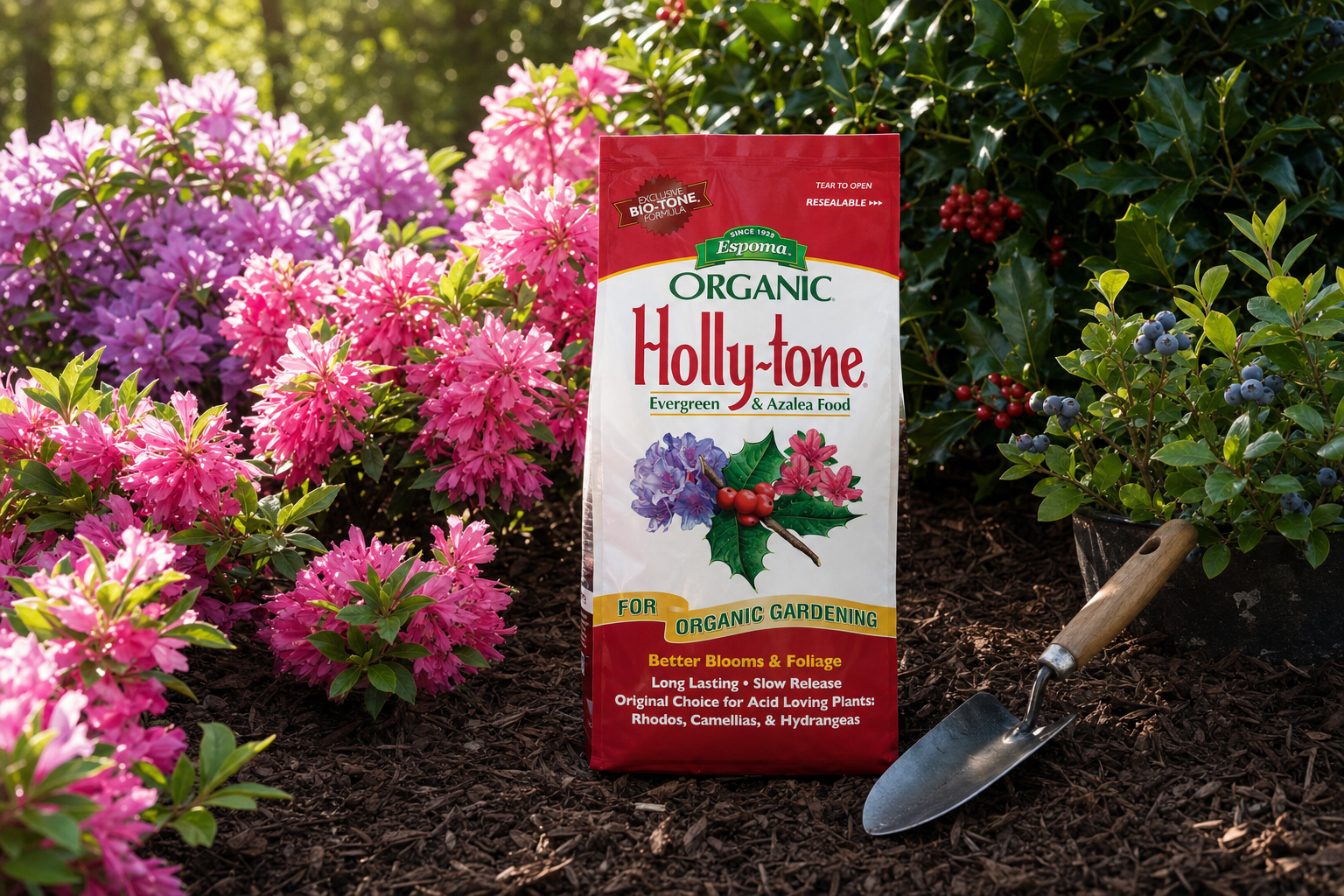
The most common mistake Ohio gardeners make with azaleas, blueberries, and hollies isn't neglect — it's using the wrong fertilizer. Standard all-purpose fertilizers are formulated for plants that thrive in neutral soil. Acid-loving plants don't just prefer lower pH; they require it for basic nutrient uptake. Apply the wrong product, keep the soil pH in the wrong range, and you can fertilize all season and still end up with yellow leaves, poor fruit set, and struggling growth. Espoma Holly Tone Fertilizer 4-3-4 (4 lb) is built specifically for this plant category — a naturally acidifying, Bio-tone microbe-enhanced formula that feeds acid-lovers on their own terms. The 4 lb bag is sized for the gardener with a few specimen plants rather than an entire landscape, giving you the right amount for a small holly hedge, a couple of azalea beds, or a modest blueberry planting without overbuying and letting fertilizer sit.
Why Acid-Loving Plants Fail on Standard Fertilizers
To understand why Holly Tone exists as a distinct product, it helps to understand what acid-loving plants are actually asking for that general fertilizers don't provide. The core issue is the relationship between soil pH and nutrient availability — specifically, how the solubility of key nutrients changes with pH in ways that directly determine whether a plant can access them at all.
Iron and manganese are the clearest examples. Both are essential micronutrients that plants require for chlorophyll synthesis and enzyme function, but their solubility drops sharply as soil pH rises above 6.0. In neutral or alkaline soils, these elements are essentially locked up — present in the soil but chemically unavailable for root uptake. The result is iron chlorosis: the characteristic yellowing between leaf veins while the veins themselves stay green, a condition that looks like a nutrient deficiency because it is one, even when the soil tests as having adequate iron levels. You can add more iron to alkaline soil and nothing will improve, because the problem isn't supply — it's chemistry.
Acid-loving plants evolved in environments where this soil chemistry was the baseline condition. Azaleas, rhododendrons, hollies, blueberries, camellias, pieris, and their relatives are native to forest understory and heath environments where decaying organic matter and leaching rainfall maintain naturally low pH. Their root systems, their mycorrhizal relationships, and their internal biochemistry are all calibrated for that acidic environment. Move them into the average Ohio garden soil — which typically runs between pH 6.2 and 7.0 depending on location and land-use history — and they're operating outside their comfort range from day one.
Standard all-purpose fertilizers don't address this. Most synthetic balanced fertilizers are pH-neutral or mildly alkaline in their effect on soil, and many contain nitrogen in nitrate form, which does not lower soil pH. Applying a 10-10-10 or similar product to an azalea bed may actually make the underlying chemistry slightly worse over time while providing a temporary nitrogen push that green-ups the plant for a season without addressing the structural problem.
Holly Tone works differently because it's built around naturally acidifying nitrogen sources — feather meal, pasteurized poultry manure, bone meal, and sulfate of potash — that release nitrogen in a form that acidifies the root zone as they break down. The product is designed not just to feed the plant but to adjust the chemical environment around the roots toward the conditions the plant actually needs.
What's Actually in Holly Tone — The 4-3-4 Formula and Bio-tone Microbes
Espoma Holly Tone carries an NPK analysis of 4-3-4, which positions it as a moderate, balanced organic fertilizer rather than a high-analysis push product. Understanding what that ratio means for acid-loving plants specifically helps explain why it performs the way it does.
The 4% nitrogen figure is deliberately moderate. Acid-loving ornamentals like azaleas and hollies are not heavy nitrogen feeders — they don't produce the volumes of rapid vegetative growth that a lawn grass or annual vegetable does, and hitting them with high nitrogen can produce lush, soft growth that's more susceptible to winter damage and less resistant to pests and disease. The organic nitrogen sources in Holly Tone — primarily feather meal and poultry manure — release nitrogen slowly as soil microbes break them down, providing a steady, modest feed over weeks rather than a single sharp peak. This sustained-release profile is far better matched to the actual nutrient uptake patterns of these plants than a water-soluble synthetic product applied once.
The 3% phosphate supports root development and flowering — both important for ornamentals like azaleas, which are prized for their bloom performance, and for fruiting plants like blueberries, where root health directly affects yield. The 4% potassium supports overall plant vigor, cell wall integrity, and disease resistance. In combination, the 4-3-4 analysis provides comprehensive nutrition without the aggressive nitrogen load that would be counterproductive for this plant category.
The Bio-tone microbe component is what distinguishes Espoma's formulas from generic organic fertilizers with similar NPK numbers. Bio-tone is Espoma's proprietary blend of beneficial microorganisms — bacteria and mycorrhizal fungi — that are incorporated into the granular product at manufacture. When applied to the soil, these organisms colonize the root zone and create a biological infrastructure that expands the plant's effective nutrient absorption surface. Mycorrhizal fungi extend the reach of the root system by forming thread-like networks (hyphae) that access pockets of soil the roots themselves cannot reach, exchanging minerals and moisture for plant-produced sugars. Beneficial bacteria fix atmospheric nitrogen, solubilize phosphates into plant-available forms, and suppress some soil-borne pathogens through competitive exclusion.
The practical result of the Bio-tone component is that plants fed with Holly Tone over multiple seasons tend to establish a progressively more efficient root zone biology — the beneficial population builds up in the soil and each subsequent application feeds a more active, productive microbial community. This is why long-term users of organic fertilizers with microbial inoculants often report better results in year three than in year one: the biology is improving with each application.
The Acid-Loving Plant Roster: Which Plants Belong on the Holly Tone Program
Holly Tone is formulated for the broad category of acid-loving ornamentals and fruiting plants. The name emphasizes hollies, but the product is appropriate for a wide range of plants that share the same soil chemistry preferences.
| Plant Category | Common Examples | Preferred Soil pH | Notes for Ohio Gardeners |
|---|---|---|---|
| Flowering Shrubs | Azaleas, Rhododendrons, Mountain Laurel, Pieris | 4.5–6.0 | Most commonly planted acid-lovers in Ohio; respond dramatically to correct soil chemistry |
| Evergreen Shrubs | Hollies (Ilex), Leucothoe, Andromeda | 5.0–6.5 | Hollies are widely used in Ohio landscapes; often show iron chlorosis in heavier, neutral soils |
| Fruiting Plants | Blueberries, Cranberries, Lingonberries | 4.5–5.5 | Blueberry production drops sharply outside the correct pH range; soil amendment is usually necessary in Ohio |
| Shade Trees | Oaks, Dogwoods, Sweetgum | 5.0–6.5 | Oaks especially prone to iron chlorosis in alkaline soils; dogwoods benefit from acidic, well-draining conditions |
| Ground Covers | Pachysandra, Heather, Bearberry | 4.5–6.0 | Often planted under acid-loving shrubs where they share the same amended soil |
| Evergreen Trees | Pines, Spruces, Firs, Blue Spruce | 4.5–6.0 | Blue spruce common in Ohio yards; benefits from acidified conditions especially when planted in heavier clay soils |
One practical note for Ohio gardeners: Galion and much of north-central Ohio sits on glacial till over limestone bedrock, which naturally buffers soil toward neutral to slightly alkaline. This means acid-loving plants in this region are often fighting their baseline soil chemistry, and consistent use of an acidifying fertilizer like Holly Tone — combined with organic mulch that acidifies as it breaks down — is particularly important for long-term plant health.
The 4 lb Bag: Right-Sizing for the Home Gardener
Holly Tone is available in multiple bag sizes, and the 4 lb format exists specifically for the gardener who doesn't have an entire landscape of acid-loving plants. Understanding how far a 4 lb bag actually goes helps ensure you buy the right amount and that the product gets used up while still fresh rather than sitting in a shed for three seasons.
The general application guideline for Holly Tone on established shrubs is approximately 1 cup (about 4 oz by weight) per foot of branch spread, worked into the soil around the drip line and watered in. A 4 lb bag contains roughly 16 to 18 cups of product, which translates to:
- Two or three mature azalea or rhododendron shrubs with 4–6 ft spread, given two applications (spring and post-bloom)
- Three to four medium hollies in the 3–4 ft range
- A small planting of two or three blueberry bushes
- A single large specimen plant like a mature holly hedge section or a substantial rhododendron
For gardeners who have a small number of specimen plants — a few azaleas along the foundation, a blueberry or two, a pair of hollies flanking the front walk — the 4 lb bag is genuinely the right size. Fertilizer has a shelf life, and an unused partial bag of organic granular fertilizer that's been through a couple of Ohio winters is not at peak efficacy. Buying the size that matches your actual use volume means you're always applying fresh product with active microbes rather than depleted granules.
If you have a larger planting — a full hedge run, multiple blueberry rows, or a substantial foundation planting of acid-lovers — the larger Holly Tone bag sizes will be more economical. The team at Liberty Farm, Home & Garden can help you calculate how much product you need based on the plants you have.
How to Apply Holly Tone Correctly
Holly Tone is an organic granular fertilizer, which means it needs to be incorporated into the soil or thoroughly watered in rather than simply scattered on the surface and left. The breakdown of organic nitrogen requires soil contact, moisture, and microbial activity — all of which improve when the granules are actually in the soil rather than sitting on top of mulch.
The standard application method for established shrubs:
- Pull back any mulch from around the drip line. The drip line — the outer edge of the plant's canopy — is where the feeder roots are most active. This is where you want the fertilizer, not against the trunk or stem base.
- Measure the product. For established shrubs, use approximately 1 cup per foot of branch spread. For a 4-foot azalea, that's roughly 4 cups, worked evenly around the drip line.
- Work the granules lightly into the top inch of soil. A hand cultivator or garden rake works well. You don't need to dig deep — the top inch is sufficient to ensure soil contact for microbial activation.
- Replace mulch and water thoroughly. Water activates the microbial component and begins the nutrient release process. Don't apply Holly Tone and leave it dry — the product needs moisture to start working.
- For blueberries, apply in a band around the base of each plant, 6 inches out from the crown, and water in. Blueberry roots are very shallow and fine; don't cultivate deeply around them.
Timing matters significantly for acid-loving plants. The standard Holly Tone schedule is two applications per year for most plants: one in early spring as new growth is beginning (typically late March through April in Ohio), and one in late spring after flowering (for blooming shrubs like azaleas and rhododendrons). Do not apply after mid-July in Ohio — late-season applications push soft new growth that won't harden off properly before frost.
Holly Tone and Soil pH: What You Actually Need to Know
The relationship between Holly Tone and soil pH is one of the most frequently misunderstood aspects of this product. Holly Tone naturally acidifies soil over time — but the mechanism, the rate, and the practical implications are worth understanding before you develop expectations for how quickly you'll see results.
The acidifying effect comes primarily from the sulfur content of Holly Tone's organic nitrogen sources. Feather meal and similar natural protein-based nitrogen sources release sulfate compounds as they break down in the soil. Sulfate, in the presence of soil bacteria and moisture, converts to sulfuric acid — a mild, slow-acting acidifier that gradually lowers soil pH in the application zone. This is fundamentally different from applying elemental sulfur, which produces a faster and more dramatic pH drop. Holly Tone's acidification is slow, gradual, and sustained over multiple applications — which is appropriate for established plantings where you're maintaining pH rather than making radical corrections.
In practical terms, regular Holly Tone use on a planting that's already in the appropriate pH range (say, pH 5.5–6.0) will help hold it there against the natural buffering tendency of Ohio soils. On a planting that's slightly out of range (pH 6.5–7.0), you'll see modest improvement over multiple seasons. If you're starting a new planting in neutral or alkaline soil, Holly Tone is best combined with sulfur amendment at planting time to establish the correct baseline pH before the plants go in.
The key takeaway: think of Holly Tone as an integrated fertilizer and pH management tool for plantings that are already in or near the correct pH range. It's not a rapid soil amendment. It's a maintenance fertilizer that keeps good soil chemistry working well season after season.
Comparing Holly Tone to Alternatives for Acid-Loving Plants
| Product Type | Acidifying Effect | Nutrient Release | Burn Risk | Bio-tone Microbes | Best Use |
|---|---|---|---|---|---|
| Espoma Holly Tone 4-3-4 | Moderate, sustained | Slow-release organic | Very low | Yes | Established acid-loving plants, maintenance program |
| Synthetic Acid Fertilizer (e.g., 30-10-10 azalea) | Variable; often minimal | Fast-release | Moderate to high | No | Quick green-up; does not improve soil biology |
| Elemental Sulfur | High, faster-acting | None (pH amendment only) | None | No | Lowering pH before planting; severe correction |
| All-Purpose Organic Fertilizer | Minimal to none | Slow-release organic | Low | Sometimes | General feeding; not optimized for acid-lovers |
| Compost / Aged Manure | Mild acidification from organic matter | Very slow, low analysis | None | Natural microbes | Soil structure improvement; supplement to fertilizer |
Related Products at Liberty Farm, Home & Garden
For gardeners building a complete program for acid-loving plants, Liberty Farm, Home & Garden carries several products that work well alongside Holly Tone:
- Miracle-Gro Performance Organics All Purpose (1 lb) — A versatile organic fertilizer for the rest of the garden. While Holly Tone handles your azaleas, blueberries, and hollies, the Miracle-Gro Performance Organics covers your vegetables, annuals, and neutral-pH perennials with an organic formulation that improves soil health alongside feeding.
- Miracle-Gro Shake 'n Feed Tomato, Fruit & Vegetable (4.5 lb) — For the vegetable garden and fruit trees that share the yard with your acid-loving ornamentals. The extended-feed formula works similarly to Holly Tone's slow-release approach — one application that feeds over a long period rather than repeated doses.
- Jobe's 4-6-6 Organics Spikes for Fruit & Nut Trees (8-Pack) — A convenient spike format for established fruit trees. If your blueberries are fed with Holly Tone, your apple or pear trees can be on the Jobe's spike program — both are organic, slow-release approaches, just matched to their respective plant categories.
Stop in at Liberty Farm, Home & Garden in Galion, Ohio to find the complete Espoma fertilizer line and a team that can help you put together the right feeding program for everything you're growing. Whether it's a few azaleas along the foundation or a full blueberry planting, the right fertilizer makes a real difference.
Frequently Asked Questions
Keep Reading
Plant Cover Crops Now: An Ohio Home Garden Guide
Plant fall cover crops in an Ohio vegetable garden with practical guidance on timing, species, seeding, winter care, and spring termination.
Save This Summer’s Garden: A Practical Ohio Seed-Saving Guide
Save tomato, bean, pea, lettuce, marigold, zinnia, and other garden seeds with this practical late-summer guide for Galion and north-central Ohio.