
The 6-Foot Stake That Actually Keeps Up With Your Indeterminate Tomatoes: A Complete Guide to the Eaton Natural Wood Garden Stake
A complete guide to using the Eaton Natural Wood Garden Stake (6 ft) for tall tomatoes, pole beans, climbing flowers, and heavy-producing plants — why two extra feet of height changes everything about how your garden performs
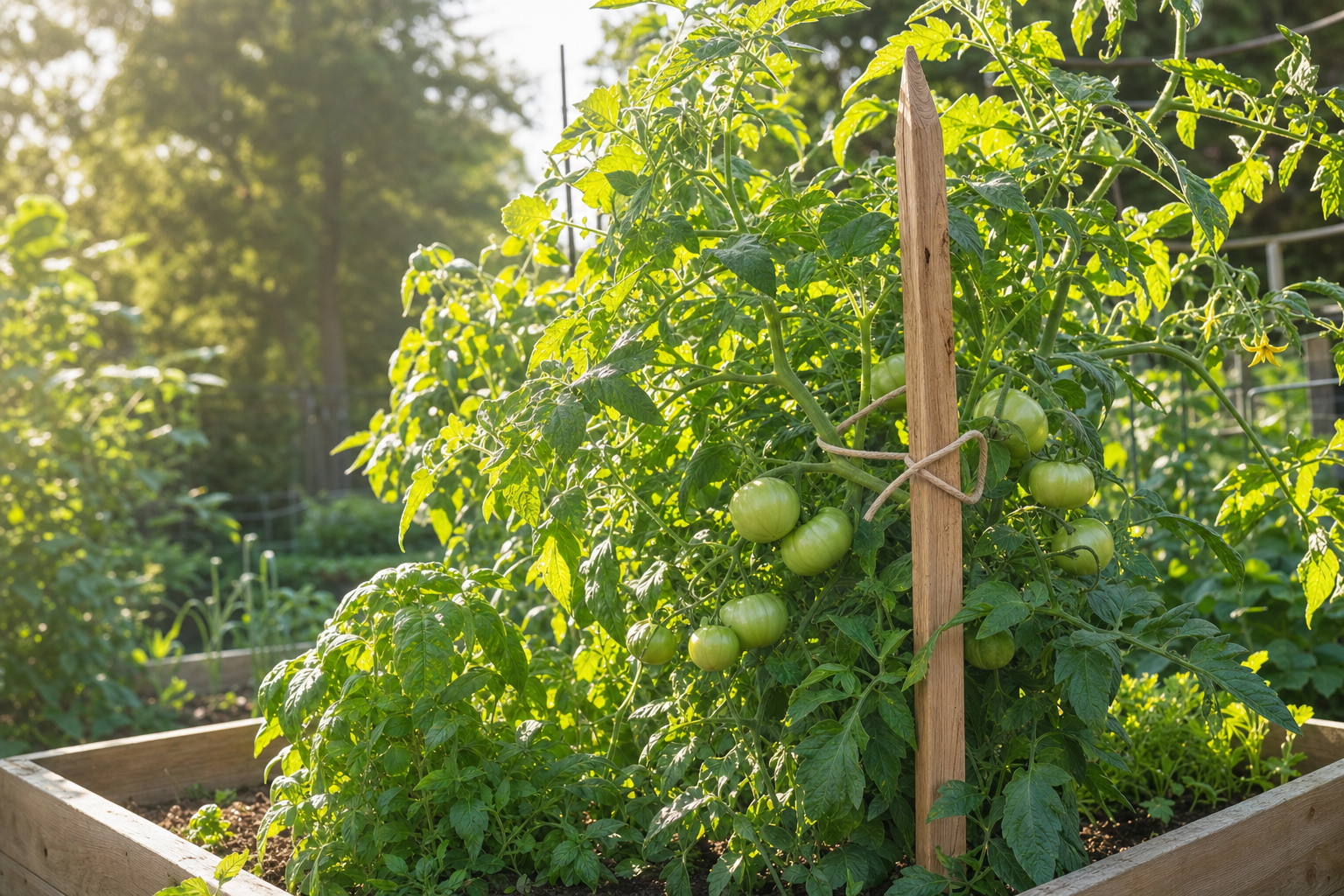
Every veteran Ohio gardener has learned the same hard lesson at least once: you stake your indeterminate tomatoes in May with four-foot stakes, watch the plants grow past the top of the stakes by late June, and spend the rest of the summer trying to manage a plant that's outgrown its support. The tomato leans, the ties slip, branches loaded with fruit start to sag toward the ground, and what should have been a clean single-stem plant becomes a sprawling tangle. The fix isn't more ties or a second stake spliced awkwardly alongside the first — it's using the right height from the beginning. The Eaton Natural Wood Garden Stake (6 ft), available at Liberty Farm, Home & Garden in Galion, Ohio, is built specifically for tall-growing plants that a four-foot stake simply can't keep up with. Crafted from natural wood and sold individually so you buy exactly what your planting calls for, it gives you the full height that indeterminate tomatoes, pole beans, dahlias, climbing cucumbers, and other tall producers need to perform at their best all the way through Ohio's growing season. This guide covers when you need a six-foot stake, how to use it correctly, and how it compares to cages and shorter stakes for different plant types and growing situations.
Why Stake Height Matters More Than Most Gardeners Realize
Garden stake selection tends to get treated as a commodity decision — any stake will do, and bigger is probably overkill. That assumption fails every season in Ohio vegetable gardens, and the failure is nearly always predictable in hindsight. Plant height at maturity, fruit load distribution, and the leverage physics of a tall plant in a summer wind event all point to the same conclusion: matching stake height to the plant you're growing isn't overcautious, it's the difference between a productive garden and an August salvage operation.
Indeterminate tomato varieties — the ones that keep growing and setting fruit until frost — can easily reach five, six, or seven feet in a productive Ohio summer. At that height, the upper third of the plant carries the most recently set fruit: the young tomatoes that represent future harvest. If the stake ends at four feet, that upper third has no support at all. The plant's weight concentrates at the point where the tied stem transitions to unsupported growth, creating exactly the kind of stress point that snaps in a storm. When a loaded tomato plant breaks at the four-foot mark in a July thunderstorm, you don't just lose the branch — you lose all the fruit on it and often permanently damage the plant's structural integrity for the rest of the season.
The six-foot stake solves this by extending support into the zone where the plant actually needs it. A six-foot stake driven 10–12 inches into the soil still presents 48–50 inches of above-ground height — enough to support most indeterminate tomato varieties through their entire productive season, even in Ohio's warm summers that push late-season growth well past what gardeners in shorter-season climates see. For the plants where height is the real variable in whether staking works or fails, those extra two feet aren't excess — they're the functional margin that makes the stake do its job.
What the Eaton Natural Wood Garden Stake Offers
The Eaton Natural Wood Garden Stake brings together the characteristics that matter most for seasonal vegetable garden use: natural wood construction, a six-foot height that covers Ohio's tallest common garden plants, and individual sale so you can buy exactly the quantity your specific planting needs rather than accepting a fixed-pack quantity that either leaves you short or with extras you don't need.
Natural wood construction. Natural wood stakes have a texture that grips soil differently than smooth bamboo or metal. The slightly rough surface of natural wood holds in the ground more reliably under lateral loading — the kind of force a heavy plant exerts during wind — without rotating or walking out of the soil over the season. Wood also has a natural warmth profile in summer sun: it doesn't conduct heat the way metal does, so there's no risk of heat stress at tie points where stem contacts stake on a hot August afternoon. And at the end of the season, a wood stake that's reached the end of its useful life returns to the compost or decomposes in a brush pile without leaving metal debris in the soil or needing special disposal.
Reusable season after season. Quality natural wood stakes maintained with basic end-of-season care — pulled after harvest, soil knocked from the base, dried before storage, stored off the ground in a dry location — carry over well for multiple growing seasons. The Eaton stake is built for this kind of seasonal reuse. Unlike bamboo stakes that are brittle and often crack within a season, or wire stakes that rust and leave sharp edges, a solid natural wood stake that's cared for properly is a multi-year garden supply investment rather than a single-season consumable.
Sold individually. The individual sale format is a genuine advantage for gardeners who don't want to work around a fixed pack quantity. If your raised bed has three indeterminate tomatoes that need six-foot stakes and two determinate plants that are fine with a cage, you buy three Eaton stakes — not a six-pack that leaves you with three extras or forces you to overstake plants that don't need the full height. Buying individually also makes it easy to replace or expand specific stakes after an unexpected breakage or a change in your planting plan mid-season.
Which Plants Need a 6-Foot Stake
Six-foot stakes aren't the right tool for every plant in the garden, but for a specific group of tall-growing, heavy-producing plants they're the only stake that actually does the job. Understanding which plants fall into that category prevents both under-staking (using a four-foot stake where six feet is needed) and over-staking (using a six-foot stake for compact plants where height is irrelevant).
Indeterminate tomatoes. This is the primary use case for six-foot garden stakes in Ohio vegetable gardens. Indeterminate varieties — any variety described as vining, heirloom, or simply "indeterminate" on the seed packet — grow continuously through the season and can easily reach five to seven feet in Ohio's warm, humid summers. Common indeterminate varieties grown in Ohio home gardens include Beefsteak, Brandywine, Cherokee Purple, Sun Gold, Sweet 100, Big Boy, Early Girl, and most paste tomatoes like San Marzano. For all of these, a six-foot stake is the practical minimum for full-season support without supplemental measures.
Pole beans. Pole bean varieties — Kentucky Wonder, Blue Lake Pole, Rattlesnake, Purple Podded Pole — are climbing legumes that can reach six feet or taller in a productive Ohio summer. Unlike bush bean varieties that are self-supporting at 18–24 inches, pole beans need vertical support from the ground up and continue extending as long as the season runs. A six-foot stake provides the full height pole beans will grow to in a typical Ohio season. Three to four stakes with twine strung between them at multiple heights creates a simple trellis that covers a row of pole beans efficiently through the full growing period.
Cucumbers trained vertically. Many Ohio gardeners now grow cucumbers vertically on stakes and twine rather than letting them sprawl on the ground — a method that saves space, improves air circulation around the foliage (reducing foliar disease), and makes fruit easier to spot and harvest. Cucumbers trained vertically can reach four to six feet in a full season. A six-foot stake gives a vertically trained cucumber the full structural height it needs without running out of stake in mid-summer when the vine is still actively extending.
Tall dahlias. Dinner plate dahlias and other large-flowered dahlia varieties are notoriously top-heavy. A single fully-opened dinner plate dahlia bloom can be eight to twelve inches across and carries substantial weight. Tall dahlia varieties regularly reach four to five feet, and the combination of height and top-heavy bloom weight makes adequate staking critical. A six-foot stake driven at the same time as the tuber — before roots have established and spread into the surrounding soil — provides support from the beginning and grows with the plant through its full height. The extra stake height beyond the plant's mature height isn't wasted; it gives you room to tie at multiple heights and provides overhead clearance if the plant grows slightly taller than typical.
Delphiniums and tall perennials. Delphiniums are among the tallest summer perennials in Ohio gardens, with mature spikes regularly reaching five to six feet. Their hollow stems are particularly vulnerable to snapping in wind when loaded with open blooms. A six-foot hardwood stake driven firmly next to the plant at the start of the growing season — while the delphinium crown is just emerging — provides the full-height support the spike needs without requiring any supplemental measures as it extends. Other tall perennials that benefit from six-foot stakes include tall garden phlox, hollyhocks, and large-flowered sunflower varieties.
How to Install a Six-Foot Garden Stake Correctly
A stake that's correctly installed provides reliable support through the full season without damaging the plant or creating new problems. A stake installed incorrectly creates pressure points, root damage, or fails under load exactly when the plant needs it most. The correct process is straightforward but specific:
Step 1: Install at planting time, not after. This is the single most important aspect of staking technique. Drive the stake when you set the transplant or plant the tuber or seed — before the root system has spread into the surrounding soil. Driving a stake next to an established plant risks severing or compressing roots, which can set the plant back significantly at exactly the point in the season when root establishment is most critical. A stake installed at planting creates zero root disruption and gives the plant a vertical guide structure to grow into from its first day in the ground.
Step 2: Position the stake on the windward side. Place the stake 3–4 inches from the main stem, on the side from which prevailing winds typically come. In Ohio, prevailing summer winds generally come from the west or northwest. A stake positioned on the windward side catches the push of the wind against the plant and transfers that load to the ground, where the stake is anchored. A stake positioned on the downwind side does the opposite — the plant leans away from the stake when it needs it most.
Step 3: Drive it to the right depth. Use a rubber mallet or hammer to drive the stake 10–12 inches into the soil. In Ohio's heavier clay soils, attempting to push a stake in by hand rarely achieves adequate depth — hand pressure gets stakes to 6–8 inches at best, which is not enough to hold against a loaded plant in a summer storm. A properly driven stake should feel solid and show no movement when you apply lateral pressure to the above-ground section. The extra mallet effort at installation prevents the stake from loosening and rocking as the season progresses.
Step 4: Tie with soft, figure-8 loops at multiple heights. Use soft plant tie material — foam ties, cloth tape, strips of old T-shirt or pantyhose — and form a loose figure-8 loop with the crossing point between the stem and stake. Never use rigid wire or cord pulled tight directly against the stem, which will girdle the stem as it grows in diameter. Plan on adding ties at roughly 12-inch intervals as the plant grows: tie at 12 inches when the plant reaches that height, add another at 24 inches, then 36, 48, and so on up to the plant's mature height. Adding ties incrementally as the plant extends is faster and more effective than trying to predict and pre-install ties for a plant that hasn't grown there yet.
Staking Indeterminate Tomatoes: Single-Stem Method
Six-foot natural wood stakes work particularly well with the single-stem or modified single-stem training method for indeterminate tomatoes — the approach that maximizes fruit production per square foot and works best in raised beds and dense plantings where horizontal space is limited.
Single-stem training means removing all suckers — the shoots that develop in the crotch between the main stem and a leaf branch — except for one that you allow to develop as a second main stem. The result is a plant trained to one or two main vertical stems, both tied to the stake at regular intervals, with all fruiting branches extending outward from those central stems. This approach has several benefits for staked tomatoes:
- The plant fits the stake's support range. A single or double-stemmed tomato has dramatically less mass and wind resistance than an unsupported plant with six or eight major branches. A six-foot stake can reliably support a plant trained this way through the full season because the load is concentrated on a manageable structure.
- Better air circulation. Single-stem plants with foliage concentrated along one vertical axis allow much better air circulation than sprawling multi-branched plants, which significantly reduces the incidence of foliar diseases — early blight, Septoria leaf spot, and late blight — that are serious problems in Ohio's humid summer weather.
- Earlier fruit production. Indeterminate tomatoes that are heavily pruned put more energy into the fruit on existing branches rather than into new vegetative growth. Single-stem plants often begin ripening fruit a week or more earlier than equivalent unpruned plants, which matters at the end of the Ohio season when fall frost can arrive before late-set fruit matures.
- Denser planting is possible. Single-stem plants can be spaced 18–24 inches apart rather than the 3–4 feet required for unpruned indeterminate tomatoes. In a raised bed, that means more plants and more total production per square foot without compromising any individual plant's performance.
The practical implication for stake selection: if you're growing indeterminate tomatoes with any degree of pruning or sucker management, the six-foot Eaton stake gives you the full-height support a single-stem plant needs through its entire productive season without requiring supplemental measures or early harvest to prevent the plant from outgrowing its support.
Using Six-Foot Stakes for Pole Beans and Climbing Crops
Pole beans and other climbing vegetable crops represent a different staking use case than tomatoes — one where the stake serves as the anchor for a trellis system rather than as a direct support structure tied to an individual plant.
The most common pole bean stake configuration uses three to four stakes arranged in a row, spaced 3–4 feet apart, with horizontal strands of garden twine strung between them at 12-inch intervals starting at 6 inches above the soil. Plants trained into this structure climb the twine and stakes using their natural tendrils, needing no individual tying once they've attached to the first strand of twine. The six-foot stake height matters here because pole beans don't stop climbing at four feet — they'll continue to the top of whatever structure you provide and then either turn over or look for additional height. A six-foot stake lets pole beans express their full growth potential, which is where maximum pod production occurs.
The same basic approach works for climbing cucumbers, small-fruited squash trained vertically, and annual climbing flowers — morning glory, black-eyed Susan vine, sweet peas. For all of these, the six-foot height provides the vertical range these climbers use naturally when given the opportunity, which translates directly into more flowers, more fruit, and better plant health through improved air circulation.
Six-Foot Stakes vs. Tomato Cages: When to Use Each
Stakes and tomato cages both solve the plant support problem, but they do it in fundamentally different ways — and understanding those differences helps you make the right call for each plant and growing situation.
Stakes are the better choice when: You're growing indeterminate tomatoes and want to maintain a single-stem or double-stem trained plant for dense spacing and maximum air circulation. You have a row of tomatoes where the Florida weave method — running twine back and forth between stakes at increasing heights — gives you efficient row-wide support with a single stake between every two plants. You're growing pole beans, climbing cucumbers, or tall climbing flowers where the stake serves as the anchor for a horizontal trellis system. You have limited horizontal space and need support that doesn't extend beyond the plant's footprint. You want stakes that store flat and compactly at the end of the season.
Tomato cages are the better choice when: You're growing heavily branching determinate tomato varieties — Roma, Celebrity, Rutgers — that develop a bush form with multiple main branches in all directions. The Galvanized Tomato Cage (54 in) provides full surrounding support for larger determinates and is a set-it-and-forget-it approach that requires no tying or ongoing management. You want the cage to serve as a physical containment structure that keeps all the plant's branches within a defined zone. You prefer lower maintenance mid-season: a cage installed at transplant needs no additional attention, while staking requires tie additions every few weeks as the plant extends.
When combining both makes sense: Many experienced Ohio gardeners use a cage at the base of their indeterminate tomatoes — where the plant branches heavily in its lower zone — and add a central hardwood stake that rises above the cage to support the single or double stem in the upper zone. This hybrid approach handles the real growth pattern of large-fruited indeterminate varieties: heavily branched lower section that benefits from a cage's surrounding support, and a tall upper section that needs the height of a six-foot stake. If you find yourself regularly managing tall indeterminate tomatoes, this combination is worth trying for the reliability it provides through the full season.
| Specification | Details |
|---|---|
| Product Name | Eaton Natural Wood Garden Stake (6 ft) |
| Brand | Eaton |
| Height | 6 feet (72 inches) |
| Material | Natural wood |
| Quantity | Sold individually (each) |
| Best For | Indeterminate tomatoes, pole beans, climbing cucumbers, tall dahlias, delphiniums, tall perennials |
| Recommended Drive Depth | 10–12 inches standard; 12–14 inches for row-end anchor stakes |
| Effective Above-Ground Height | 48–50 inches after proper drive depth |
| Reusability | Multiple seasons with proper end-of-season care |
| Available At | Liberty Farm, Home & Garden, Galion, Ohio |
End-of-Season Care and Storage for Maximum Reuse
Natural wood garden stakes are a multi-season investment that pays back with proper end-of-season handling. The main enemies of wooden stake longevity are moisture, soil contact during storage, and being bundled while still wet. Avoiding these three problems is straightforward and adds years to the useful life of each stake.
At season's end, after tomato plants have been pulled and the garden is being put to bed for winter, pull stakes from the soil while the ground is still workable — before freeze makes extraction difficult or damaging. Knock the soil from the bottom of each stake immediately after pulling. Wet soil adhering to the stake's base retains moisture against the wood and accelerates the fungal decay that reduces strength over time.
Lay the pulled stakes out in a single layer in a dry location — a barn, garage, shed, or covered porch — for several days before bundling them. Stakes pulled while still damp that are immediately bundled together create a humid micro-environment in the bundle that promotes rapid decay. A week of open air drying eliminates that risk entirely. Once fully dry, bundle and store horizontally on a shelf, wall rack, or raised pallet — not on a concrete floor, where moisture wicks up through the wood. Adequate airflow around stored stakes during the off-season matters as much as the initial drying.
At the start of the next season, before driving any previously used stake, flex the lower section (the end that was buried) to check for soft spots or significant compression. A stake that bends easily near its base, or that shows visible softening or surface fungal growth, should be retired rather than trusted with another season of plant weight. One failed stake mid-season costs you more than the replacement stake would have. Stakes that pass inspection are ready for another full season of reliable use.
Plant Support Options at Liberty Farm, Home & Garden
Liberty Farm, Home & Garden in Galion, Ohio carries a full range of plant support options to match every growing method, plant type, and garden scale:
- Galvanized Tomato Cage (33 in) — The right size for compact determinate tomato varieties, pepper plants, and eggplant. Durable galvanized construction holds up season after season, and the 33-inch height is well matched to the mature form of bush-type tomatoes and most common pepper varieties.
- Galvanized Tomato Cage (42 in) — A step up in height for mid-size determinate tomato varieties and larger peppers. Works well as a standalone support for plants in the 3–4 foot range, and can be combined with a center stake for additional height support on larger varieties.
- Galvanized Tomato Cage (54 in) — The tallest galvanized cage option in our lineup, suited for larger determinate and compact indeterminate tomato varieties. Provides surrounding support through the full height range of most garden tomatoes and is built to last for many seasons with proper storage.
- Panacea Square Folding Tomato Tower (44 in) — A square-profile tower that provides a structured growing frame for compact indeterminate and larger determinate varieties. The fold-flat design makes off-season storage simple, and the square footprint anchors particularly well in raised bed corners.
The Eaton Natural Wood Garden Stake (6 ft) is available individually at Liberty Farm, Home & Garden in Galion, alongside our full selection of plant support products. Whether you're setting up a row of indeterminate tomatoes, building a pole bean trellis, or supporting tall dahlias through the season, stop in and our team can help you put together the right support plan for your specific planting situation.
Frequently Asked Questions
Keep Reading
Plant Cover Crops Now: An Ohio Home Garden Guide
Plant fall cover crops in an Ohio vegetable garden with practical guidance on timing, species, seeding, winter care, and spring termination.

Save This Summer’s Garden: A Practical Ohio Seed-Saving Guide
Save tomato, bean, pea, lettuce, marigold, zinnia, and other garden seeds with this practical late-summer guide for Galion and north-central Ohio.