
The Suet Nugget Built for Woodpeckers: A Complete Guide to C&S Woodpecker Suet Nuggets
Most suet cakes are made for any bird that shows up. C&S Woodpecker Suet Nuggets were made for one specific group — and the difference is immediately obvious at the feeder. Here's what makes them work, which woodpeckers to expect, and how to set up the right station in your Ohio yard.
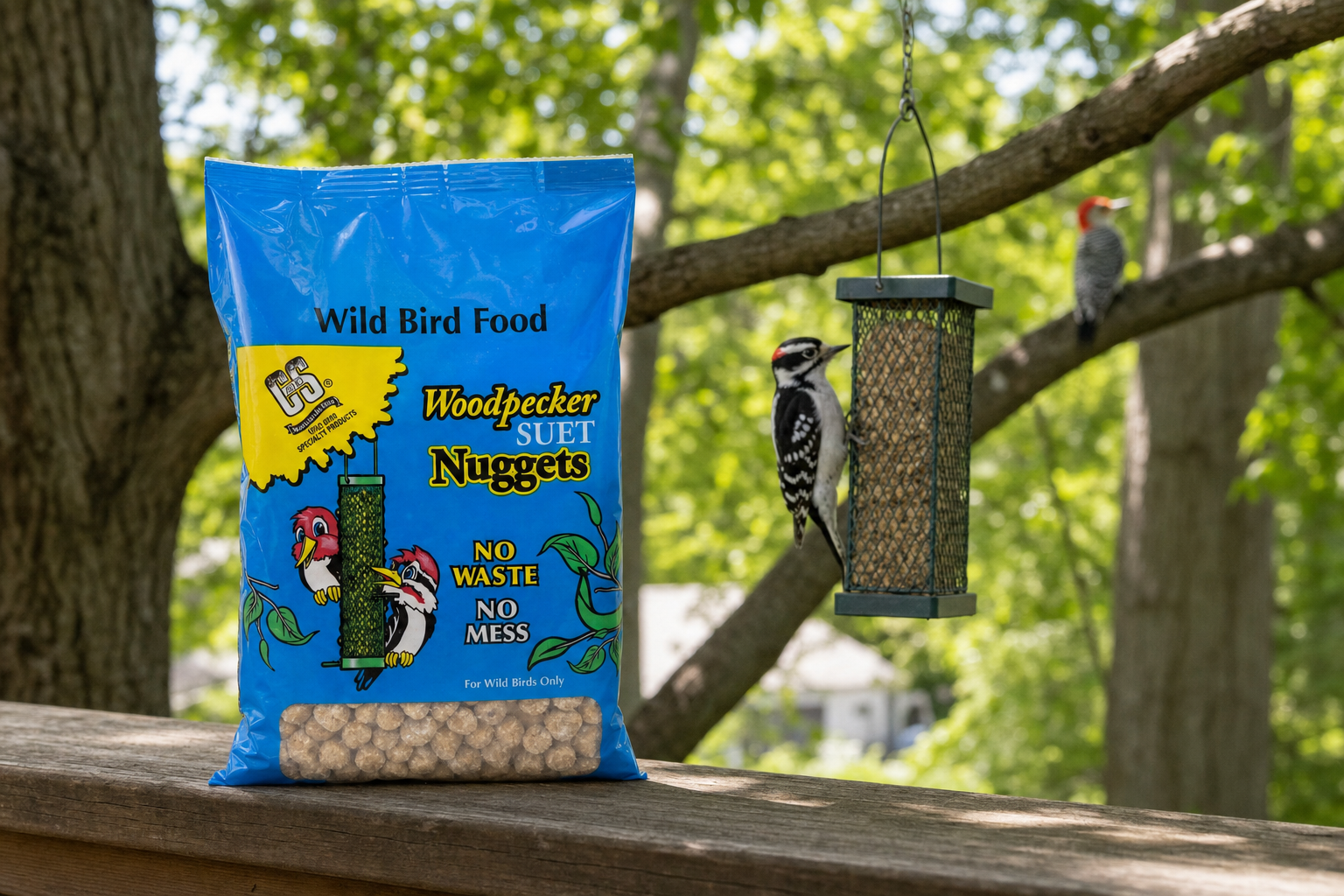
Walk into almost any farm or garden store in June and you will find a shelf of suet cakes labeled something like "Wild Bird Suet" — generic blends formulated for whatever bird happens to land on the cage. That works reasonably well if your goal is general feeder traffic. But if you have ever watched a Red-bellied Woodpecker work its way across your yard, or heard the mechanical drumming of a Hairy Woodpecker in the tree line behind your house, and wanted to specifically attract and hold those birds at your feeding station, a generic suet cake is not the tool for the job. C&S Woodpecker Suet Nuggets (1.68 lb) are different in two important ways: the formula is built around the nutritional preferences of woodpeckers specifically — beef suet, roasted peanuts, and corn rather than generic fat and millet — and the nugget format makes them easy to serve in mesh feeders, on platform feeders, or scattered on a feeding station without the mess and crumbling that suet cakes produce in warm weather. Available at Liberty Farm, Home & Garden in Galion, Ohio, the 1.68 lb resealable bag is designed as the right size to try woodpecker suet feeding for the first time — enough supply to establish feeder habits in resident woodpeckers without committing to a large bulk quantity before you've seen how your local birds respond.
What Are Woodpecker Suet Nuggets and Why Nuggets Instead of a Cake?
Suet in its traditional form is rendered beef fat — the hard fat surrounding cattle kidneys and loins that has been cleaned, melted, and solidified into a dense, high-energy block. Suet cakes are made by blending this rendered fat with seeds, grains, fruits, or insects and pressing the mixture into a square cake that fits standard wire suet cages. They have been a staple of winter bird feeding for decades and remain effective, particularly in cold weather when the fat stays solid and palatable.
The nugget format is a more recent evolution. Instead of a single pressed cake, manufacturers blend the same base ingredients and portion them into small individual pieces — roughly the size of a large raisin or small grape — that can be served in a variety of ways that standard cakes cannot. The practical advantages of the nugget format are significant:
Feeder flexibility. Suet nuggets can go into mesh feeders (the same log-style or tube-shaped mesh feeders used for peanuts in the shell), onto open platform feeders, into tray-style inserts that hang below existing feeders, or scattered directly on a flat surface or rock near the tree line. Standard suet cakes are locked into the wire cage format — you need the right cage hardware for them to work. Nuggets work in any setup that can hold small loose pieces.
Warm-weather stability. Traditional suet cakes become soft, greasy, and eventually rancid in summer heat. When temperatures climb above 80°F, a standard suet cake in a cage will often melt into a grease slick by midday. C&S Woodpecker Suet Nuggets use a formulation that is more resistant to heat deformation than traditional pressed cakes. They maintain their texture through moderate summer temperatures — though they should still be stored cool and served in manageable quantities during prolonged hot spells.
No-mess handling. The C&S nuggets are described specifically as a no-mess formula — they handle cleanly without leaving greasy residue on your hands when you fill the feeder. Anyone who has filled a standard suet cage in July knows exactly how significant this feature is. The clean-handling formulation also reduces the buildup of rancid fat residue inside feeder hardware that requires frequent scrubbing when standard cakes are used in summer.
Portion control. Because nuggets are individual pieces, you can put out exactly the quantity you expect birds to consume in a single day without opening a whole new cake. This reduces waste, reduces the amount of food sitting in the feeder overnight (when it is more vulnerable to moisture), and lets you calibrate supply to actual feeder traffic as the season develops.
The Ohio Woodpeckers You're Most Likely to See at a Nugget Feeder
Ohio is home to eight woodpecker species, six of which are resident year-round and regularly visit feeding stations. C&S Woodpecker Suet Nuggets are specifically formulated for the four most common backyard woodpecker visitors in north-central Ohio — and understanding each species helps you set up a station that attracts them most effectively.
Downy Woodpecker (Picoides pubescens). The smallest and most common woodpecker at Ohio feeding stations, the Downy is a year-round resident with a black-and-white pattern and a short bill. Despite its small size, the Downy is an enthusiastic suet consumer — it readily clings to standard suet cages and will also visit mesh nugget feeders and platform feeders for nuggets. Downy Woodpeckers are often the first woodpecker species to discover a new suet offering at a feeding station and, once habituated, will visit multiple times per day. During the breeding season (May through July), males are highly active at suet feeders, often carrying food back to nestlings in their tree cavity nests.
Hairy Woodpecker (Leuconotopicus villosus). Nearly identical in pattern to the Downy but meaningfully larger — about the size of a robin compared to the sparrow-sized Downy — the Hairy is a more wary species that tends to prefer sites with good tree cover near the feeder. Hairy Woodpeckers are powerful foragers with longer, heavier bills; they can excavate deep into dead wood for insects and approach a suet nugget feeder with the same focused efficiency they bring to foraging in bark. They are somewhat less common at close-in suburban feeders than Downys but reliably attracted to suet in wooded or semi-rural settings like the areas around Galion.
Red-bellied Woodpecker (Melanerpes carolinus). The Red-bellied is the largest of the three most common backyard woodpeckers and one of the most visually striking — brilliant red cap extending from the bill to the nape in males, with a barred black-and-white back. Despite the name, the red belly is rarely visible in the field; look instead for the distinctive red head and the bird's habit of bracing its tail against a vertical surface. Red-bellied Woodpeckers are highly omnivorous for a woodpecker — they eat insects, nuts, berries, seeds, and suet — and readily visit platform feeders and cage-style suet feeders throughout the year. They are bolder than Hairy Woodpeckers and less easily displaced from feeders by other species. In June in north-central Ohio, Red-bellied Woodpeckers are feeding nestlings and will make repeated trips to a suet feeder as a reliable energy source for growing chicks.
Northern Flicker (Colaptes auratus). The Flicker is different from the other three in behavior and appearance — it is the only Ohio woodpecker that regularly feeds on the ground, probing soil for ants and beetle larvae with its curved bill. The yellow-shafted form, which is the race present in Ohio, has a distinctive yellow underwing flash visible in flight and a prominent black crescent bib. Flickers visit suet feeders less consistently than the smaller woodpecker species but will come to platform feeders and to feeders placed near or on the ground. Offering nuggets scattered on a low platform or directly on the ground near a tree base can attract Flickers that might not visit an elevated suet cage. Flicker populations in Ohio have declined over the past several decades due to loss of open foraging habitat and suitable tree cavities for nesting, making them a particularly welcome visitor when they do appear at a station.
Why June Is One of the Best Times to Start Feeding Woodpeckers
There is a persistent misconception in backyard bird feeding that suet is a winter food — something you put out when it's cold to help birds through the lean season and take down when spring arrives. This view significantly underestimates how important high-fat foods are to woodpeckers during the breeding season and how much June specifically benefits from a well-stocked suet station.
By early June in north-central Ohio, all four of the woodpecker species described above are deep into their breeding cycles. Downy and Hairy Woodpeckers are typically feeding nestlings in tree cavity nests through most of June. Red-bellied Woodpeckers begin their nesting cycle slightly later and may still be incubating eggs in early June or beginning to feed newly hatched chicks. For all of these birds, the energy demands of feeding nestlings are the highest of the entire year — parent birds are making dozens of foraging trips per day, bringing food back to a clutch of rapidly growing chicks that can quadruple their body weight in the first two weeks after hatching.
A reliable suet nugget feeder reduces the foraging range that parent birds need to cover and provides a consistently available, calorie-dense food source at a location the birds learn to trust. Parent birds that establish a suet feeder as part of their regular foraging circuit during early June will continue visiting it through July and August as the nesting cycle completes and young birds begin accompanying parents on foraging flights. This is how multi-year feeding station attendance develops — resident woodpeckers that learn a station during their first breeding season often return to it year after year as part of their established territory.
June is also an effective time to start because the 1.68 lb bag allows you to test whether your yard and feeder placement will attract woodpeckers before investing in larger quantities. Resident woodpeckers have established territories by early June and are actively patrolling those territories for food sources. A new feeder that goes up in the first week of June can be discovered within days by birds already working your yard — and once discovered, a high-quality suet nugget feeder is almost always incorporated into their regular foraging route.
How to Feed C&S Woodpecker Suet Nuggets — Feeder Types and Setup
The nugget format gives you more feeder options than a standard cake, and the right setup depends on which woodpecker species you most want to attract and how your yard is laid out.
Mesh tube or log feeders. Tube-shaped mesh feeders — the same type used to offer peanuts in the shell — work well for suet nuggets. The rigid mesh structure allows woodpeckers to cling vertically in the posture they use naturally on tree bark, making them comfortable and confident at the feeder. A log-style mesh feeder (a cylinder of hardware cloth or similar material) can hold a generous quantity of nuggets and is easy to refill. The Heath Bell Seed Cake Feeder is a versatile option that works with multiple food formats and accommodates the clinging woodpecker feeding posture.
Platform feeders. An open platform feeder placed near tree cover is an excellent choice for Red-bellied Woodpeckers and Flickers, which prefer a wider landing surface than a narrow cage or mesh tube provides. Place the nuggets in a corner or along one edge of the platform rather than scattered loosely across the whole surface — this concentrates the food in a predictable location that birds learn to revisit. Platform feeders need regular cleaning during summer; remove unused food after 24 hours in hot weather to prevent the fats from going rancid in the heat.
Cage-style suet feeders. A standard wire suet cage holds nuggets just as well as it holds a pressed cake — pour the nuggets directly into the cage and hang it in your usual suet feeder location. Downy and Hairy Woodpeckers are very comfortable on standard cage hardware. The cage format is the easiest for first-time suet feeders to set up, though nuggets may shift and compact inside the cage over time in a way that a pressed cake does not.
Ground and low platform placement. To attract Northern Flickers — which often forage near ground level — scatter a small number of nuggets on a flat rock, a low platform, or the ground near the base of a large tree. Flickers are ground foragers by habit and may not initially visit an elevated feeder even if suet is a food they would otherwise accept. A low-level presentation near tree root structures mimics their natural ant-foraging habitat and gives them the confidence to approach.
Feeder placement near trees. Woodpeckers are fundamentally tree birds — their comfort at any feeder is directly related to how close they can be to vertical tree cover when feeding. Place suet nugget feeders within 10 to 15 feet of a mature tree trunk or large shrub. This provides the woodpeckers with an escape route and a vantage point before committing to the feeder, and it allows them to immediately retreat to tree cover if disturbed. Feeders placed in the open center of a lawn, well away from any tree cover, will be used by woodpeckers much less consistently than feeders positioned near the tree line.
The Ingredients That Make C&S Woodpecker Nuggets Work
The C&S formula for Woodpecker Suet Nuggets is built around three core ingredients: rendered beef suet, roasted peanuts, and corn. Each plays a specific role in the nutritional profile and palatability of the nuggets — and understanding the ingredient rationale helps explain why a purpose-formulated woodpecker product is more effective than a generic suet cake at attracting the target species.
Rendered beef suet. Suet is the primary fat source and the ingredient that makes suet feeding work for birds. Woodpeckers, like all birds in the insectivore family, are metabolically adapted to extracting energy from fat-rich foods — insect larvae, grubs, and beetle pupae are high-fat foods that woodpeckers have evolved to seek out and consume. Rendered beef suet closely mimics the fat density of insect larvae in a way that seed-based fats do not, and it provides the calories-per-gram efficiency that makes a suet feeder worth the energy investment for a foraging woodpecker. The rendering process (melting and filtering the raw fat) removes water, protein fragments, and other components that accelerate spoilage and improves the stability and shelf life of the final product.
Roasted peanuts. Peanuts are the highest-fat nut available for bird feeding and are particularly attractive to woodpeckers, which encounter peanut-like foods naturally in the form of hard-shelled insect egg cases and dense grubs. Roasting concentrates the fat content slightly and enhances the aroma — roasted peanut is a more potent olfactory signal to foraging birds than raw peanut. Woodpeckers have a relatively well-developed sense of smell for birds, and the roasted peanut component in the C&S formula is part of what makes a freshly opened bag of these nuggets an effective attractor, particularly for Red-bellied Woodpeckers, which are among the most omnivorous of Ohio's common woodpecker species.
Corn. Coarsely cracked or whole corn provides carbohydrate energy and adds textural variation to the nugget. Corn is a dietary staple for Northern Flickers (which forage for corn kernels as well as ants and other insects) and is acceptable to Red-bellied Woodpeckers, which have a broader dietary range than the more strictly insectivorous Downy and Hairy. Corn's role in the nugget formula is primarily as a caloric complement to the fat from suet and peanuts — it rounds out the energy density and makes the nugget a more nutritionally complete food rather than a pure fat source.
Combining Nuggets with Other Suet and Seed Products for a Complete Woodpecker Station
The 1.68 lb bag of C&S Woodpecker Suet Nuggets works well as a standalone product for establishing woodpecker feeding, but its effectiveness increases significantly when combined with complementary products that extend the feeding station's appeal across species and temperature conditions.
For colder weather or for maintaining a permanent suet station alongside the nuggets, the C&S High Energy Large Suet Cake (3.5 lb) offers the same brand's high-quality suet formulation in the traditional pressed cake format. Pressed cakes hold together better in below-freezing temperatures and are appropriate for winter stations when melting is not a concern. Running both a nugget feeder and a suet cake cage gives birds options in different feeder types — some individual woodpeckers develop preferences for one format over the other, and a two-feeder approach maximizes station attendance across the full range of woodpecker temperaments.
A tube-style seed feeder alongside the suet station broadens the range of species drawn to the area. The More Birds Silver Plastic Tube Bird Feeder with a 3.32 lb capacity is well-suited to a mixed seed or black oil sunflower offering that will attract chickadees, nuthatches, and titmice — species that coexist comfortably with woodpeckers at a multi-feeder station and whose activity can actually alert woodpeckers to a new food source. Birds communicate the location of reliable food sources indirectly through their presence and activity; a busy mixed-seed feeder near a suet nugget feeder speeds up the discovery of the suet by species that might not otherwise investigate a new addition to the feeding area.
During summer, adding a hummingbird nectar feeder completes the station's appeal across the full range of species active in north-central Ohio backyards in June, July, and August. Perky-Pet Pure Ready-to-Use Sugar Bird Nectar in a standard hummingbird feeder attracts ruby-throated hummingbirds, and a yard with active hummingbirds alongside active woodpeckers is one of the most reliably engaging backyard setups possible through the Ohio summer season.
Setting Up for First-Time Woodpecker Feeding Success
The 1.68 lb bag of C&S Woodpecker Suet Nuggets is explicitly positioned as the right format for trying woodpecker feeding for the first time — and this framing is accurate. New suet feeders often make predictable mistakes in the first few weeks that reduce their chances of attracting and retaining woodpecker visitors. Here are the most common first-time setup issues and how to avoid them.
Feeder placement too exposed. The number one reason a new suet feeder doesn't attract woodpeckers is that it's placed in the open center of a lawn or yard, far from any tree cover. Woodpeckers will not regularly use a feeder that requires a long, open approach flight. Move the feeder within 10 to 15 feet of a mature tree or dense shrub, even if that location is less visible from a window. The birds' comfort with the location matters more than your view of it — and you will still be able to see them clearly from most positions in a typical backyard.
Inconsistent supply. Woodpeckers learn the locations of food sources and return to them habitually. A feeder that is frequently empty for several days at a time trains birds to skip it in their foraging circuit — they learn quickly that the location is unreliable and downgrade it in their foraging priority. Check the feeder every morning during the first few weeks and keep it consistently stocked. The 1.68 lb bag provides enough supply to maintain a feeder for several weeks of initial establishment.
Wrong feeder for the species. If your primary goal is Downy and Hairy Woodpeckers, a standard suet cage or mesh tube feeder works perfectly. If you are hoping for Red-bellied Woodpeckers or Flickers, a wider platform or low-profile tray feeder near tree cover is more effective. Match the feeder type to the target species, and don't be discouraged if it takes a few days for a freshly set-up station to be discovered.
Competing noise and disturbance. Woodpeckers are somewhat more sensitive to human activity near the feeder than chickadees or sparrows. Place feeders in a location that can be observed from indoors but that isn't subject to constant foot traffic, dog activity, or power equipment noise directly adjacent to the feeder area. Once woodpeckers become habituated to a feeding station, they become progressively more tolerant of background activity — but the initial discovery and habituation period benefits from low disturbance near the feeder.
| Woodpecker Species | Feeder Type Preference | Peak Activity (Ohio) |
|---|---|---|
| Downy Woodpecker | Suet cage, mesh tube, platform | Year-round; nestlings May–July |
| Hairy Woodpecker | Suet cage, mesh tube; prefers wooded settings | Year-round; less common in open suburbs |
| Red-bellied Woodpecker | Platform, suet cage; bold, large bird | Year-round; nestlings May–July |
| Northern Flicker | Ground-level or low platform; near trees | Year-round; ground foraging Apr–Oct |
| Best Feeder Placement | 10–15 feet from mature tree or shrub cover | |
| Heat Threshold | Limit outdoor exposure above 90°F; use daily portions | |
| Storage | Resealable bag; cool, dry location; use within 60 days of opening | |
| Available At | Liberty Farm, Home & Garden — Galion, Ohio (1.68 lb resealable bag) | |
The C&S Woodpecker Suet Nuggets (1.68 lb) are available at Liberty Farm, Home & Garden in Galion, Ohio. Whether you are setting up your first dedicated woodpecker station or adding a nugget feeder to an existing multi-feeder setup, the 1.68 lb resealable bag gives you the right quantity to establish woodpecker feeder habits through the peak of Ohio's summer nesting season. Pair it with the C&S High Energy Large Suet Cake for a year-round suet station, add a tube seed feeder alongside it to broaden species appeal, and the woodpeckers in your neighborhood will find it.
Frequently Asked Questions
Keep Reading
Keep the Feeder Up: An Ohio Guide to Fall Hummingbird Migration
Learn when to take down hummingbird feeders in Ohio, how to mix safe nectar, and how often to clean during late-summer migration near Galion.
Planting Fall Deer Food Plots in Ohio: An August Field Plan
Plan an Ohio fall deer food plot with soil testing, smart seedbed prep, mix selection, and local tips from Liberty Farm, Home & Garden in Galion.