
The Most Useful Bulk Material on Your Property — If You Buy It Right: A Complete Guide to All Purpose Sand by the Cubic Yard
All purpose sand — also known as concrete sand — is the go-to bulk material for concrete mixing, paver leveling, drainage correction, lawn repair, and fill work. Here's how to use it right, how much to order, and why bulk by the cubic yard beats bags every time.
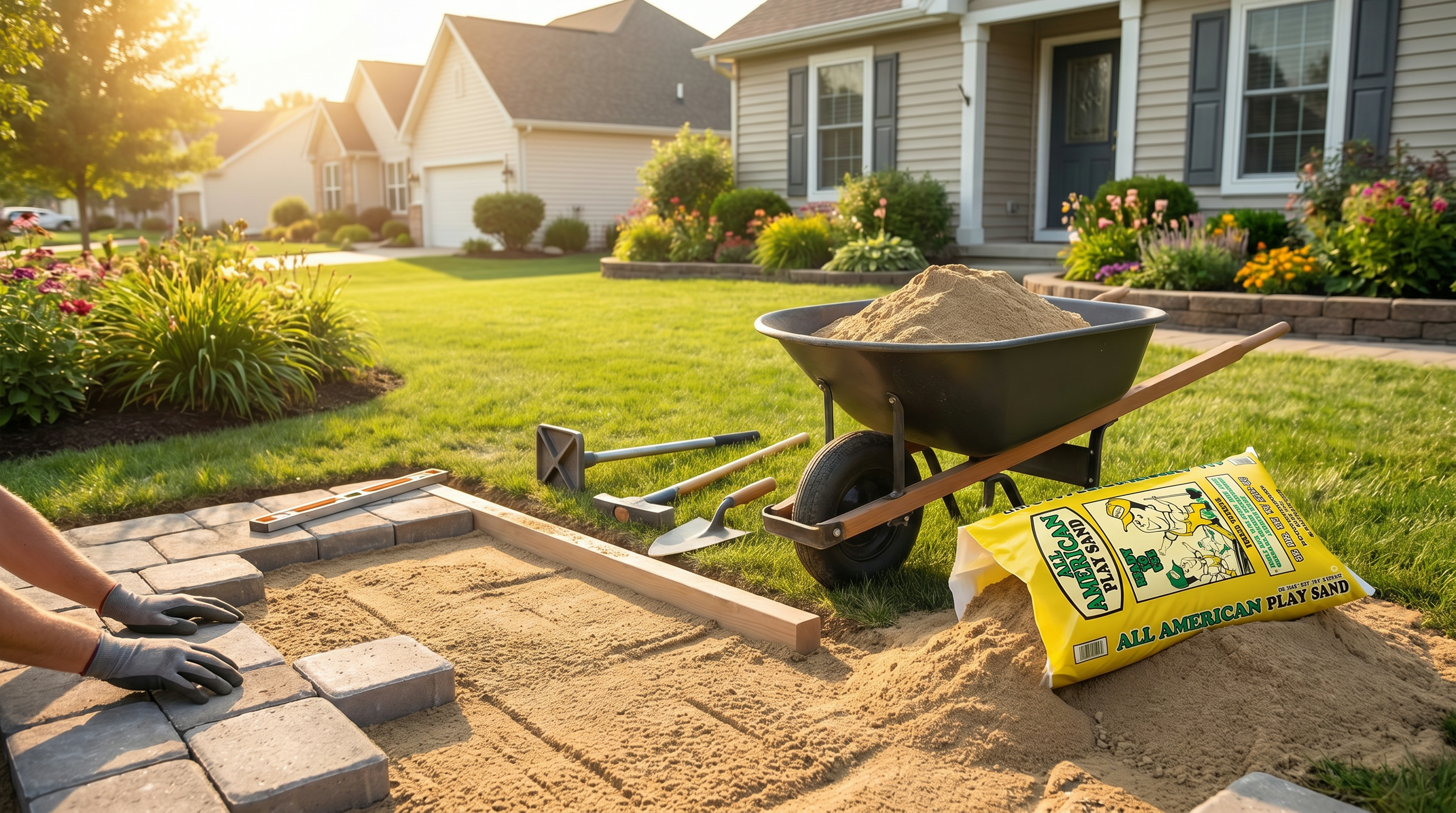
There is a short list of materials that show up in more outdoor projects than anything else — the materials you reach for when you're setting a patio, mixing concrete for a post, correcting drainage in a soggy corner of the yard, or leveling a low spot in the lawn before the growing season. All purpose sand is near the top of that list. Coarser than mason sand, with enough particle angularity to lock into a stable base and enough permeability to drain freely, all purpose sand — sometimes called concrete sand — is the workhorse bulk material behind more successful outdoor projects than homeowners typically realize. The problem with all purpose sand is not that it's hard to find or hard to use. The problem is that most homeowners either buy it in the wrong form — bags, when they need a cubic yard — or don't know enough about its actual properties to use it correctly for the project at hand. This guide covers both. Available by the cubic yard at Liberty Farm, Home & Garden in Galion, Ohio, all purpose sand is sold in true bulk quantities — the way serious outdoor projects actually get done.
What Is All Purpose Sand — and How Is It Different from Mason Sand?
Not all sand is the same, and the difference matters more than most homeowners realize when they're planning a project. All purpose sand — the type available by the cubic yard at Liberty Farm, Home & Garden — is a natural, unprocessed or minimally processed sand with a slightly coarser particle gradation than mason sand. It is also referred to as concrete sand in many markets, and the two names describe the same material.
Mason sand, by contrast, is a finer, more uniformly graded sand with a softer, smoother texture — it is screened and processed to a consistent fine particle size that makes it ideal for mortar work, filling joints between pavers, and applications where a smooth, compact finish is required. Mason sand is excellent for what it does, but it is not interchangeable with all purpose sand in most heavy-construction or drainage applications. The coarser particle size and angular grain shape of all purpose sand give it different physical properties that make it better suited for its specific uses.
Particle size and gradation. All purpose sand contains a range of particle sizes from very fine to medium-coarse — typically from 0.1 mm to 5 mm depending on the source quarry. This range of gradations is what makes it ideal for concrete mixing, because the varying particle sizes pack together and fill the void spaces between aggregate particles in a concrete mix, producing a denser, stronger finished product than a uniformly graded sand would create.
Particle shape. All purpose sand particles tend to be angular or sub-angular — they have edges and facets rather than perfectly round surfaces. This angularity is critical for stability in base applications: angular particles interlock when compacted, creating a base that resists shifting and settling under load. Round-particle sands (like some river sands) have less interlocking and are more prone to movement under weight.
Drainage characteristics. The coarser, mixed gradation of all purpose sand drains faster than fine mason sand. Water moves through all purpose sand quickly because the irregular particle packing creates more connected void space between particles than tightly packed fine sand does. This makes all purpose sand the right choice for drainage correction applications where you need water to move through the material, not just sit at the surface.
Compaction behavior. All purpose sand compacts well under mechanical or manual tamping, achieving a stable, load-bearing surface when properly installed and compacted. It does not compact as tightly as crushed stone or gravel — materials like #8 Gravel and #8 Limestone provide a harder, more rigid compacted base — but for leveling applications where you need some give in the base layer, sand is the correct choice over stone.
Using All Purpose Sand for Concrete Mixing
Concrete is a blend of three essential components: Portland cement (the binder), aggregate (coarse stone or gravel), and sand (fine aggregate). The sand fills the voids between aggregate particles, binds with cement paste to create the dense matrix of hardened concrete, and affects both the workability of the wet mix and the strength and surface finish of the cured product. Getting the sand right matters.
All purpose sand is the correct sand for standard concrete mixes — it is coarser than mason sand, which means it contributes better to the mix's structural integrity. Using mason sand in a structural concrete pour is not advisable for load-bearing applications: the fine particles produce a weaker, more porous matrix, and the mix tends to be stickier and more difficult to work with at standard water-to-cement ratios. All purpose sand mixed at the standard 1:2:3 ratio (one part cement, two parts sand, three parts gravel) produces the structural concrete appropriate for footings, posts, and pads.
For homeowners mixing concrete manually — hand-mixing in a wheelbarrow or using a small electric mixer — bulk all purpose sand delivered by the cubic yard is far more practical than hauling bags of pre-blended concrete mix. A cubic yard of sand combined with a cubic yard of gravel and the appropriate quantity of Portland cement produces enough concrete for a serious project volume at a fraction of the cost of pre-bagged mix. For projects that require a significant number of bags — setting more than six or eight posts, pouring a concrete pad, or backfilling a retaining wall footing — ordering bulk sand and gravel and mixing your own concrete is the approach that makes economic and practical sense.
The water-to-cement ratio in your mix is the single most important variable for concrete strength. More water makes the mix easier to work with but produces weaker, more porous concrete. For most structural applications, mix to a stiff, barely-workable consistency — the mix should hold its shape when formed into a ball by hand and not slump freely when released. All purpose sand's coarser gradation helps produce a mix that holds shape at the right water ratio better than fine sand does.
All Purpose Sand as a Leveling Base for Pavers, Stepping Stones, and Retaining Wall Block
One of the most common uses of all purpose sand in residential landscaping is as a leveling bed under concrete pavers, natural stone stepping stones, and retaining wall block. Every professional hardscape installation — patio, walkway, driveway apron, or retaining wall — uses a compacted sand setting bed as the final leveling layer between the compacted gravel base and the surface material, and for good reason.
Sand's role in a hardscape base is not to provide structural support — that's the job of the compacted #8 Gravel or crushed stone layer below it. Sand's role is to provide a screeded, level surface on which to set each paver or stone, and to allow fine adjustments during installation. A paver set in a 1-inch sand bed can be tapped down with a rubber mallet to bring it flush with adjacent pieces, filled under with additional sand if it's running low, or lifted and re-set if the first placement is off-level. None of these adjustments are possible once the paver is set in mortar or set directly on compacted gravel without a sand bed.
The standard installation sequence for a sand-set paver patio is well established: excavate to depth (typically 6 to 8 inches below finished surface for a patio, more for a driveway), install compacted gravel base at 4 to 6 inches compacted depth, screed a 1-inch layer of all purpose sand level across the gravel, set pavers in the sand bed using a straight edge and level to check each course, compact the set pavers with a plate compactor (which drives the pavers down into the sand and locks them in position), and then sweep fine dry sand into the paver joints to lock the surface and prevent individual paver movement.
The sand setting bed should be exactly 1 inch deep after final screening — thicker sand beds (2 inches or more) are more prone to shifting and settling over time because the sand isn't well-confined at the edges. If your gravel base is slightly uneven after compaction, add more gravel and re-compact rather than using a thicker sand bed as a correction. The sand is the precision layer, not the correction layer.
Drainage Applications: Where Sand Does What Soil Can't
Ohio soils — particularly the heavy clay soils common across north-central Ohio — have notoriously poor drainage characteristics. Clay particles are extremely fine and pack closely together, leaving very little space between particles for water to move through. The result is soil that holds water for extended periods after rain, creating saturated conditions that drown plant roots, turn lawn areas into standing water zones, and push water toward foundations.
All purpose sand improves drainage by providing a zone of permeable material through which water can move freely. The physics is straightforward: water moves through sand many times faster than through clay because the larger, irregular sand particles create a connected network of pore spaces that water follows by gravity. Introducing a layer of sand into a poorly draining area creates a fast-drainage path that draws water down and away from the surface.
Common drainage applications for all purpose sand include:
Dry creek beds and French drain trenches. A trench excavated along a drainage swale or at the base of a slope, filled with sand and covered with landscape fabric and stone, functions as a subsurface channel that intercepts water moving through the soil profile and redirects it to a discharge point. All purpose sand is frequently used as the initial fill in a French drain trench before coarser gravel is added on top, providing fine particle filtration that prevents the gravel void spaces from silting up over time.
Improving planting bed drainage. Adding a 3 to 4 inch layer of all purpose sand to a planting bed and tilling it into the top 8 to 10 inches of clay soil can meaningfully improve drainage for plants that require well-drained conditions — herbs, lavender, rosemary, succulents, and most ornamental perennials that are prone to root rot in wet clay. The improvement works best when sand is combined with organic matter (compost or aged manure) to prevent the worst outcome of sand-only amendments: a concrete-like compacted layer at the sand-clay interface.
Lawn areas with persistent standing water. Low spots in lawn areas that collect standing water after rain can be improved by core-aeration followed by topdressing with a sand-compost mix. The aeration holes create channels that allow the sand-compost mix to infiltrate into the soil profile, gradually improving the drainage characteristics of the surface layer over two or three seasons of repeated treatment. This approach is gentler than full excavation and re-grading, and it works well for moderate drainage problems that don't require major earthwork.
Foundation backfill. When backfilling around foundations after construction or repair, using a permeable material like sand rather than compacted clay ensures that water from rain and snowmelt drains away from the foundation wall rather than pooling against it. Saturated clay against a foundation wall creates hydrostatic pressure that can crack masonry and push water through even minor cracks in the waterproofing. All purpose sand backfill reduces this hydrostatic pressure significantly by allowing water to move freely downward to the footing drain.
Leveling Low Spots in the Lawn with Sand Topdressing
Lawn areas develop low spots over time from soil settling, tree root decomposition, animal tunneling, and simple seasonal freeze-thaw cycles that gradually displace soil particles. Low spots create two practical problems: they collect standing water after rain, and they create tripping hazards and uneven cutting surfaces for lawn mowers. Topdressing with sand — applying a thin, level layer across the low area and working it into the existing grass — is the standard approach for correcting minor to moderate depressions without killing the lawn.
The key to successful sand topdressing in a lawn is matching the particle gradation of the topdressing material to the existing soil. Heavy clay soils benefit from a coarser all purpose sand topdressing because the coarser particles resist compaction and improve drainage. The topdressing layer should be applied no deeper than 1 inch per application — thicker applications smother grass crowns and kill the turf. For deeper depressions, make multiple applications in the same season (spaced a month or more apart to allow the grass to grow up through each layer) rather than a single deep application.
For very deep depressions — more than 2 to 3 inches below the surrounding grade — the most effective correction is to cut the sod from the low area with a flat spade, set it aside, add sand and topsoil mix to bring the area up to the desired grade, firm the base by tamping, and re-lay the sod over the corrected base. This approach corrects the grade immediately rather than over multiple seasons of topdressing. The sod re-establishes its root contact within a few weeks of being laid back down, and the corrected area can be mowed normally within a month.
How Much Sand Do You Need? Calculating Cubic Yards
One of the most common mistakes homeowners make when ordering bulk materials is underestimating quantity — ordering one cubic yard when the project requires two, then paying a second delivery charge or making a second trip for the shortfall. Getting the calculation right before you order saves time, money, and frustration. Here is how to calculate cubic yards for the most common all purpose sand applications.
The basic cubic yard formula: Multiply the length (in feet) × width (in feet) × depth (in inches), then divide by 324. This gives you cubic yards. For example, a patio that is 12 feet wide and 20 feet long, with a 1-inch sand setting bed, requires: 12 × 20 × 1 ÷ 324 = 0.74 cubic yards. Round up to 1 cubic yard to have enough material and some cushion for waste.
For a concrete mix: A standard 1:2:3 concrete mix (one part cement, two parts sand, three parts gravel) by volume requires roughly 0.5 cubic yards of sand per cubic yard of finished concrete. A typical 10×10-foot concrete slab at 4 inches thick contains roughly 1.2 cubic yards of finished concrete, requiring about 0.6 cubic yards of sand in the mix.
For a drainage trench: A French drain trench that is 2 feet wide, 18 inches deep, and 40 feet long requires: 2 × 40 × 18 ÷ 324 = 4.4 cubic yards of fill material (sand and gravel combined). Plan on roughly 1 to 1.5 cubic yards of sand for the bottom and sides of the trench, with gravel making up the remaining volume.
For lawn topdressing: At a 0.5-inch depth, one cubic yard of sand covers approximately 648 square feet of lawn area. For a 1-inch depth, the same cubic yard covers about 324 square feet. Most lawn topdressing applications use 0.25 to 0.5 inches per application — thin enough to work into the grass without smothering it.
When in doubt, order slightly more than your calculation suggests. All purpose sand has dozens of secondary uses — excess material from a patio project can fill a low spot in the lawn, top-dress around a post, or be saved in a tarp for a future project. Unlike perishable materials, bulk sand doesn't degrade if it sits for a season before you need it.
Comparing All Purpose Sand, Gravel, and Limestone for Base Applications
For outdoor base and drainage projects, homeowners often face a choice between several bulk materials — sand, gravel, or limestone. Understanding what each material does best helps you choose the right one for each layer of your project, or determine whether you need more than one material in combination.
All purpose sand excels as a leveling layer, a screeded setting bed for hardscape materials, a drainage amendment mixed into soil, and a fine-aggregate component in concrete mixes. It compacts moderately, provides excellent drainage, and is easy to screed to a precise level grade. It is not a structural base material on its own — it does not provide the rigid, load-bearing sub-base that compacted gravel provides.
#8 Gravel (rounded or crushed stone approximately 3/8 to 3/4 inch in diameter) provides the structural compacted base that patios, driveways, walkways, and shed pads need below the sand setting bed. Gravel compacts under a plate compactor or mechanical tamper to create a rigid, load-distributing layer that prevents surface pavers or slabs from shifting or sinking. Gravel also drains very freely, which is why it is the standard material for the base layer of any hardscape project where good drainage is required. Most professional patio and driveway installations combine a 4 to 6-inch compacted gravel base with a 1-inch screeded sand setting bed on top — the gravel provides structural support, and the sand provides final leveling precision.
#8 Limestone is angular crushed limestone in the same approximate size range as #8 gravel. The angular particle shape of crushed limestone interlock more aggressively than rounded gravel, creating an even more stable compacted base. Limestone is commonly used as a base layer for driveways, parking areas, and heavy-use paths where a hard, stable surface that resists lateral movement is required. Because limestone particles are angular rather than round, the compacted surface stays in place better under vehicle traffic than rounded gravel does. For light vehicle and pedestrian applications either gravel or limestone works well; for heavier vehicle use, crushed limestone is often the stronger choice.
The practical takeaway: for a standard residential patio or walkway project, order all purpose sand for the setting bed layer and #8 gravel or #8 limestone for the compacted base. For a concrete project, order all purpose sand as the fine aggregate and pair it with your preferred coarse aggregate. For drainage-only applications, all purpose sand alone often provides sufficient drainage improvement without gravel if you are amending soil rather than building a hardscape base.
Delivery, Placement, and Handling of Bulk Sand
Ordering bulk sand for delivery requires a bit of planning to make the most of the delivery — knowing where the sand will be placed, how it will be moved to the work area, and what tools you'll need to work with it efficiently.
Delivery access and placement. Bulk sand is delivered by dump truck and deposited in a pile at a designated location on your property. The truck needs reasonable road access and a spot where the pile won't block drainage, damage the lawn excessively, or create a hazard. Most residential deliveries are placed in a driveway or at the edge of a grass area adjacent to the worksite. If your worksite is a rear yard with no drive access, make sure you have a plan for moving the sand — wheelbarrows, a small garden tractor with a bucket attachment, or a temporary ramp for wheeled equipment.
Working with sand in different weather conditions. Sand is easiest to screed and work with at moderate moisture — bone-dry sand is dusty and difficult to maintain at a consistent grade; oversaturated sand from prolonged rain is too heavy and flows rather than screening to a level surface. If your delivery arrives very dry, a light misting with a garden hose before screeding improves workability. If working after recent rain, give saturated sand a day to drain before attempting to screed a setting bed.
Tools for sand work. For screeding a sand setting bed, you need screed rails — lengths of rigid pipe or conduit set to the target depth — and a straight board (a 2×4 works well) to drag along the rails. A shovel, a square-edged spade, and a hand tamper are the basic tools for moving, shaping, and firming the sand. For larger areas, a plate compactor (available at most tool rental locations) compacts the full installation after pavers are laid and makes a significant difference in long-term stability.
Covering stored sand between work sessions. If your project spans multiple days or weekends, cover the sand pile between sessions with a tarp or plastic sheeting to prevent rain saturation and to keep it from being disturbed by wind, animals, or foot traffic. A covered sand pile stays in workable condition for weeks without any deterioration in quality.
| Application | Recommended Depth / Use | Cubic Yards per 100 sq ft |
|---|---|---|
| Paver setting bed | 1 inch screeded layer | 0.31 cubic yards |
| Concrete mix (fine aggregate) | 2 parts sand per 1 part cement (1:2:3 mix) | Varies by project volume |
| Lawn topdressing | 0.25–0.5 inch per application | 0.08–0.15 cubic yards |
| Drainage trench fill | Bottom / side layer of French drain trench | Varies by trench depth and width |
| Foundation backfill | Fill in lifts, tamp between layers | Varies by excavation depth |
| Soil amendment (clay improvement) | 3–4 inch layer tilled to 8–10 inch depth | 1.0–1.25 cubic yards per 100 sq ft |
| Low spot fill (lawn) | Fill to grade, sod overlay or reseed | Varies by depression depth |
| Available At | Liberty Farm, Home & Garden, Galion, Ohio | |
The All Purpose Sand by the Cubic Yard is available for local pickup or delivery in Galion at Liberty Farm, Home & Garden. We also carry #8 Gravel and #8 Limestone by the cubic yard for complete project sourcing — whether you're building a patio, mixing concrete, improving drainage, or leveling a lawn area, stop in and talk through your project with our team.
Frequently Asked Questions
Keep Reading
Plant Cover Crops Now: An Ohio Home Garden Guide
Plant fall cover crops in an Ohio vegetable garden with practical guidance on timing, species, seeding, winter care, and spring termination.

Save This Summer’s Garden: A Practical Ohio Seed-Saving Guide
Save tomato, bean, pea, lettuce, marigold, zinnia, and other garden seeds with this practical late-summer guide for Galion and north-central Ohio.