
The 16-Inch Bone Built for Dogs That Destroy Everything Else: A Complete Guide to Nature's Own Giant Smoked Femur
Why large and giant breed dogs need a fundamentally different kind of chew, how free-range American beef femur bones are sourced and slow-smoked for lasting flavor, which dogs belong in the giant chewer category, and how to give any bone safely
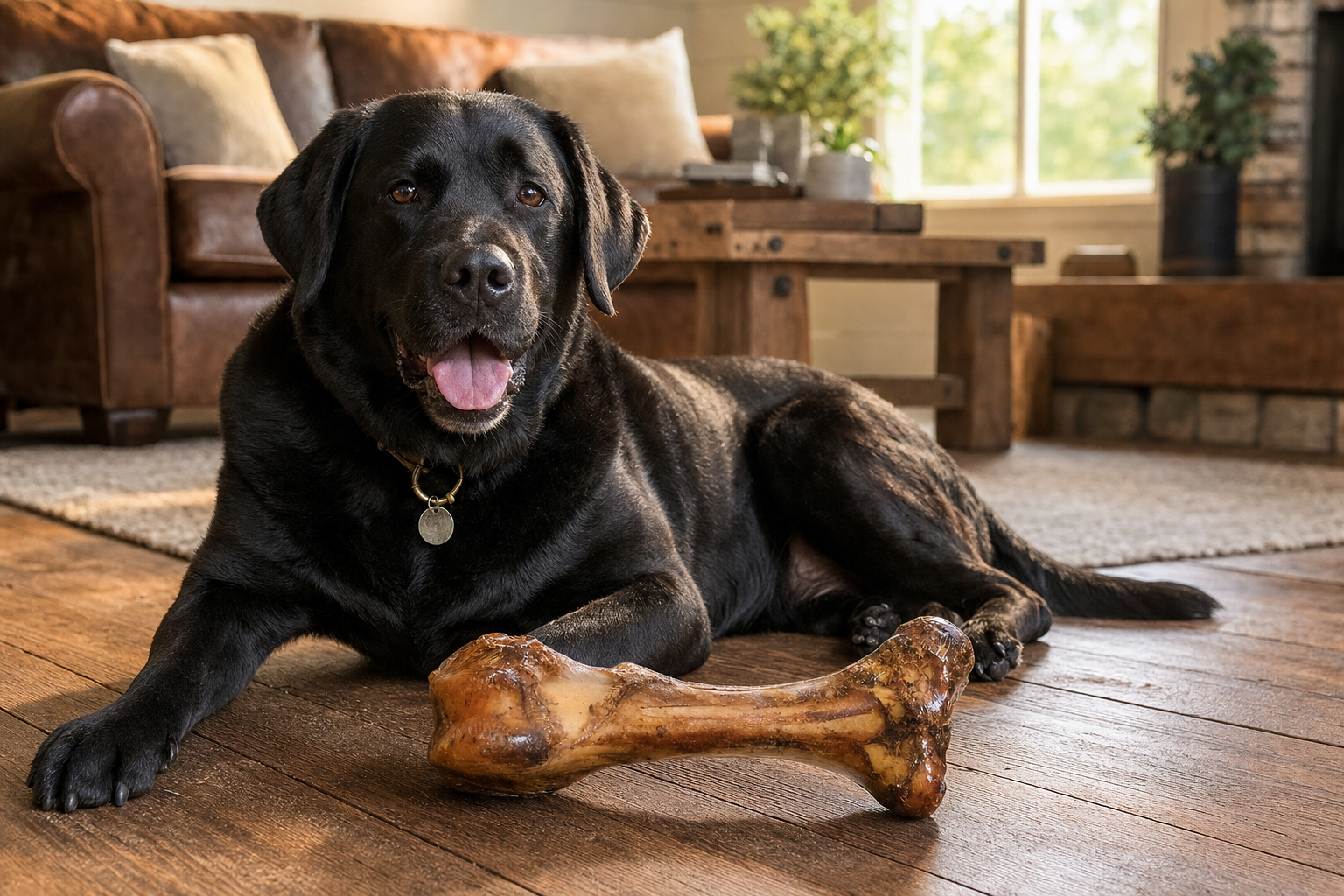
Most dog bones are sized for the average dog. They're engineered to satisfy a 30- or 45-pound Beagle or Cocker Spaniel — which works fine until you have a Rottweiler, a Mastiff, a Great Dane, or a 90-pound Labrador sitting in front of you expecting something worthwhile. Those dogs don't chew bones so much as they dismantle them, and a bone that disappears in under fifteen minutes isn't enrichment — it's a snack. The Nature's Own Giant Smoked Femur (16 in) starts from a different premise: that large and giant breed dogs deserve a chew that's actually sized for their jaws, their chewing strength, and their capacity for sustained engagement. Made from 100% natural, free-range beef femur from cattle raised in Michigan, slow-smoked without added chemicals or artificial flavors, this 16-inch bone is one of the few chew products genuinely built for the dogs that destroy everything else.
Why Large and Giant Breed Dogs Need a Different Kind of Chew
The chewing needs of a 100-pound Bernese Mountain Dog and a 20-pound Shih Tzu are not just quantitatively different — they're categorically different. Large and giant breed dogs have larger jaw muscles, denser skeletal structure, and significantly greater bite force, which means they engage with chew products in a fundamentally more powerful way. A bone that provides meaningful resistance to a small dog is structurally trivial for a large breed. It's consumed quickly, provides little dental benefit because the teeth barely have to work, and leaves the dog with the behavioral need to chew still entirely unmet.
This matters for several practical reasons. First, dental hygiene through chewing depends on mechanical abrasion — the physical friction of a dog working around a chew surface against tooth enamel. For that abrasion to occur across the back molars and premolars where tartar accumulation is most problematic, the chew must provide genuine resistance over a sustained session. A bone that's gone in ten minutes doesn't produce enough abrasion across enough of the tooth surface to contribute meaningfully to dental health. A 16-inch femur that occupies an 80-pound dog for 30 to 45 minutes is doing real dental work.
Second, the behavioral dimension of chewing is dose-dependent. Chewing triggers the release of calming neurochemicals — serotonin, endorphins — and the duration and intensity of the session determines how much of that calming effect the dog experiences. A brief, unsatisfying session may take the edge off momentarily but won't produce the settled, content demeanor that follows a genuinely satisfying chew. Large breed dogs that are under-stimulated through inadequate chew options often redirect their drive to destructive behavior — furniture, baseboards, shoes, socks — not because they're poorly trained, but because the drive to chew is hardwired and has nowhere appropriate to go.
Third, large breed dogs are often kept on lower-fat or calorie-controlled diets due to their predisposition to weight management challenges and conditions like bloat. A chew that is structurally robust — providing engagement through its density rather than through a calorie-dense marrow filling — gives these dogs a long, satisfying session without the fat loading that a heavily marrow-filled small bone might provide. The femur's design delivers occupation through structure rather than through calories alone.
Free-Range Michigan Cattle: Why the Source Matters
Nature's Own Giant Smoked Femur is made from beef sourced from free-range cattle raised in Michigan — a provenance detail that's more meaningful than it might first appear on a pet treat label. When it comes to natural bones given to dogs, the life conditions of the source animal have a real effect on the quality of what ends up in your dog's mouth.
Cattle raised on pasture with room to move develop denser bones than feedlot animals that spend the majority of their lives in confined, low-movement conditions. Bone density is not just a structural curiosity — it directly affects how a chew product behaves. A denser bone provides more sustained resistance to chewing, holds its shape longer under powerful jaw force, and tends to produce fewer sharp micro-fractures as it's worked down. For a large breed dog with real biting power, bone density matters for both safety and longevity of the chewing session.
Free-range cattle also tend to have fewer residual veterinary pharmaceuticals — particularly the sub-therapeutic antibiotic use that remains common in confined livestock operations — in their tissues and bones. While the smoking and processing steps in pet bone production do not fully eliminate such compounds if present, sourcing from operations that don't rely on preventive antibiotic regimens reduces the baseline load. For pet owners who are already paying attention to sourcing in their own food purchasing decisions, having that same standard available for their dog's treats is genuinely valuable.
The Michigan origin is also simply verifiable. Domestic sourcing allows for traceable supply chains in a way that international ingredient sourcing — which has been associated with a number of recalled pet treat products over the past two decades — does not. When you buy a product made from USA-raised cattle, you're buying into an auditable supply chain rather than relying on a country-of-origin claim that's difficult to verify independently.
What Slow Smoking Does to a Femur Bone
The Nature's Own Giant Smoked Femur isn't just a raw bone with smoke flavoring sprayed on it. It's a bone that has been slow-smoked — subjected to the actual thermal process of wood smoke exposure over an extended period — and that distinction has practical consequences for what the dog experiences and how the product behaves.
Natural slow smoking accomplishes several things simultaneously. The heat drives moisture out of the outer layers of the bone progressively rather than suddenly, which prevents the kind of uneven brittleness that can occur when a bone is dried too quickly. Slow, even dehydration produces a product that's firm and dense throughout rather than brittle on the outside and porous in a way that leads to unpredictable splintering behavior.
The smoke compounds themselves — phenols, aldehydes, and organic acids produced by combusting wood — penetrate into the porous outer bone layer during the smoking process. These aren't surface coatings that wash off at the first lick or get rapidly consumed in the first few minutes of chewing. They're embedded in the bone's structure, which means the flavor profile that makes the bone interesting to a dog persists and even renews as the dog works through successive layers. This is part of why naturally smoked bones produce longer engagement sessions than flavored alternatives — the flavor isn't front-loaded on the surface but distributed through the depth of the material.
Slow smoking also produces the Maillard reaction on the surface — the same chemistry responsible for the appealing crust on well-seared meat. The resulting surface layer has a complex aromatic profile that dogs find intensely interesting and that differs from the raw bone beneath it. A dog approaching a slow-smoked femur is receiving a multi-layered sensory invitation: the surface Maillard aroma, the smoke compounds, and the underlying bone scent — a combination that engages the olfactory system far more completely than a single-note flavoring can.
Which Dogs Belong in the "Giant Chewer" Category
The Giant Smoked Femur is engineered for large and giant breed dogs with the jaw strength and body size to work a 16-inch bone effectively. Understanding which dogs fall into this category — and which are at the edges — helps owners make the right sizing call.
| Weight Range | Representative Breeds | Fit for 16-Inch Femur |
|---|---|---|
| Under 40 lbs | Beagles, French Bulldogs, Cavaliers | Not recommended — too large to work effectively; choose smaller format |
| 40–60 lbs | Border Collies, Springer Spaniels, Whippets | May work for enthusiastic chewers; moderate chewers may prefer the 8 in option |
| 60–90 lbs | Labrador Retrievers, Golden Retrievers, German Shepherds, Huskies | Good fit — this is the core weight range the 16-inch femur is designed for |
| 90–130 lbs | Rottweilers, Dobermans, Bernese Mountain Dogs, Akitas | Excellent fit — extended sessions, appropriate challenge level |
| 130+ lbs | Great Danes, Mastiffs, Saint Bernards, Great Pyrenees | Very good fit — genuine chewing challenge; monitor session pace for exceptional power chewers |
Chewing style is at least as important as weight. A 65-pound dog that's an extreme power chewer — the kind that destroys antlers, goes through compressed rawhide in a single session, and leaves teeth marks in Nylabones — will work through a femur faster than a 90-pound moderate chewer. Know your dog's chewing intensity, not just their weight class, when deciding whether the Giant Femur is the right format.
How the Femur's Anatomy Engages a Dog's Instincts
The femur is the thigh bone — in cattle, the longest and densest long bone in the body. It's not a random cut of bone chosen for convenience; it's specifically the bone type that working dogs, wolves, and wild canids have historically been most motivated to interact with. Understanding why the femur engages dogs so completely helps owners appreciate what they're giving their dog and why it produces the behavioral results it does.
A femur has several distinct anatomical features that translate to different types of engagement:
- The shaft: The long central shaft of the femur is dense cortical bone — the hardest, most structurally solid part of any bone. Chewing on the shaft provides maximum resistance, works the back molars and carnassial teeth (the large shearing teeth at the sides of the jaw), and is the part of the bone that provides the sustained abrasive dental benefit. Dogs will work the shaft for extended periods, repositioning frequently to access different angles.
- The epiphyses (the rounded ends): The flared ends of the femur have a different character — they're denser than marrow cavity walls but more porous than the shaft, and they often contain trabecular bone that crumbles slightly as the dog works it. These ends are where a lot of the flavor compounds concentrate, and where dogs tend to start before moving to the shaft. They also provide a gripping surface that helps large dogs position the bone.
- The marrow cavity: The hollow interior of a femur shaft contains or once contained marrow — the rich fatty tissue that wild canids have always prized as a high-calorie reward. In a smoked femur product, the marrow may be partially or fully rendered out during the smoking process, but the cavity itself retains the marrow scent profile and any residual fat, which provides olfactory motivation to keep working at the interior of the bone. Dogs are innately motivated to access bone interiors — it's a behavior pattern tens of thousands of years in the making.
This structural variety — multiple textures, multiple zones of different density and flavor concentration — is what produces extended engagement sessions rather than the rapid consumption of a simpler, single-texture chew. The dog isn't just chewing; it's systematically investigating a complex object with different rewards available in different locations.
Bone Safety for Large Breed Dogs: What You Need to Know Before Starting
Large breed dogs interacting with bones require the same supervision principles as any dog, applied with an additional awareness of the greater jaw force involved. A dog that can exert 300 to 500 pounds of bite pressure — as many large and giant breeds can — is capable of fracturing bone fragments that a smaller dog would simply wear down through patient chewing. The safety practices that apply to all bone chewing apply here with heightened importance.
The essential safety framework for large breed bone chewing:
- Active supervision throughout the session. Do not leave a large breed dog alone with a femur. "Active" doesn't mean hovering — it means being present and checking in frequently enough that you can intervene if the bone reaches a hazardous size or configuration. The moment a bone has been worked down to a piece the dog could potentially attempt to swallow whole, the session ends.
- Discard the bone at the right threshold. For a large breed dog, this threshold arrives earlier relative to the starting bone size than it would for a small breed. A piece that a Beagle couldn't swallow may be exactly the right size for a Labrador to attempt. Know your dog's mouth size and apply a conservative discard threshold.
- Monitor for abnormal chewing behavior. Most dogs chew bones in a steady, rhythmic pattern, repositioning periodically. Frantic, obsessive chewing with no pausing — sometimes called resource guarding behavior — can produce faster bone reduction and higher ingestion risk. If your dog shows this pattern, shorten sessions rather than allowing unlimited access.
- No cooked bones, ever. This is stated in detail in the callout below, but it bears repeating in any bone safety discussion: cooked bones are structurally incompatible with safe chewing. The smoked femur from Nature's Own is not a cooked bone in the culinary sense — it is a purpose-processed pet chew that has been treated through controlled slow smoking, not by boiling, roasting, or any other cooking method that produces dangerous brittleness.
- Check teeth after bone sessions. Large breed dogs with strong chewing intensity occasionally chip or crack teeth on very hard chew items. After the first several sessions with a new chew type, inspect the dog's mouth for any cracked molars or unusual sensitivity. A dog that suddenly becomes reluctant to chew hard items may have a dental injury that warrants a veterinary check.
- Fresh water always available. Bone chewing is physically effortful. Large breed dogs in extended sessions will pant and may overheat slightly. Fresh water accessible throughout the session is not optional.
How to Introduce the Giant Femur to a New Chewer
Not all large breed dogs have had extensive experience with natural bones, and a first bone session with a 16-inch femur can produce variable responses depending on the individual dog's background. Managing the introduction thoughtfully sets the dog up for successful, safe chewing sessions from the start.
For dogs with no prior bone experience, the first session should be relatively short — 15 to 20 minutes of supervised access rather than an unlimited free session. This is partly about safety monitoring, and partly about giving the dog's digestive system time to adjust to the fat and protein content of a natural bone before sustained exposure. Some dogs experience mild digestive looseness after their first bone session simply because the experience is novel and the fat content is higher than their baseline treats. A short initial session followed by a day off and then progressive increase in session length prevents this from becoming a problem.
Present the bone in a space where the dog can settle comfortably — on a mat, on an easily cleaned floor surface, or outdoors. Dogs naturally want to take a bone to a preferred location and settle down to work it, which is fine and actually a sign of healthy engagement. Avoid locations where the dog may feel pressured to guard the bone from other animals or family members — resource guarding behavior is amplified when a dog feels its prized item is at risk, and that's when reckless chewing rather than methodical chewing occurs.
For multi-dog households, give bones in separate spaces with supervision. Two large breed dogs chewing bones in the same room may trigger competitive behavior that accelerates the chewing pace and increases the chance of swallowing rather than chewing. Separation during bone sessions is standard good practice in any multi-dog home.
Between sessions, store the bone in a cool, dry location — a dedicated bag or sealed container works well. Naturally smoked bones are shelf-stable in dry conditions and do not require refrigeration. Introduce moisture through poor storage conditions, however, and the surface can develop bacterial growth. Keep it dry, keep it clean, and the bone remains in good condition across multiple sessions.
Smoked Femur vs. Other Large Breed Chew Options
| Chew Type | Duration for Large Breeds | Dental Benefit | Digestibility | Best For |
|---|---|---|---|---|
| Giant Smoked Femur (16 in) | Long — 30 min to multiple sessions | High — hard cortical bone, full molar engagement | Not fully digestible; discard when small | Power chewers, daily enrichment, dental maintenance |
| Bully Stick (12 in) | Medium — 20–40 min depending on chewer | Moderate — softer, still provides abrasion | Fully digestible | Dogs that need a digestible option or softer chew |
| Compressed Rawhide (large) | Medium — highly variable | Moderate | Partially digestible; discard when soft and small | Dogs that prefer rawhide texture |
| Dental Chew Treat | Short — 5–15 min | Light to moderate | Fully digestible | Daily dental habit without a dedicated bone session |
| Antler / Horn | Very long — days to weeks | High — very hard | Not digestible | Extreme power chewers; can pose tooth fracture risk |
Related Products at Liberty Farm, Home & Garden
For large breed dog owners building out a complete chew and treat rotation, Liberty Farm, Home & Garden carries complementary options alongside the Giant Smoked Femur:
- Bully Stick 12 in — A single-ingredient, fully digestible chew for dogs that need a long-lasting option between bone sessions. Bully sticks are a softer alternative that's gentler on teeth than a hard femur — ideal for rotating in on days when you want to give the dog's molars a break while still satisfying the chewing drive. Fully digestible end to end, no discard threshold to manage.
- Wholesomes Rewards Variety Medium (3 lb) — A high-quality mixed treat bag for daily training rewards and spot reinforcement. The Giant Femur is the big-session chew; Wholesomes Rewards covers the daily soft treat moments — training, recall, crate rewards, and mealtime manners. Keeping both in the rotation means the dog always has an appropriate, high-value reward available for any situation.
For multi-pet households with both dogs and cats, Liberty Farm, Home & Garden also carries cat enrichment options:
- Cat Candy Silver - Catnip & Silver Vine (1 oz) and Cat Candy Original - Leaf & Flower Catnip (1 oz) — Premium single-herb and blended enrichment for cats while the dog gets their bone session in a separate room. A practical way to keep both pets occupied simultaneously.
Stop in at Liberty Farm, Home & Garden in Galion, Ohio to see the Nature's Own Giant Smoked Femur and our full selection of natural chews for large and giant breed dogs. Our team can help match the right product to your dog's size, chewing style, and daily routine.
Frequently Asked Questions
Keep Reading
Back-to-School Routine Changes: Helping Dogs Adjust to More Time Alone
Prepare your dog for back-to-school schedule changes with gradual departures, safe enrichment, camera checks, and veterinarian-backed warning signs.
Ohio Flea Season Peaks in June — Why Your Small Dog Needs Protection on Before It's Too Late
June marks the annual turning point when Ohio's flea and tick populations reach peak activity. Here's what's happening in your yard right now, why small dogs are especially vulnerable, and why the Adams Plus Flea & Tick Collar for Small Dogs is the simplest way to stay ahead of an infestation before it starts.