
Late-Summer Hydrangea Care: Keeping Blooms Beautiful Through Ohio's Hottest Weeks
August heat and humidity can stress even established hydrangeas, but with the right care right now, you can extend the bloom season, protect your shrubs, and set them up for a stunning show next year.
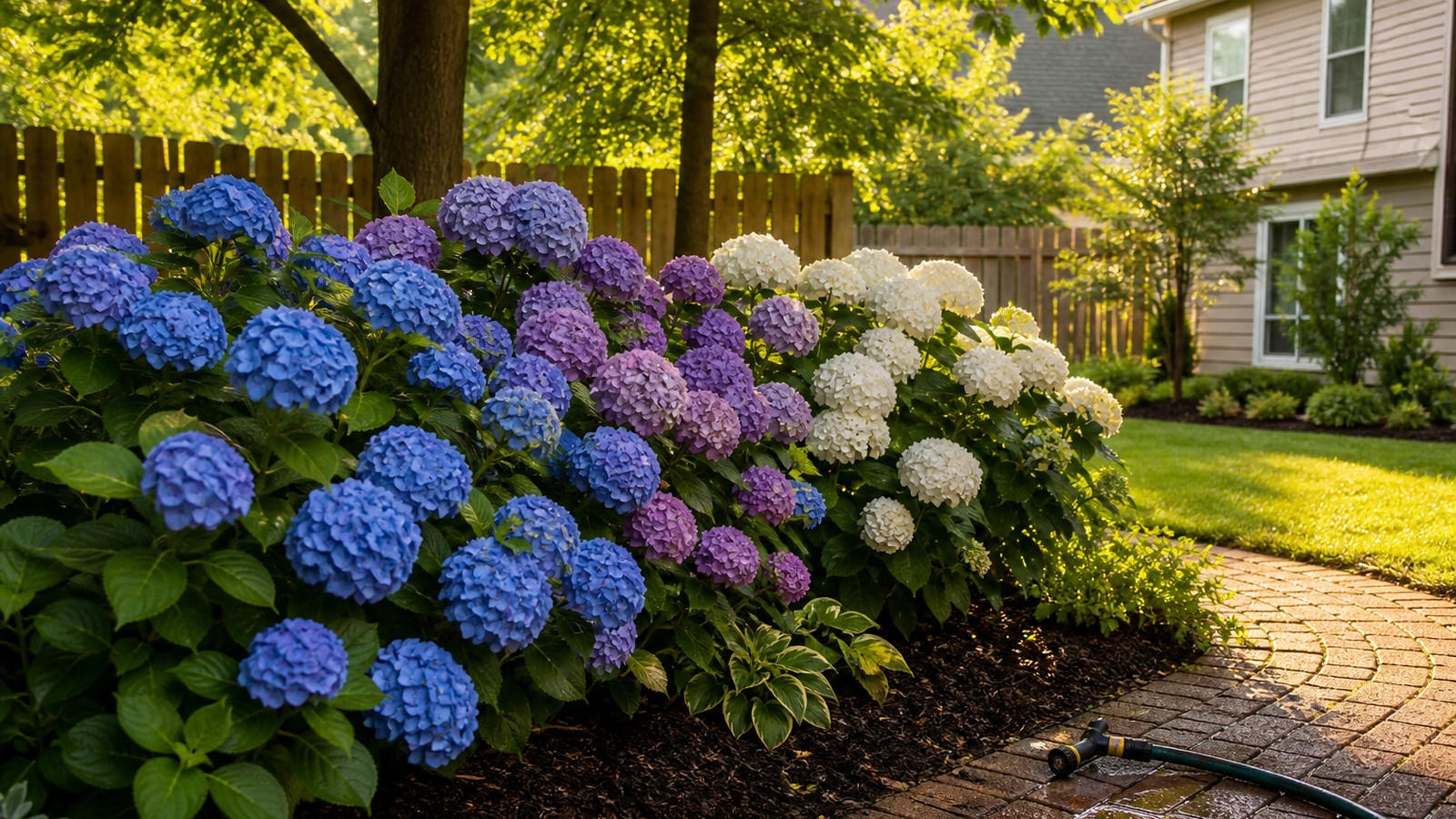
Hydrangeas are one of the most beloved flowering shrubs in north-central Ohio yards — and for good reason. Few plants deliver that same combination of bold, long-lasting blooms and relatively forgiving care. But August in Crawford County is not without its challenges: temperatures pushing into the upper 80s and low 90s, stretches of dry weather broken by heavy thunderstorms, and humidity that can invite fungal problems almost overnight. Right now, in the final weeks of summer, your hydrangeas need some specific attention to finish the season strong, survive the coming fall transition, and come back even more vigorous in 2027. This guide walks you through exactly what to do — and just as importantly, what not to do — between now and the first frost.
Understanding What You're Growing: Hydrangea Types Common in Ohio
Before you can care for your hydrangeas correctly in August, you need to know which type you have. Different species bloom on different wood, handle pruning differently, and respond differently to heat stress. Getting this wrong — especially with pruning — is the single most common reason gardeners in Galion and surrounding communities end up with beautiful foliage and almost no flowers the following year.
Here are the four types you're most likely to find in north-central Ohio landscapes:
- Bigleaf hydrangea (Hydrangea macrophylla): The classic mophead and lacecap types. These bloom on old wood — stems that grew the previous season. They're the most cold-sensitive of the group and the trickiest to manage in Zone 6, where late freezes can kill flower buds set over winter. Common varieties include Endless Summer, Nikko Blue, and Blushing Bride. Soil pH directly affects flower color: acidic soil (below 6.0) pushes toward blue and purple; alkaline soil (above 7.0) pushes toward pink.
- Smooth hydrangea (Hydrangea arborescens): Includes the popular Annabelle and Incrediball types. These bloom on new wood grown in the current season, making them extremely reliable bloomers even after hard winters. They're very well suited to Ohio conditions and are arguably the lowest-maintenance option for Galion-area yards.
- Panicle hydrangea (Hydrangea paniculata): Includes Limelight, Quick Fire, and Pinky Winky. These also bloom on new wood, tolerate more sun than other types, and are the hardiest of the group — actually rated to Zone 3 or 4. Their cone-shaped flower clusters (panicles) start white or cream in summer and age to pink or burgundy in fall. They're an excellent choice for sunnier spots in your yard.
- Oakleaf hydrangea (Hydrangea quercifolia): Named for its distinctive lobed leaves that turn brilliant red and burgundy in fall. Blooms on old wood. Excellent for part-shade sites and offers multi-season interest with peeling bark, fall color, and dried flower heads that persist into winter.
If you're not certain which type you have, take a stem cutting or clear photo to the team at Liberty Farm, Home & Garden in Galion — they can help you identify it and point you toward the right care approach.
Watering Hydrangeas in August: More Critical Than You Think
The name "hydrangea" comes from the Greek word for water vessel, and that's not just botanical trivia — these shrubs have genuinely high water needs, especially during the heat of August. Wilting is the most common complaint Ohio gardeners bring up this time of year, and it's worth understanding that not all wilting is a crisis. Hydrangeas commonly droop during the hottest part of the afternoon (roughly 2–5 p.m.) even when soil moisture is perfectly adequate. This is a temporary response to transpiration demand exceeding water uptake in peak heat. If your plants perk back up by evening or early the next morning, they're probably fine.
True drought stress is a different story. Signs include wilting that persists into the evening, leaves that feel thin and papery rather than supple, and leaf edges that begin to brown and crisp — starting at the tips and moving inward. At this point, the plant is genuinely struggling, and consistent watering becomes urgent.
Practical August Watering Guidelines
- Deep and infrequent beats shallow and frequent. Aim for 1 to 1.5 inches of water per week total, whether from rainfall or irrigation. A deep soaking two or three times a week encourages roots to grow downward, building drought resilience. Frequent light sprinkles keep roots shallow and actually worsen long-term drought sensitivity.
- Water at the base, not overhead. Wetting foliage in humid Ohio August conditions is a reliable recipe for powdery mildew and Cercospora leaf spot — two fungal problems that love exactly this environment. Use a soaker hose, drip line, or a hose wand held low at the root zone.
- Water in the morning. If you do need to water by hand and some splash is unavoidable, morning watering gives leaves the rest of the day to dry off. Evening watering leaves moisture on leaves through the night — prime fungal infection conditions.
- Check soil before watering. Push a finger 2–3 inches into the soil near the drip line of the shrub. It should feel cool and slightly moist. If it's bone dry that deep, water immediately. If it's still damp, wait another day.
- Newly planted shrubs need more attention. A hydrangea planted within the last 12 months has a limited root system and should be checked and watered more frequently — potentially every day during a heat wave above 90°F.
Mulching: Your Most Effective Tool Against August Heat and Moisture Loss
If there's one single action that does more for hydrangeas in late summer than any other, it's maintaining a proper mulch layer. Mulch moderates soil temperature — keeping root zones meaningfully cooler than the air above — and dramatically slows surface moisture evaporation. Research from university extension programs consistently shows mulched shrubs require significantly less supplemental irrigation than unmulched ones during heat events.
In August, check the mulch depth around your hydrangeas. It should be 2 to 3 inches deep across the entire root zone, which extends roughly as far out as the branch tips (the "drip line"). Over the course of a summer, mulch breaks down and compresses; what started as 3 inches in May may now be barely 1.5 inches. Top it up if needed.
Choose organic mulch materials — shredded hardwood, wood chips, or pine bark — over inorganic options like gravel for this application. Organic mulches gradually break down and improve soil structure and water retention over time, which is exactly what you want for moisture-hungry hydrangeas. Keep mulch pulled back 2 to 3 inches from the actual stem of the shrub to prevent crown rot and discourage rodent nesting against the bark.
You can find bagged and bulk mulch options at Liberty Farm, Home & Garden on S. Liberty St. in Galion — it's worth picking up a few bags now to refresh beds before the September transition.
Should You Fertilize Hydrangeas in August? The Honest Answer
This is one of the most common questions about late-summer shrub care, and the honest answer is: probably not, and timing matters more than most gardeners realize.
Here's the reasoning. Hydrangeas set their flower buds for next year during late summer and early fall. Applying a high-nitrogen fertilizer now pushes the plant to produce lush new vegetative growth — soft, tender stems and leaves — at exactly the time it should be slowing down and hardening off for winter. That soft growth is highly vulnerable to cold damage. A hard frost in late October or November (which is entirely normal in Crawford County) can kill those tender new stems and take next year's flower buds with them, particularly on bigleaf varieties that bloom on old wood.
The Safe Fertilizing Window for Hydrangeas in Ohio
- If you didn't fertilize this spring: You can apply a balanced, slow-release granular fertilizer (such as a 10-10-10 or similar balanced formula) very early in August — no later than the first week of the month. By this point in early-to-mid August, that window has effectively closed for most varieties. Skip it and wait until next April.
- If you fertilized in spring: Do nothing. Your plants have sufficient nutrition to finish the season. Additional feeding now does more harm than good.
- Exception — container-grown hydrangeas: Potted hydrangeas deplete nutrients from their limited soil volume much faster. A half-strength dose of a balanced liquid fertilizer in early August is reasonable for container plants, but stop by mid-August at the latest.
- Adjusting soil pH for bigleaf varieties: If you want to shift your mophead hydrangeas toward blue flowers next season, late summer and early fall is an acceptable time to acidify the soil using sulfur amendments or aluminum sulfate. This is not fertilizing — it's pH adjustment — and it won't push new growth. Work it into the soil around the drip line according to package directions and water it in thoroughly.
Deadheading and Late-Season Pruning: What to Do Right Now
Deadheading — removing spent flower heads — is one of those tasks where the right answer depends entirely on which hydrangea type you're working with. Get it wrong on a bigleaf, and you'll be removing the stems that carry next year's buds.
| Hydrangea Type | Blooms On | August Deadheading? | When to Prune | Notes |
|---|---|---|---|---|
| Bigleaf (H. macrophylla) | Old wood | Remove faded heads only — cut just below the bloom, leave the stem | Immediately after bloom, before Aug. 1 if possible; avoid fall/winter pruning | Late pruning removes next year's buds; most critical type to get right |
| Smooth (H. arborescens) | New wood | Yes — remove spent heads freely | Late winter to early spring (February–March) | Can be cut back hard each spring; very forgiving |
| Panicle (H. paniculata) | New wood | Optional — many gardeners leave heads on to enjoy fall color | Late winter to early spring | Dried panicles provide winter garden interest and wildlife cover |
| Oakleaf (H. quercifolia) | Old wood | Leave spent heads — they add fall and winter interest | Immediately after bloom (by mid-July ideally); never fall pruning | Peeling bark and fall foliage are major ornamental assets |
| Product | Clean bypass hand pruners, loppers, isopropyl alcohol (blade sanitation) | |||
| Available At | Liberty Farm, Home & Garden - Galion, Ohio | libertyfhg.com | |||
Whatever type you're pruning, tool hygiene matters. Wipe your pruner blades with isopropyl alcohol between plants — botrytis blight and other fungal pathogens can travel from a diseased plant to a healthy one on dirty blades. Make cuts at a 45-degree angle just above a leaf node or pair of healthy leaves. Clean cuts heal faster and create less entry point for disease than ragged ones, so keep your pruners sharp.
Recognizing and Managing Common August Problems in Ohio
The warm, humid conditions that define August in north-central Ohio create ideal conditions for a handful of fungal and insect issues on hydrangeas. Catching them early makes management much more straightforward.
Powdery Mildew
Appears as a white or grayish powdery coating on leaf surfaces, usually starting on the upper side of lower leaves. It thrives when nights are cool and humid but days are warm — a very common pattern in Ohio August. Bigleaf hydrangeas are most susceptible. Improve air circulation by removing overcrowded stems from the center of the plant. Avoid overhead watering. Fungicidal sprays containing potassium bicarbonate or neem oil can help suppress active infections; follow label directions carefully. Severely infected leaves can be removed and bagged — do not compost them.
Cercospora Leaf Spot
Shows up as circular brown or purple spots with lighter tan centers, usually on lower leaves first. Common on bigleaf and smooth hydrangeas in Ohio summers. Like powdery mildew, it spreads via wet foliage. Remove affected leaves, improve air circulation, and switch to base-only watering. Fungicides labeled for cercospora can help in severe cases.
Botrytis Blight (Gray Mold)
A fuzzy gray mold that typically attacks spent flower heads and then moves into stems. Remove spent blooms promptly (see deadheading section), avoid overhead water, and ensure good air movement through the plant. This is one more reason not to let dead flower heads linger on susceptible varieties.
Japanese Beetles
By early to mid-August in Ohio, Japanese beetle populations are typically beginning to decline from their July peak, but they can still do meaningful damage to hydrangea leaves and flowers. Hand-picking in the early morning (when beetles are sluggish) into a bucket of soapy water is effective for light infestations. For heavier pressure, insecticides labeled for Japanese beetles on ornamentals can be used — always read labels and follow all directions.
Deer Browse
Deer pressure tends to increase in late summer as preferred forage dries up in fields and pastures around Galion and rural Crawford County. Hydrangeas are a preferred target. If you're seeing browse damage — stems snapped off cleanly at an upward angle, often with remnants of flowers — apply a deer repellent spray around your shrubs. Reapply after rain. Physical fencing is the only truly reliable long-term solution for high-pressure areas.
Preparing Your Hydrangeas for the Fall Transition
August in Ohio is not just the tail end of summer — it's the beginning of your hydrangeas' preparation for winter dormancy, even if the plants don't look like they're slowing down yet. How you manage them over the next six to eight weeks has a direct impact on how well they survive winter and how vigorously they bloom next year.
Stop Deadheading Bigleaf Varieties by Late August
As noted in the pruning section, bigleaf hydrangeas set next year's flower buds on old wood throughout late summer and fall. By the end of August, the emphasis should shift from tidying up spent blooms to protecting the stems that are actively forming those buds. Stop removing healthy stems. Let the plant be.
Let Panicle and Smooth Types Keep Their Seed Heads
Panicle hydrangea flower heads age beautifully from white or green to pink, rose, and eventually a warm tan or burgundy through fall. These dried heads provide ornamental interest well into winter and offer shelter and minimal food value for overwintering birds and insects. There's no horticultural reason to cut them before late winter. Leave them and enjoy them.
Do Not Apply High-Nitrogen Fertilizer After Mid-August
Already covered in the fertilizer section, but worth repeating in the fall context: nitrogen-rich feeding now promotes soft new growth that won't have time to harden before frost. In Crawford County, the average first fall frost typically arrives in mid-to-late October, and an early frost in late September is not unheard of. New growth pushed by late-summer fertilizing can be killed outright by those early frosts, setting the plant back significantly.
Maintain Watering Through September
One of the most common — and damaging — mistakes Ohio gardeners make with hydrangeas is shutting off irrigation once temperatures drop in September. Shrubs going into winter in moisture-stressed condition are far more susceptible to winter desiccation injury, where cold dry winds pull moisture from stems that can't replace it from frozen ground. Keep watering as long as your ground remains unfrozen and the plant has not fully dropped its leaves. Give everything a thorough deep soaking in late October before the ground freezes.
Consider Winter Protection for Bigleaf Varieties
For Zone 6 Galion gardens, bigleaf hydrangeas are the type most likely to experience bud kill over winter — especially in years with open, windswept winters without good insulating snow cover. After the plant drops its leaves in fall (not before), you can loosely wrap the stems with burlap or build a simple wire cage packed with straw or dry leaves around the plant. The goal is to insulate the buds from extreme temperature swings and desiccating winter winds, not to keep the plant warm. Smooth, panicle, and oakleaf varieties are generally hardy enough in Zone 6 that they don't need this treatment.
Getting the Most Color From Your Bigleaf Hydrangeas
One of the most-asked questions about hydrangeas at garden centers everywhere — including right here in Galion — is "why won't mine turn blue?" or "how do I make mine pink?" The answer is soil chemistry, and late summer into fall is actually a reasonable window to start influencing next year's color.
Blue and purple tones in bigleaf hydrangea flowers are produced when the plant takes up aluminum from the soil — and aluminum is only soluble and available to plants in acidic soil (roughly pH 5.0 to 5.5). Pink and red tones develop when the plant can't access aluminum, which happens in neutral to slightly alkaline soil (pH 6.5 and above). White-flowering varieties like Annabelle or Limelight don't change color regardless of pH — color shifting only applies to varieties with anthocyanin pigmentation (the pink/blue/purple types).
Crawford County soils tend to be mildly acidic to near-neutral in most residential settings, which means many gardeners see a mixed or muddy mauve color rather than true deep blue. To push toward blue, you'll need to lower soil pH with elemental sulfur amendments, and this takes time — pH change doesn't happen in days or weeks. Starting in late summer gives the amendments months to work before next spring's growth begins. To push toward pink, raise pH by incorporating agricultural lime into the soil around the drip line. In both cases, test your soil first so you know your actual starting point, and follow product label rates carefully — swinging pH too far in either direction causes its own set of problems with nutrient availability.
Soil test kits are a quick, practical investment and are available at Liberty Farm, Home & Garden along with the pH-adjusting amendments you'll need once you know where your soil stands.
A Late-Summer Hydrangea Care Checklist for North-Central Ohio
Use this practical summary to make sure you haven't missed anything important before September arrives:
- Identify your hydrangea types if you haven't already — it changes nearly every care decision, especially pruning.
- Check soil moisture consistently. Water deeply 2–3 times per week if rainfall is inadequate. Aim for 1 to 1.5 inches per week total. Always water at the base, not overhead.
- Top up mulch to a 2–3 inch depth across the root zone, keeping it a few inches back from the stem. Use organic mulch (shredded hardwood, wood chips, pine bark).
- Deadhead appropriately by type. Bigleaf: remove spent heads only, leave stems. Smooth: deadhead freely. Panicle and oakleaf: leave heads for fall interest.
- Stop major pruning. No structural pruning of bigleaf or oakleaf types from now through winter. New wood types (smooth, panicle) should not be pruned until late winter.
- Do not fertilize with high-nitrogen products from now through winter. If you want to adjust soil pH for color, you can start that process now.
- Scout for fungal disease and insect damage weekly. Remove infected leaves; treat with appropriate products if needed. Keep pruner blades sanitized.
- Apply deer repellent if pressure is present, and reapply after rain.
- Plan for winter mulching of bigleaf varieties — gather burlap or straw now so you're ready to act after leaf drop in October.
- Keep watering through September and into October — don't quit just because temperatures drop.
Hydrangeas reward consistent, thoughtful attention far more than dramatic interventions. The work you put in during these last few weeks of summer — the careful watering, the mulch refresh, the restrained pruning hand — is exactly what results in those big, breathtaking blooms that make neighbors stop and ask what your secret is. Stop into Liberty Farm, Home & Garden at 222 S. Liberty St. in Galion for mulch, soil amendments, pruning tools, and any other supplies you need to finish the season right.
Frequently Asked Questions
Keep Reading
Plant Cover Crops Now: An Ohio Home Garden Guide
Plant fall cover crops in an Ohio vegetable garden with practical guidance on timing, species, seeding, winter care, and spring termination.
Save This Summer’s Garden: A Practical Ohio Seed-Saving Guide
Save tomato, bean, pea, lettuce, marigold, zinnia, and other garden seeds with this practical late-summer guide for Galion and north-central Ohio.