
Fall Lawn Overseeding in Ohio: A Late-August Plan for Thicker Grass
Late August through September is Ohio’s preferred lawn-seeding window. Use this Galion-focused plan to diagnose thin turf, choose the right seed, prepare the surface, water correctly, and protect new grass before winter.
By early August, a north-central Ohio lawn can show every place summer has taken a toll: thin turf under trees, worn paths, heat-stressed patches, and bare soil left by insects or weeds. The useful response is not to scatter seed immediately and hope for rain. It is to diagnose the problem now, prepare the site, and be ready for Ohio’s preferred late-August-through-September seeding window. This guide gives Galion homeowners a practical overseeding plan built around soil testing, seed selection, good seed-to-soil contact, careful watering, and realistic expectations.
Why Late Summer Is Ohio’s Best Seeding Window
Timing is the first major decision. Ohio State University Extension says home-lawn seeding or overseeding should ideally be completed in late August or September. That guidance fits cool-season grasses used in Ohio: soil is still warm enough to support germination, while the trend toward cooler air reduces some of the heat stress that works against spring and midsummer seedlings.
The timing is especially useful because young grass needs more than germination. It needs enough growing time to form roots and begin tillering before cold weather slows growth. Starting too early, while the surface is hot and dries quickly, raises the watering burden. Starting too late compresses establishment into a shorter period. On August 3, 2026, the Ohio State turf team was already advising Ohio property owners to make preparations for fall seeding, so early August is planning time even if the seed does not go down for a few more weeks.
The window is not a single magic date. A bare, sunny slope with irrigation may be ready sooner than a shaded area that stays warm and damp. A renovation that follows herbicide use may have to wait for the reseeding interval printed on the product label. Weather also matters: do not sow into powder-dry soil without a watering plan, and do not spread seed just before a downpour that could wash it into gutters or low spots.
| When | Main job | What success looks like |
|---|---|---|
| Early August | Diagnose thin areas, measure the site, order a soil test, and read any herbicide labels | A clear cause and a written materials list |
| Late August–September | Prepare soil, seed at the label rate, and begin careful irrigation | Even seed placement and a consistently moist surface |
| After germination | Reduce watering frequency gradually and begin mowing at the proper height | Seedlings develop without being scalped or kept waterlogged |
| Before winter | Limit traffic and continue normal mowing while growth continues | Young turf enters dormancy rooted and established |
Think of August 6 as a deadline to begin the homework, not as an order to seed today. The goal is to enter the late-summer window with the site ready rather than losing two good weeks to avoidable preparation.
Diagnose Thin Turf Before You Buy Seed
Overseeding adds plants; it does not remove the condition that thinned the lawn. Before buying seed, walk the property at two or three different times of day. Mark areas that receive full sun, partial shade, heavy foot traffic, runoff, standing water, pet traffic, or competition from tree roots. Look for patterns. A strip beside a driveway may be compacted. A patch below a downspout may stay too wet. Grass under a dense tree canopy may be limited by both shade and root competition.
Pull gently on the edge of damaged turf. Grass weakened by drought or traffic generally remains rooted, while some insect injury can allow the turf to lift more easily. Do not identify a pest from one symptom alone. Inspect the crown, roots, soil moisture, and surrounding pattern. If the cause is uncertain, take clear photos and a sample to an Extension educator or qualified lawn professional instead of applying a broad treatment “just in case.”
Next, decide whether the lawn needs spot repair, overseeding, or more extensive renovation. Spot repair makes sense when healthy turf surrounds isolated bare patches. Overseeding is useful where the stand is broadly thin but a substantial amount of desirable grass remains. Full renovation is a larger project for lawns dominated by unwanted species or damaged so severely that new seed cannot compete.
Measure each work area rather than estimating the whole lot. Multiply length by width for rectangles, divide irregular areas into smaller shapes, and record the total square footage. Product coverage varies between new-lawn and overseeding rates, so the same bag can cover very different areas depending on the job. Using the bag’s overseeding coverage for bare-soil renovation will leave the stand too thin.
Finally, correct obvious site problems first. Redirect concentrated runoff where appropriate, relieve severe compaction with core aeration when soil conditions allow, remove loose debris, and plan a traffic route around seeded areas. If shade is too dense for turf, pruning by a qualified professional or converting the area to a shade-tolerant planting may be more durable than repeated seeding.
Use a Soil Test, Not a Guess
A soil test is the most useful pre-seeding purchase because it separates what the lawn needs from what a shelf display suggests. Ohio State’s 2025 soil-testing guidance explains that laboratory results identify nutrient deficiencies or excesses and provide recommendations that can prevent wasted fertilizer and unnecessary environmental impact.
Take a representative sample, not one scoop from the worst spot. Follow the selected laboratory’s directions, usually combining multiple cores from a consistent management area while avoiding unusual places such as compost piles, pet areas, fertilizer spills, and the immediate edge of a road. Submit shaded and sunny areas separately if their soil or management history differs. Tell the lab the intended crop is a home lawn so its interpretation fits turfgrass.
Pay close attention to pH, phosphorus, potassium, and the laboratory’s amendment recommendations. Ohio State notes that many Ohio lawns already contain adequate nutrients and that pH can control how available those nutrients are. Lime should not be treated as an annual habit. Apply it only when a soil test indicates a need, then follow the report and product label for rate and timing.
New seed is one of the situations in which phosphorus may be useful, but that does not mean every lawn needs a high-phosphorus starter fertilizer. The test and label should drive the decision. Nitrogen also needs restraint: too much can push tender top growth, raise disease pressure, or move off-site when applied carelessly. Sweep granules from sidewalks, driveways, and streets back onto the turf so they do not wash into storm drains.
If test results will not arrive before the preferred seeding window, do not invent a lime or fertilizer rate. Complete the physical preparation, sow the seed according to its label, and wait for a defensible recommendation before applying an amendment. Soil testing is not a reason to delay basic planning; it is a way to avoid turning one lawn problem into another.
Choose Seed for the Site You Actually Have
Grass seed should match the light, traffic, drainage, and maintenance level of the site. Ohio State lists Kentucky bluegrass, perennial ryegrass, tall fescue, and fine fescue among the principal lawn grasses used in Ohio. Each has trade-offs, and a mixture or blend can spread risk across cultivars or species.
Turf-type tall fescue is a practical Ohio choice for many home lawns. Ohio State specifically notes that it performs well in full sun and moderately shaded settings. Its deeper-rooting habit can improve summer resilience once established, but new seedlings still require consistent moisture. Fine fescues can contribute shade tolerance and lower-input performance in suitable sites. Kentucky bluegrass can produce a dense lawn and repair through rhizomes, but it is slower to establish than perennial ryegrass. Perennial ryegrass germinates quickly and is often included in mixes, though the final choice should reflect the entire seed label rather than one attractive percentage.
Read the analysis label before looking at the marketing name. Check the species and cultivar percentages, germination percentage, test date, weed seed, noxious weed seed, other crop seed, and inert material. Ohio State recommends high-quality seed with no weed or other crop seed and advises using seed no older than one year when possible. A low sticker price can be expensive if the bag contains more inert coating, lower germination, or unwanted seed.
Match the new seed to desirable grass already present when appearance matters. Mixing a very coarse tall fescue into a fine-textured lawn can produce visible clumps. For a lawn with changing light through the day, a labeled sun-and-shade mix may be more appropriate than a single-species product. In deep shade where turf has repeatedly failed, seed selection cannot compensate for inadequate light.
Buy by square footage and the bag’s stated overseeding rate. Do not double the rate in hopes of getting a faster lawn. Excess seedlings compete with one another for light, water, and nutrients, which can produce a weak stand and more disease pressure.
Prepare the Surface for Seed-to-Soil Contact
Seed left on top of a matted lawn has poor odds. It can lodge in thatch, dry out, wash away, or become bird food before roots reach soil. Preparation should expose enough soil for contact without turning a modest overseeding job into unnecessary tillage.
- Mow lower than your normal maintenance height, but do not scalp the crowns. Collect heavy clippings so seed can reach the surface.
- Remove loose debris and excessive thatch. A firm rake works for small patches. Larger thin areas may benefit from vertical mowing or slit seeding.
- Core-aerate compacted soil when it is moist enough for the machine to pull cores but not saturated. Multiple passes in different directions improve coverage.
- Loosen bare soil lightly. Break the crust and smooth high spots without pulverizing the site into dust.
- Divide the seed. Apply half in one direction and the other half perpendicular to it for more even distribution.
- Rake or roll lightly. The goal is firm contact, not deeply buried seed. Follow the depth directions on the seed label.
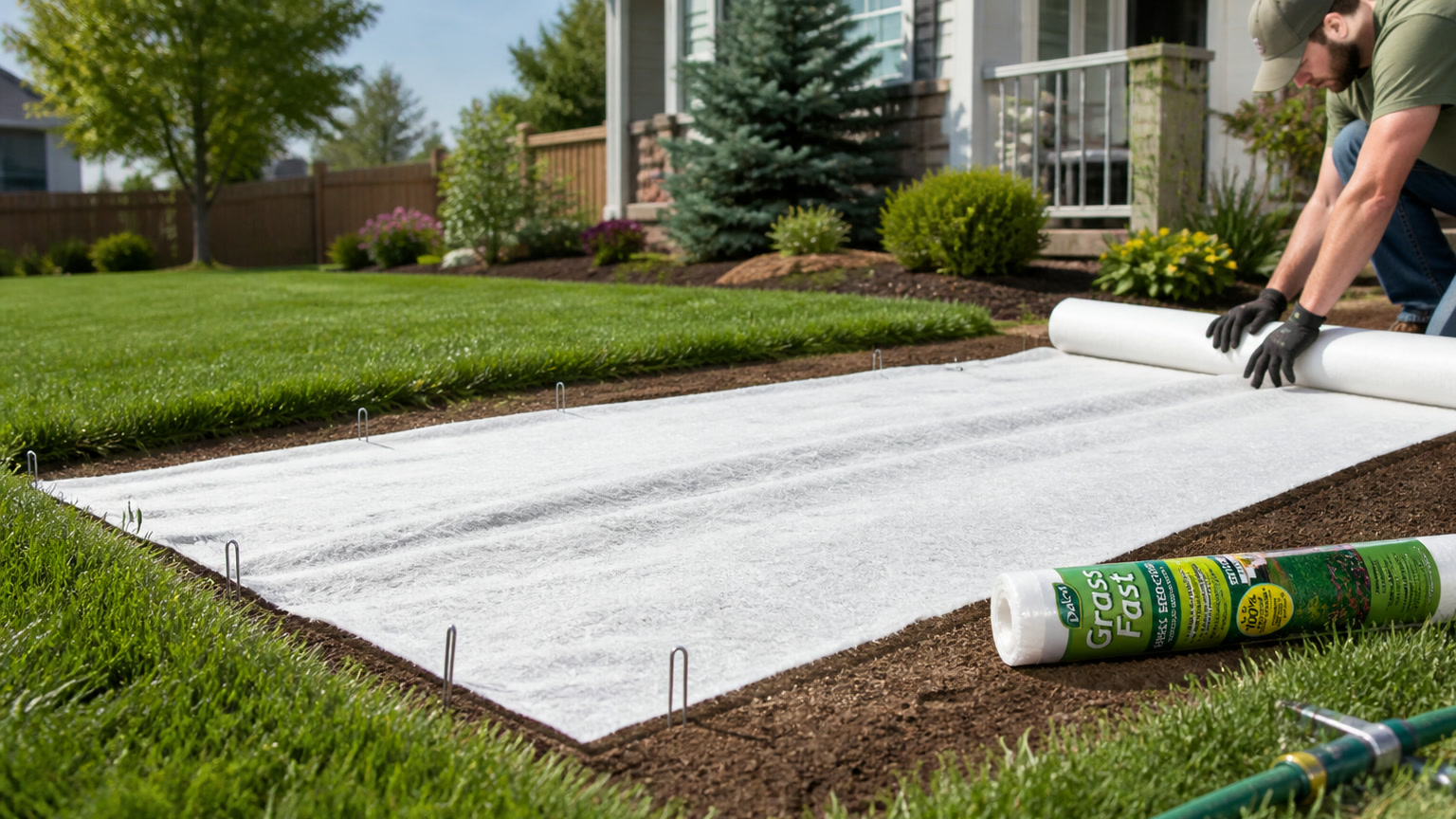
On slopes, runoff-prone patches, and exposed bare soil, a purpose-made seed covering can help keep the surface moist and reduce movement. The Dalen Grass Fast Seed Germination Blanket (40 inches by 50 feet) is a currently available option for larger bare patches; its product page says water passes through the material and the blanket biodegrades over time. Secure any covering according to its directions and check that it lies against the soil rather than bridging over depressions.
For broad bare-soil areas, Penn Mulch Seed Accelerator (40 lb) is another currently in-stock establishment aid. Its pellets expand when wetted to cover soil and hold moisture around seed. It is not a substitute for grading, correct seeding rate, or irrigation; it is a tool for managing the vulnerable surface.
Water for Germination, Then Train the Roots
The watering goal changes as the grass develops. Immediately after seeding, keep the upper layer of soil consistently moist. That usually means light, frequent applications rather than one heavy soaking. The exact frequency depends on sun, wind, soil texture, slope, mulch, and rainfall; a fixed clock schedule is less reliable than inspecting the seedbed.
Use a gentle spray that does not move seed. Watch for puddling, rivulets, and seed collecting at the low edge of a patch. If those appear, shorten the run time or reduce flow. Check more than one part of the site: a sunny curb strip can dry while the shaded side yard remains wet.
As seedlings emerge, gradually reduce frequency and increase the amount per watering so moisture reaches deeper into the root zone. Do not flip overnight from frequent misting to the established-lawn routine. Young roots need a transition. At the same time, avoid keeping the site continuously soggy. Saturated soil limits oxygen and can favor disease.
Different species germinate at different rates, so the first green haze is not proof that every component of a mix has emerged. Keep following the seed label and monitor the slower areas. Rain helps only when it supplies useful moisture; a brief shower may wet leaves without moistening the seedbed, while a thunderstorm can move seed.
Place straight-sided containers around the irrigation pattern if coverage is unclear. Compare the captured depth and adjust sprinkler position to eliminate dry zones and excessive overlap. Repair leaks before seeding, and water early enough that foliage is not left wet through every night.
Once the new grass is established, shift toward deeper, less frequent irrigation based on weather and soil conditions. That change encourages roots to explore a larger soil volume and makes the lawn less dependent on constant surface moisture.
Choose a Practical Fall Overseeding Kit
Liberty Farm, Home & Garden’s live webstore showed several relevant items in stock when this draft was researched on August 6, 2026. Availability can change, so open the product page before making a trip and choose by site conditions rather than brand familiarity.
| Site need | Current in-stock option | Verified product-page detail |
|---|---|---|
| Larger sunny to partly shaded overseeding area | Vigoro Tall Fescue Grass Seed (20 lb) | Up to 5,000 sq. ft. at the overseeding rate; full sun to partial shade |
| Mid-size lawn with mixed sun and shade | Vigoro Sun and Shade Grass Seed Mix (7 lb) | Up to 1,750 sq. ft. at the overseeding rate; full sun to moderate shade |
| Exposed bare patch | Dalen Grass Fast Seed Germination Blanket | 40 inches by 50 feet; water-permeable biodegradable covering |
| Broad bare-soil establishment area | Penn Mulch Seed Accelerator (40 lb) | Pelletized mulch that expands when wet and helps hold moisture around seed |
The tall fescue option aligns with Ohio State’s general recommendation that turf-type tall fescue works in Ohio sun and moderate shade, but the package label remains the authority for the specific product. The sun-and-shade mix can fit a yard where exposure changes, provided its species composition suits the existing lawn. The blanket and pelletized mulch solve a different problem: protecting a prepared seedbed, not selecting the grass.
Bring three pieces of information when asking for help: total square footage, hours of direct sun in the thinnest area, and whether the job is overseeding existing turf or establishing bare soil. Those details are more useful than asking for “the best seed.” Liberty Farm, Home & Garden in Galion can help compare bag labels and coverage, but no retailer can make a shade-intolerant lawn thrive under a dense canopy or correct drainage with seed alone.
Protect the New Grass for the First Six Weeks
Germination is the beginning, not the finish. Keep people, pets, and equipment off soft seedbeds as much as practical. Footprints compact wet soil and uproot tiny plants. If the seeded area crosses a normal walking route, create a temporary path before work begins.
Mow when the new grass reaches the height recommended for that species, using a sharp blade and removing no more than about one-third of the leaf blade at a time. Do not wait until seedlings flop over, and do not scalp them because the surrounding established turf looks uneven. Mow when the soil surface is firm enough that wheels will not rut it.
Delay broadleaf weed control until the new grass has reached the mowing or establishment stage specified on the herbicide label. Pre-emergent herbicides are especially important to check: most products that stop weed seeds from germinating can also interfere with turfgrass seed. Ohio State identifies mesotrione as a limited exception in some seeding programs, but that is not a reason to improvise. The label is the law, and the seeded turf species and site must both be listed.
Expect a few weeds. Pull isolated weeds by hand when the soil is firm enough to avoid disturbing seedlings. A dense, correctly mowed lawn becomes more competitive over time; the goal in the first weeks is establishment, not instant visual perfection.
Common failures usually trace to one of six causes: seed selected for the wrong light level, poor contact with soil, application at the wrong rate, a seedbed allowed to dry, seed washed by heavy irrigation, or traffic before roots anchored. Review those variables before blaming the seed.
Take photos from the same position on seeding day and at two-week intervals. Record rainfall, irrigation changes, and first mowing. That simple log makes it easier to diagnose uneven results and plan a smaller follow-up repair if needed. A successful fall overseeding project is measured by a better-rooted stand entering winter, not by a perfectly uniform lawn one week after sowing.
Frequently Asked Questions
Keep Reading
Plant Cover Crops Now: An Ohio Home Garden Guide
Plant fall cover crops in an Ohio vegetable garden with practical guidance on timing, species, seeding, winter care, and spring termination.

Save This Summer’s Garden: A Practical Ohio Seed-Saving Guide
Save tomato, bean, pea, lettuce, marigold, zinnia, and other garden seeds with this practical late-summer guide for Galion and north-central Ohio.