
Plant Cover Crops Now: An Ohio Home Garden Guide
Turn empty garden beds into living soil protection. This practical north-central Ohio guide explains what to sow in September, how to establish it, and how to prevent a cover crop from complicating spring planting.
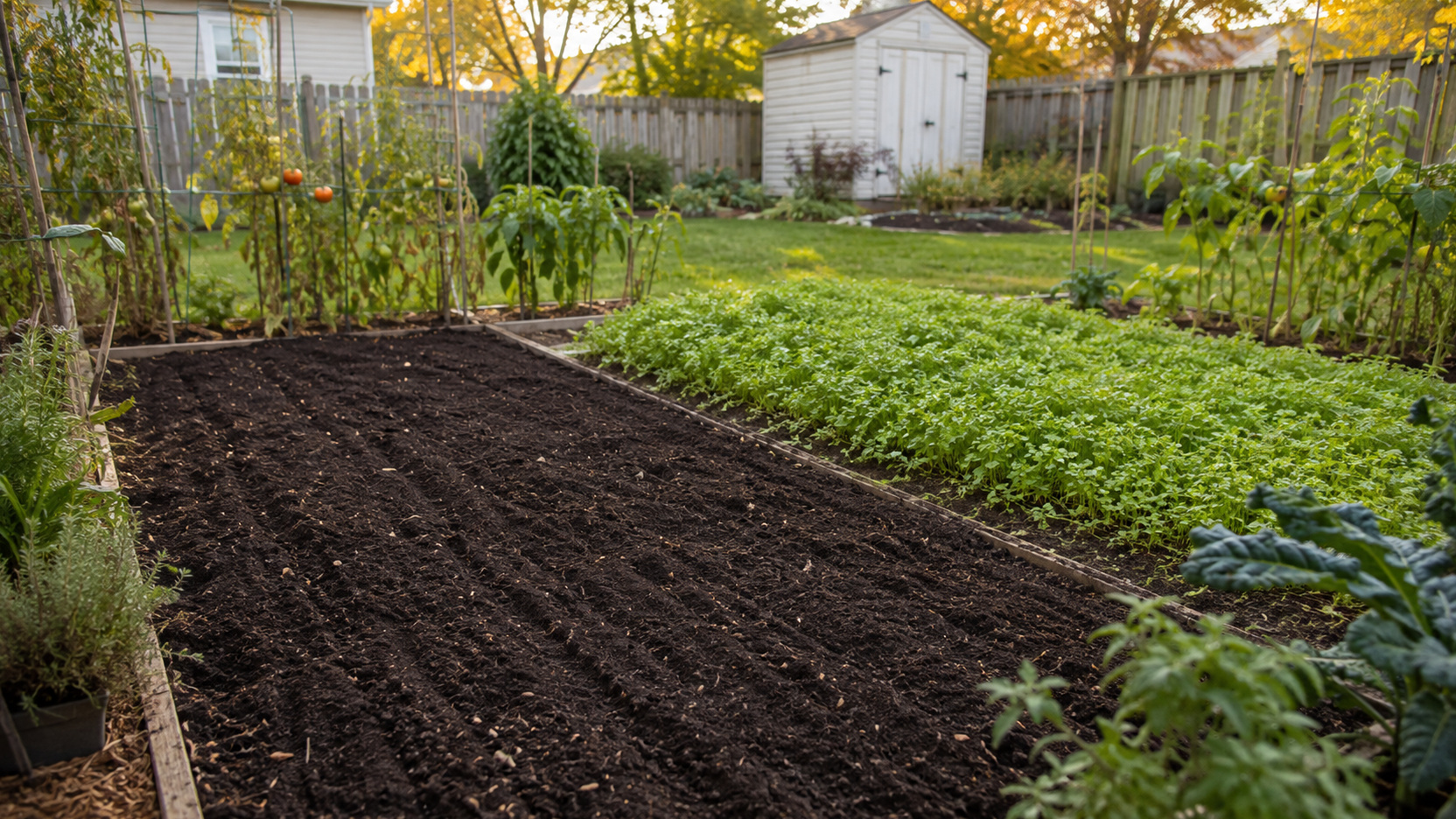
By early September, a north-central Ohio vegetable garden often looks like two seasons at once. Tomatoes and peppers may still be producing at one end, while cleared bean, cucumber, or early-crop beds sit bare at the other. Those open beds are an opportunity: instead of leaving the soil exposed until spring, you can sow a cover crop that protects the surface, competes with winter weeds, captures leftover nutrients, and adds plant residue to the garden.
The important part is choosing the cover crop with spring in mind. A crop that winter-kills can be easy for a beginner; a crop that survives winter can offer longer protection but demands a reliable termination plan. This guide walks through that decision for home gardens around Galion and north-central Ohio, where September is still a useful planting window for many cover crops.
Why Early September Is a Useful Window
Cover crops are planted to serve the soil and the next garden crop, not to produce a harvest. Their roots hold soil in place, keep living processes active longer into the year, and take up nutrients that might otherwise move away from the root zone. Aboveground growth shields the surface from pounding rain and competes with weeds. When the crop is terminated, its roots and residue become organic material that soil organisms can use.
Timing controls how much of that work a cover crop can do. The Ohio State University Extension home-garden cover crop guide says most cover crops can be planted after vegetables are harvested through the end of September. It lists winter wheat, cereal rye, rapeseed, and kale as options that can be planted into mid- to late October, while noting that later October planting carries more frost risk. That makes the first half of September especially valuable: there is still time for seed to germinate, roots to establish, and foliage to cover soil before cold weather slows growth.
You do not have to clear the whole garden at once. Treat the garden as a series of planting zones. Remove a finished crop, prepare that section, and seed it while later tomatoes, peppers, squash, or flowers continue growing nearby. This staggered approach preserves the remaining harvest and prevents the earliest open ground from sitting idle for another month.
Do not confuse a calendar window with a guarantee. Germination still depends on moisture, seed-to-soil contact, species, and actual weather. A hot, dry September may require careful watering; a very wet bed may need time to drain before it can be worked without damaging its structure. The goal is prompt planting under workable conditions, not tilling mud or scattering seed onto hard, dry clods and hoping for the best.
Choose One Main Job for the Cover Crop
A seed mix can promise many benefits, but a small home garden is easier to manage when you name one primary goal first. Are you trying to cover erosion-prone soil, suppress winter weeds, add root mass, loosen a compacted area, capture leftover nutrients, or experiment with a no-till residue? The answer affects both the species and the work you will face in spring.
For a first attempt, simplicity is a legitimate goal. Oats are inexpensive and usually winter-kill in Ohio, according to OSU Extension. Their fall roots and foliage provide cover, then cold weather generally leaves residue that can be raked aside, lightly incorporated, or planted through after it has begun to break down. Winter-kill is not absolute, especially after an early planting and a mild winter, so inspect the bed rather than assuming every plant is dead.
Cereal rye offers a different bargain. It tolerates later planting, survives winter, resumes growth in spring, and can provide strong weed competition. That extra performance creates extra responsibility. It must be cut, crimped at the correct growth stage, smothered, tilled, pulled in a small area, or otherwise controlled before it sets seed or interferes with garden planting. OSU also cautions that cereal rye residue can temporarily inhibit germination of small-seeded vegetables such as lettuce and carrots. If those crops are in your spring plan, rye should not be treated as a plant-it-and-forget-it choice.
Brassica covers such as forage radish, rapeseed, or even leftover kale and radish seed can produce substantial roots and may winter-kill. Legumes can contribute nitrogen, but the result depends on the species, establishment, biomass, inoculation where appropriate, and termination timing. For a small home bed, it is better to choose a crop you can establish and control confidently than to build a complicated mix with no clear purpose.
Match the Species to the Bed and Spring Plan
The best cover crop is not simply the one with the longest list of benefits. It is the one that fits the open planting date, the condition of the bed, and what you intend to grow next. The table below summarizes practical starting points drawn from OSU Extension guidance for Ohio gardens. Use the seed label for the specific variety's planting depth and rate.
| Garden goal | Practical option | Fall behavior | Spring consideration |
|---|---|---|---|
| Beginner-friendly soil cover | Oats | Quick fall growth; usually winter-kills in Ohio | Check for survivors and manage the residue before planting |
| Late planting and long winter cover | Cereal rye | Cold-tolerant and continues in spring | Requires timely termination; residue can hinder small-seeded crops for a period |
| Rooting into a compacted bed | Forage-type radish or another suitable brassica | Develops a large root and may winter-kill | Expect decomposing root channels and residue rather than a perfectly clean bed |
| Add a nitrogen-fixing component | An appropriate legume selected for the planting window | Performance depends heavily on species and establishment | Plan inoculation if required and do not assume a fixed nitrogen credit |
| Keep management simple | One well-chosen species in a small test area | Easier to identify and evaluate | Easier to choose and verify a termination method |
OSU's home-garden guidance specifically advises Ohio gardeners to avoid annual ryegrass and vetch because they can be difficult to control. Annual ryegrass is not the same plant as cereal rye, even though the names are easy to confuse. Read the seed tag carefully and keep the common name, species, and intended use straight.
Also consider bed sequence. A winter-killed cover is often the simpler choice before early spring vegetables. A winter-hardy cover may fit better before warm-season transplants that will not go into the ground until later, because there is more time to terminate the cover and let residue settle. Map next spring's carrots, lettuce, peas, onions, tomatoes, and squash now; then choose the fall cover that creates the fewest conflicts.
Prepare a Cleared Bed Without Overworking It
Good establishment starts before seed is opened. Remove spent crop plants, stakes, twine, labels, and large weeds. Diseased plant material should be handled separately from healthy residue so that obvious problems are not spread through the bed. Leave crops that are still productive, but make the boundary between active and cleared ground obvious enough that seed will not be lost under sprawling vines.
Next, look at the soil surface. Cover crop seed needs contact with soil. A crusted bed, deep layer of intact mulch, or mat of weeds can keep seed suspended where it dries out or becomes bird food. Pull the weeds, move heavy mulch aside, and lightly rake the surface. If the ground is hard, OSU recommends tillage and/or raking to improve seed-to-soil contact. In a home garden, that often means shallow preparation rather than turning the entire soil profile.
Avoid working soil when it is sticky and wet. Squeezing and smearing wet soil destroys the pore spaces that roots and water need. If a handful remains a dense, slick clump instead of breaking apart with light pressure, wait. Conversely, powder-dry soil may need gentle irrigation before final preparation so that the seeded surface can hold moisture consistently.
This is also a good moment to note recurring drainage, crusting, or compaction, but do not diagnose every problem by appearance. A soil test is the sound basis for lime and nutrient decisions. Cover crops can recycle nutrients and improve physical conditions over time, but they are not a substitute for correcting a measured pH problem, managing drainage, or avoiding repeated traffic on wet beds.
Finally, decide how you will water. A hose wand, sprinkler, or gentle watering attachment should wet the seed zone without washing seed into the paths. If you cannot reach the bed reliably during establishment, reduce the planted area to what you can manage. A smaller, even stand teaches more than a large patchy one.
Sow for Even Contact and Reliable Germination
Follow the seed label for rate and depth. Seed sizes differ, and a method that works for a large oat seed can bury a smaller seed too deeply. For a small bed, divide the measured seed into two portions. Broadcast the first while walking in one direction, then spread the second while moving across the bed at a right angle. This cross-pattern helps reduce bare stripes and dense piles.
After broadcasting, use a rake only as deeply as the seed requires. The objective is not to hide every seed several inches down; it is to place seed at an appropriate depth with firm contact against moist soil. In a very small area, rows opened with a hoe are another option. Lightly firming the surface after covering seed can remove large air gaps, but do not compact a wet bed.
Water with a soft spray. Keep the upper seed zone evenly moist during germination without leaving puddles. Weather, species, and soil determine how often that is necessary, so inspect the bed rather than watering by a fixed daily rule. Once seedlings establish roots, gradually shift from frequent surface wetting toward watering that moistens the root zone when rainfall is insufficient.
Mark the bed with the species and planting date. That simple step matters months later, when an unfamiliar grass emerges in spring and you need to know whether it is the intended cereal rye, a weed, or a mixture. Take one photo after sowing and another when the stand has emerged. These records help you evaluate coverage and make a better decision next year.
If the stand is patchy, identify the cause before adding more seed. Drying, washout, birds, poor contact, old seed, excessive depth, and heavy mulch can look similar from a distance. A few bare spots can be hand-raked and reseeded while the planting window remains open. Repeatedly broadcasting onto an uncorrected surface usually wastes seed.
Manage the Stand Through Fall and Winter
Once established, the cover crop should be inspected, not fussed over. Look for bare channels where runoff is moving, dense patches that may be hiding a spreading weed, and edges that are encroaching on crops still in production. Keep paths distinct and prevent the cover from becoming a refuge for weeds that are already setting seed.
Expect growth to change with day length and temperature. A September planting may make visible progress before slowing in colder weather. Winter-killed foliage can flatten into a protective mat. Winter-hardy cereal rye may stay modest during the coldest stretch and then grow rapidly when spring conditions return. Neither appearance should be judged against a summer lawn; the cover is doing a different job.
Do not mow a young stand merely to make it look tidy. Unnecessary cutting reduces leaf area and can weaken establishment. Later management depends on the species and goal. If a winter-hardy crop is approaching seed production or growing beyond the plan, act before it becomes harder to control. The 2025 OSU Extension review of cereal rye emphasizes that the crop's useful traits—vigorous growth, nutrient capture, and weed competition—are also reasons management and termination must be deliberate.
A cover crop does not guarantee that every nutrient stays available to the next vegetable on demand. Living plants take nutrients into their tissue; residue releases them as it decomposes, and the timing varies. Grass residue with a high carbon-to-nitrogen ratio can temporarily tie up available nitrogen near the surface. Base spring fertility on the following crop, soil test information, and observed residue rather than assuming the cover has either fertilized the bed completely or robbed it permanently.
Keep foot traffic out of the bed during wet winter and early-spring conditions. Protecting the soil with roots while compacting it with boots works against the purpose of the cover. Use stable paths for access and let the planted area carry living roots undisturbed.
Make the Spring Termination Plan Now
Before sowing, write down how and when the cover will end. Winter-killed oats or brassicas may require only an inspection and residue management, but survival is possible. Pull or cut any survivors before they flower and set seed. Residue can remain as surface protection, be moved to a compost system, or be incorporated shallowly if that fits your soil and planting method.
Winter-hardy cereal rye demands closer timing. It can be cut, tilled, pulled in a small plot, smothered with a barrier such as cardboard, or crimped at the correct reproductive stage. OSU notes that crimping must be timed at full flower, or anthesis, and may fail if done too early. A gardener who needs the bed for early peas or carrots may not have time to wait for that stage, so another method—or another fall species—may be the better choice.
Allow a buffer between termination and seeding small vegetables, especially where cereal rye has grown. Rye's weed-suppressing chemistry and fresh residue can also suppress wanted small seeds temporarily. Transplants such as tomatoes generally create a different scheduling problem than direct-sown lettuce or carrots. This is why next year's bed map belongs in the fall decision.
Do not let a cover crop mature simply because spring became busy. Once it sets viable seed, a helpful cover can become a recurring weed. Put two reminders on the calendar: an early inspection to identify winter survival and a second date based on the needs of the next crop. Weather can move the exact workday, but reminders keep the decision from disappearing during the busiest garden weeks.
Start with a control method you are actually willing and able to use. A no-herbicide garden might favor winter-killed oats, pulling in a small plot, smothering, shallow tillage, or carefully timed crimping. Whatever the method, confirm that it matches the species and growth stage. Management is part of the cover crop—not an afterthought.
Start Small and Learn From One Bed
A cover crop is a practical experiment, and one bed is enough to learn from. Choose a section that has finished producing, identify its main need, and plant one manageable species. Record the date, seed source, weather after planting, emergence, winter survival, termination method, and the crop that follows. Compare it with an unplanted bed if you have the space.
In Galion, the strongest reason to begin now is not a promise of instant perfect soil. It is the chance to replace months of bare ground with roots and cover while the September establishment window remains open. OSU Extension's Ohio home-garden guidance repeatedly returns to the same sensible principle: match the species' benefits with a workable control strategy, and begin on a scale where you can manage both.
Before buying seed, bring four facts: the bed size, the date it became available, the main goal, and what will be planted there next spring. At Liberty Farm, Home & Garden in Galion, we can help you think through seed types, spreaders, rakes, watering tools, and other basic supplies without pretending every garden needs the same mix. Current selection can change, so check availability rather than assuming a particular species or package is on the shelf.
Then keep the project simple. Clear one bed, prepare only the surface you need, sow at the label rate, water for establishment, and mark the planting. The payoff is not just this winter's soil cover. By spring, you will know how that species behaved in your own soil and schedule—and that local observation is what turns a general recommendation into a dependable garden practice.
Frequently Asked Questions
Keep Reading

Save This Summer’s Garden: A Practical Ohio Seed-Saving Guide
Save tomato, bean, pea, lettuce, marigold, zinnia, and other garden seeds with this practical late-summer guide for Galion and north-central Ohio.
Spring Color Starts Now: An Ohio Guide to Planning and Planting Fall Bulbs
Learn when and how to plant tulips, daffodils, crocus, hyacinths, and alliums for reliable spring color in north-central Ohio.